How to Motivate Yourself to Workout (and Stay Motivated)

If you’re waiting until you feel like working out, you’ll probably be waiting a long time. The honest answer to how to motivate yourself to workout is that you don’t, at least not first. You move first, and you build systems that make starting almost too easy to refuse on the days your energy is gone. Motivation usually turns up a minute or two in, once you’re already moving.
That probably isn’t the pep talk you wanted. But it’s the approach that works, and everything below is about building those systems so showing up stops depending on your mood. The focus here is the workout itself, in your living room or out on a trail. If the hard part for you is physically getting to the gym, that’s a different problem, covered in how to motivate yourself to go to the gym.
The short answer: stop waiting to feel motivated
Motivation is a feeling, and feelings are bad managers. They turn up when conditions are perfect and vanish the second you’re tired, stressed, or it’s raining. If your fitness plan depends on a feeling arriving on schedule, the plan is already broken.
The people who train every week aren’t sitting on some bottomless reserve of willpower you weren’t issued. They’ve just removed the decision. The workout is small, it happens at a set time, and the cost of starting is so low that “not feeling like it” doesn’t get a vote. The whole job is shrinking the gap between I should and I’m doing it until the gap basically disappears.
Everything below is a way to do that, and to keep going once you’ve started.
Why working out feels so hard to start
It helps to know what you’re up against, because it isn’t a character flaw. Exercise is a poor fit for the human reward system.
Your brain is wired for now, not later
The payoff from working out (strength, energy, a body you’re comfortable in) is weeks or months out. The cost is right now: effort, discomfort, the friction of changing clothes and clearing space. Behavioral psychologists call the tendency to overweight immediate costs and discount distant rewards present bias, and it’s exactly backwards for exercise. You pay today, you get paid in spring. No wonder the couch wins.
This is also why “remember your goals” rarely gets anyone off the couch. The goal is real, but it’s too far away to compete with the very immediate appeal of not moving.
Motivation is a mood, not a fuel tank
We talk about motivation like it’s gas in a tank you can top up. It behaves more like weather. Some mornings you wake up ready to go, most mornings you don’t, and there’s no reliable lever to summon it on demand. Build your routine around catching the good-weather days and it’ll collapse the first ordinary week.
”21 days to a habit” is a myth
You’ve heard that it takes 21 days to build a habit. It doesn’t, and believing it sets you up to quit at day 22 when it still feels like work. In a study published in the European Journal of Social Psychology, University College London researchers tracked people adopting a new daily health behavior and found it took a median of 66 days for the action to feel automatic, with a range running from 18 days to a predicted 254 depending on the person and how hard the habit was (Lally et al., 2010).
Two months of effort is the realistic price. Knowing that upfront is itself motivating, because it reframes the slog from “something’s wrong with me” to “this is exactly how long it’s supposed to take.”
Make starting stupidly easy
If present bias is the enemy, the counter is to crush the cost of starting. Most missed workouts were lost before the first rep, at the point of starting.
Shrink the workout until you can’t say no
“Do a full workout” is a wall. “Do five push-ups” is a door you can walk through half-asleep. Set your minimum so low it feels almost embarrassing (one set, five reps, two minutes) and let that count as a win on the worst days, the same logic behind exercise snacks.
Once you’ve started, finishing is usually easy. Five push-ups often become fifteen because you’re already on the floor. Even if they don’t, you still showed up, and showing up is the skill you’re actually training. We go deeper on this scaffolding in our guide to fitness gamification; the gist is that lowering the cost of starting beats hyping yourself up, nearly every time.
Cut the friction before motivation has to fight it
Every extra step between you and the first rep is a place to quit. Sleep in your workout clothes. Leave the mat unrolled on the floor. Keep the dumbbells where you’ll trip over them.
None of this is glamorous, and it isn’t supposed to be. All it does is make the path of least resistance run toward the workout instead of away from it.
 Photo: Andrea Piacquadio / Unsplash
Decide in advance with an if-then plan
Vague intentions (“I’ll work out more this week”) lose to specific ones. Psychologist Peter Gollwitzer calls the specific kind implementation intentions: simple “if X, then Y” plans that pin down when, where, and how you’ll act. A meta-analysis he ran with Paschal Sheeran across 94 studies found a medium-to-large effect on whether people actually reached their goals (Gollwitzer & Sheeran, 2006).
So don’t plan to “exercise.” Plan: If it’s 7pm and I’ve finished dinner, then I’ll do my 10-minute session before I open Discord. A 10-minute walk after dinner counts as that session too. You’ve pre-made the decision, which means tired-you at 7pm doesn’t have to win an argument with itself. The choice was already made by the version of you that had energy.
The no-motivation protocol: what to do when you’ve got nothing
Eventually you’ll hit a day with nothing in the tank. For those days you want a plan so small it’s hard to argue with, and it starts on the floor, literally. Put the mat down. Lie on it. Do the two-minute version of your routine: one set of anything, or just the five push-ups. Then give yourself full permission to stop.
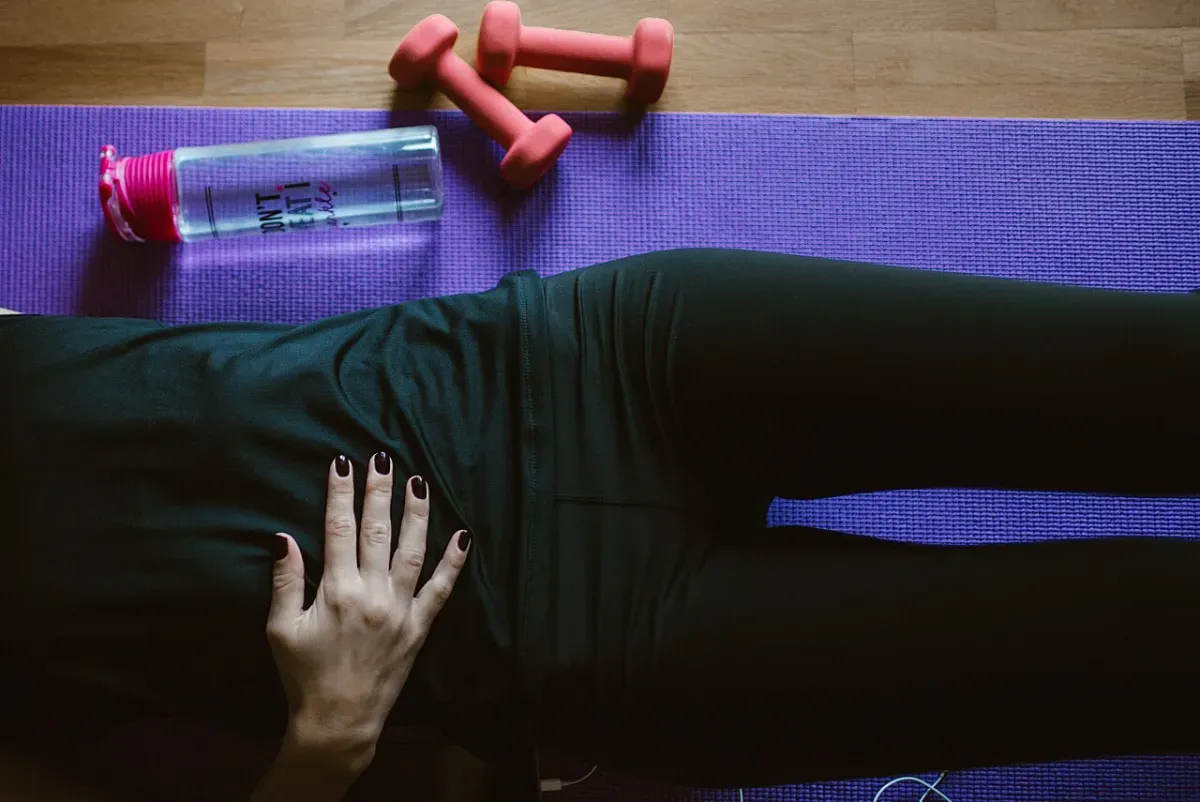 Photo: Shixart1985 / Wikimedia Commons (CC BY 2.0)
Count that as done. On a day like this the muscles get almost nothing, and that’s fine. What you’re protecting is the identity: you’re someone who shows up, whatever the day looks like. That belief is worth more than anything you’d get from grinding out a longer session with nothing left to give.
If your workout is a walk or a run, the two-minute version is shoes on and two minutes of walking, and turning around is allowed. Tomorrow you go back to the normal minimum. You don’t owe tomorrow anything extra; the floor day counted.
Build in a reason to actually show up today
Lowering the cost is half of it. The other half is giving your present-biased brain a reward it can collect now, not in six months.
Bundle the workout with something you’d enjoy anyway
This one has a proper field experiment behind it. Take something you genuinely like and only allow yourself to have it while you exercise. Wharton’s Katherine Milkman and her colleagues tested exactly this: tempting page-turner audiobooks that participants could only listen to at the gym. The group with gym-only access visited 51% more often than the control group (Milkman, Minson & Volpp, 2014, Management Science). The experiment measured gym visits, but the rule travels: for a home session or a run, the audiobook only plays while you move.
She calls it temptation bundling, and it works because it fixes the timing problem underneath all of this. The strength gains are months away, but the next chapter is available the second you start moving. The workout stops being a chore and turns into finding out what happens next. Pick your bundle and protect it. The moment you let yourself binge the same audiobook on the couch, the spell breaks.
Make the streak something you don’t want to break
Most of us hate losing something we’ve built more than we enjoy a new gain; behavioral economists call it loss aversion. A streak points that quirk at the part of you that wants to skip today. After you’ve strung together two weeks, the fifteenth day isn’t about gaining anything. It’s about not losing the fourteen you’ve banked. Duolingo built a billion-dollar business mostly on this one mechanic, and it works the same way for workouts.
One rule keeps a streak from backfiring: make it survivable. “Move for ten minutes daily” can survive a rough week. “Train hard five times a week” can’t, and the day it snaps tends to take your whole routine with it.
Use other people (the lightest possible version)
Solo motivation is the hardest mode. Adding even one other person changes the math, because now skipping has a social cost, not just a private one.
Tell one person you’ll report to them
A training partner or a 6am running club would be nice, but one reliable witness is enough. Text a friend after each session: a thumbs up, a sweaty selfie, “done.” Knowing someone will notice the silence if you skip is one of the cheapest, strongest commitment devices there is. If you want to take this further, we round up the best tools for it in our guide to the best gym buddy apps.
Pick accountability over competition
There’s a real difference between someone notices whether I showed up and I’m ranked against strangers. The first one helps almost everyone. The second motivates the people already winning and quietly demoralizes everyone else, which, if you’re reading an article on how to find motivation, is probably you right now. Skip the leaderboards. Find one person who’s in your corner, not above you on a chart.
How to stay motivated during a workout
Getting started is the first hurdle. Keeping your energy up once you’re moving takes a different set of tactics.
Put the part you like first
When energy is fragile, order matters. Open with the exercise you actually like, so the first thing your body gets is something it wanted to do. Then fix the end point before you start: three sets means three sets, decided while you’re still calm. Deciding early means there’s nothing left to negotiate halfway through the second set, when your lungs are burning and quitting sounds reasonable.
Use music, and pick it on purpose
Music does help, under specific conditions. A 2012 review by Karageorghis and Priest in the International Review of Sport and Exercise Psychology found that during repetitive, endurance-type exercise, self-selected motivational music improves mood, lowers how hard the effort feels and increases work output. The same review notes that the music stops lowering the sense of effort once intensity passes the anaerobic threshold.
In practice: a playlist you chose yourself, saved for workouts only, which also feeds the bundling rule above. Don’t expect it to carry a brutal set, though. Past the anaerobic threshold the effort feels like what it is. Lean on music for the long, repetitive stretches, where the review found it does the most.
Keep the intensity where it feels good
Pushing yourself until you feel sick is a poor long-term strategy. Rhodes and Kates published a 2015 systematic review of 24 studies in the Annals of Behavioral Medicine looking at how people feel during exercise. Their review found that feeling better during moderate-intensity exercise was linked to future physical activity, while how people felt after a session was not.
So if a workout feels awful while you’re doing it, lower the intensity until it doesn’t, with a slower pace, a lighter weight or longer rests. That isn’t the mid-set negotiation from earlier. The number of sets stays fixed; what you adjust is how hard each one is. The version you can stand to be inside is the version you’ll repeat next week.
Common mistakes that kill your motivation
A few well-meaning habits actively make this harder.
- Relying on inspiration. Motivational videos and quote walls feel good for an hour and change nothing. If your system needs a hype reel to function, the system is the problem.
- Setting the bar too high. “I’ll work out an hour a day, six days a week” almost always becomes zero days a week by Thursday. Ambitious plans feel great to write and terrible to live. Start embarrassingly small and let it grow.
- Treating one miss as failure. Missing a single day is noise. The damage comes from the story you tell about it: “I’ve blown it, might as well quit.” The only rule that matters here: never miss twice in a row. One off day is a rest day. Two is the start of a new pattern.
- Waiting for the perfect setup. The right shoes, the right program, the membership, Monday. Perfect conditions are a procrastination tool dressed up as preparation. You can do five squats in your kitchen right now.
Close the gap with an immediate reason to move
Every tactic above is really about the same fix: giving your brain an immediate reason to move when the real reward is too far off to feel.
A growing class of apps does that by tying your workouts to a companion you raise, the same loop that made virtual pet apps for adults sticky in the first place. You train, it grows. You skip, it notices. Suddenly the workout isn’t a favor to a future version of you who feels abstract and far away. It’s a small responsibility to something in the present, which is exactly the timing your brain responds to. For the bigger picture on why these mechanics outlast willpower, see our pillar guide to gym motivation.
Frequently asked
- How do I motivate myself to workout when I have zero energy?
- Lower the bar until starting is trivial. Tell yourself you only have to do five reps or put on your shoes, then stop if you want. Most of the time you won't stop, because the hardest part was beginning, not continuing. Energy usually arrives a minute or two after you move, not before.
- Why do I lose motivation to workout after a few days?
- Because motivation was never the engine. It's a mood, and moods come and go. Early on you're running on willpower, which is unreliable. The fix is to make the behavior small and scheduled enough that it survives the days willpower is gone, until it turns into a habit you don't have to feel motivated to do.
- How long until working out stops feeling like a chore?
- Longer than the '21 days' myth. A University College London study found it took a median of 66 days for a new health behavior to feel automatic, with a wide range of 18 to 254 days depending on the person and the habit. Plan for two to three months of it feeling like effort before it gets easier.