Calisthenics for Beginners: A Real Roadmap
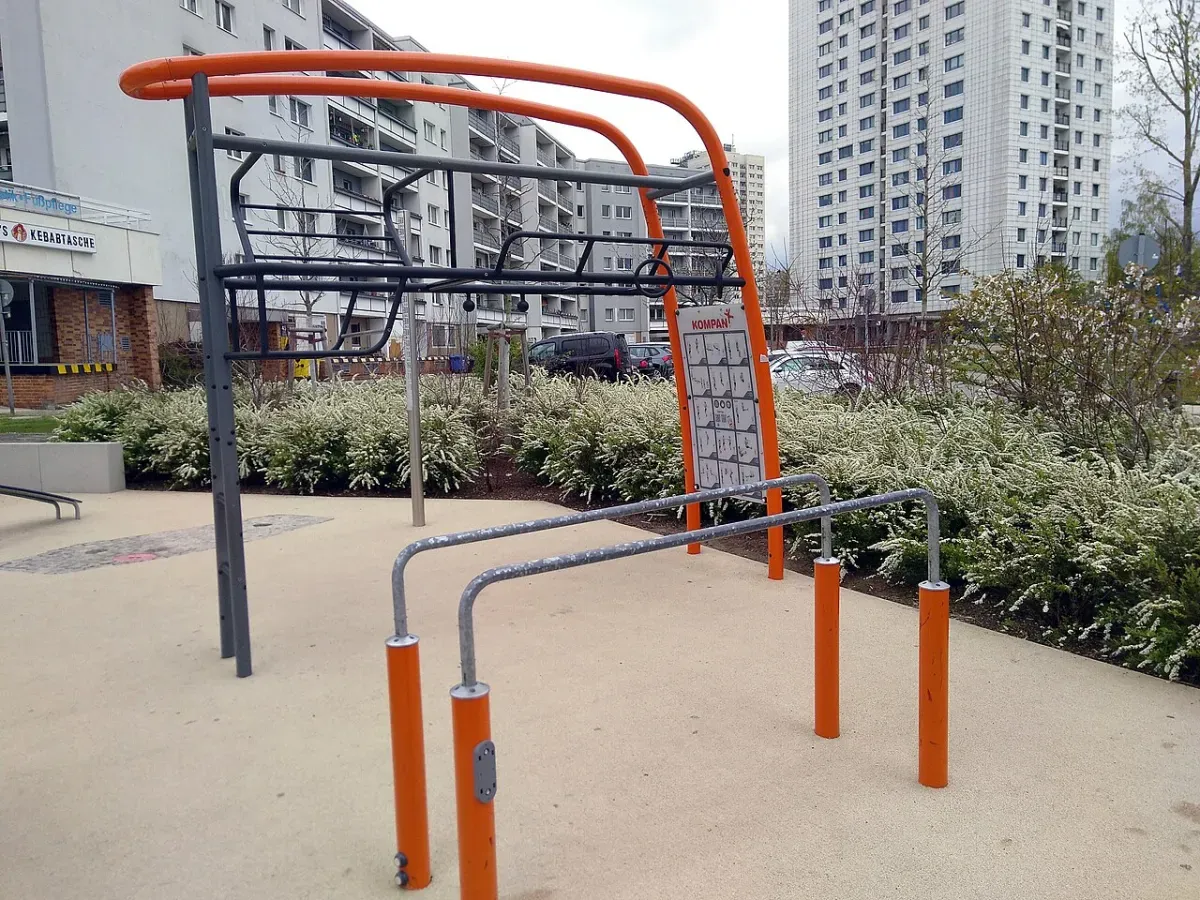
You can get genuinely strong without ever touching a weight. Calisthenics, which just means training with your own bodyweight, is the cheapest and most forgiving way for a beginner to build strength at home, and the early gains are real rather than wishful. A four-week study found that men doing progressive push-ups built the same bench-press strength as a group training on an actual barbell bench (Kotarsky et al., 2018). No equipment, comparable result.
This is the pillar guide for the whole cluster. It covers what calisthenics actually is, the handful of patterns that matter, a full-body routine you can run in your living room, and how to keep getting stronger when you have no plates to add. Where a body part deserves its own deep dive, I’ll point you to the focused guide for it.
The short version
Pick a few foundational movements, train them two or three times a week, and make them harder over time. That’s the entire method.
For most beginners the starting kit is six things: the push-up, the bodyweight squat, the lunge, the plank, the glute bridge, and some form of row you can do at home. Master those before you go looking for anything flashier. The people who stall in calisthenics almost always do it because they chased a muscle-up in month two instead of building a clean push-up first.
You don’t progress by adding weight, because there isn’t any. You progress by changing leverage, slowing the tempo, and extending the range until each rep is hard again. More on that below, because it’s the part beginners get wrong most often.
Why calisthenics works for a beginner
There’s a quiet assumption that bodyweight training is “just for warm-ups” and real strength needs iron. For a beginner, that’s backwards.
Progressive overload still happens, just differently
The thing that makes any muscle grow is progressive overload: gradually asking it to do more than it’s used to. In the gym you do that by adding plates. With bodyweight you do it by shifting leverage. A push-up with your feet on a chair is harder than one on the floor, which is harder than one with your hands raised onto a counter, and you’ve changed nothing but the angle. The ACSM’s progression guidance for novices is built on the same principle of gradually increasing the challenge, whether the load comes from a barbell or from a tougher variation (ACSM position stand, 2009).
Your bodyweight is a heavy enough load when you start
A standard push-up moves roughly two-thirds of your bodyweight. A pull-up moves all of it. For someone who hasn’t trained, that is plenty of resistance, which is exactly why the Kotarsky push-up group kept pace with the bench-press group. You will outgrow the easiest versions, and that’s the point at which you reach for a harder variation rather than a heavier weight.
It builds the coordination weights skip
Because nothing is bolted to a machine, you brace your whole body on every rep. A push-up trains your core and shoulders to hold a rigid line while your chest does the pressing. That carryover is hard to replicate on a chest-press machine, and it’s part of why bodyweight work feels so useful in everyday life.
The five movement patterns
Forget the long exercise list for a second. Almost every useful bodyweight exercise is a version of one of five patterns. Learn the patterns and the exercises organize themselves.
- Push. Pressing something away from you or yourself away from the floor. Push-ups, dips.
- Pull. Drawing something toward you or yourself toward a bar. Rows, pull-ups, the pattern beginners neglect most.
- Squat. Bending at the knees and hips to lower and stand. Bodyweight squats, lunges, step-ups.
- Hinge. Folding at the hips with a flatter back to load the glutes and hamstrings. Glute bridges, hip hinges.
- Core. Resisting movement to keep your spine stable. Planks, dead bugs, hollow holds.
A balanced beginner routine touches all five every week. Skip one and you build an imbalance, and the most common skipped pattern is pull, because it’s the one home trainees have the least obvious equipment for. We’ll fix that.
The core beginner exercises
Here are the movements worth learning first, one per slot. Each links out to the focused guide if you want to go deeper on that area later.
Push-up (push)
The single most valuable home exercise. Hands a little wider than your shoulders, body braced into one straight line from heels to head, elbows tucked to about 45 degrees rather than flared out. Lower until your chest is an inch off the floor, then press back up.
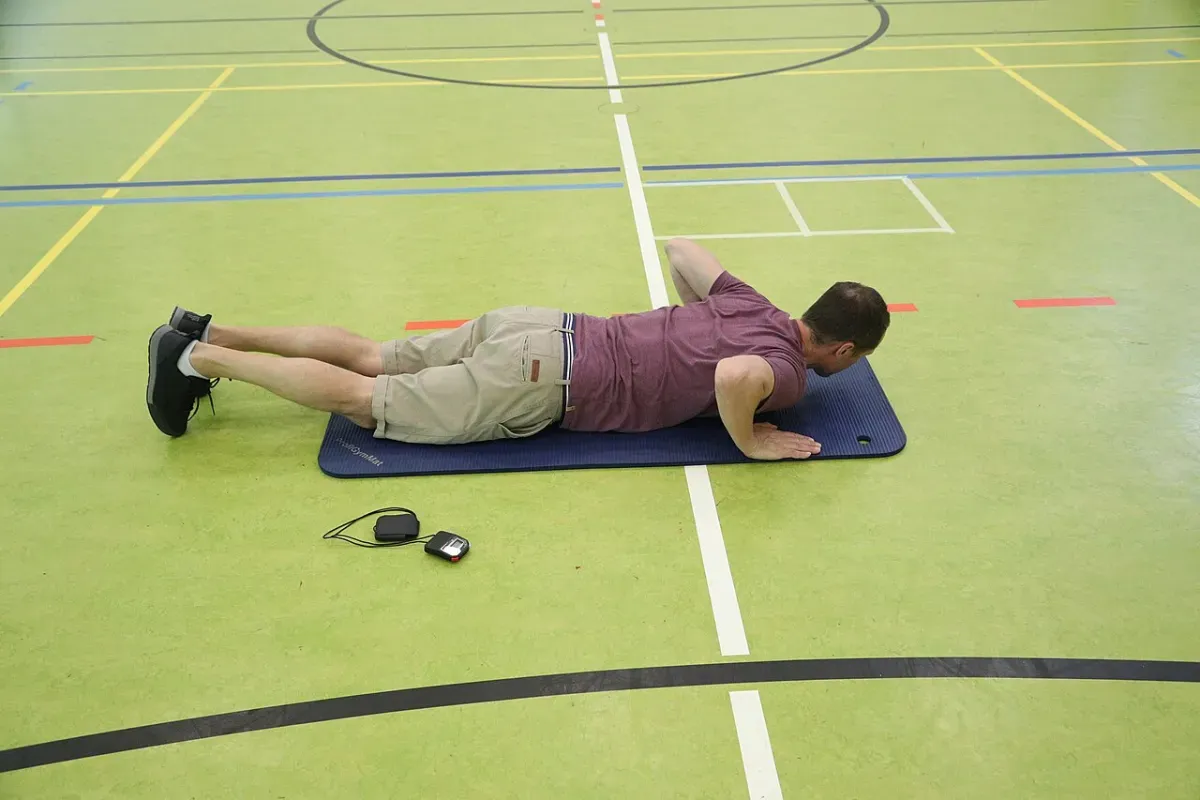 Photo by Uzltt123 via Wikimedia Commons (CC BY-SA 4.0)
Can’t do one yet? Put your hands on a kitchen counter so the angle takes load off, and lower the surface over the weeks. Our chest workout at home guide is the full deep dive on push-up variations and how to keep them hard, and the arm workout at home guide covers the triceps side of the press.
Bodyweight squat (squat)
Feet about shoulder-width, toes turned out slightly. Sit your hips back and down like you’re reaching for a low chair, keeping your chest up and your knees tracking over your toes. Go as deep as you can while keeping your heels down, then stand and squeeze your glutes. This is the foundation for everything your lower body does. The leg workout at home guide breaks down depth, tempo, and the harder single-leg variations, and our quad exercises at home guide goes further on the front of the thigh.
Lunge (squat)
Step forward and lower your back knee toward the floor, both knees bending to about 90 degrees, torso upright. Push back to standing. Lunges train each leg on its own, which exposes and fixes the side-to-side imbalances a two-legged squat hides.
Plank (core)
Forearms on the floor, body in a straight line, glutes and abs braced. Hold without letting your hips sag or pike. Thirty seconds of a genuinely tight plank beats two minutes of a saggy one. The ab workout at home guide goes through the full progression from a basic plank to harder anti-rotation work.
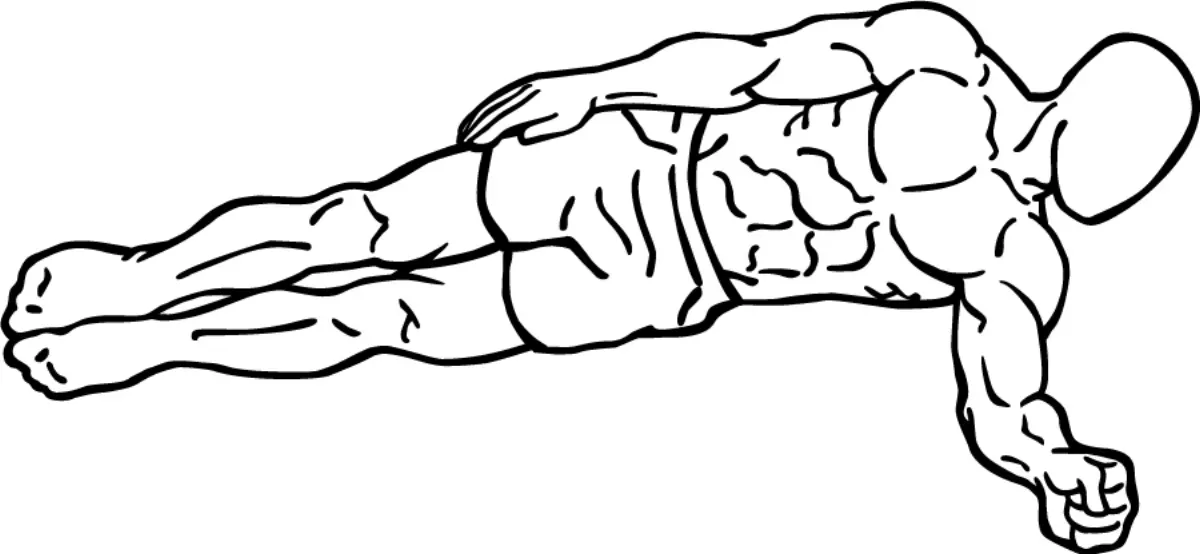 Illustration by Everkinetic via Wikimedia Commons (CC BY-SA 3.0)
Glute bridge (hinge)
Lie on your back, knees bent, feet flat. Drive through your heels to lift your hips until your body forms a straight line from knees to shoulders, squeeze hard at the top, lower slowly. This is your introduction to the hinge pattern and a direct way to wake up glutes that sitting all day has switched off. The booty workout at home guide takes it from here, including single-leg versions.
Row (pull)
Pulling is where home training falls apart, so don’t skip this. The simplest version is an inverted row under a sturdy table: lie underneath, grab the edge, keep your body straight, and pull your chest up to meet it. A bag of books in each hand for bent-over rows works too. The shoulder workout at home guide covers the pulling muscles around the upper back in more detail.
Dips, later (push)
Once push-ups feel solid, dips between two stable chairs add a harder pressing movement for the chest and triceps. They’re worth knowing, but they’re not a week-one exercise. Build the push-up first.
A beginner full-body routine
Three full-body sessions a week, each touching all five patterns. This matches the ACSM’s novice recommendation of two to three days per week at a repetition range around 8 to 12 (ACSM position stand, 2009), and the WHO’s guidance that adults do muscle-strengthening activity working all major muscle groups on two or more days a week (WHO physical activity fact sheet, 2024).
Run this on, say, Monday, Wednesday, and Friday:
| Pattern | Exercise | Sets x reps |
|---|---|---|
| Push | Push-up (scaled to your level) | 3 x 8 to 12 |
| Pull | Inverted row or bent-over row | 3 x 8 to 12 |
| Squat | Bodyweight squat | 3 x 12 to 15 |
| Squat (single leg) | Lunge | 2 x 8 each leg |
| Hinge | Glute bridge | 3 x 12 to 15 |
| Core | Plank | 3 x 20 to 40 seconds |
A few rules that matter more than the exact numbers:
- Rest 60 to 90 seconds between sets. Long enough to recover, short enough to keep the session under 45 minutes.
- Stop a rep or two short of failure. Grinding to total failure on every set wrecks your form and your recovery for little extra benefit when you’re new.
- Leave a day between sessions. Muscle rebuilds on the rest days, not during the workout. Back-to-back hammering of the same muscles is a common beginner mistake.
If 30-something minutes feels like a lot at first, cut it to two rounds instead of three. A shorter session you actually finish beats a perfect one you skip.
How to progress without weights
This is the section to reread, because it’s where beginners stall. When you can’t add plates, you have three dials.
Harder variations (leverage)
The main one. Make the exercise mechanically harder by changing your position. Push-ups go: hands raised, then floor, then feet raised, then one-arm progressions. Squats go: two legs, then split squats, then assisted pistol squats. You’re not adding weight, you’re removing the leverage that made it easy.
Tempo
Slow the rep down. Take three or four seconds to lower into each push-up and pause for a beat at the bottom. The muscle is under tension far longer, so the same exercise becomes meaningfully harder with zero change to the movement. It’s the cheapest progression you have.
Range of motion
Go deeper. Put your hands on books so your chest sinks lower than them in a push-up, or squat to a deeper position than you did last month. A bigger range means more work for the muscle through a longer stretch.
The trigger for all three is the same. When a set starts feeling easy at the top of your rep range, don’t just pile on more reps. Reach for a harder variation, slow the tempo, or add range. Doing 50 easy push-ups builds endurance, not strength. Strength comes from the reps being hard.
A realistic timeline
Calisthenics rewards patience, and the internet’s “30 days to a six-pack” framing sets you up to quit. Here’s roughly what actually happens.
- Weeks 1 to 4. Most of your early progress is your nervous system learning the movements. You’ll add reps quickly and it’ll feel like fast progress, partly because it is and partly because coordination improves before muscle does.
- Months 2 to 3. Visible strength gains. The scaled versions stop being necessary, push-ups move to the floor, plank holds lengthen, squats get deeper.
- Months 4 to 6. This is when shape changes become obvious and you start reaching for genuinely hard variations. A solid set of clean push-ups, a deep squat, a controlled inverted row.
Skills like the pull-up, the muscle-up, and the handstand sit beyond this window for most people, and that’s fine. They’re built on the foundation, not instead of it.
Common beginner mistakes
Most failed calisthenics attempts trace back to the same few errors.
- Ego over form. Half-rep push-ups and quarter squats let you feel strong while building little. Full range, controlled tempo, even if it means fewer reps and an easier variation.
- Skipping the pull. It’s the least convenient pattern at home, so people quietly drop it and end up round-shouldered and imbalanced. Find a table to row under and keep pull in every week.
- No progression plan. Doing the same easy workout for months, then concluding “bodyweight doesn’t work.” It works right up until it stops challenging you, at which point you change the variation.
- Chasing skills too early. Trying to train muscle-ups before you can do ten clean push-ups and a few pull-ups. The flashy moves are downstream of the boring foundation. Build the foundation.
- Training through real pain. Muscle soreness is fine. Sharp joint pain is a signal to back off and scale down, not to push harder.
The pull-up gap, honestly
The pull-up is the hardest movement for a beginner to reach, because there’s no easy way to make it lighter, you either lift your whole bodyweight or you don’t. So a lot of beginners avoid pulling entirely, which is the worst possible response.
The fix is to train the pattern with movements you can actually do now. Inverted rows under a table build the same pulling muscles at an angle you can scale by walking your feet in or out. Negative pull-ups, where you jump or step to the top of a bar and lower yourself as slowly as possible, build the strength to eventually pull up. Do those consistently for a couple of months and your first real pull-up arrives on its own. Trying to muscle one out from a dead hang in week one just teaches you that you can’t, which isn’t useful information.
My take: master a handful of patterns first
If there’s one opinion to take from this guide, it’s this: spend your first six months getting genuinely good at the basics rather than collecting party tricks. A clean, deep, controlled push-up is worth more than a sloppy attempt at something advanced, and it’s the thing that builds you the strength to do the advanced move properly later.
The internet pushes muscle-ups and handstands because they make better video. They’re built on dozens of solid push-ups, pull-ups, and squats. Get those first and the rest becomes a question of when, not if.
Keep it going past week three
The program isn’t the hard part. The hard part is doing this on a normal Wednesday when nothing forces you to and no one’s watching. Consistency, not the perfect routine, is what separates people who get strong from people who quit early.
If getting started at all is the real obstacle, our guide on how to motivate yourself to work out and our piece on fitness gamification dig into why a small daily nudge beats waiting to feel inspired.
Pick the routine above, scale every exercise to a version you can do for 8 to 12 honest reps, and put the next session on the calendar two days out. The strength takes care of itself after that.
Frequently asked
- Can a complete beginner build muscle with calisthenics alone?
- Yes, especially in the first year. In a four-week trial, men who trained with progressive push-ups gained the same bench-press strength as a group training on an actual bench. Bodyweight movements load the muscle plenty when you're new, and you keep progress going by moving to harder variations as the easy ones stop challenging you.
- How often should a beginner do calisthenics?
- Two or three full-body sessions a week, with a rest day between them, matches the standard novice guidance from the ACSM. Each session is roughly 30 to 45 minutes. Training the same muscles on back-to-back days gives them no time to recover and rebuild, which is when the actual adaptation happens.
- What if I can't do a single push-up or pull-up yet?
- That's the normal starting point, not a failure. For push-ups, raise your hands onto a counter or table so the angle takes load off, then lower the surface over weeks. For pulling, start with rows under a sturdy table and slow lowering from the top of a pull-up. Both build the strength to reach the full version.