Stretching for Beginners: A Calm Starter Guide
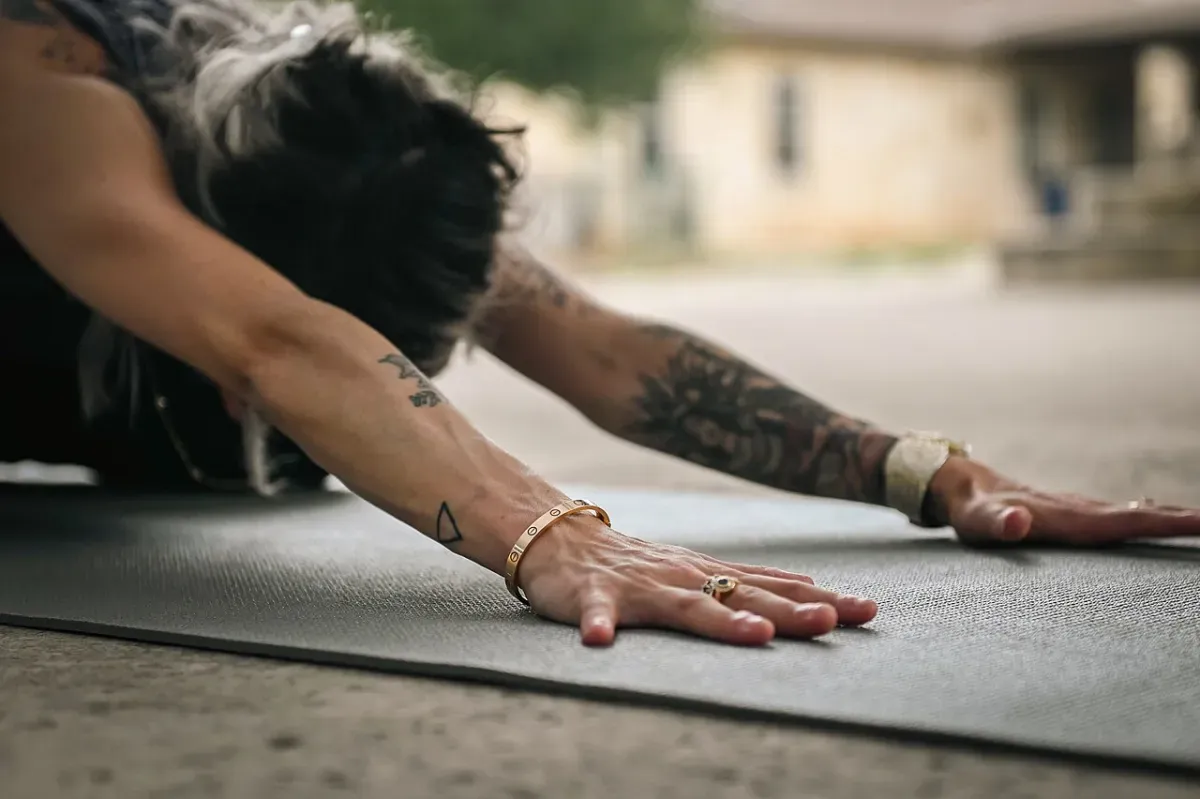
If you’ve decided to start stretching, here’s the calm version of the advice: pick five or six stretches, hold each for about 30 seconds, do it a few times a week, and stop chasing the idea that this will protect you from injury. It won’t, at least not the way the old gym posters claimed. What gentle stretching does reliably is give you range of motion and a small daily moment to undo a day of sitting.
This guide is the starting point for the whole stretching cluster on this blog. It covers what stretching actually does, a full-body routine you can learn in one sitting, how long to hold, how often to go, and the handful of mistakes that make stretching feel pointless or sore.
The short answer
A beginner stretching routine is six stretches, held 30 seconds each, two or three days a week. That’s enough to noticeably loosen tight hips, hamstrings, shoulders, and a stiff neck within a few weeks.
Two rules carry most of the benefit. First, stretch when you’re warm, not cold from the couch. Second, ease to mild tension and stay there, breathing, instead of bouncing or forcing it. Everything else is detail.
If you want one honest reframe: most people overrate stretching before a workout and underrate a few minutes of gentle mobility on an ordinary day. The pre-game toe-touch was never the magic. The boring daily version is where the value lives.
Why stretch at all
Stretching has a marketing problem. It got sold for decades as injury insurance, and that part mostly didn’t hold up. The real reasons to do it are quieter and more useful.
What stretching does well
Regular stretching increases your range of motion, which is the practical ability to reach, bend, and rotate without feeling stiff. Harvard Health frames flexibility work as protection for your mobility as you age, the thing that keeps you tying your shoes and twisting to grab a seatbelt without a complaint from your lower back (Harvard Health Publishing).
For anyone who sits most of the day, that matters more than it sounds. Hours in a chair leave the hip flexors short and the hamstrings tight, and a few minutes of targeted stretching is a direct counterweight. There’s also a relaxation angle. Slowing down to breathe through a stretch lowers your shoulders away from your ears after a tense day, which is part of why stretching shows up in so many wind-down routines. It feels good, and feeling good is a perfectly valid reason to keep a habit going.
What stretching does not do
Here’s the part the posters skipped. A systematic review of static stretching as part of a warm-up found “moderate to strong evidence that routine application of static stretching does not reduce overall injury rates” (Small, McNaughton & Matthews, 2008). All four of the randomized trials in that review reached the same conclusion. So if your only reason to stretch is dodging injuries, the evidence doesn’t back you.
There’s a second catch worth knowing. Long static holds right before a power or strength effort can briefly blunt it. A 2011 review reported that long-duration static holds can produce small acute drops in strength and power, while dynamic stretching tends to be neutral or slightly helpful (Behm & Chaouachi, 2011). The effect is modest and short-lived, but it’s the reason to save your long holds for after a workout, not before.
None of this means stretching is useless. It means you should do it for mobility and how it feels, not as a shield, and you should time it right.
Static vs dynamic, and when to use each
These two words cause most of the confusion, so here’s the plain version.
Static stretching
Static stretching is the classic kind: you move into a position and hold it still. Reach down toward your toes and stay there for 30 seconds, and that’s a static hamstring stretch. It’s the best tool for building flexibility over time, and it belongs after activity or on its own, when your muscles are already warm.
Dynamic stretching
Dynamic stretching means moving through a range repeatedly without holding the end position. Leg swings, arm circles, walking lunges, gentle torso twists. Because dynamic work warms the muscle and doesn’t carry the small power cost of long static holds, it’s the better choice before a workout. The same 2011 review pointed to a warm-up of light aerobic movement followed by dynamic stretching as the sensible default (Behm & Chaouachi, 2011).
A simple way to remember it: dynamic before, static after. If you’re doing a standalone flexibility session with no workout attached, just make sure you’re warm first, even a five-minute brisk walk does the job.
There’s a third style you’ll see mentioned, PNF, where you contract a muscle against resistance and then stretch it further. It works, but it’s fiddly and usually wants a partner, so skip it as a beginner. The static-and-dynamic split above covers everything you need for the first several months.
Stretching myths worth dropping
A few beliefs about stretching survive long past their evidence. Letting go of them makes the habit easier, not harder, because you stop expecting things stretching was never going to deliver.
Stretching won’t save you from next-day soreness
This is the big one. The deep ache you feel a day or two after a hard session, delayed-onset muscle soreness, is not something a few hamstring holds will fix. A Cochrane review pooled twelve randomised studies on exactly this question, including one large field trial of over 2,000 people, and the verdict was blunt: stretching “whether conducted before, after, or before and after exercise, does not produce clinically important reductions in delayed-onset muscle soreness in healthy adults” (Herbert, de Noronha & Kamper, 2011). The average effect on soreness was tiny, well below anything you’d actually notice.
So a cooldown stretch is fine, and it feels nice, but don’t do it as soreness insurance. If a session leaves you wrecked, the things that help are a slower build-up next time, sleep, and patience. The muscle is repairing, and stretching the repair doesn’t speed it up.
You don’t need to hold for minutes
There’s a quiet belief that longer is better, that gritting through a two-minute hold buys you twice the flexibility of a 30-second one. It doesn’t. Most of the change in muscle length happens in the first 30 seconds or so, which is why Harvard Health and the American College of Sports Medicine both settle in that 10 to 30 second window (Harvard Health Publishing). Past that point you’re mostly just enduring. If a spot is stubborn, an extra round of 30 seconds does more than one long, white-knuckled stretch.
Getting more flexible is partly your nerves, not just your muscles
Here’s the one that surprises people. When you first start stretching and your reach improves within a couple of weeks, your muscles haven’t physically grown longer yet. A lot of that early gain comes from stretch tolerance, your nervous system learning to allow a deeper range before it flags discomfort. Researchers studying how flexibility improves have pointed to this sensory adaptation as a real driver of short-term gains, alongside slower structural change over longer timeframes (Weppler & Magnusson, 2010).
Why does that matter to a beginner? Because it explains the timeline. The fast early progress is your body deciding the position is safe, and that comes from showing up often, not from forcing depth on any single day. Gentle and frequent teaches tolerance. One heroic session that leaves you sore teaches your nervous system to guard, which is the opposite of what you want.
A beginner full-body stretching routine
Here’s a routine that hits the spots a sedentary day wrecks: hamstrings, hips, chest, shoulders, and neck. Learn these six and you have a full body stretching routine you can run in under ten minutes. Hold each for 30 seconds, breathe normally, and ease to mild tension, not strain.
Do this when warm. After a walk, a workout, or a hot shower all work.
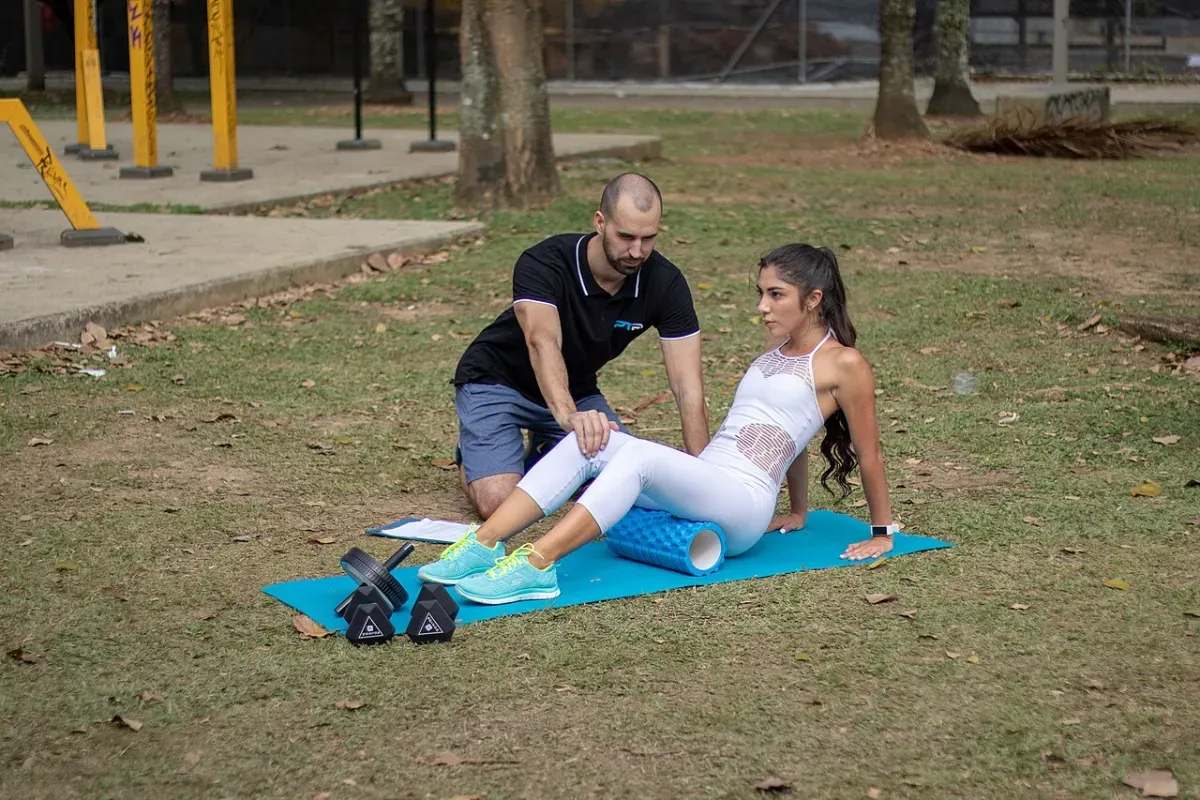 Photo by PTPioneer via Wikimedia Commons (CC BY 2.0)
Lower body: hamstrings, hips, calves
- Seated hamstring stretch. Sit with one leg straight, the other foot tucked toward your inner thigh. Hinge forward from the hips, not the spine, reaching toward your straight foot. Keep your back long rather than rounding hard. You’ll feel it along the back of the thigh.
- Standing quad stretch. Stand tall, grab one ankle behind you, and pull your heel toward your glute while keeping your knees close together. Hold a wall for balance. This one undoes a lot of sitting, and there are gentler entry points in our guide to quad stretches.
- Figure-four hip stretch. Lie on your back, cross one ankle over the opposite knee, then pull the supporting thigh toward your chest. It opens the glutes and outer hip, often the tightest spot for desk workers. For a deeper dive on this area, see our lower back stretches routine, which pairs nicely with hip work.
- Standing calf stretch. Step one foot back, keep the heel down and the back leg straight, and lean into a wall until you feel the calf lengthen. Tight calves quietly affect how you walk and squat.
Upper body: chest, shoulders, neck
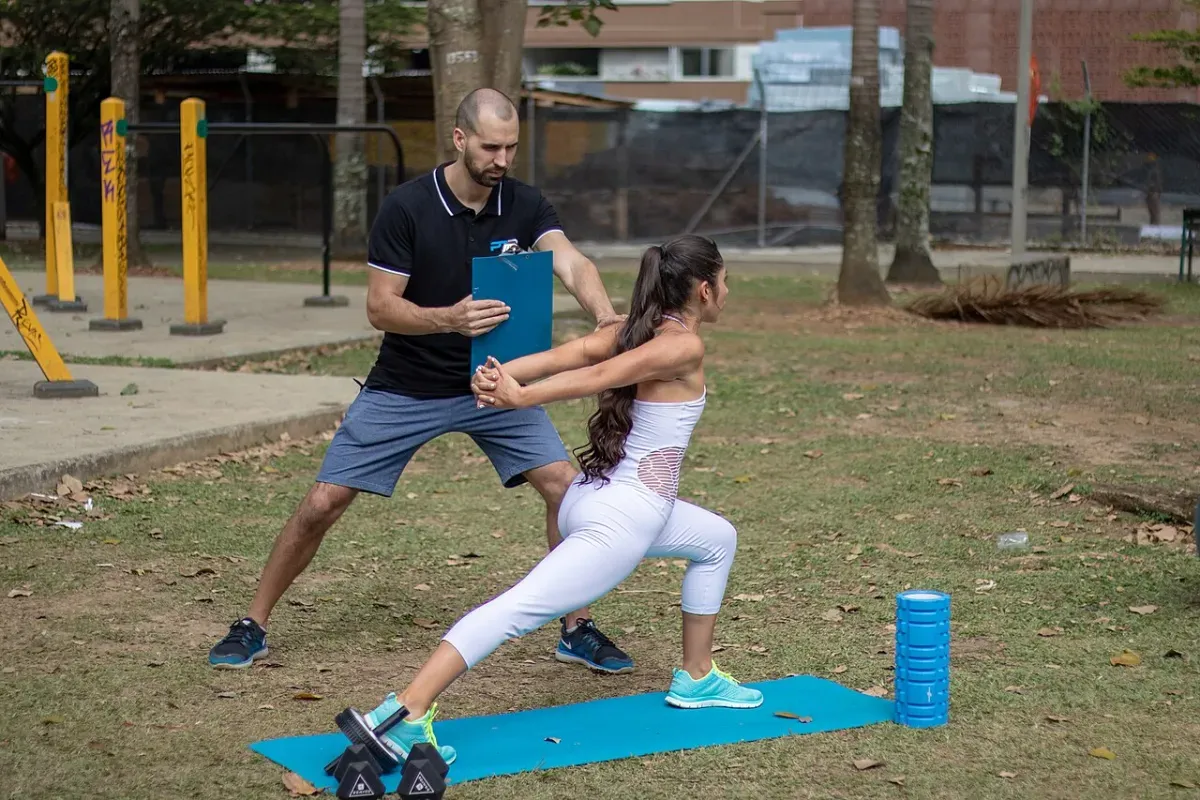 Photo by PTPioneer via Wikimedia Commons (CC BY 2.0)
- Doorway chest stretch. Place your forearm on a door frame at shoulder height and step gently through until you feel a stretch across the chest and front of the shoulder. Hours of hunching over a screen pull these forward, so this is one most people need.
- Cross-body shoulder and neck release. Draw one arm across your body and hold it with the other, then finish by tilting your head gently toward each shoulder for the neck.
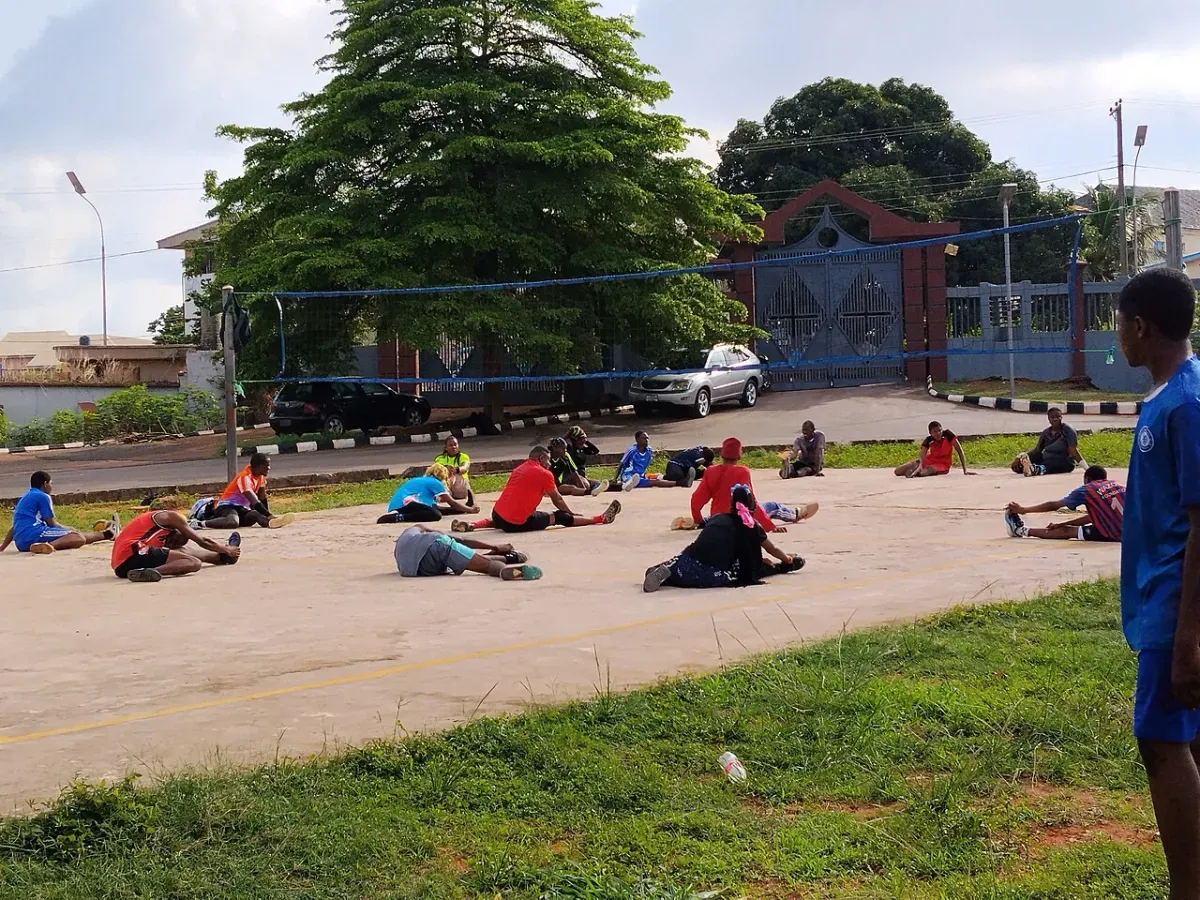 Photo by Johnnybam via Wikimedia Commons (CC BY-SA 4.0)
Run through all six and you’ve covered the major muscle groups. If you’d rather make this the first thing you do each day, our morning stretch routine builds the same idea into a gentle wake-up sequence.
How long to hold and how often to go
The numbers here are settled enough that you don’t need to overthink them.
Hold time
About 30 seconds per stretch. Harvard Health and the American College of Sports Medicine both land in the 10 to 30 second range, and around 30 seconds is where the muscle actually lengthens most (Harvard Health Publishing). Older adults sometimes benefit from holding a little longer, closer to a minute. Repeat each stretch two to four times if you have the minutes.
You don’t need to hold longer than that. Two minutes of clenching into one stretch isn’t twice as good as 30 seconds, it’s mostly just uncomfortable. The one exception is if a muscle is genuinely tight, where an extra round or two helps more than one heroic long hold. Spread the work across a few short holds rather than gritting through a single endless one.
Frequency
Aim for at least two to three sessions a week, and stretch daily if you can. Harvard’s guidance is a program of daily stretches, or at least three or four times a week, focusing on the areas that get tight (Harvard Health Publishing). Because a full session runs five to ten minutes, daily is genuinely doable for most people. The short, frequent version beats the long, rare one.
This is exactly where stretching has an edge over harder training. It asks for so little time that the only real obstacle is remembering to do it.
Common beginner mistakes
A few habits turn stretching from useful to sore or useless. These are the ones worth catching early.
Bouncing into the stretch
Bobbing or pulsing to push deeper, sometimes called ballistic stretching, is the classic error. Harvard’s flat advice: “Don’t bounce, which can cause injury” (Harvard Health Publishing). Ease in smoothly and hold still. The slow version reaches further over time anyway.
Stretching cold muscles
Folding into a deep stretch straight off the couch is asking for a strain. Cold muscle fibers aren’t ready to lengthen and can get damaged. Warm up first with a few minutes of light movement, or stretch after activity when you’re already warm.
Holding your breath and pushing into pain
Two related faults. People tense up and forget to breathe, which works against the relaxation a stretch needs. And they confuse pain with progress. The target is mild tension you can hold comfortably, not the sharp pull that makes you wince. If it hurts, you’ve gone too far, so back off until it’s just a gentle pull.
Treating static stretching as your warm-up
This circles back to the evidence. Long static holds before a power effort can briefly reduce strength (Behm & Chaouachi, 2011), and they won’t make you injury-proof (Small, McNaughton & Matthews, 2008). If you’re warming up for exercise, move dynamically. Keep your long holds for the cooldown.
Building the habit that makes it work
The routine is simple. Sticking with it is the actual challenge, the same one that makes any health habit hard. A perfect stretching program you abandon in week two does nothing.
The trick is to attach stretching to something you already do. Stretch while the coffee brews, during a show, or right after you brush your teeth. Five minutes slotted into an existing moment survives far better than a separate appointment you have to remember.
A small dose of gentle accountability helps too, on the days you’d otherwise skip. It’s the same idea we cover in our guide on how to motivate yourself to work out, applied to the easiest habit to start with.
Pick your six stretches, do them tonight while you’re warm, and put them on tomorrow’s list too. Flexibility is one of the few things in fitness where small and consistent genuinely wins. If you want to keep building, the rest of this cluster, from lower back stretches to a full morning stretch routine, grows out from here.
Frequently asked
- How long should beginners hold a stretch?
- Hold each static stretch for about 30 seconds. Harvard Health and the American College of Sports Medicine both land on the 10 to 30 second range, and roughly 30 seconds is where most of the change in muscle length happens. Hold to the point of mild tension, never pain, and breathe normally the whole time. Repeat each stretch two to four times.
- Should I stretch before or after a workout?
- Save long static holds for after, when your muscles are warm. Before a workout, do dynamic stretches: leg swings, arm circles, walking lunges. A 2011 review found static stretching can slightly cut strength and power for a short window afterward, while dynamic stretching has no negative effect and may help. If you only want gentle daily flexibility, any warm time of day works.
- How often should a beginner stretch each week?
- At least two to three times a week covers the major muscle groups, and daily is better if you can manage it. A full-body session only takes five to ten minutes. Consistency matters more than length, so a short routine most days beats one long session you do once and forget.