Lower Back Stretches That Actually Ease Tightness
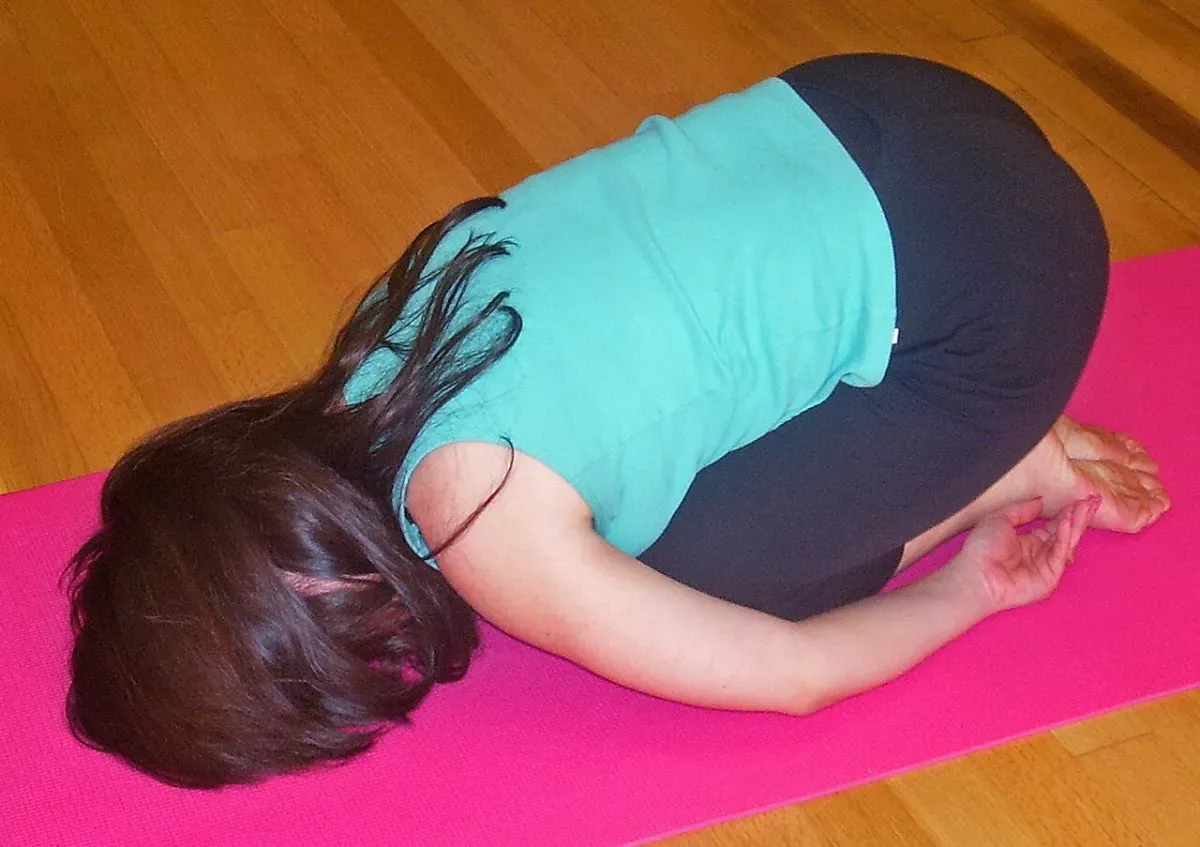
If your lower back feels tight after a day at a desk, a few minutes of gentle stretching most days will usually help more than lying down and waiting it out. That’s not a hunch. For ordinary, non-specific low back pain, the guidance is consistent: keep moving, stretch gently, and don’t retreat to bed. The NHS puts it plainly, telling people to “stay active and try to continue with your daily activities” and to “not stay in bed for long periods of time” (NHS, back pain).
So this is a set of stretches you can do on a mat or a carpet, with form cues that matter, and an honest note about what stretching can and can’t fix. Movement helps. It isn’t a cure for a structural problem, and there are a few warning signs where you should close this tab and call a doctor instead. Those are at the end, and they’re worth reading.
The short answer
Pick four or five gentle stretches, hold each for 20 to 30 seconds, breathe, and do them most days. Knee-to-chest, child’s pose, cat-cow, a supine spinal twist, and a hamstring stretch cover almost everyone’s needs. None of them should hurt.
Consistency does the heavy lifting here, not intensity. A five-minute routine you actually repeat beats an ambitious 30-minute session you do once and abandon. Harvard Health makes the same point about chronic low back pain, noting that stretching “is most effective when you do it regularly, since it helps prevent recurrences” (Harvard Health).
That’s the whole strategy. The rest is doing each stretch well enough that it helps and gently enough that it doesn’t backfire.
Why sitting makes your lower back tight
A long day in a chair doesn’t usually injure your back. It stiffens it. Your hip flexors shorten, your glutes switch off, and the muscles around your spine spend hours holding one slightly slumped position. By evening, everything in that region feels short and cranky.
There’s a second culprit most people miss: the hamstrings. When they get tight, they pull down on the back of the pelvis and tilt it, and the lower back gets dragged along with it. Harvard Health describes it directly: “if the hamstrings are tight, they pull the pelvis down… and if the pelvis is being pulled, the low back is being pulled, which can hurt” (Harvard Health). This is why a hamstring stretch belongs in a lower-back routine even though the hamstrings sit nowhere near your spine.
So you’re not chasing one tight muscle. You’re loosening a small chain of them: hips, glutes, the spinal muscles, and the hamstrings underneath. The stretches below hit all four.
A note before you start
Two rules keep these stretches helpful rather than aggravating.
First, slow down. Ease into each position until you feel a mild pull, not a sharp pain, then stop there and breathe. Harvard’s advice is worth taking literally: “be gentle when you stretch, so you help your muscles and don’t injure them or aggravate the cause of the pain.” If a movement produces sharp or shooting pain, especially down a leg, back off and don’t force it.
Second, breathe out as you ease deeper. Holding your breath tenses the very muscles you’re trying to relax. Aim for 20 to 30 seconds per hold, two or three rounds, and don’t bounce.
Knee-to-chest stretch
This is the gentlest place to start and the one people with a sore lower back tolerate best.
Lie on your back with both knees bent and feet flat. Draw one knee up toward your chest and hold it there with your hands, just below the kneecap or behind the thigh if your knee is sensitive. You should feel a soft stretch across your lower back and the top of your glute. Keep the other foot flat on the floor, or extend that leg straight along the ground for a slightly stronger version. Hold for 20 to 30 seconds, then switch sides. Finish by hugging both knees in together.
Keep your head and shoulders relaxed on the floor the whole time. If you find yourself craning your neck up, you’re working too hard.
Child’s pose
A resting stretch that lengthens the whole lower back at once, which is why it’s the hero image of this article.
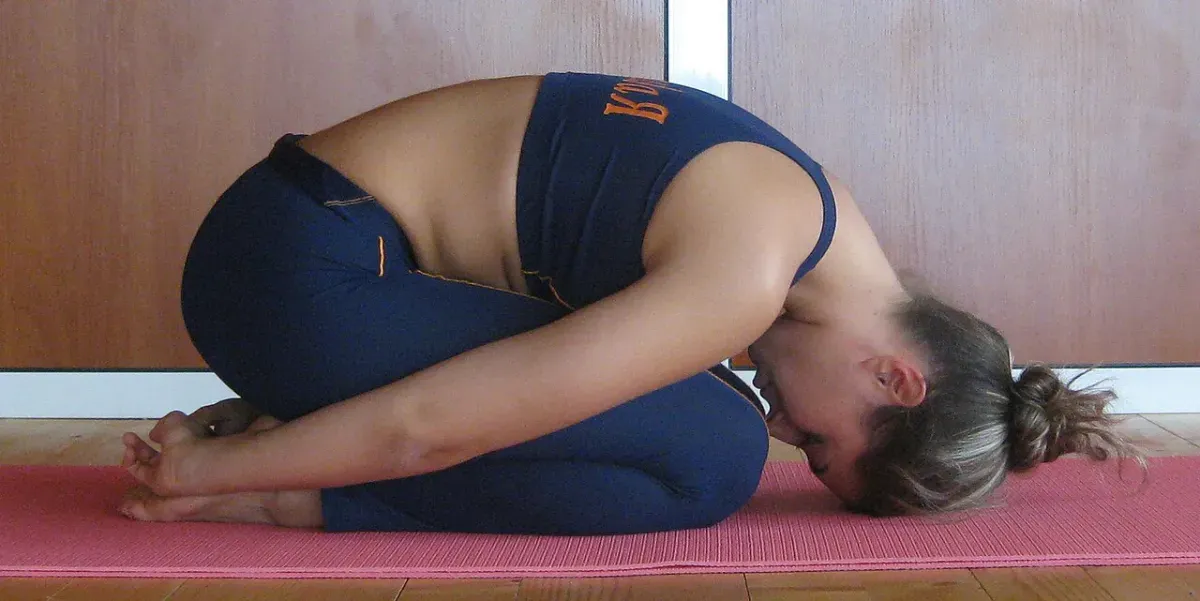 Illustration by Iveto via Wikimedia Commons (CC BY-SA 4.0)
Start on your hands and knees. Sit your hips back toward your heels and walk your hands forward, letting your chest sink toward the floor and your forehead rest down. Spread your knees a little wider than your hips if that feels easier on the belly and lower back. You’ll feel a long, gentle stretch from your tailbone up through your mid-back.
Breathe into your back ribs and let each exhale settle you a touch deeper. If kneeling bothers your knees, put a folded towel behind them or skip this one. It’s meant to feel like a rest, not a strain.
Cat-cow
Less a stretch than a slow mobility drill, and a good one for waking up a stiff spine in the morning.
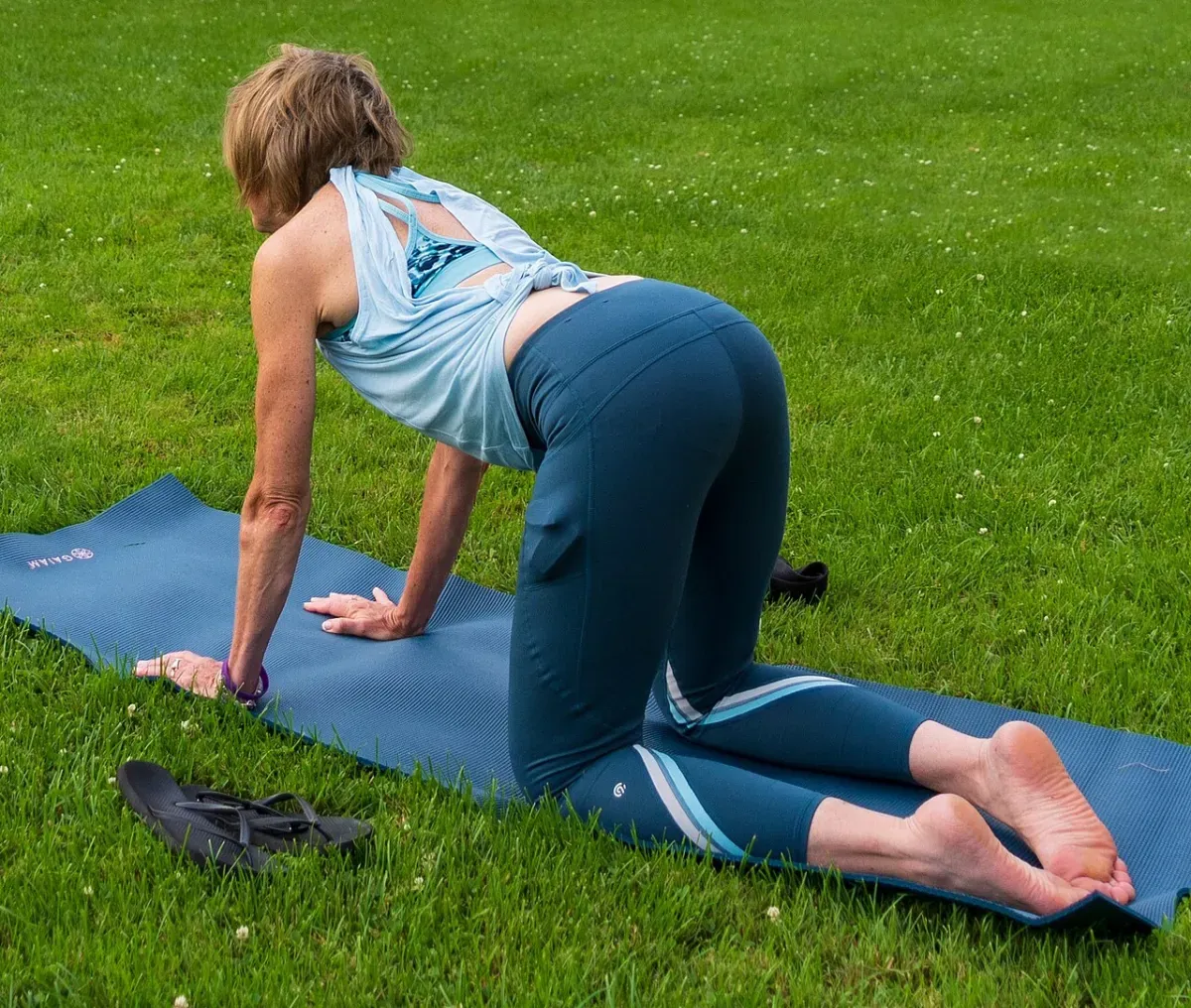 Photo by Mary O’Neill via Wikimedia Commons (Public domain)
On your hands and knees, wrists under shoulders and knees under hips, alternate between two shapes. For “cow,” drop your belly, lift your chest and tailbone, and look slightly up. For “cat,” press the floor away, round your spine toward the ceiling, and tuck your chin and tailbone. Move slowly, following your breath: inhale into cow, exhale into cat. Do eight to ten slow rounds.
Skip the deep end ranges here. The aim is to move every segment of your spine through a small, easy arc, which is exactly the kind of gentle motion stiff backs respond well to.
Pelvic tilt
A small, almost invisible movement that teaches your lower back and deep abdominals to work together. People underrate it because it looks like nothing.
Lie on your back, knees bent, feet flat. Without pushing with your feet, gently flatten your lower back into the floor by tilting your pelvis, as if drawing your belly button down toward your spine. You’ll feel your lower abdominals switch on and the arch in your back ease. Hold for five seconds, release, and repeat ten to fifteen times.
This one bridges stretching and strength, and that overlap matters. The lower back behaves better when the core around it is doing its share, which is why a steady core routine pairs naturally with stretching. Our ab workout at home guide covers the strength side without wrecking your back in the process.
Supine spinal twist
A rotational stretch that reaches the muscles along the side of your spine and into the glutes.
Lie on your back, arms out in a T. Bend your knees and let them drop slowly to one side while you turn your head gently the other way. Keep both shoulders on the floor, or as close as you comfortably can. You’ll feel a stretch across your lower back, into the hip, and sometimes up through the chest. Hold for 20 to 30 seconds, breathe, then bring your knees back to center and drop them to the other side.
Don’t yank your knees down to force the floor. Let gravity do the work and stop where the stretch is mild. If your shoulder lifts way off the ground, you’ve gone too far for today, and that’s fine.
Hamstring and figure-4 stretches
These two reach the muscles that quietly drag on your lower back from below and behind.
Lying hamstring stretch
Stay on your back. Bend one knee with the foot flat, and raise the other leg toward the ceiling, holding behind the thigh or calf with both hands. Keep a slight bend in the raised knee and ease it gently toward you until you feel a stretch up the back of the thigh. Tight hamstrings tilt the pelvis and pull on the lower back, so loosening them often takes pressure off the spine indirectly. Hold 20 to 30 seconds per side. A towel or strap looped around the foot makes this easier if you can’t reach.
Figure-4 (piriformis) stretch
Still on your back, cross one ankle over the opposite thigh just above the knee, making a number four. Reach through and clasp the back of the lower thigh, then draw both legs gently toward your chest. You’ll feel a deep stretch in the glute and outer hip of the crossed leg. The piriformis sits deep in the buttock near the sciatic nerve, and when it’s tight it can refer discomfort into the lower back and hip. Keep it gentle and stop if anything shoots down the leg.
How to put it together
You don’t need all seven every day. A short, repeatable routine works better than a marathon.
A simple version: child’s pose, knee-to-chest both sides, cat-cow for eight rounds, supine twist both sides, and a hamstring stretch. That’s about five minutes. Do it in the morning to loosen an overnight-stiff back, or in the evening to undo a day of sitting, or both. If mornings suit you, our morning stretch routine folds several of these into a full-body wake-up.
This is the conservative, evidence-backed approach, and it’s worth being clear about what it does. A large Cochrane review of 249 trials found that exercise “probably reduces pain compared to no treatment, usual care or placebo in people with long-lasting (chronic) low back pain,” with people improving by roughly 15 points on a 0-to-100 pain scale (Hayden et al., 2021, Cochrane). That’s a real, meaningful effect. It is also not a cure. Movement manages symptoms and reduces flare-ups. It doesn’t rebuild a damaged disc or undo years of posture in a week. Set the expectation at “steadily better and more comfortable,” not “fixed by Friday.” If you’re brand new to all of this, the beginner’s guide to stretching walks through the basics of holds, breathing, and frequency.
When to see a doctor
Most lower back tightness is harmless and eases with gentle movement. A small number of symptoms are different, and they mean you should seek medical help quickly rather than stretch through it.
The NHS lists signs that warrant urgent care, including “pain, tingling, weakness or numbness in both legs,” “a loss of feeling around your genitals or anus,” and “changes in your bladder or bowels, such as difficulty peeing” (NHS, back pain). Together these can point to cauda equina syndrome, a rare emergency where nerves at the base of the spine are compressed, and it’s treated as urgent because delays can cause lasting damage.
Also see a doctor, though less urgently, if your back pain follows a serious fall or accident, comes with a fever or unexplained weight loss, doesn’t improve at all after a few weeks of gentle movement, or shoots down one leg severely. Stretching is for ordinary stiffness and mild, non-specific aches. It is not a substitute for a diagnosis when something feels genuinely wrong.
Build the habit, not just the routine
The stretches are easy. Remembering to do them on a forgettable Wednesday is the actual challenge, and it’s the same reason most people’s good intentions fade by the second week.
A five-minute stretch is small enough that the only real obstacle is showing up, and on the days you can’t be bothered, a gentle reason to get onto the mat tends to win out. If getting started at all is the sticking point, our guide on how to motivate yourself to work out digs into why a small, consistent nudge beats waiting to feel motivated. Roll out the mat, do four or five of these, and put it on tomorrow’s list too.
Frequently asked
- What are the best stretches for lower back pain?
- Knee-to-chest, child's pose, cat-cow, the supine spinal twist, and a gentle pelvic tilt are the ones most people get relief from, partly because they're hard to do wrong. Add a hamstring stretch, since tight hamstrings tug on the pelvis and the lower back. Do them slowly, hold each for 20 to 30 seconds, and stop short of any sharp pain.
- How often should I stretch my lower back?
- Most days, or at least two or three times a week. Harvard Health notes that stretching for chronic low back pain works best when you do it regularly, since it helps prevent recurrences. A short five-minute routine done consistently beats a long session you only manage once a week. If you sit all day, a couple of short breaks to move are more useful than one big stretch.
- Should I rest or stay active with lower back pain?
- Stay active. The NHS is explicit that you should keep up your daily activities and avoid long periods in bed, because prolonged rest tends to make non-specific back pain worse, not better. Gentle stretching and walking help symptoms. The exceptions are red-flag signs like numbness in both legs or loss of bladder or bowel control, which need urgent medical care.