Morning Stretch Routine: A Doable 8-Minute Wake-Up
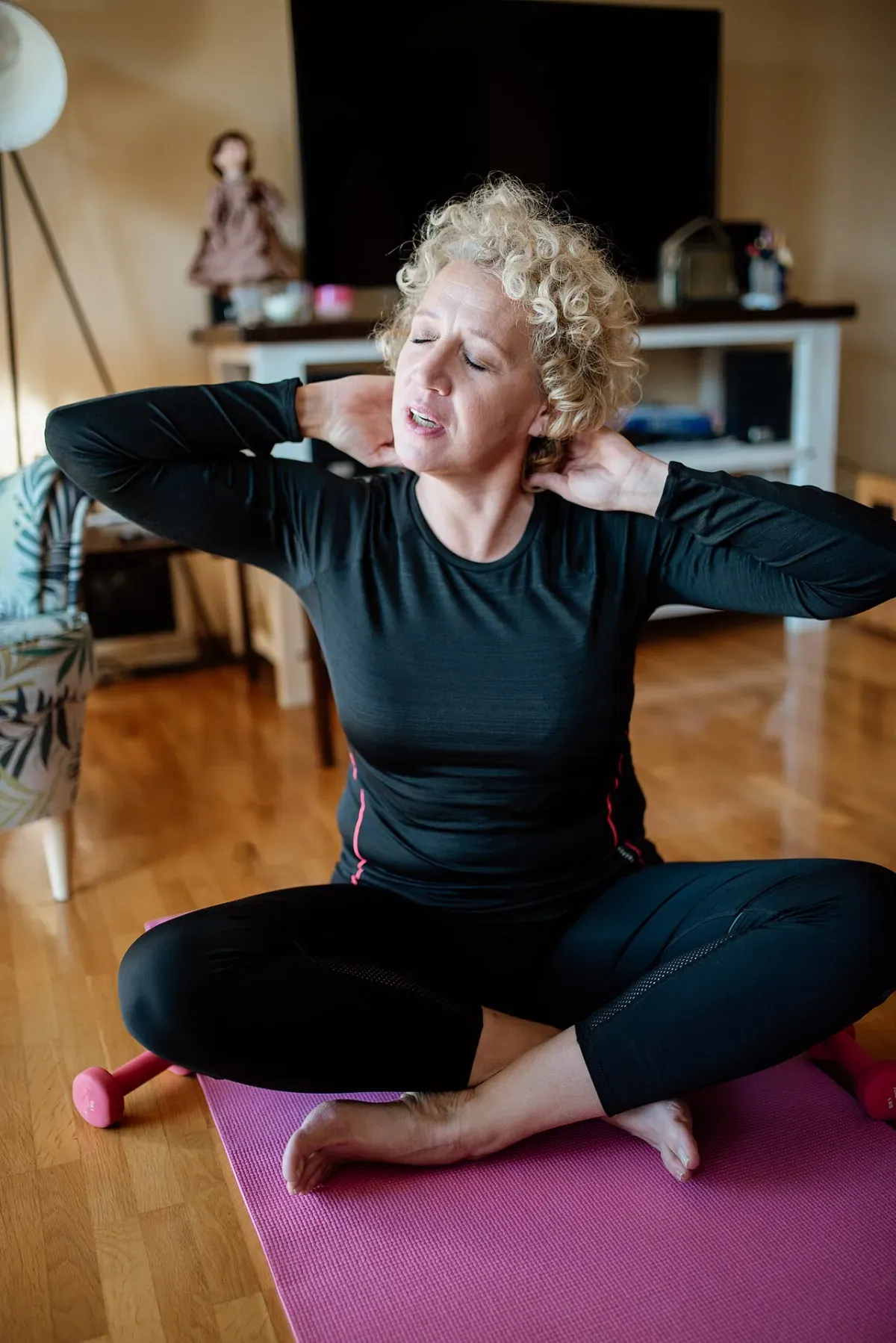
You wake up stiff because your body has been more or less motionless for seven or eight hours, and your joints produce less of the fluid that lubricates them while you sleep. A few minutes of gentle movement reverses that. This is a morning stretch routine you can finish in about eight minutes, before coffee or after it, in a hallway or beside your bed.
One opinion up front, because most “morning routine” content is bloated past the point of usefulness: keep it under ten minutes. A 25-minute sequence with mood lighting and a playlist sounds lovely and you will do it twice. Eight minutes you can do half-asleep is the one that survives to next month.
The short answer
Move through six or seven gentle moves, hold nothing for very long, and keep it under ten minutes. In the morning your muscles are cold, so the job is to wake the body and loosen the joints, not to chase your deepest split.
That means dynamic movement, the kind where you flow in and out of a position, rather than long static holds where you sink into a stretch and wait. Cold muscle does not love being yanked toward its end range. A cat-cow, a few slow lunges, some easy reaches. You will feel looser by the end without forcing anything.
Run the sequence below in order. The whole thing is one continuous flow, from neck down to legs, so you are never standing around wondering what comes next.
Why mornings call for movement, not deep holds
Plenty of routines online have you holding a hamstring stretch for 60 seconds the second your feet hit the floor, and that is the part worth pushing back on.
Your tissues are cold first thing in the morning, and cold muscle is stiffer and less compliant. That is exactly when a long, forced static hold has the least to offer and the most chance of feeling unpleasant. Harvard Health notes that stretching before you get out of bed helps wake the body, improve circulation, and lubricate the joints (Harvard Health, Try these stretches before you get out of bed). Notice the goal there: circulation and lubrication, not flexibility gains.
That fits what the warm-up research says. In a widely cited review, dynamic stretching was shown to maintain or even improve subsequent performance, while longer static stretching before activity could blunt it (Behm & Chaouachi, 2011). The American College of Sports Medicine and the European College of Sport Science lean the same way: dynamic movement to prepare a cold body, static work saved for when you are already warm.
None of this means static stretching is bad. If your real goal is to get more flexible over time, held static stretches done a few times a week genuinely work (Harvard Health, The ideal stretching routine). It just means the morning, with a cold body and a tired brain, is the wrong slot for it. Use the morning to feel less stiff and to lock in a habit. Chase range of motion later in the day.
The 8-minute morning stretch routine
Do these in order. The times are loose targets, not rules. If a move feels good, linger; if it does not, move on. Breathe through your nose and keep everything gentle. Nothing here should hurt.
1. Neck rolls and shoulder rolls (45 seconds)
Start standing or sitting tall. Drop your chin toward your chest and roll your head slowly to one side, then the other, like you are tracing a smile shape from shoulder to shoulder. Avoid cranking your head all the way back. Do four or five passes.
Then roll your shoulders: lift them toward your ears, draw them back, and let them drop. Five rolls back, five forward. This wakes up the upper back and neck, the spots that stiffen most from a night on a pillow.
2. Cat-cow (60 seconds)
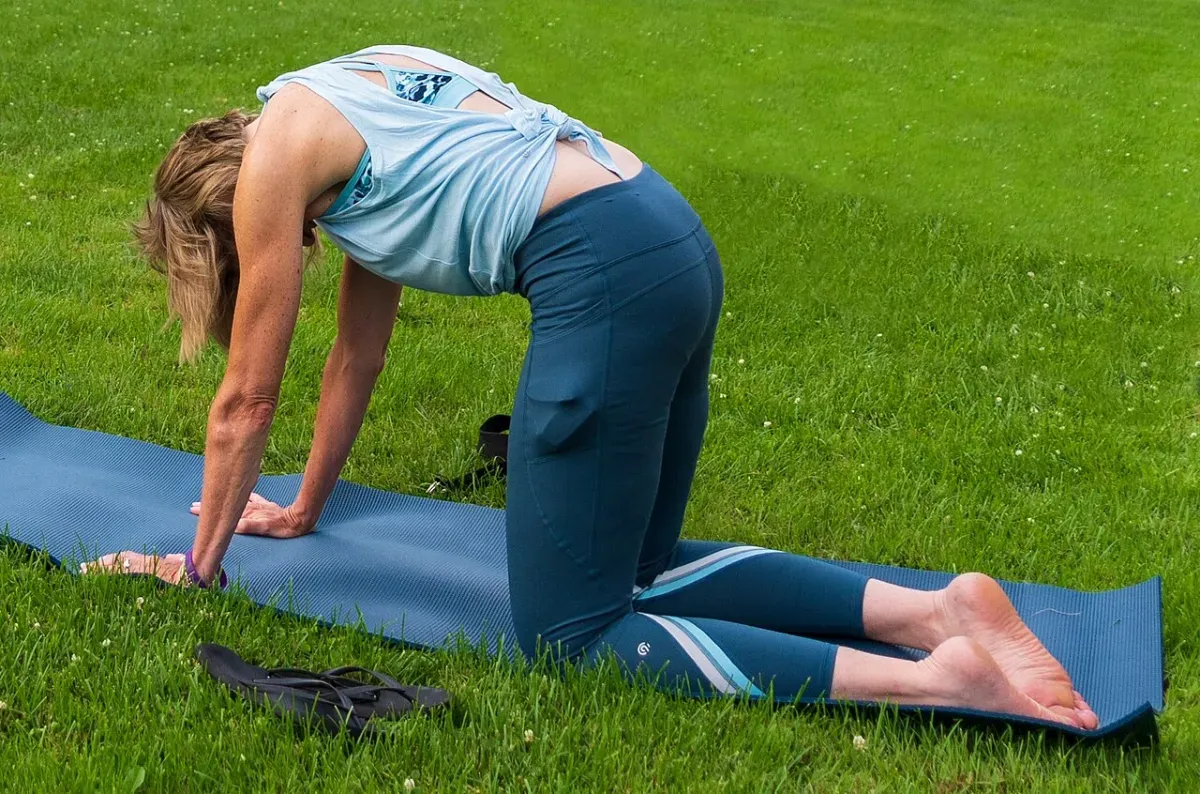 Illustration by Mary O’Neill via Wikimedia Commons (Public domain)
Get onto your hands and knees, hands under shoulders, knees under hips. As you inhale, drop your belly, lift your chest and tailbone, and look slightly up (cow). As you exhale, round your spine toward the ceiling and tuck your chin (cat).
Move with your breath, slow and smooth, for about a minute. This is the single best move in the routine. It takes your spine through its full range in both directions and is the textbook example of dynamic mobility: you are flowing, not holding.
3. World’s greatest stretch (60 seconds)
Worth the dramatic name. From standing, step one foot far forward into a deep lunge. Place both hands on the floor inside your front foot. Then rotate your front-side arm up toward the ceiling, opening your chest and following your hand with your eyes. Lower it back down, switch the lunge to the other leg, and repeat.
Do three or four per side. It opens the hips, the upper back, and the shoulders in one movement, which is why coaches love it as a warm-up.
4. Hip flexor lunge (45 seconds per side)
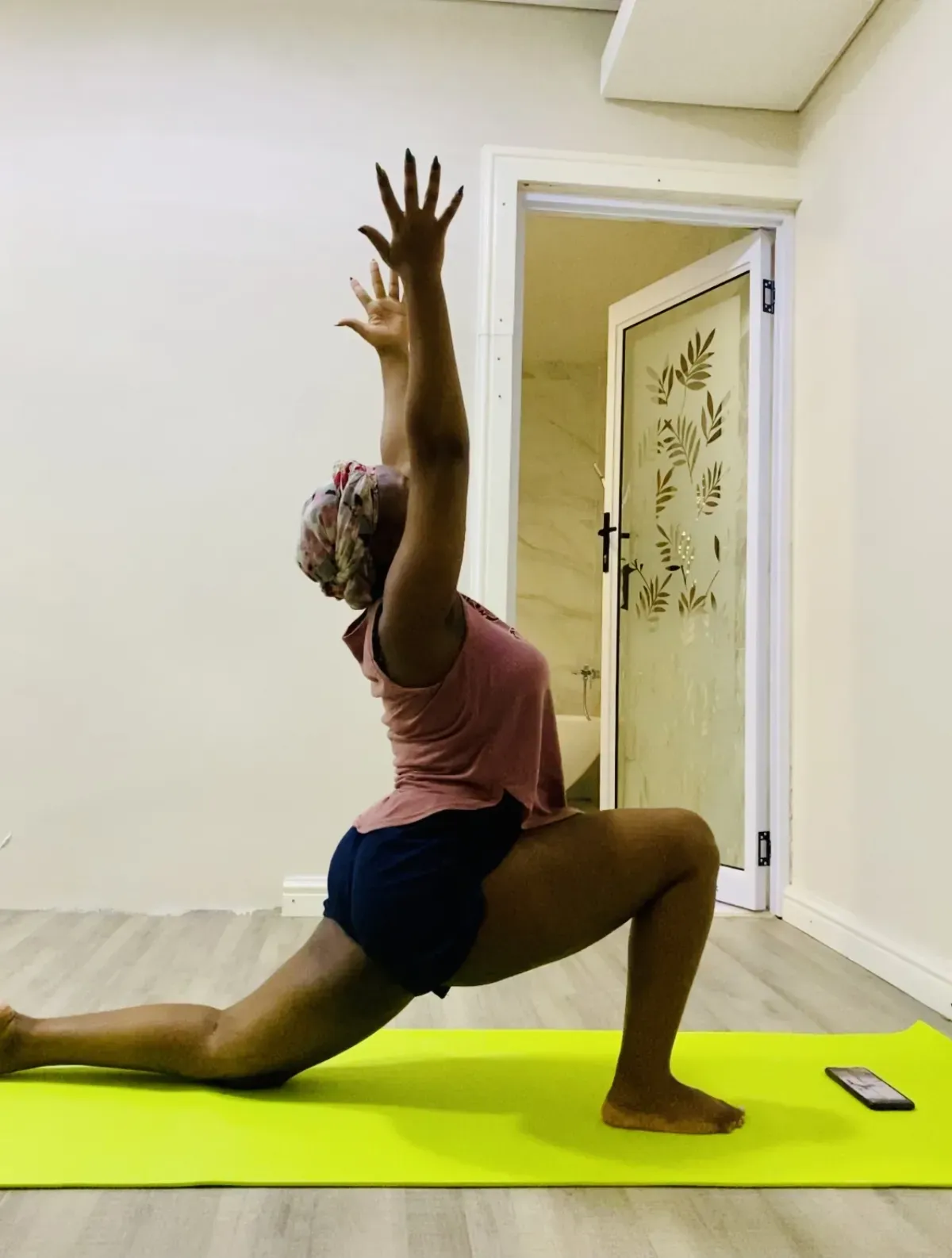 Illustration by BameSanah88 via Wikimedia Commons (CC BY-SA 4.0)
Step into a lunge and lower your back knee gently to the floor. Tuck your tailbone slightly and ease your hips forward until you feel a soft stretch along the front of the back-leg hip. Sink and lift a few times rather than holding dead still, then switch sides.
If you sit for work, this is the move you will feel the most. Hours in a chair shorten the hip flexors, and a daily morning lunge keeps them honest.
5. Standing side bend (30 seconds)
Stand tall, reach both arms overhead, and clasp your hands. Lean slowly to one side, feeling the stretch run down the opposite ribs and waist, then come back through center and lean to the other side. Keep your hips steady and do not collapse forward. Four or five passes each way, breathing out as you bend.
6. Hamstring reach (45 seconds)
 Illustration by Nenad Stojkovic via Wikimedia Commons (CC BY 2.0)
From standing, hinge at the hips and let your hands drift toward your shins or the floor, knees soft. Rather than locking into a deep hold, bend and straighten your knees gently a few times so the back of your legs warms up through movement. This is a dynamic version of the classic toe-touch, which suits a cold morning body far better than hanging there for a minute.
7. Shoulder rolls and a big reach (30 seconds)
Finish by standing tall, reaching both arms straight up as if pulling on a high shelf, rising onto your toes, then releasing. Do it two or three times, exhale on the way down, and you are done. Total time, give or take a yawn, is about eight minutes.
If you only have five minutes some days, cut moves 5 and 7 and shorten the lunges. Cat-cow, the world’s greatest stretch, and a hamstring reach are the three that carry most of the value, so a stripped-back 5-minute morning stretch still earns its place.
Common mistakes that wreck a morning routine
A short routine is easy to get wrong in ways that quietly make it pointless or unpleasant. Most people trip on the same few things.
Bouncing into a cold stretch
Ballistic bouncing, where you bob up and down to push past your range, is the one bit of dynamic movement to avoid first thing. Flowing is good; bouncing aggressively against a cold muscle is how you tweak something. The cat-cow flow and the gentle knee bends in the hamstring reach are dynamic without ever yanking. Keep that gentle quality everywhere.
Holding your breath
Watch yourself during the side bend or the lunge and you may notice you have stopped breathing. Holding your breath tenses the very muscles you are trying to loosen. Exhale as you move into each stretch and let the breath stay slow and nasal. It sounds fussy, but it changes how loose you feel by the end.
Making it a workout
The temptation, once you are up and moving, is to bolt on push-ups, a plank, maybe a quick jog in place, and suddenly your eight-minute routine is a 25-minute one you dread. There is nothing wrong with a morning workout, but it is a different commitment with a different failure rate. Keep the stretch routine as its own small, near-frictionless thing. If you want strength work, give it its own slot.
Treating soreness as progress
A morning stretch should leave you feeling looser, not sore. If a move consistently hurts or leaves a muscle aching later, you are pushing a cold body too hard. Ease off the depth. The point is circulation and mobility, and neither requires you to reach your end range.
How to make it stick
The routine is the easy part. Doing it on a grey Tuesday when nobody is watching is the part that decides whether you still have a morning stretch routine in March.
Two things help more than any clever sequence. First, anchor it to something you already do. Stretch right after you turn off your alarm, or while the kettle boils, so the habit rides on an existing cue instead of relying on fresh willpower. Second, keep the bar embarrassingly low. On a rough morning, one cat-cow counts. A tiny version you actually do protects the streak, and the streak is what compounds.
The flexibility payoff, if you want one, comes from frequency rather than heroics. Harvard Health points out that lasting improvement in flexibility shows up when you stretch at least two or three times a week (Harvard Health, The ideal stretching routine). A short daily routine clears that bar without you ever scheduling a “stretching session.”
For the bigger picture on holds, frequency, and how to progress your flexibility over time, see our stretching for beginners guide. And if your stiffness lives mostly in your lower back, which is common for desk workers, our roundup of lower back stretches goes deeper on safe moves for that area.
When to skip dynamic and hold instead
One caveat, so this does not read as anti-static-stretching. If a specific muscle is genuinely tight, a tight hamstring before a run, say, a held static stretch after you are warm can be useful. The warm-up research that favors dynamic movement is about cold muscle and immediate performance, not a blanket ban on holds.
So the practical rule is simple. Morning, cold body, half-awake: keep it dynamic and short. Later in the day, after a walk or a workout, when you actually want to build range of motion: that is the time to hold. Both have a place. They just live at different hours.
Make it the easiest thing you do all day
The hardest rep in any routine is the decision to start it. On the mornings motivation is thin, the fix is to keep the bar low enough that eight minutes feels like nothing, because eight minutes is the whole routine. If your trouble is starting at all, our piece on how to motivate yourself to work out digs into why a small daily cue beats waiting to feel inspired, and our leg workout at home guide pairs nicely once the morning stiffness is gone and you want to build a little strength.
Pick the eight-minute version tomorrow, anchor it to your alarm, and let the easy days stay easy. The looseness shows up within a week. The habit takes care of the rest.
Frequently asked
- How long should a morning stretch routine be?
- Five to ten minutes is plenty for most people. The goal of a morning routine is to feel less stiff and to build a daily habit, not to fit in a workout. A short routine you actually do every day beats a 30-minute one you skip by Wednesday. Aim for around eight minutes of gentle, flowing movement.
- Is it better to do dynamic or static stretching in the morning?
- Dynamic, mostly. Your muscles are cold after a night of stillness, so gentle movement like cat-cow, leg swings, and slow lunges warms the tissue and moves your joints through their range. Save long, held static stretches for later in the day or after activity, when your body is already warm.
- Should I stretch before or after coffee and breakfast?
- Whatever makes it happen. There is no physiological rule that forces stretching before food. Many people stretch right after getting out of bed because it anchors the habit to something they already do. If you would rather move after coffee, that is fine. Consistency matters more than timing.