Games Like Pokémon GO: 9 Worth Playing in 2026

The closest games to Pokémon GO you can play in September 2026 are Monster Hunter Now, Pikmin Bloom, Ingress, Geocaching, Jurassic World Alive, Orna and Zombies, Run!, all on the US App Store, plus Dragon Quest Walk if you’re in Japan and WalkScape if you can get into its closed beta. The landscape has changed a lot since the genre first peaked a decade ago. Several major titles have shut down their mobile servers completely. A 2025 acquisition also moved Pokémon GO and two sister games to a new publisher, Scopely.
The games available today fall into three distinct categories based on how much physical movement they demand. Some require you to navigate to specific real-world coordinates to capture territory or find hidden items. Others track your location but let you interact with the game world wherever you happen to be. A final group ignores GPS entirely and simply uses your phone’s pedometer to reward your daily step count.
Choosing the right alternative depends heavily on your daily routine. A game that demands you visit dense city landmarks will frustrate a player living in a rural area. A simple pedometer app might feel boring to someone who wants a rich augmented reality experience.
The short answer: games like Pokémon GO that still work in 2026
Quick picks by what you liked about Pokémon GO
If you enjoy heading to specific real-world landmarks, Ingress and Geocaching offer destination-driven gameplay where you must physically reach coordinates to progress. Players who prefer having creatures appear nearby wherever they walk will likely enjoy Monster Hunter Now or Jurassic World Alive. Finally, if you want something that runs in your pocket without demanding constant screen attention, Pikmin Bloom and Zombies, Run! are your best options, and WalkScape is worth applying for if you don’t mind a wait.
At a glance: walking demand, GPS, price model, status
The location-based gaming market looks very different today than it did in 2016. In 2025, Savvy Games Group completed a $3.5 billion acquisition of Niantic’s games business through its wholly-owned entity, Scopely. The deal covered Pokémon GO, Pikmin Bloom, Monster Hunter Now and the companion apps Campfire and Wayfarer. The three games are now sold on the App Store by Scopely Explore, Inc. Ingress wasn’t part of the sale and is still listed under Niantic Spatial.
The following table compares the nine games covered below, with Pokémon GO as a baseline. The games are categorized by their walking demand: go-places (requires visiting specific coordinates), walk-anywhere GPS (tracks movement on a map), and step-counter (uses pedometer data).
| Game | Publisher | Walking Demand | GPS Required | Price Model | Status |
|---|---|---|---|---|---|
| Pokémon GO | Scopely Explore | Go-places | Yes (Adventure Sync optional) | Free + IAP | Live |
| Ingress | Niantic Spatial | Go-places | Yes | Free + IAP & Sub | Live |
| Geocaching | Groundspeak Inc. | Go-places | Yes | Free + Premium Sub | Live |
| Dragon Quest Walk | Square Enix | Go-places | Yes | Free + IAP | Live (Japan only) |
| Monster Hunter Now | Scopely Explore | Walk-anywhere | Yes (Adventure Sync optional) | Free + IAP | Live |
| Jurassic World Alive | Ludia | Walk-anywhere | Yes | Free + IAP & Sub | Live |
| Orna | Northern Forge | Walk-anywhere | Yes | Free + IAP | Live |
| Pikmin Bloom | Scopely Explore | Step-counter | Yes (for map) | Free + IAP | Live |
| Zombies, Run! | Six to Start | Any pace (audio) | Optional | Free + Memberships | Live |
| WalkScape | WalkScape | Step-counter | No | F2P area + optional purchases planned | Closed Beta |
High walking: games that send you to real places
These apps demand deliberate travel. You pick a spot on the map and walk (or drive) there.
Ingress: territory control at real-world portals
Ingress came out on 14 December 2013, two and a half years before Pokémon GO. The App Store description establishes a science-fiction premise where a mysterious energy source known as Exotic Matter has been discovered. Players must choose between two factions, the Enlightened or the Resistance, who are racing to control it.
The core gameplay involves physically traveling to real-world locations called Portals to capture them for your faction. Ingress is listed on the US App Store with Niantic Spatial, Inc. as the seller, meaning it wasn’t part of the portfolio sold to Scopely. It’s free to download. It offers currency packs ranging from $0.99 to $99.99 and an optional C.O.R.E. subscription listed at $7.99. Players must be at least 13 years old, or 16 if they reside in the European Economic Area.
Geocaching: physical containers hidden outdoors
If you want to travel to specific coordinates for a tangible reward, Geocaching takes the concept into the physical world. It describes itself as the official app of the world’s largest treasure-hunting community. Instead of capturing virtual portals, players use GPS to locate physical containers hidden by other community members in almost every country on Earth.
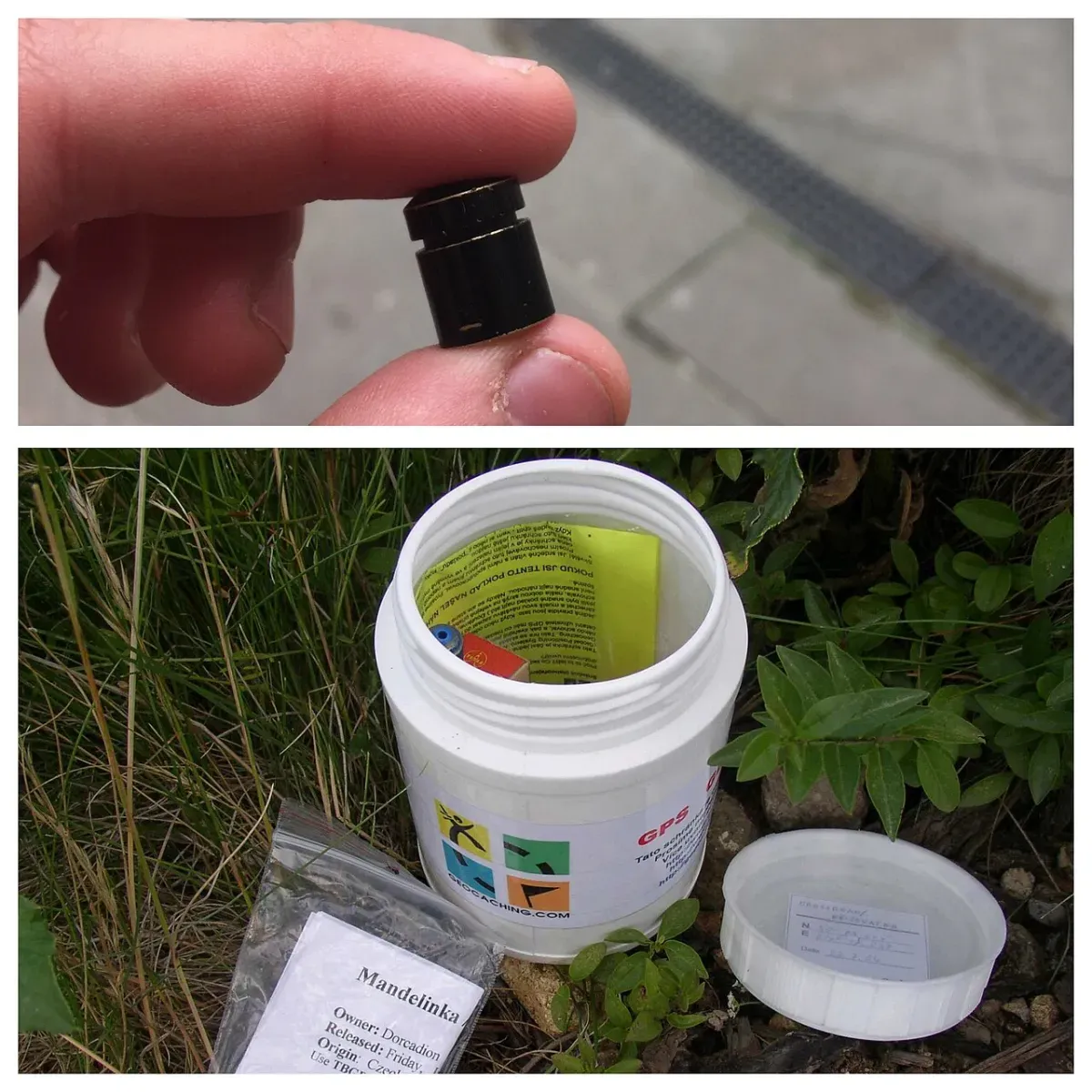 Photo: Mojo0306 / Wikimedia Commons (CC BY-SA 4.0)
The app is published by Groundspeak Inc., and its free tier covers Traditional caches. Premium-only caches and offline maps need the subscription ($5.99-$6.99 a month or $29.99-$39.99 a year).
Dragon Quest Walk: Japan-only, Japanese-language
Developed by COLOPL and published by Square Enix, Dragon Quest Walk brought classic role-playing mechanics to the real world. The game was released in Japan on 12 September 2019. Quests require you to walk to destinations in real life to unlock enemies or character interactions.
The game remains geographically restricted. It’s listed on the Japanese App Store as free with in-app purchases. Japanese is its only supported language, making it largely inaccessible to players outside the country.
Medium walking: GPS games you can play on any route
These three put monsters, dinosaurs or dungeons on the map around you, so any route through your neighborhood works.
Monster Hunter Now: 75-second hunts and background paintballs
Monster Hunter Now brings creatures from the famous hunting franchise into the real world. The App Store description invites players to hunt monsters as they appear in our world. Published by Scopely Explore, Inc., the app is free to download with in-app purchases ranging from $1.99 to $29.99.
Fights last about 75 seconds. The game also features a background tracking system via Adventure Sync. This allows players to mark monsters with paintballs while the app runs in the background. You can go for a walk with your phone in your pocket, mark several creatures, and fight them later.
Jurassic World Alive: dinosaur collecting and PvP
Released in 2018 and published by Ludia, Jurassic World Alive puts prehistoric creatures on your local map. The App Store description notes that dinosaurs are roaming free in your world. Players collect dinosaur DNA at real-world locations, which they can then use to create hybrids and battle other players.
The app is rated for ages 13 and up. It contains ads and loot boxes, and offers a VIP membership listed at $9.99 a month.
Orna: a GPS RPG with turn-based combat
Developed by Northern Forge Studios, Orna uses GPS technology to transform your surroundings into an ever-expanding fantasy world. The map populates with monsters, dungeons, NPCs, quests, and bosses based on your location.
Combat is turn-based, giving it a very traditional role-playing feel. The app is free with optional in-app purchases. Because the game generates its fantasy elements based on your general location, landmark density varies heavily by area. You might find your quiet suburban street is suddenly home to a challenging dungeon.
Low attention: step-counter games that stay in your pocket
These three stay in your pocket. (For plain step trackers with no game attached, see our walking apps that track and reward your steps.) They mostly run in the background while you walk.
Pikmin Bloom: steps, flowers and a calm pace
Released in 2021, Pikmin Bloom offers a much gentler experience than fighting monsters. Listed on the US App Store as ‘Pikmin Bloom Walking Adventure’ by Scopely Explore, Inc., the game is rated for ages 9 and up. The listing describes it as a step counter and collector.
The primary mechanic involves planting virtual flora. The app lets players decorate the world with beautiful flowers everywhere they go. It runs quietly in the background, counting your steps and leaving a trail of petals on the map. It’s free to play with optional in-app purchases from $0.99 to $19.99.
Zombies, Run!: audio missions for walks, runs and treadmills
Zombies, Run! treats your workout as an interactive audio drama. The App Store listing calls it the world’s most popular smartphone fitness game, claiming over 10 million runners. Instead of looking at a screen, you listen to a story through your headphones while you move.
The game is free to download, with membership in-app purchases listed from $2.99 to $89.99. The listing explicitly describes the app as suitable for outdoor running, walking, treadmill workouts, and wheelchair users.
WalkScape: a pedometer RPG still in closed beta
WalkScape takes a different approach by abandoning GPS entirely. The game uses the pedometer built into your smartphone to track progress. It counts your steps even when the game isn’t open.
The game is currently in closed beta and distributed through Google Play for Android and TestFlight for iOS. According to the WalkScape help page, the developers plan to leave closed beta once they add Trading, Quests, and Combat systems. They invite a limited number of beta applicants at a time, which can mean waits of several months. Players can get instant access by supporting the project on Patreon or Buy Me a Coffee. The final release plans a free-to-play area plus optional purchases and subscriptions, with a strict promise of no microtransactions or advertisements.
Location-based games that shut down (skip old recommendations)
Plenty of big-name location games have closed. If an older list recommends any of the titles below, skip it: none of them can be played now.
Peridot: servers closed 31 August 2026
Peridot, Niantic’s AR pet game, has closed on mobile. Our guide to virtual pet games covers its full history. According to the official shutdown announcement, in-app purchases were disabled on 23 April 2026. The app was removed from the App Store and Google Play on 14 May 2026, and its mobile servers closed completely on 31 August 2026.
The franchise hasn’t disappeared entirely. The announcement noted that a mixed-reality experience called ‘Hello, Dot’ remains available on Meta Quest 3 and Apple Vision Pro. A version called ‘Peridot Beyond’ is also available on Snap Spectacles (5th Generation).
Harry Potter: Wizards Unite and Minecraft Earth
Two huge franchises tried and failed to replicate the success of Pokémon GO. Harry Potter: Wizards Unite launched in the US and UK on 20 June 2019. The developers announced its closure on 2 November 2021, and service officially ended on 31 January 2022.
Minecraft Earth faced terrible timing. The game entered early access on 17 October 2019. It shut down on 30 June 2021. Mojang cited the COVID-19 pandemic and its impact on real-world movement when it closed the game.
The Walking Dead: Our World, Catan: World Explorers, Ghostbusters World
Several other notable attempts at the genre have also been discontinued. The Walking Dead: Our World, released by Next Games in 2018, is listed as discontinued. Ghostbusters World, also released in 2018, met a similar fate. Catan: World Explorers, from Niantic and Catan GmbH in 2020, is also listed as discontinued.
Do location-based games actually make you walk more?
The core appeal of fitness gamification is the promise that game mechanics will trick you into exercising. Researchers have spent a decade studying whether apps like Pokémon GO actually change human behavior. The consistent finding is a real bump in steps that often fades within weeks. The three studies below are all observational, so they show that playing went along with more walking, not that the game caused it.
The 2016 wearable data: about 1,473 extra steps a day for engaged players
Shortly after Pokémon GO launched, Althoff, White, and Horvitz published a study in the Journal of Medical Internet Research. They combined wearable sensor data and search engine logs for 32,000 Microsoft Band users over 3 months, identifying players through their search queries.
The early numbers looked good. Particularly engaged Pokémon GO players increased their activity by 1,473 steps a day on average over 30 days. This represented a more than 25% increase over their prior activity level. The researchers estimated the game added a total of 144 billion steps to US physical activity during the study period. They also found the app reached low-activity populations, whereas four leading mobile health apps drew largely from people who were already very active.
The authors acknowledged several limitations. Participants were self-selected owners of a wearable device, and the follow-up period was restricted to just 30 days. They explicitly noted that future studies were needed to investigate potential long-term effects.
The six-week fade in the BMJ study
A separate 2016 cohort study published in the BMJ by Howe et al. tracked how long the extra steps lasted. They used online survey data from 1,182 Amazon Mechanical Turk participants in the US aged 18 to 35 who used iPhone 6 series phones. Daily steps came from the iPhone Health app and were reported by the participants.
 Photo: oinonio from New York City, USA / Wikimedia Commons (CC BY-SA 2.0)
Out of the cohort, 560 participants played Pokémon GO. These players averaged 4,256 steps a day in the four weeks before installing the game, which is somewhere around 1.7 to 2 miles depending on how many steps are in a mile for your stride. In the first week after installation, players took 955 additional steps a day.
The researchers estimated this 955-step increase would translate into about 11 minutes of extra walking a day. This covers around half of the World Health Organization’s recommendation of 150 or more minutes weekly, a target that brisk walking counts toward. The bump looked about the same regardless of sex, age, race, weight status, how urban the area was or how walkable it was. The problem was how long it lasted. Over the next five weeks the extra steps shrank, and by week six players were back to their pre-installation levels. The authors called the association “moderate and no longer observed after six weeks.”
Ten years of research: a 2026 scoping review
A decade on, researchers have a clearer picture of Pokémon GO’s impact. A 2026 scoping review by Koh et al. in the Journal of Medical Internet Research searched seven databases from August 2016 to December 2025. They included 186 sources specifically focused on Pokémon GO.
The reviewers found 29 studies reporting increases in steps, walking or running distance, and outdoor time. However, the effects were often short-lived. The review noted that physical activity gains were more sustained among older adults and sedentary or overweight young adults. Koh et al. concluded the game is associated with increased walking and reduced loneliness for some demographics, although long-term effects remain unclear.
Playing safely: crossings, driving and battery
Navigating city streets while staring at a screen brings obvious risks.
What the crash data showed near PokéStops
Purdue University economists Mara Faccio and John McConnell put numbers on the driving risk. They analyzed police accident reports for Tippecanoe County, Indiana, from March 2015 through November 2016. They found a disproportionate increase in crashes, injuries, and fatalities near PokéStops starting on 6 July 2016.
The Purdue analysis attributed two incremental deaths in the county specifically to people playing while driving. They estimated the county-wide financial cost at $5.2 million to $25.5 million over the first 148 days. When extrapolated nationally, they estimated the cost at $2 billion to $7.3 billion.
Heads-up ways to play: background tracking and audio
The 2026 scoping review by Koh et al. identified safety concerns as the most prevalent negative finding, reported across 17 different studies. These included unsafe crossing behaviors and general risk-taking.
 Photo: Ed Yourdon from New York City, USA / Wikimedia Commons (CC BY-SA 2.0)
If you struggle to pay attention to your surroundings, avoid games that require active screen-tapping while moving. Use modes like Adventure Sync, switch to a pedometer-based game, or pick an audio game such as Zombies, Run! instead of a map game.
Battery drain from background GPS
Running GPS in the background drains batteries. The App Store listings for both Pokémon GO and Pikmin Bloom warn that continued background GPS use can dramatically reduce battery life, so a power bank is worth packing for long sessions. In Pokémon GO, Adventure Sync can use the Health app, with your permission, to credit walking distance while the game is closed.
How to pick one, and what to do when the novelty fades
The best game for you is the one that fits the place you already live.
Match the walking tier to your neighborhood and schedule
Look at how many landmarks are within walking distance of home. If you live in a rural area with few public landmarks, games like Ingress or Geocaching will involve more driving than walking. You’ll be better served by Monster Hunter Now, which tracks general movement, or by pocket games like Zombies, Run! and Pikmin Bloom.
Consider the cost as well. While most of these games are free to download, their monetization strategies vary. You can play Orna with optional in-app purchases, but you’ll need a Premium subscription for Premium-only caches and offline maps in Geocaching.
When the game stops pulling you outside
The research pattern is clear. In the BMJ cohort the extra steps were gone by week six, and the 2026 review found gains were often short-lived. When that happens, you have to find new ways to stay motivated to work out.
You can try rotating through different apps to keep the experience fresh. When you get tired of fighting monsters outdoors, you might switch to cozy games or indoor fitness games in the evening. You can also look for virtual pet apps that reward indoor habits. For example, TrainWiz, a free iOS and Android app, has you raise a pet that levels up as you work out, with reps counted by your phone’s camera. If you’d rather skip the game layer, our walking apps roundup covers free step trackers and guided walks. Treat whichever game you pick as a way to start a daily walking habit that can outlast it.
Frequently asked
- Are there any games like Pokémon GO that don't require GPS?
- Yes. WalkScape uses your phone's built-in pedometer instead of GPS and counts steps even when the game is closed, though it's still in closed beta. Zombies, Run! is available now, and its App Store listing says it works for walking and treadmill workouts as well as outdoor runs.
- Why did so many location-based games shut down?
- Most publishers don't give a detailed reason. Mojang is an exception: it cited the COVID-19 pandemic and its impact on real-world movement when it closed Minecraft Earth on 30 June 2021.
- Does Pokémon GO really make you walk more?
- For a while. In a 2016 study of 32,000 Microsoft Band users, the most engaged players added about 1,473 steps a day over 30 days. A BMJ cohort found players took 955 extra steps a day in their first week, but by week six they were back to their pre-installation levels. A 2026 review of 186 sources found the gains were often short-lived, lasting longer in older adults and sedentary or overweight young adults.