Best Walking Apps (2026): Free & Paid Picks by Goal

For most people, the best walking app is the one already on the phone: the iPhone’s built-in Fitness app counts steps, distance, and flights climbed from its motion sensors, with no download or watch needed. For a map of your route, Map My Walk and Strava both record GPS walks for free. Pikmin Bloom and Zombies, Run! turn walks into a game, and Apple Fitness+ adds audio-guided walks if you own an Apple Watch.
Most of these apps are free to start. You pay for extras such as offline maps, heart-rate zone analysis, or guided audio walks. On Android, the Fitbit app became the Google Health app on May 19, 2026, and Google Fit users are being asked to move their data there later this year.
Ten thousand steps a day is the number most people have heard, but two large meta-analyses link lower mortality risk with step counts well below it. A 2025 meta-analysis of cohort studies found that 7,000 steps a day was associated with a 47% lower risk of death from any cause than 2,000 steps. That’s an association, not proof, but it’s a useful benchmark for any app’s step goal.
Quick picks: the best walking app for what you want
The picks below are sorted by four common goals.
| App | Best for | Free version | Paid tier (US) |
|---|---|---|---|
| iPhone Fitness app | Daily step count on iPhone | Built in | Not needed |
| Google Health app (Android) | Google’s tracker after the Fitbit rename | App with optional paid tier | Google Health Premium |
| Pedometer++ | Simple step goal on iPhone/Apple Watch | Free with in-app purchases | Premium: offline maps, GPS walks |
| Map My Walk | GPS route map with audio updates | Free with in-app purchases | MVP: $6.99-$9.99/month or $29.99-$39.99/year |
| Strava | Routes and sharing walks | Record walks, community, suggested routes | Subscription, 30-day free trial |
| Pikmin Bloom | Turning walks into a game | Free with in-app purchases | In-app purchases |
| Zombies, Run! | Story-led audio | Try it free | Subscription unlocks every mission |
| Apple Fitness+ | Audio-guided walks (Apple Watch) | One-month free trial | $9.99/month or $79.99/year |
Best free option already on your phone
On iPhone, the built-in Fitness app counts your steps from the phone’s motion sensors. It’s free and needs no download or watch. On Android, Google’s tracking now lives in the Google Health app, which is the renamed Fitbit app and has an optional paid Premium tier.
Best for mapping routes
Map My Walk offers a real-time GPS map with audio updates on your pace and distance, which makes it easy to check how long it takes you to walk a mile. Strava suits walkers who want to share walks with friends and try suggested routes.
Best for turning walks into a game
Pikmin Bloom turns your neighborhood into a garden where you plant virtual flowers. Zombies, Run! drops you into a narrative audio adventure where you survive a post-apocalyptic world. Both are free to download, with in-app purchases.
Best for guided walks
Apple Fitness+ ($9.99 a month in the US) includes audio-guided walks, but Apple lists them as an Apple Watch feature, so you’ll need a watch for them. If you want a completely free approach, you can build a simple do-it-yourself walking plan using basic targets set by public health guidelines.
What “free” means for a walking app in 2026
Truly free, freemium, and trial-then-billed
Pedometer++, Map My Walk, Pikmin Bloom, and Zombies, Run! are all listed on the US App Store as free with in-app purchases. The basics cost nothing, and the extras are paid. Among the apps here, offline maps (Pedometer++, Strava), heart-rate zone analysis (Map My Walk), and drawing your own routes (Strava) are paid features.
Truly free means the iPhone’s built-in Fitness app: there’s nothing to buy. Trial-then-billed covers Strava’s 30-day free trial and Apple Fitness+‘s one-month trial for new subscribers. Note when the trial ends so you aren’t billed for a plan you don’t use.
Do you need a smartwatch to count steps?
You don’t. Your smartphone can record your daily movement. A 2015 study tested step counts in 14 participants across 56 treadmill walking trials at 3.0 mph (Case et al. 2015, JAMA). The authors point out that smartphone applications differed from observed step counts by -6.7% to 6.2%. Wearable devices differed by -22.7% to -1.5%. They concluded that many smartphone applications and wearable devices were accurate for tracking step counts.
It was a small lab test: 14 people, one treadmill speed, 2014-era devices. So it can’t tell you how today’s phones handle hills or a slow stroll. For a daily step goal, though, it’s reasonable evidence that the phone in your pocket is enough.
Free step trackers for iPhone and Android
Before you clutter your phone with new downloads, check what Apple and Google already offer.
Apple Fitness on iPhone
Apple built tracking right into iOS. When you carry your iPhone with you, motion sensors track your steps, distance, and flights climbed (Apple Support, iPhone User Guide). This data estimates active calories burned. These numbers feed directly into the Fitness app’s Activity rings. The red Move ring shows those active calories. If you pair your phone with an Apple Watch, you also get a green Exercise ring and a blue Stand ring.
Google Fit, Fitbit, and the new Google Health app
Google announced that the Fitbit app is becoming the Google Health app. That change rolled out automatically on May 19, 2026 (Google’s The Keyword blog). Google stated it will invite Google Fit users to migrate their data into this new Google Health app later in 2026. Fitbit Premium was renamed Google Health Premium on May 19, 2026, and remains a paid tier (Google Health Help Center).
Pedometer++ for a simple daily step goal
If you find the built-in apps too cluttered, Pedometer++ is an alternative. It shows your step count, walking distance, active calories, and heart rate data on your iPhone and Apple Watch using standard iPhone motion data (Pedometer++ App Store listing). It features widgets and achievement badges. A Pedometer++ Premium subscription unlocks custom routes with offline maps, GPS tracking for walks, and an Expedition Mode.
Best walking apps for route and GPS tracking
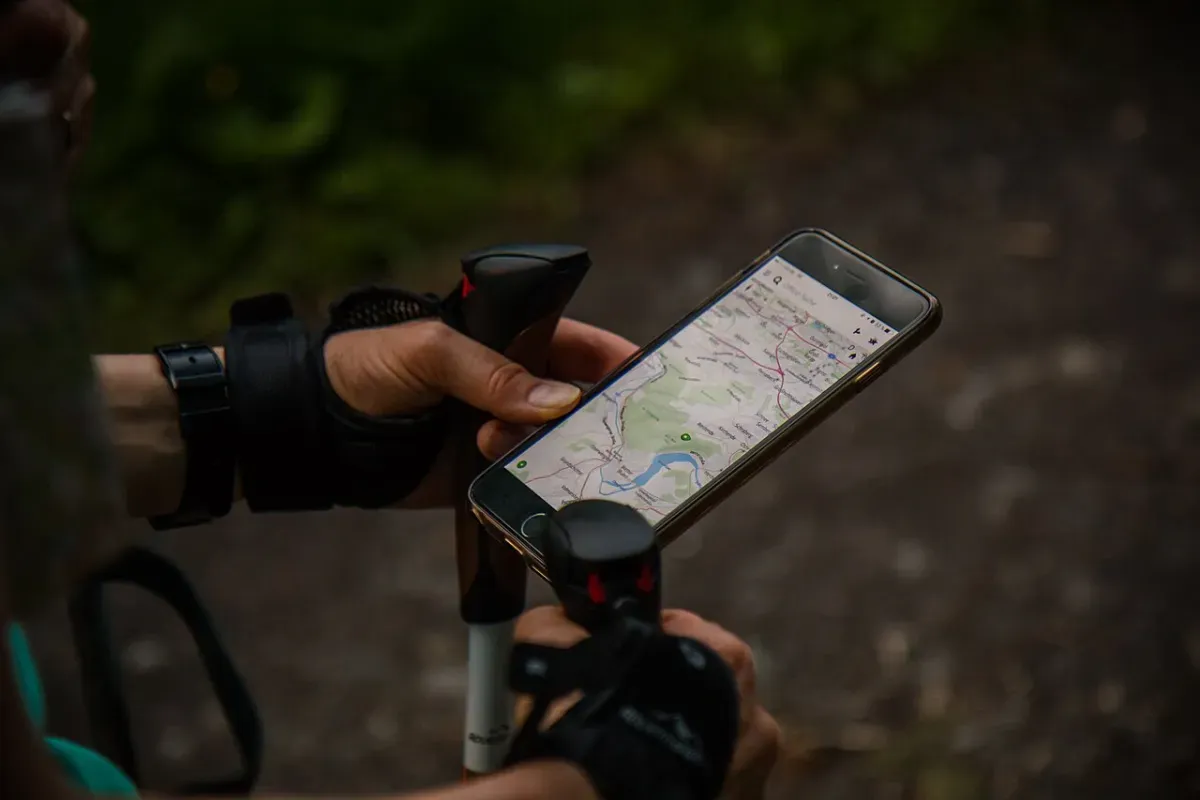 Photo: Antonio Grosz angro / Wikimedia Commons (CC0)
Map My Walk
Map My Walk provides a real-time GPS map of your route and the ability to save favorite walks (Map My Walk App Store listing). You get audio updates on your pace, distance, duration, and calories while you move. The app was updated in September 2026. The premium tier, called MVP, costs $6.99 to $9.99 a month or $29.99 to $39.99 a year on the US App Store and unlocks features like heart-rate zone analysis.
Strava
Strava is usually thought of as a running and cycling app, but it’s just as useful for walkers. The free tier lets you record activities, join a community, use safety features, try suggested routes, and view your training history (Strava subscribe page). Strava’s dedicated walking page highlights a walking route planner, a detailed breakdown of each walk, and encouragement from friends and other walkers on the platform (Strava walking page).
What stays free and what sits behind a paywall
Strava keeps the social feed and basic GPS recording completely free. If you want deeper tools, you have to pay. Strava’s subscription adds offline routes, drawing your own routes, advanced workout insights, custom goals, segment leaderboards, and creating challenges with friends. They offer a 30-day free trial so you can decide if those extra features actually change how often you walk.
Gamified walking apps: when steps need a story
Game mechanics can get people walking more, at least while the game is running. If you have trouble getting motivated on low-energy days, tying your steps to progress in a game can help.
Pikmin Bloom
Pikmin Bloom turns walking into a game (Pikmin Bloom App Store listing). Players grow and collect little creatures called Pikmin as they walk in the real world. You plant virtual flowers along the routes you walk and team up with friends to take down mushrooms. It integrates nicely with Apple HealthKit to count walking while the app is closed. It was updated in September 2026.
Zombies, Run!
Zombies, Run! places you in an audio story (Zombies, Run! App Store listing). You can try it for free or subscribe to unlock every mission. The official site describes it as an audio adventure heard through headphones during a workout, supporting outdoor, indoor, and treadmill tracking across iOS and Android (Zombies, Run! official site). The developer says it has 10 million users. Despite the name, it works anywhere and at any speed. You can jog in a park, walk a trail, use a treadmill, or work out in a wheelchair.
WalkScape (still in closed beta)
For fans of deep role-playing games, WalkScape is an upcoming option. The official site describes it as a game inspired by old-school MMORPGs where you gain progress by walking in real life (WalkScape official site). It features more than 15 skills to level up, alongside quests and a story campaign. The game is currently in Closed Beta. Access is limited to invited applicants and paying supporters; Patreon and Buy Me a Coffee supporters can start playing right away.
GPS and AR games beyond walking apps
These apps borrow the ideas covered in why game mechanics make exercise stick: points, levels, and a story that gives each walk a reason. If you enjoy Pikmin Bloom, there’s a whole world of GPS and AR games like Pokémon GO that use location data to turn your neighborhood into a giant game board.
Guided walking programs
 Photo: Jerónimo Roure / Wikimedia Commons (CC BY-SA 4.0)
Apple Fitness+ audio-guided walks
Apple Fitness+ provides guided sessions. The service costs $9.99 per month or $79.99 per year in the US, with a one-month free trial for new subscribers (Apple Fitness+ official page). You can use it with an iPhone 8 or later running iOS 16.1 or later without an Apple Watch. However, Apple lists exclusive audio-guided walks, runs, and meditations as a specific Apple Watch feature of the service. So if audio-guided walks are the reason you’re subscribing, you’ll need an Apple Watch.
Story-led audio walks
The Zombies, Run! missions function as story-led audio walks. The developer describes it as an audio adventure you hear through headphones, and the listing says it works at any speed, walking included, so you can listen without looking at the screen.
A free do-it-yourself walking plan
You don’t have to pay a subscription to follow a structured plan. The CDC states that adults need 150 minutes of moderate-intensity physical activity a week, such as brisk walking (CDC adult physical activity guidelines). They suggest breaking this down to 30 minutes a day, 5 days a week. You can build a free plan by setting a goal to increase your daily walking time by five or ten minutes until you hit that 150-minute threshold. A short walk after eating, especially after dinner, is an easy place to find those extra minutes.
How many steps actually matter? What the research says
 Photo: Rhoda Baer (Photographer) / Wikimedia Commons (Public domain)
The 10,000-step goal vs the data
A major 2022 meta-analysis in The Lancet Public Health looked closely at step counts and mortality. Paluch and colleagues pooled participant-level data from 15 international cohort studies covering 47,471 adults (Paluch et al. 2022, Lancet Public Health). There were 3,013 deaths over a median follow-up of 7.1 years. The authors point out that although 10,000 steps per day is widely promoted to have health benefits, there is little evidence to support this specific recommendation.
In the Paluch 2022 study, median daily steps by quartile were 3,553, 5,801, 7,842, and 10,901. People in the second, third, and top quartiles had a 40%, 45%, and 53% lower risk of death from any cause than the lowest quartile (hazard ratios 0.60, 0.55, and 0.47). Mortality risk decreased with more daily steps until about 6,000 to 8,000 steps per day among adults aged 60 and older. For adults younger than 60, the risk decreased until about 8,000 to 10,000 steps per day. The researchers describe this result as an association, noting that taking more steps per day was associated with a progressively lower risk of all-cause mortality up to a level that varied by age. This work was funded by the US Centers for Disease Control and Prevention.
The 7,000-step finding
More recent research points to an even more achievable target. A 2025 systematic review and dose-response meta-analysis led by Melody Ding at the University of Sydney included 57 studies from 35 cohorts in the review and 31 studies from 24 cohorts in its meta-analyses (Ding et al. 2025, Lancet Public Health). All studies used device-measured daily steps in prospective cohorts.
The Ding 2025 meta-analysis found that compared with 2,000 steps per day, 7,000 steps per day was associated with a 47% lower risk of all-cause mortality. Reaching 7,000 steps was also associated with a 25% lower risk of cardiovascular disease incidence, a 38% lower risk of dementia, a 22% lower risk of depressive symptoms, and a 28% lower risk of falls. The researchers found non-linear associations with inflection points at around 5,000 to 7,000 steps per day for all-cause mortality, cardiovascular disease incidence, dementia, and falls.
Ding 2025 rated the certainty of evidence as moderate for most outcomes, low for cardiovascular disease mortality, cancer incidence, and physical function, and very low for falls. The authors list limitations including the small number of studies for most outcomes, a lack of age-specific analysis, and biases at the individual study level including residual confounding. They conclude that although 10,000 steps per day can still be a viable target for those who are more active, 7,000 steps per day is associated with clinically meaningful improvements in health outcomes and might be a more realistic and achievable target for some. The University of Sydney’s release on the study notes that even small increases, such as going from 2,000 to 4,000 steps a day, are associated with significant health gain, and that beyond 7,000 steps the extra benefits for most outcomes studied were modest (University of Sydney news release, July 2025).
Do apps and games actually make people walk more?
In one large trial, a step game raised activity while it ran, and most of the gain faded once it stopped. The STEP UP trial was a 36-week randomized clinical trial with a 24-week intervention and a 12-week follow-up (Patel et al. 2019, JAMA Intern Med). It included 602 adults with a body mass index of 25 or higher from 40 US states. Participants established a baseline, selected a step-goal increase, and tracked daily steps with a wearable device. They were randomized to a control group or to support, collaboration, or competition gamification arms. The game used points and levels designed with insights from behavioral economics.
During the 24-week intervention, mean daily steps increased more than in controls by an adjusted 920 steps in the competition arm, 689 in the support arm, and 637 in the collaboration arm. However, during the 12-week follow-up when there was no game, physical activity dropped across all arms. Only the competition arm remained significantly above the control group (adjusted difference of 569 steps per day). The support and collaboration arms were no longer significantly above the control group.
Medical note: Step-count and mortality findings from Paluch 2022 and Ding 2025 come from observational prospective cohort data and describe associations. Ding 2025 notes possible residual confounding and rates the falls evidence as very low certainty. The STEP UP trial population consisted of adults with a body mass index of 25 or higher (mean age 39, 70.9% male), which limits generalization.
Getting more out of any walking app
Set your goal from your own baseline
Don’t pick 10,000 steps just because it’s the famous number. See what your average is. If you currently walk 3,000 steps a day, going straight to 10,000 is a big jump that’s hard to keep up: those 7,000 extra steps are close to three more miles for most people. Aim for small step-goal increases. Add 1,000 steps to your daily average and hold that for a few weeks before bumping it up again.
Add strength days to your walking week
Walking is fantastic cardiovascular exercise, but you need resistance training too. The CDC states that adults also need 2 days of muscle-strengthening activity each week (CDC adult physical activity guidelines). You can easily accomplish this with a leg workout at home using your body weight. Stronger legs can make longer walks feel easier. You should also take care of your lower legs if you increase your walking volume quickly. Basic calf stretches and stretches for heel and arch pain can relieve tightness in your feet and ankles. If you eventually decide to speed up and try jogging, look into a dynamic warm-up first.
When a paid plan is worth it
Before you agree to an annual subscription for a walking app, look at the feature checklist. Are you paying for GPS tracking that you could get for free elsewhere? Are you buying heart-rate analytics that you don’t actually understand how to use? A paid plan makes sense if it solves a specific problem for you. If a guided audio walk gets you off the couch on a rainy Tuesday, the subscription fee is money well spent. If you just want to know you hit 7,000 steps today, your phone handles the basics for free.
Frequently asked
- Do I need a smartwatch to track my steps accurately?
- You don't need a smartwatch to get a reliable step count. Modern smartphones use built-in motion sensors to track your steps with good accuracy, as long as you carry the phone with you. A watch adds extras like heart rate, but in a small 2015 treadmill test, phone apps counted steps about as accurately as wearables did.
- Is 10,000 steps a day really necessary for good health?
- Probably not. A 2025 meta-analysis of cohort studies found that 7,000 steps a day was associated with a 47% lower risk of death from any cause than 2,000 steps. The authors say 10,000 can still be a viable target for more active people, but 7,000 might be more realistic for some. Beyond 7,000, the extra benefits for most outcomes studied were modest. These are associations, not proof of cause.
- Are there completely free walking apps available?
- Yes. On iPhone, the built-in Fitness app counts steps from the phone's motion sensors at no cost. Pedometer++, Map My Walk, Pikmin Bloom, and Zombies, Run! are all free to download with in-app purchases, and Strava's free tier records walks. You only pay for extras like offline maps, heart-rate zone analysis, or guided audio walks.