Is Walking Good Exercise? What It Does and What It Misses

Yes, brisk walking is moderate-intensity aerobic exercise, and the Centers for Disease Control and Prevention names it as the standard example for the 150-minute weekly guideline. If you take a brisk 30-minute walk five days a week, you’ll meet the CDC’s aerobic target. A slow amble around the house is lighter than that and doesn’t count toward the aerobic goal. You have to move with enough purpose to raise your heart rate.
There’s an honest caveat to keep in mind before you rely on walking alone. Walking leaves two gaps. First, the CDC treats it as aerobic activity, and muscle strengthening is a separate target. Second, it involves less impact than a UK consensus recommends for bone strength in people with osteoporosis.
Walking is a good base to build on. You just need to know what it covers and where to add a little extra work.
Is walking good exercise? Yes, when the pace is brisk
What the guidelines actually count
The CDC states that adults need at least 150 minutes of moderate-intensity physical activity a week. You can spread this activity out over the week and break it into smaller chunks of time. The CDC’s own example is 30 minutes a day, five days a week. You could also choose to do 75 minutes of vigorous-intensity activity instead, or mix the two together in an equivalent combination. The page doesn’t set a minimum length for each chunk, and it adds that some physical activity is better than none. Every minute you spend moving with purpose adds up.
Where a stroll ends and exercise begins
To count toward that 150-minute goal, your effort needs to reach a certain threshold. The CDC defines moderate intensity as 3 to 5.9 metabolic equivalents (METs). For walking, the CDC’s example of moderate intensity is walking briskly, at 2.5 miles per hour or faster. A leisurely window-shopping trip falls below this mark. Vigorous intensity is 6.0 METs or more, and the CDC’s examples include jogging or running.
How to tell if your walk is brisk enough
The talk test
You don’t need a smartwatch to know if you’re walking hard enough. The most practical way to check your intensity is the talk test. During moderate-intensity activity, a person can talk but they can’t sing. If you pick up the pace to a vigorous effort, you won’t be able to say more than a few words without pausing for a breath. The talk test is much more useful day to day than any specific number. A steep hill or a strong headwind changes how hard you have to work to maintain the exact same speed.
The 0-10 effort scale
If you prefer to rate your exertion, the CDC uses a relative scale from 0 to 10. Sitting quietly is a zero, and 10 is your hardest possible effort. A moderate effort sits right in the middle at a 5 or a 6. A vigorous effort begins at a 7 or an 8. You can use this scale to quickly gauge whether you’re pushing yourself hard enough to count toward your weekly aerobic target.
Pace: 2.5 mph and up
If you’re on a treadmill or a flat track, you can measure your speed directly. At the CDC’s 2.5 mph floor, a mile takes 24 minutes. That’s a minimum, not a target, and our chart of how long it takes to walk a mile at a brisk pace shows how the minutes drop as you speed up. The CDC doesn’t give a walking speed for vigorous intensity.
Is walking enough exercise on its own?
For the aerobic guideline, it can be all you need
On this point, walking holds up. Hitting 150 minutes of brisk walking meets the CDC aerobic recommendation by itself. You don’t have to run or cycle to meet it.
Muscle strength is a separate target
The CDC describes muscle-strengthening activity as work for all the major muscle groups: legs, hips, back, abdomen, chest, shoulders and arms. A walk mostly loads the first two, and only lightly. Your legs certainly do work to move you forward, but they are enduring a light load for a long time rather than moving a heavy load for a few repetitions. You need to challenge your muscles on purpose.
 Photo: DiplomatTesterMan / Wikimedia Commons (CC BY-SA 4.0)
Bones respond to more impact than walking gives
Bone is a different story. A 2022 UK consensus statement on physical activity and exercise for osteoporosis, endorsed by the Royal Osteoporosis Society, notes that an aerobic target of 30 minutes a day, five days a week, “may not necessarily include exercise with sufficient gravitational loading to increase bone strength.”
For people with osteoporosis who do not have vertebral or multiple low-trauma fractures, the consensus recommends moderate impact exercise on most days. This means at least 50 impacts per session. They list jogging, hopping, stamping, and low-level jumping as examples. They also recommend muscle-strengthening exercise on two or three days of the week. These recommendations were written for people with osteoporosis, and several rest on expert consensus rather than trials, so they aren’t a tested prescription for healthy adults. What they do suggest is that walking alone may not load bone as much as jogging or hopping does.
A week that covers both targets
A week that meets both the aerobic and the strength targets is simple to build. Walk briskly for about 30 minutes on five days of the week. Then, add two short strength sessions on the remaining days. You can try a no-equipment leg workout at home using bodyweight squats and lunges. Add some push-ups against a sturdy bench or wall to hit your upper body.
How many steps a day make walking worthwhile?
What step counts from 47,471 adults showed
A 2022 meta-analysis published in The Lancet Public Health looked at 15 international cohorts to see how device-measured daily steps relate to death from any cause. The researchers pooled data on 47,471 adults, 3,013 of whom died during a median follow-up of 7.1 years. They divided the adults into four groups based on how much they walked. The median step counts for these groups were 3,553, 5,801, 7,842, and 10,901 steps per day.
Compared with the lowest quartile, the adjusted hazard ratios for death in the higher groups were 0.60, 0.55 and 0.47, meaning roughly 40, 45 and 53 percent lower risk of dying during follow-up. The most active quarter had about half the risk of the least active.
The benefit levels off sooner after 60
The benefits didn’t increase forever. Mortality risk declined as step counts rose, but it eventually leveled off. For adults aged 60 and older, the risk leveled out at about 6,000 to 8,000 steps a day. For adults under 60, the benefit maxed out at about 8,000 to 10,000 steps a day. If you’d rather think in distance, our guide to how many steps are in a mile turns these daily totals into miles.
Does walking faster add anything beyond steps?
The researchers also looked at how fast people walked. After adjusting for the total number of steps, the findings on stepping rate were mixed. People in the top quarter for peak 30-minute stepping rate had a hazard ratio of 0.67 compared with the bottom quarter, about a third lower risk. But time spent walking at 100 steps a minute or faster was not significantly linked to risk. The authors concluded that the evidence for intensity beyond total step volume is inconsistent.
We should read these findings with a few clear limits in mind. The study is observational, which means it shows an association but can’t prove cause and effect. It relied on a one-time measurement, typically just one week of tracking, and drew on cohorts mostly made up of White volunteers from high-income countries. And step counts from research monitors and consumer devices can vary by 20 percent or more, so treat the number on your watch or in one of the walking apps that count your steps and map your routes as an estimate rather than a perfect match for the study figures.
Walking vs running: which is better for your health?
Same energy, similar risk reductions
Researchers compared these two popular activities using data from the National Runners’ and Walkers’ Health Studies. They followed 33,060 runners and 15,945 walkers over 6.2 years. They found that each MET-hour a day of running (a MET-hour is a unit of energy spent that lets a slow and a fast activity be compared like for like) was linked to a 4.2 percent lower risk of new hypertension, a 4.3 percent lower risk of high cholesterol, a 12.1 percent lower risk of diabetes, and a 4.5 percent lower risk of coronary heart disease.
Equivalent energy spent walking was linked to 7.2, 7.0, 12.3 and 9.3 percent lower risk. The authors concluded that equal energy spent walking or running produced similar risk reductions for hypertension, high cholesterol, diabetes and possibly coronary heart disease. Walking’s numbers look larger, but the gaps were small and mostly not statistically significant, and the authors note the study had limited power to judge heart disease. The diagnoses were self-reported, and the design was observational using a convenience sample of volunteers.
The difference is time
The paper notes that runners can expend more calories in a given period of time, so a walker needs a longer session to reach the same energy dose.
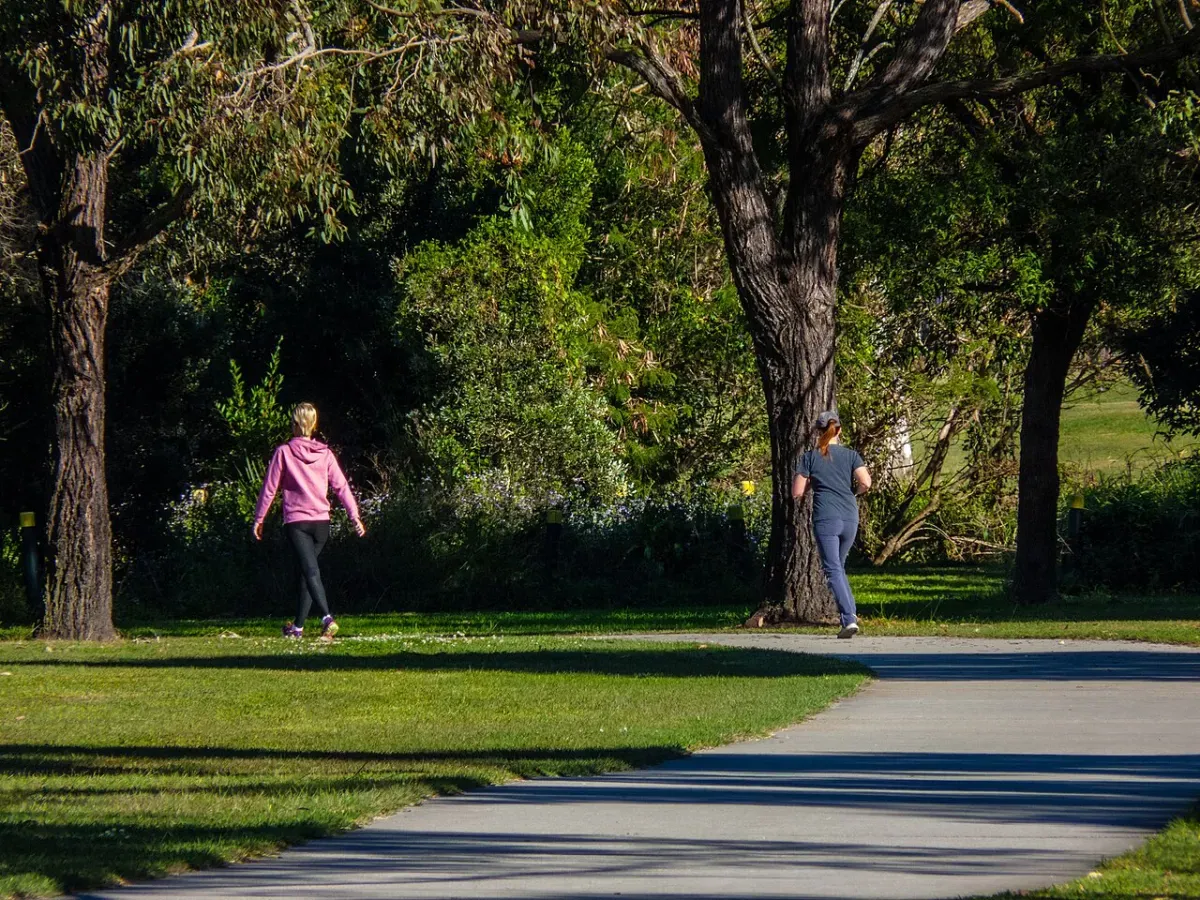 Photo: John Robert McPherson / Wikimedia Commons (CC BY-SA 4.0)
How to choose between them
The best exercise is the one you’ll actually repeat for years. Running adds the kind of impact the UK osteoporosis consensus recommends for bone, and it gets the same energy dose done faster. Walking is easier to fit into a commute, and you won’t need a shower when you arrive.
Is walking a good workout? How to make it harder
Add hills and stairs
Walking is easy to make harder. If a flat neighborhood loop starts to feel too easy, you have several ways to increase the challenge without ever breaking into a run. The most direct way to work harder is to walk uphill. Seek out local trails with elevation changes or incorporate public staircases into your route.
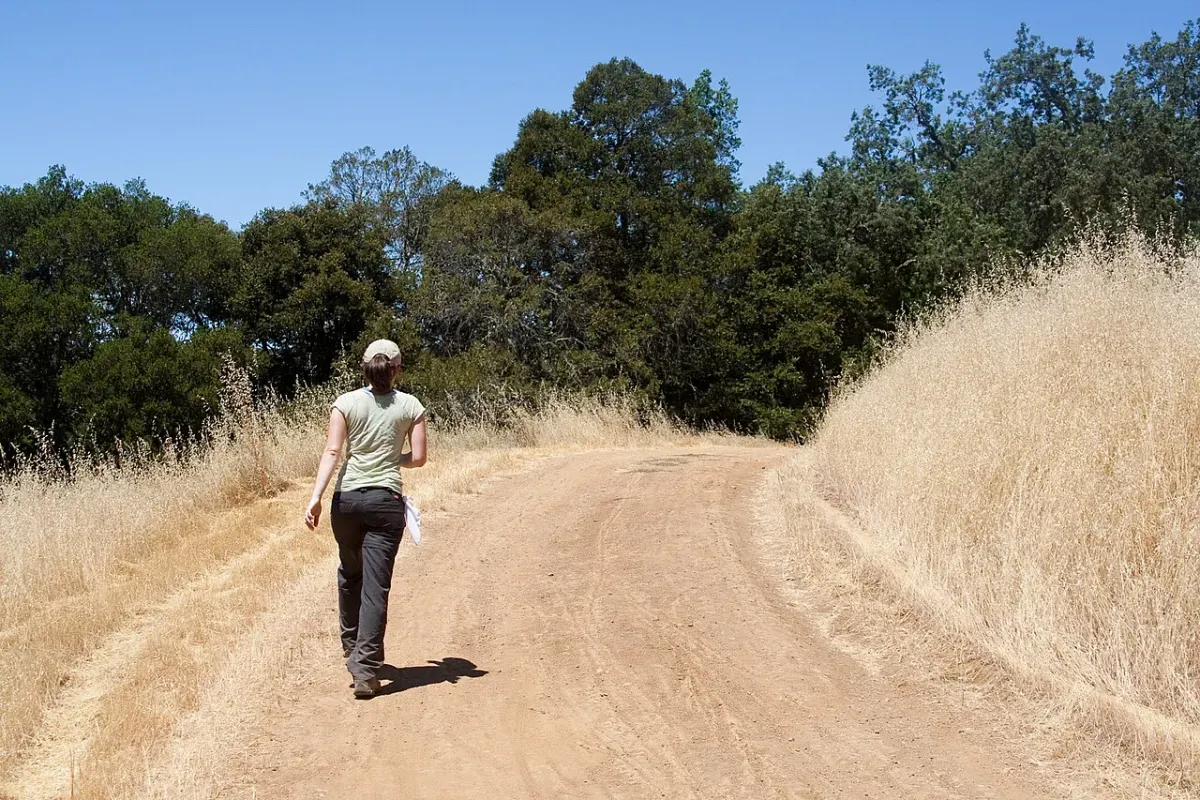 Photo: J Doll / Wikimedia Commons (CC BY 3.0)
You don’t need to measure the grade of the hill. Just use the talk test to confirm your effort rose. If you can suddenly only speak a few words before needing a breath, you’ve successfully pushed your body into a vigorous effort.
Try interval walking
You can also play with your speed. A four-month randomized trial published in Diabetes Care randomly assigned 32 adults with type 2 diabetes to no training, continuous walking or interval walking. Both walking groups trained five times a week for 60 minutes. The interval walkers alternated three minutes of fast walking above a set target with three minutes of slow walking below it. The training energy expenditure and mean intensity were comparable between the two walking groups.
Only the interval walkers improved their VO2max, a standard measure of aerobic fitness, raising it by 16.1 percent. Only the interval group lost body mass, fat mass, and visceral fat. Continuous walking did prevent the worsening of blood glucose seen in the non-exercising control group, but it didn’t improve their fitness.
This was a small trial, 12 people per walking group, in adults with type 2 diabetes who walked five hours a week, so it doesn’t show that healthy adults on shorter walks would get the same gains. Still, it’s an easy pattern to borrow. Try alternating three minutes of fast walking, where you can only get a few words out, with three minutes at an easy pace for part of your usual walk.
Short walks still count
You don’t have to do your walking all at once. The CDC specifically notes that activity can be broken into smaller chunks of time. A short walk after eating is an easy slot to fit in, and if you keep the pace brisk, those minutes count toward the weekly target. On busy days, exercise snacks, short bouts of activity spread through the day, add hard effort in a minute or so at a time, though they won’t fill 150 minutes on their own.
Build strength stops into your route
Finally, you can pause your walk to do some resistance work. Stop at a park bench to do incline push-ups or step-ups. Do a set of walking lunges across a stretch of grass. These basic additions help bridge the gap between aerobic exercise and muscle strengthening.
Who should check with a clinician first
Heart, lung, or blood sugar conditions
This article provides general information rather than medical advice. People with heart or lung disease, diabetes treated with glucose-lowering medication, joint pain, osteoporosis or a history of fractures should check with a clinician before adding fast intervals or impact exercise. You should always stop and seek care if you experience chest pain, faintness, or unusual breathlessness during a walk.
Osteoporosis, past fractures, or a high fall risk
The UK consensus on osteoporosis includes specific safety advice. For people with vertebral or multiple low-trauma fractures, the consensus advises keeping impact exercise up to the level of brisk walking. They suggest aiming for 150 minutes over the week, which is roughly 20 minutes a day. People at risk of falls should focus on strength and balance training before they increase their pace to brisk walking. The consensus notes there is some evidence that brisk walking actually increased fracture risk in a population already at risk of falls and fracture. If any of this applies to you, a physiotherapist or your doctor can help set the level.
For most people, then, the plan is simple. Brisk walking counts as moderate aerobic exercise, and the talk test tells you whether your pace is brisk. Add two days of strength work each week, and when your usual loop feels easy, find a hill or try three-minute intervals.
Frequently asked
- Is a 30-minute walk enough exercise for the day?
- Yes, a brisk 30-minute walk five days a week meets the CDC recommendation for 150 minutes of moderate aerobic activity. Just make sure your pace is fast enough that you can't easily sing while walking. You'll still need to add two days of muscle-strengthening exercises to your week.
- How fast is considered a brisk walk?
- The CDC defines brisk walking as a pace of 2.5 miles per hour or faster. A simple way to check your effort is the talk test. If you can talk but not sing, you're walking at a moderate, brisk pace.
- Does walking build muscle?
- Brisk walking counts toward the aerobic guideline, but the CDC treats muscle strengthening as a separate weekly target that walking doesn't meet. Your legs are doing light work for a long time rather than moving a heavy load. You need separate resistance exercises like squats or lunges to build and maintain muscle mass.