How Long Does It Take to Walk a Mile? Times by Pace and Age

A typical 3 mph walk covers a mile in 20 minutes. If you pick up the pace to a brisk 4 mph, you’ll finish that same mile in just 15 minutes. There isn’t a single universal target time you must hit. Your own comfortable pace matters far more than the average, and establishing a solid baseline gives you a reliable way to measure your fitness over time.
For a sense of what’s typical, a 2011 meta-analysis by Bohannon & Williams Andrews pooled 41 studies containing 23,111 apparently healthy adults. Researchers found that mean normal walking speeds ranged from about 3.2 mph for men in their forties down to about 2.1 mph for women aged 80 to 99. Translated into mile times, that’s a range from roughly 18 minutes and 42 seconds to 28 minutes and 27 seconds per mile. Participants were timed over short laboratory walkways of 3 to 30 meters, not a full measured mile, and the authors caution that their figures may not hold when people are timed from a standing start or on a course with a turn.
The CDC line for a brisk walk is lower: 2.5 mph, which takes 24 minutes to cover a mile. Whether you want to beat 20 minutes or just stay comfortably ahead of the 24-minute mark, knowing your current speed helps you set realistic goals.
How long it takes to walk a mile
At an everyday pace: about 20 minutes
Walking with purpose but not rushing, about 3 mph, gets you through a mile in 20 minutes. At this speed, you’ll likely feel comfortable enough to hold a full conversation the entire time.
At a brisk pace: 15 to 17 minutes
When you’re late for an appointment or walking specifically for fitness, your speed increases. Push to 3.5 to 4 mph, well above the CDC’s 2.5 mph brisk line, and a mile takes 15 to 17 minutes, three to five minutes faster than an everyday mile. Your arms will likely start swinging with more purpose. At 4 mph the young adults in a treadmill study averaged just over the CDC’s vigorous threshold, so expect conversation to shrink to a few words at a time.
At a slower or recovery pace: 24 to 30 minutes
Sometimes you just want to stroll through a park, or perhaps you’re recovering from a minor injury. Walking at 2 to 2.5 mph takes 24 to 30 minutes per mile. The top of that range already meets the CDC’s brisk line (about 3.4 METs in the treadmill data below), while 2 mph sits just under the moderate cut-off at about 2.9 METs.
Walking pace chart: mph to minutes per mile
Pace table from 2 to 5 mph
| Speed (mph) | Speed (km/h) | Time per mile | Avg cadence (steps/min)* | Avg METs* |
|---|---|---|---|---|
| 2.0 | 3.2 | 30:00 | 96 | 2.9 |
| 2.5 | 4.0 | 24:00 | 106 | 3.4 |
| 3.0 | 4.8 | 20:00 | 114 | 4.0 |
| 3.5 | 5.6 | 17:09 | 122 | 5.0 |
| 4.0 | 6.4 | 15:00 | 129 | 6.2 |
| 4.5 | 7.2 | 13:20 | - | - |
| 5.0 | 8.0 | 12:00 | - | - |
Cadence and METs are treadmill averages for adults aged 21 to 40 in Tudor-Locke et al. 2019. The 4.5 and 5 mph rows are blank because fewer than half the participants completed walking bouts at those speeds.
How to work out your own mile time
If you know your speed in miles per hour, you can find your mile time by dividing 60 by your mph. For example, a 3 mph walk means 60 divided by 3, giving you a 20-minute mile. You can also run the formula backwards. If it takes you 22 minutes to walk a mile, divide 60 by 22. That means you’re walking at about 2.7 mph. If you cover a mile in exactly 15 minutes, you divide 60 by 15 to get 4.0 mph.
How hard each pace is
Scientists measure the intensity of physical activity using Metabolic Equivalent of Task, or METs. The CDC defines activity that burns 3 to 5.9 METs as moderate intensity, and anything 6.0 METs or more as vigorous. In that treadmill study, 3 mph averaged 4.0 METs, firmly moderate. At 4 mph the average reached 6.2 METs, just over the vigorous line. Steps per mile change with your height and pace; see how many steps are in a mile.
What counts as a brisk walk?
The CDC line: 2.5 mph or faster
The CDC explicitly lists walking briskly at 2.5 miles per hour or faster as an example of moderate-intensity aerobic activity. At 2.5 mph, you’ll complete a mile in exactly 24 minutes. That same line decides whether walking counts as real exercise under the activity guidelines. They don’t give a specific mph value for vigorous walking.
The cadence check: about 100 steps a minute
You don’t need a smartwatch to check whether you’re walking briskly. A 2019 laboratory study by Tudor-Locke et al. looked at 76 healthy adults aged 21 to 40 doing five-minute treadmill bouts. Researchers hand-counted the cadences while measuring METs with a portable indirect calorimeter. They found that walking at 100 or more steps per minute corresponded to roughly 2.0 to 2.5 mph, hitting the study’s cut-off for moderate intensity (3 METs). Pushing to 130 steps per minute aligned with about 4.0 mph, reaching vigorous intensity at 6 METs.
To try this yourself, count your steps for 15 seconds and multiply by four. Keep in mind that this data comes from young adults on treadmills. The authors note that absolute intensity thresholds may not suit older or low-fitness adults, and any heuristic has limited precision for a single individual.
The talk test
The simplest way to gauge your effort requires no math at all. The CDC offers a simple rule of thumb called the talk test. During moderate-intensity activity, a person can talk but not sing. When you cross over into vigorous activity, you cannot say more than a few words without pausing for a breath.
Mile times by age
Typical times for each age group
 Photo: pasja1000 (Pixabay) / Wikimedia Commons (CC0)
Static-start testing gives slower numbers. When Bohannon & Wang timed 1,320 US adults aged 18 to 85, participants walked over a four-meter course from a static, standing start. The researchers found a mean usual speed of 1.12 meters per second, and a mean maximum speed of 1.61 meters per second. The fastest maximum-speed group was men aged 18 to 29 at 1.85 meters per second, which is about a 14:30 mile. Here is that usual pace converted to a mile time. These are 4-meter, standing-start speeds stretched out to a mile, not timed miles:
| Age | Men usual speed | Men time per mile | Women usual speed | Women time per mile |
|---|---|---|---|---|
| 18-29 | 1.18 m/s (2.6 mph) | 22:44 | 1.11 m/s (2.5 mph) | 24:10 |
| 30-39 | 1.21 (2.7) | 22:10 | 1.15 (2.6) | 23:19 |
| 40-49 | 1.21 (2.7) | 22:10 | 1.14 (2.6) | 23:32 |
| 50-59 | 1.16 (2.6) | 23:07 | 1.15 (2.6) | 23:19 |
| 60-69 | 1.16 (2.6) | 23:07 | 1.05 (2.3) | 25:33 |
| 70-79 | 1.07 (2.4) | 25:04 | 0.99 (2.2) | 27:06 |
| 80-85 | 0.97 (2.2) | 27:39 | 0.95 (2.1) | 28:14 |
Usual pace over 4 meters from a standing start (NIH Toolbox), converted to minutes per mile. A continuous walk is usually faster.
Why age charts disagree
You might notice these times are slower than the 20-minute mile we discussed earlier. Bohannon and Wang note that dynamic starts, where you’re already walking before the timer begins, are associated with higher gait speeds than static starts. When you start from a dead stop, you lose time accelerating your body mass. For example, men aged 70 to 79 averaged 1.07 meters per second in this study, versus 1.26 meters per second for the same age group in the 2011 meta-analysis mentioned above, which drew mainly on dynamic-start studies.
Treat these times as conservative; the same people would likely clock a faster continuous mile. In this cross-sectional data, average speed barely changes from the 20s to the 50s. The clearest drops appear in the sixties for women and the seventies for men. Rather than measuring yourself against a chart, compare your current pace with your own earlier times.
Men and women
The study found that speed differed significantly by sex and age group. Men were slightly faster on average across the different age brackets. The gap was widest in the 60s, where men averaged 1.16 meters per second (about a 23:07 mile) and women 1.05 (about 25:33), and almost nil in the 50s (1.16 vs 1.15).
Walking speed as a health signal
What the big pooled study found in adults over 65
A 2011 pooled analysis by Studenski et al. in JAMA looked at nine cohorts with 34,485 community-dwelling adults aged 65 and older. Participants were timed from a standing start over courses ranging from eight feet to six meters. Each 0.1 meter per second faster usual gait speed was associated with a lower risk of death (hazard ratio 0.88). People walking at about 0.8 meters per second had roughly the median predicted life expectancy for their age and sex. The authors tentatively suggested that walking faster than 1.0 meter per second may indicate better-than-average life expectancy, though they noted this needs more research.
What it does and doesn’t mean for you
The study was observational, so it can’t show that walking faster causes a longer life. This research also only involved older adults taking short walk tests, not holding a full mile pace. A slow mile time isn’t a diagnosis on its own, and some slowing with age is normal.
Treadmill vs outdoors: why your mile time differs
People choose a slower pace on a treadmill
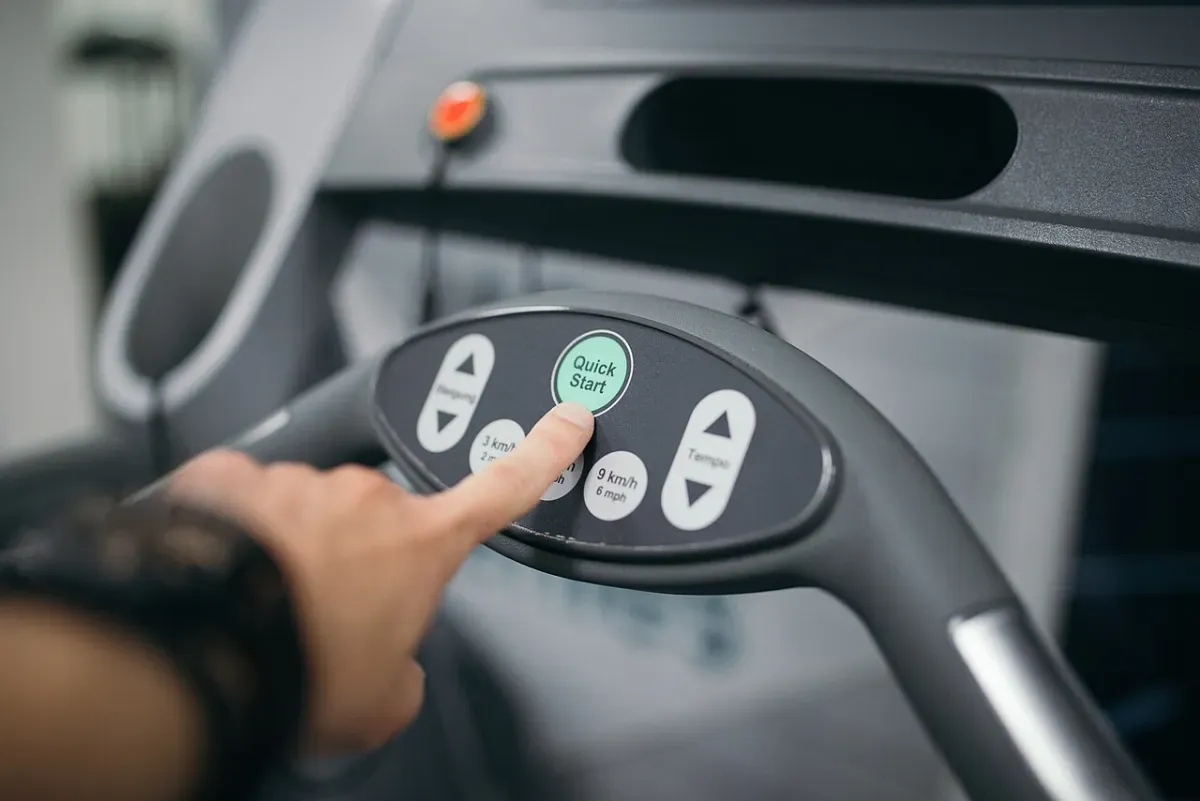 Photo: Shixart1985 / Wikimedia Commons (CC BY 2.0)
Most people walk a little slower on a treadmill than on solid ground. In a 2017 comparison, Malatesta et al. tested 25 older adults aged 66 to 80 and 20 young adults aged 20 to 30. All were physically active. After a familiarization period, participants picked a preferred speed overground that was significantly faster than on the treadmill. Older adults walked 1.45 meters per second overground versus 1.31 on the belt (roughly an 18:30 versus 20:29 mile). Young adults chose 1.37 versus 1.25 (about 19:35 versus 21:27).
The researchers observed small safety-related gait changes during treadmill walking. Participants spent about 1 percent longer in the stance phase and the double-support phase, which is when both feet are touching the belt. They also had a shorter swing time. This was a small group of fit, active adults, so the gap may be bigger or smaller for you.
Matching the treadmill to your outdoor pace
To get a true reflection of your natural speed, time an outdoor mile first. Once you know your overground mph, you can manually set the treadmill console to that exact number using the pace chart. If that speed feels unsteady on the belt, start a little below it and work up over a few sessions.
Timing a mile on a track or with your phone
 Photo: Mr Thinktank from Östersund, Sweden / Wikimedia Commons (CC BY 2.0)
You have a few straightforward options for tracking your distance. You can use walking apps that record your pace and distance with GPS on your phone. These apps handle the math for you, updating your minutes per mile as you walk. If you prefer a measured route without technology, head to a local running track. Four laps of the inside lane on a standard 400-meter track is 1,600 meters. That puts you just a few meters short of a true 1,609-meter mile. Walking on a track provides a flat, predictable surface free of traffic lights and uneven sidewalks. This controlled environment makes it much easier to hold a steady pace and get an accurate baseline time.
How to walk a faster mile safely
Quicken your steps before lengthening them
When people try to walk faster, many reach for longer strides. In the pace table above, cadence rose steadily with speed, so a quicker step count is a practical cue. Pick up the tempo of your feet and let your stride length follow. You can practice this by counting your steps for brief stretches and trying to add just a few extra steps per minute.
Add short brisk intervals
You don’t need to sustain a high speed for a full mile immediately. Try adding short brisk intervals inside a normal walk. Speed up to a vigorous pace for a minute, then recover at your everyday speed. You might start by walking briskly for one block, then recovering for two blocks. Over time, you can shorten the recovery blocks until you hold the faster pace for the entire distance. Keep these intervals for a separate walk. A walk after eating works best at an easy pace, but it’s a simple way to add distance to your day.
Build up gradually
If your shins ache when you speed up, you need to ease off. Ramping up your training load too quickly often leads to discomfort, so take time to look into shin splint stretches and rest. People with a heart or lung condition, recent surgery, joint problems or balance concerns should check with a clinician before pushing their pace. Stop and get medical help for chest pain, fainting, or breathlessness that is out of proportion to the effort.
Retest once a month
Revisit the exact same route every four weeks. Log the time in a notebook or on your phone so you can track your progress clearly. Walking into a strong headwind or navigating icy sidewalks will slow you down, so try to keep the conditions consistent for your test walks.
The bottom line on your mile time
Pick a target pace, not a target age
For most healthy adults, 20 minutes is a solid everyday mile. A 15-minute mile is a fast walk that sits right around the vigorous line. If you’re just starting out, a realistic first goal is the CDC’s 2.5 mph brisk floor, bringing you across the mile mark in 24 minutes. Compare your times against your own baseline rather than stressing over age brackets.
When a slow mile is worth mentioning to a doctor
A sudden, unexplained slowdown in your walking speed is worth raising with a clinician. The same applies if you experience falls or find yourself repeatedly needing to stop and rest before finishing a mile. Some slowing with age is normal, but abrupt changes warrant a professional opinion.
Frequently asked
- How long does it take a senior to walk a mile?
- In a US study of 1,320 adults timed over 4 meters from a standing start, average usual pace worked out to about 23 to 25.5 minutes per mile in the 60s, 25 to 27 minutes in the 70s, and 27.5 to 28 minutes at ages 80 to 85. A continuous walk is usually a little faster than these short-test figures.
- Is a 15 minute mile walking fast?
- Yes. A 15-minute mile means walking at 4 mph. In a treadmill study of adults aged 21 to 40 that pace averaged 6.2 METs, just over the CDC's vigorous threshold of 6, so most walkers can say only a few words at a time without pausing for breath.
- Does walking a mile count as a workout?
- It does if the pace is brisk. The CDC counts walking at 2.5 mph or faster as moderate-intensity aerobic activity, so a mile in 24 minutes or less qualifies. A 20-minute mile at 3 mph averaged 4.0 METs in a treadmill study of young adults, well inside the moderate range.