Leg Workout at Home: Build Real Legs, No Equipment
Legs are the body part beginners undertrain the most at home, and it’s not because legs are hard to train without equipment. It’s because legs are easy to fake. A shallow squat feels like a squat. A few half-depth reps feel like a set. Then a month goes by and nothing has changed below the waist.
You can build real legs at home with nothing but the floor and a chair. The trick isn’t a secret exercise, it’s loading one leg at a time and refusing to cut the range short. Here’s how to map the muscles, do the movements properly, and keep making them harder so your legs actually grow.
The short answer
Do bodyweight squats, lunges, and split squats two or three times a week, go to a depth that feels uncomfortable, and shift toward single-leg work as you get stronger. That’s the entire plan.
The reason it works without weights comes down to one idea: a movement only has to be hard enough to challenge the muscle, and you control difficulty with leverage, not iron. Standing on one leg roughly doubles the load that leg carries. Slowing a rep down or pausing at the bottom keeps the muscle under tension longer. A backpack full of books adds weight in a pinch. None of that needs a gym.
Start each exercise at a version you can do for 8 to 15 honest reps, stop a rep or two short of failure, and move to a harder variation when the easy one stops feeling like work. Everything below is the detail on how.
What your legs actually are
“Leg day” hides four different muscle groups, and a good home routine touches all of them. Skip one and you get the imbalanced look most home trainees end up with: okay quads, neglected everything else. Heavy quad work also tightens the front of the thigh, so pair it with quad stretches on the days in between.
- Quadriceps sit on the front of your thigh and straighten the knee. Squats, lunges, and step-ups hammer them, which is why they’re the part people accidentally over-favour at home.
- Hamstrings run down the back of your thigh and bend the knee and extend the hip. They’re the most undertrained muscle in bodyweight leg work because squats barely touch them. You have to train them on purpose with bridges and single-leg hinges.
- Glutes (gluteus maximus and the smaller medius and minimus) extend and stabilise the hip. They drive you out of the bottom of a deep squat and out of a lunge. Depth matters here a lot, which we’ll get to.
- Calves (gastrocnemius and soleus) point the foot down and carry you through every step. One movement covers them: the calf raise.
A useful detail from the research: squat depth changes which of these you build. In a 10-week study comparing full squats to half squats in untrained men, the deep-squat group grew their glutes and adductors significantly more, while the quads grew about the same in both groups (Kubo, Ikebukuro & Yata, 2019). The takeaway for home training is blunt: half-squatting still builds your quads, but if you want glutes, you have to go deep.
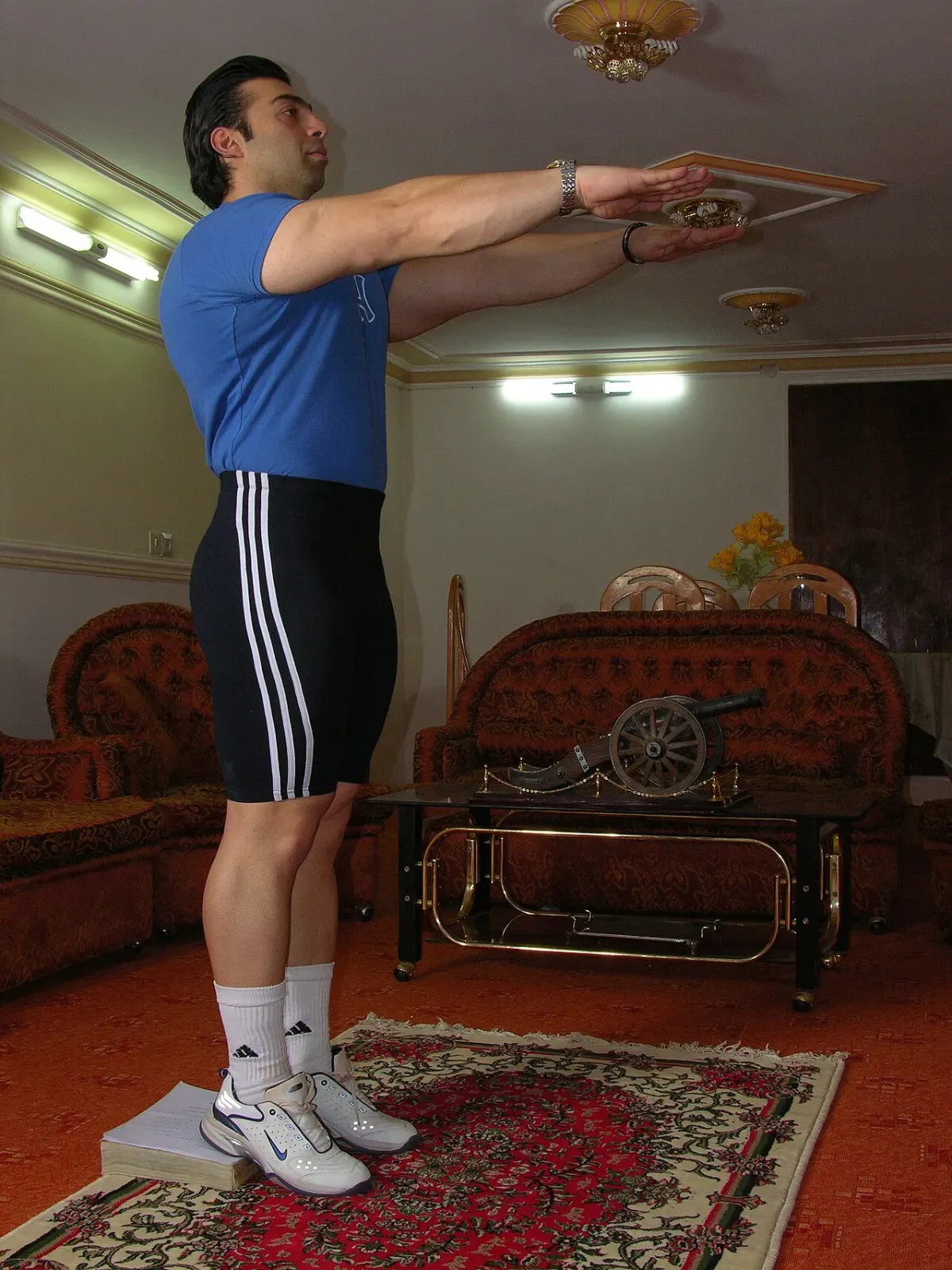
How to do a bodyweight squat
The squat is the base of every leg workout at home, and most people’s version is too shallow to do much. Fix the depth and you’ve fixed most of the problem.
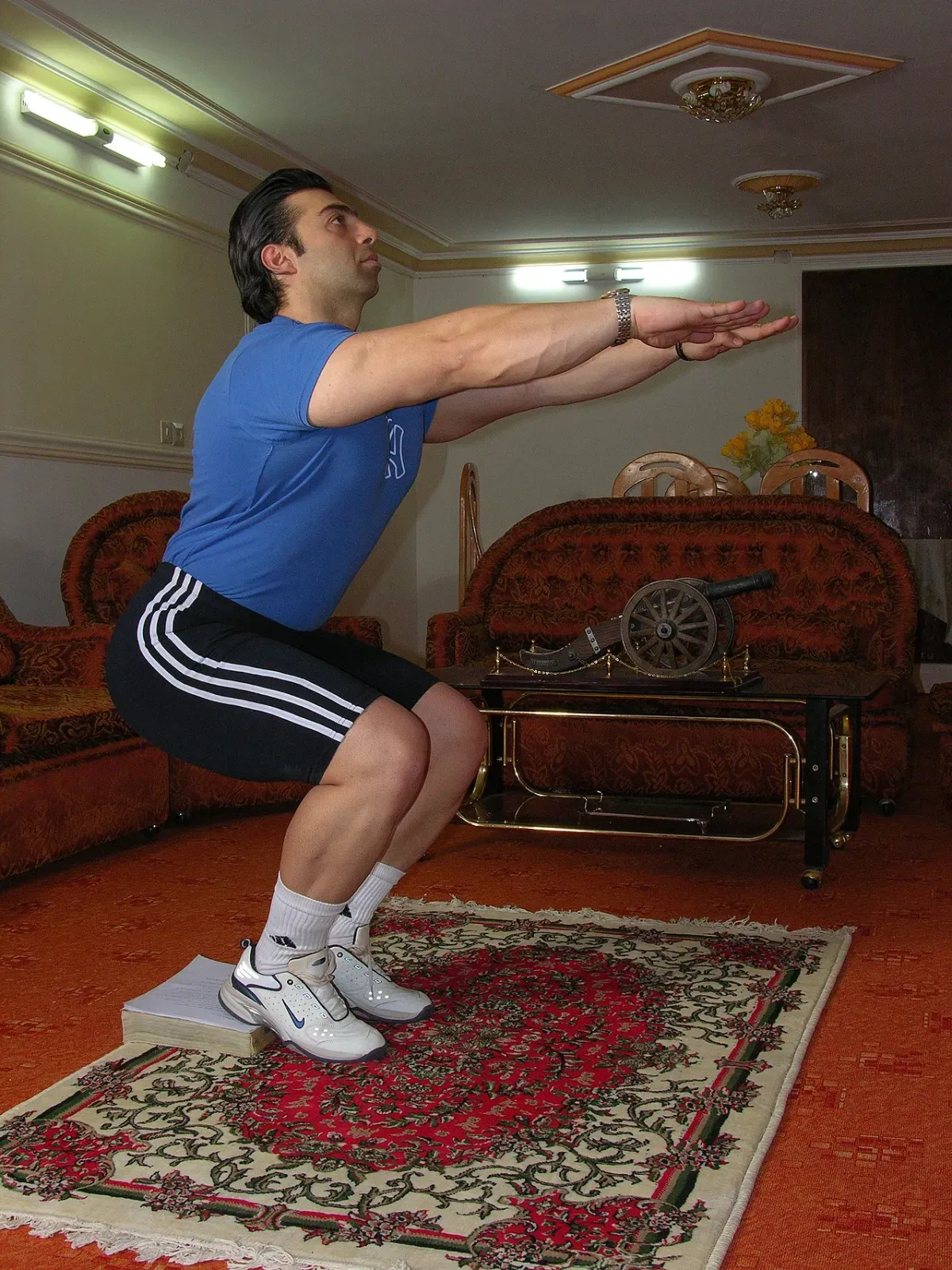 Photo by Mahdi Mousavi via Wikimedia Commons (CC BY-SA 4.0)
- Stand with feet about shoulder-width apart, toes turned out slightly, maybe 15 to 30 degrees.
- Brace your abs and take a breath. Reach your arms forward as a counterweight.
- Sit down and back as if lowering onto a low stool, pushing your knees out over your toes, not letting them collapse inward.
- Go below parallel. Your hip crease should drop below the top of your knee. This is the part everyone skips. If you can’t get there yet without your heels lifting or your lower back rounding, that’s an ankle or hip mobility limit, and squatting to your honest depth daily will improve it.
- Drive up through your whole foot, squeezing your glutes at the top.
If 20 bodyweight squats feel easy, you don’t need more reps. You need a harder variation. Adding reps past 15 to 20 mostly builds endurance, not size. The list below is how you keep adding difficulty without ever touching a weight.
Bodyweight leg exercises, easiest to hardest
Think of these as rungs on a ladder. Start where 8 to 15 clean reps is genuinely hard, and climb when it stops being hard.
Bodyweight squat
The starting point above. Master the depth here before you load one leg, because every harder move is just a squat or lunge on a worse leverage.
Reverse lunge
Step one foot back and drop the back knee toward the floor, keeping most of your weight on the front foot. Reverse lunges are kinder to the knees than forward lunges and easier to balance, which makes them the right first step into single-leg work. Do all reps on one leg, then switch, or alternate. Either way, the front leg is doing the job.
Split squat
Set up in a stationary lunge stance, front foot flat, back foot on its toes, and move straight up and down without stepping. Removing the step lets you focus on the working leg through a full range. This is where bodyweight starts feeling heavy, because one leg now carries what two used to share.
Bulgarian split squat
The single most useful bodyweight leg exercise, and the one I’d keep if I could keep only one. Put the top of your back foot on a chair, couch, or low bed behind you, then lower the front leg deep. With your rear foot elevated, the front leg takes nearly all the load through a long range, so your own bodyweight finally feels like a real set. It trains the quads, glutes, and hamstrings of the front leg together; in EMG work the hamstrings actually fire harder in the Bulgarian split squat than in a back squat. Expect to wobble at first. That balance demand is part of the training.
Step-up
Find a sturdy knee-height surface (a solid chair, a low table, a staircase) and step up onto it with one leg, driving through that heel without pushing off the floor leg. Step-ups carry over well to real strength: in a study where one group trained only step-ups and another only back squats, both built strength that transferred to the exercise they hadn’t trained, and the step-up group even held an edge on their own movement (Appleby, Cormack & Newton, 2019). The lesson is that single-leg bodyweight work is its own legitimate path to strength, not a poor substitute for the barbell.
Single-leg glute bridge
This is the hamstring and glute exercise the squat-heavy routines forget. Lie on your back, one foot flat on the floor with the knee bent, the other leg lifted. Drive through the heel of the planted foot to lift your hips until your body is a straight line from shoulder to knee, squeeze the glute hard at the top, then lower. One leg at a time turns an easy floor exercise into a hard one. Train this every leg day or your hamstrings will lag.
Wall sit
Slide your back down a wall until your thighs are parallel to the floor, then hold. There are no reps, just time. The wall sit is a static quad and glute exercise that’s brutal on a tired session and useful as a finisher. Start with 30 seconds and build toward a couple of minutes.
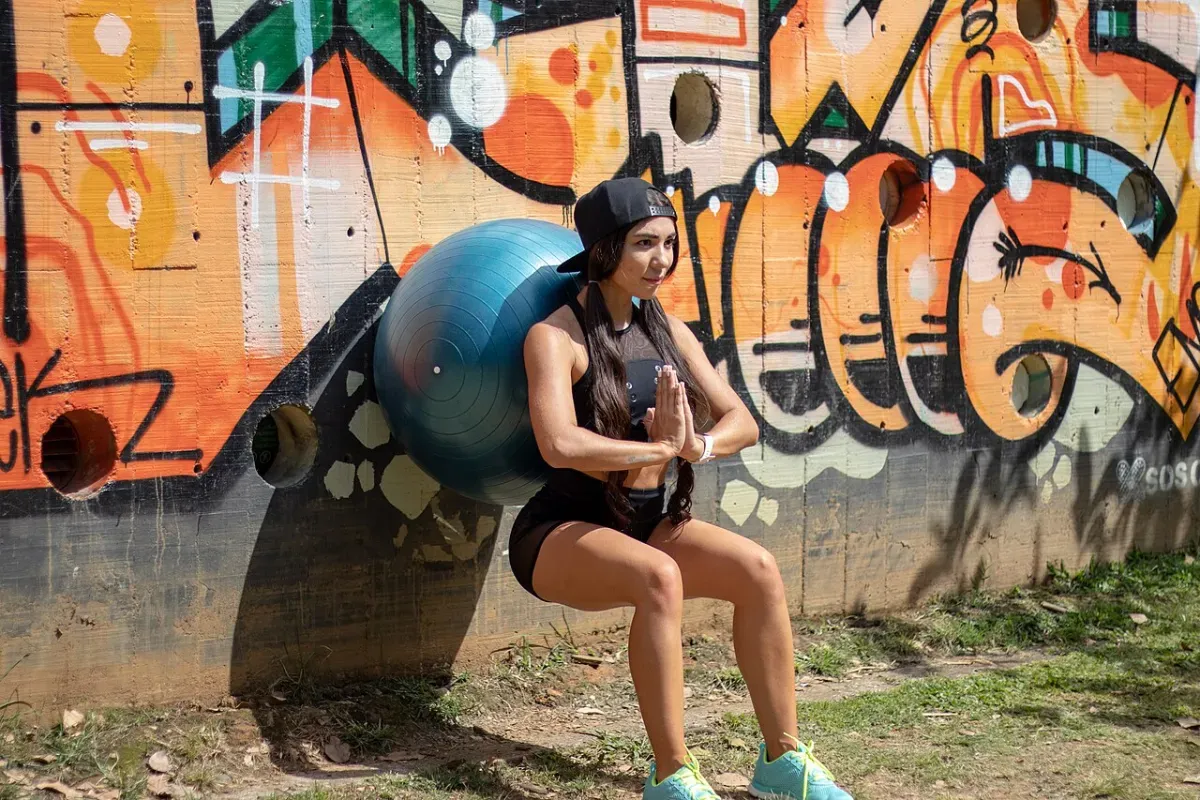 Photo by Tyler Read via Wikimedia Commons (CC BY 2.0)
Calf raise
Stand on the edge of a step with your heels hanging off, rise onto your toes as high as you can, pause, then lower your heels below the step for a full stretch. Do them on one leg once two-leg raises get easy. Calves take a lot of reps, so 15 to 25 per set is normal.
Pistol squat progression
The pistol, a full one-leg squat, is the high end of bodyweight leg training, and you reach it in steps rather than all at once. Work the progression in this order: box squats to a chair on one leg, then to a lower surface, then assisted pistols holding a doorframe, then the free pistol. It demands serious quad strength, ankle mobility, and balance. Treat it as a long-term goal, not a week-one move.
How to load your legs without any weights
This is the part that decides whether your legs keep growing or stall in month two. Without dumbbells, you make a bodyweight exercise harder four ways:
- Go single-leg. The biggest lever you have. Splitting your weight onto one leg roughly doubles its load, which is why the progression above marches steadily from two legs to one. This is the cheat code for home leg training, full stop.
- Slow the tempo. Take three or four seconds to lower into each rep and pause at the bottom. More time under tension means more work without a single extra pound. A slow-tempo squat you’ve outgrown becomes hard again instantly.
- Add pauses. Stop and hold for two seconds at the hardest point, the bottom of a split squat or the top of a glute bridge. Pauses kill the bounce that momentum gives you and force the muscle to do the lifting.
- Load a backpack. When single-leg and tempo aren’t enough, fill a backpack with books or water bottles and wear it. It’s a free, adjustable weight vest, and it extends bodyweight training a long way before you’d need actual equipment.
You don’t need all four at once. Climb the exercise ladder first, then layer tempo and pauses, then reach for the backpack when even Bulgarian split squats stop being hard.
A simple weekly leg plan
Train legs two or three times a week, never on back-to-back days. Muscle is built during recovery, and the WHO’s physical activity guidance counts muscle-strengthening work among the activities that benefit everyone, recommending it on two or more days a week (WHO, physical activity fact sheet). Two honest leg sessions clears that bar.
Here’s a beginner-to-intermediate week you can run in a living room:
- Day 1 (squat focus): Bodyweight squats, 4 sets of 10 to 15. Reverse lunges, 3 sets of 8 to 10 per leg. Single-leg glute bridge, 3 sets of 10 per leg. Calf raises, 3 sets of 20.
- Day 2 (rest or upper body): Train another area or walk. Our chest workout at home and shoulder workout at home guides slot in cleanly on leg rest days.
- Day 3 (single-leg focus): Bulgarian split squats, 4 sets of 8 per leg. Step-ups, 3 sets of 10 per leg. Wall sit, 3 holds to near-failure. Single-leg calf raises, 3 sets.
- Day 4 (rest).
- Day 5 (optional mix): Pick the two moves that felt weakest and do 4 sets of each, slow tempo.
When a set starts feeling easy at the top of its rep range, climb a rung on the ladder or slow the tempo down rather than just piling on reps. Your legs don’t grow because you did 50 squats. They grow because the squats were hard. If you’re adding ab and glute work, our ab workout at home and booty workout at home routines pair well with a leg day.
Common mistakes
A few errors quietly cancel out most home leg training. Fix these before anything else.
- Shallow squats. This is the big one. A quarter-squat trains almost nothing in your glutes and barely stretches the quads. The depth research is clear that deeper squats build the glutes and adductors more (Kubo, Ikebukuro & Yata, 2019). Get your hips below your knees every rep, even if that means fewer reps or an easier variation.
- Knees caving inward. When your knees collapse toward each other at the bottom of a squat or lunge, you’re leaking force and stressing the joint. Cue yourself to push your knees out, tracking over your toes. Weak glute medius is usually the culprit, and single-leg work fixes it.
- Ignoring the back of your legs. Squats and lunges are quad-and-glute dominant and leave the hamstrings nearly untouched. In the Kubo study, even full squats produced no measurable hamstring growth at all. If your only leg work is squatting, your hamstrings will lag and your knees won’t thank you. Glute bridges and single-leg hinges are not optional.
- Living on two legs. Doing endless two-leg squats and never progressing to single-leg work is why people decide bodyweight legs “don’t grow.” The load is just too light once you’re trained. Single-leg variations are how you keep the weight heavy without weights.
- Skipping calves entirely. Calves are stubborn and dull to train, so they get dropped. They need volume and a full stretch at the bottom. Two sets at the end of each session is the minimum.
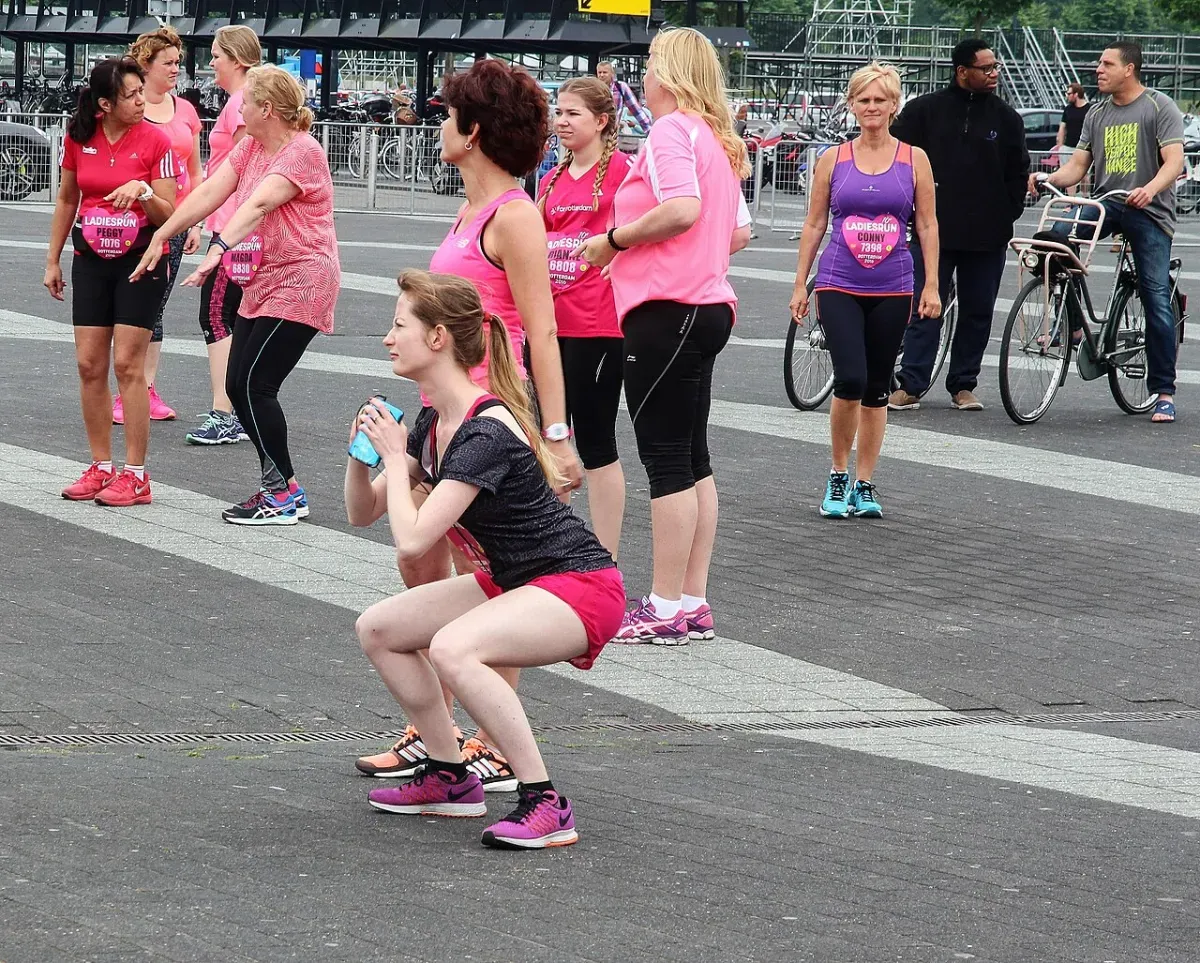 Photo by Peter van der Sluijs via Wikimedia Commons (CC BY-SA 4.0)
Keep showing up on the days you don’t feel like it
The exercises are the easy part. The hard part is doing a single-leg session on a Tuesday when your quads remember last time and nothing is forcing you onto the floor. Legs are also the body part where progress is slowest to see in the mirror, which makes them the easiest to quietly abandon. Consistency, not a perfect routine, is what separates the people who build legs at home from the people who stop in week three.
On the days motivation runs thin, the trick is to shrink the decision: fifteen minutes of split squats is the whole session, and getting onto the floor at all is usually the hardest part. If getting started is the real problem, our guide on how to motivate yourself to work out digs into why a small daily nudge beats waiting to feel inspired, and our stretching for beginners piece helps with the mobility that deep squats demand.
Pick the hardest squat variation you can do clean today, train one leg at a time, and put it back on the calendar two days out. Your legs do the rest.
Frequently asked
- Can you build leg muscle at home without weights?
- Yes, especially in your first year of training. Bodyweight squats, lunges, split squats, and single-leg work all create enough tension to grow muscle, and you keep progressing by moving to single-leg versions, slowing the tempo, adding pauses, or loading a backpack. Just remember that legs are easy to half-rep at home, so depth and honest effort matter more than the exercise list.
- How often should I train legs at home?
- Two to three sessions a week, with at least a day of rest between them. Legs recover well and respond to frequency, but the growth happens during the rest days, so back-to-back leg sessions usually leave you sore without adding stimulus. Two focused sessions is plenty for most people building legs at home.
- What is the best bodyweight exercise for legs at home?
- There is no single best one, but the Bulgarian split squat covers the most ground. It loads one leg at a time through a deep range, which lets your bodyweight feel heavy without any equipment, and it hits the quads, glutes, and hamstrings in one movement. Pair it with a hamstring exercise like a single-leg glute bridge and you have most of the leg covered.