Tai Chi Walking: What It Is, Does It Work, How to Start
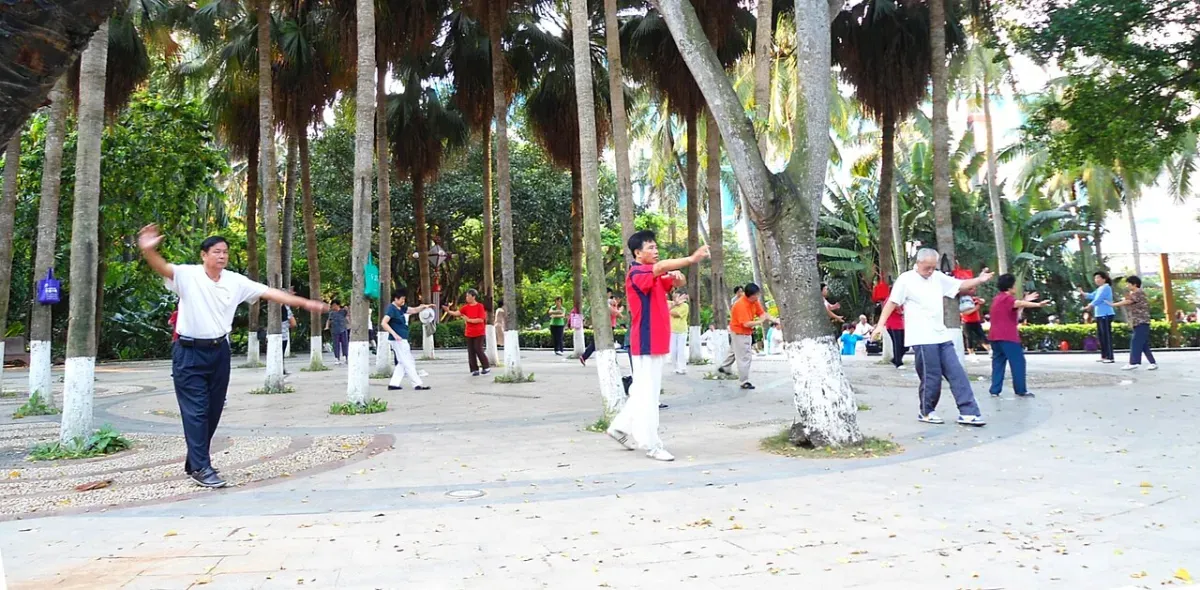
Tai chi walking is the slow stepping drill extracted from traditional tai chi forms. You do it slowly, about three to five seconds per step. You can do it forward, sideways or backward in a hallway or on a garden path. When you take a regular walk, you use forward momentum to carry you into the next step. Tai chi walking waits until your body weight is fully resting on the front leg before the back foot moves at all.
It has recently gained traction under the name “tai chi indoor walking” across YouTube and mobile app stores. Those are usually short follow-along videos designed for small spaces. This article covers both meanings: the traditional drill and the video genre that borrowed its name.
Moving this slowly is harder than it sounds. With the arm movements stripped away, all that is left to think about is your base of support. You learn exactly where your center of gravity sits over your feet.
What tai chi walking actually is
The footwork of tai chi, taken out of the form
A complete traditional tai chi form can take up to a year to learn. According to a guide from Harvard Health, tai chi walking isolates the footwork component of these longer forms. It gives you a practical way to get the lower-body benefits of the practice without needing to memorize a long sequence of arm movements, weight shifts and complex turns.
Why it became a 2026 trend
Much of the current interest comes from “tai chi indoor walking” follow-along videos and from “Tai Chi Walking” apps on the App Store that sell 28-day plans starting at five minutes a day. The appeal is simple: a gentle, low-impact routine you can follow in a living room, with no treadmill and no backyard. None of this changes what the drill is. The apps package the same slow steps described below.
How it differs from a normal walk: full weight transfer before each step
The difference comes down to momentum and control. Physiotherapist Rebecca Bossick explains in the Irish Examiner that regular walking relies heavily on momentum. Each step naturally carries you forward as the other foot swings into place. Tai chi walking removes that momentum entirely. You must control your balance on a single leg while you slowly place the other foot on the ground.
Does tai chi walking really work? What the evidence says
The honest caveat: the trials studied full tai chi programs
There is no randomized controlled trial of tai chi walking as a standalone daily practice. The Harvard Health article cites no specific study for the walking drill itself. The Tai Chi for Health Institute openly admits that the solo walking drill is not yet fully supported by clinical studies. The step-and-weight-shift drill is one component of the full programs tested below, so it plausibly accounts for some share of the benefit. That share is unproven. Every number in this section comes from instructor-led tai chi classes, not from people walking slowly down a hallway on their own.
Falls and balance in older adults
The strongest clinical evidence for tai chi involves fall prevention. A 2019 Cochrane Database of Systematic Reviews paper looked at 108 trials involving 23,407 community-dwelling people aged 60 and older (mean age 76). The researchers found that exercise of all types reduces the rate of falls by 23 percent. Balance and functional exercise cuts the rate by 24 percent. Tai chi specifically may reduce the rate of falls by 19 percent (the review rated this low-certainty evidence), and it lowers the number of people who fall by 20 percent (high certainty). The review was uncertain about the effect of plain walking programs on falls.
A 2018 randomized trial in JAMA Internal Medicine followed 670 community-dwelling adults aged 70 and older who had fallen in the past year or had impaired mobility. They attended two 60-minute therapeutic tai chi classes a week for 24 weeks. This instructor-led program cut falls by 58 percent compared to a stretching routine, and by 31 percent compared to a multimodal exercise program.
Parkinson’s disease balance
A 2012 trial in the New England Journal of Medicine tested tai chi on 195 patients with idiopathic Parkinson’s disease (stages 1 to 4). After attending 60-minute sessions twice weekly for 24 weeks, the tai chi group improved their limits-of-stability maximum excursion by 5.55 percentage points over a resistance training group. They improved by 11.98 points over a stretching group. They also saw better stride length and fewer falls than the stretching group. These specific results apply to Parkinson’s patients and can’t be generalized to healthy adults.
Knee osteoarthritis pain
A 52-week trial in the Annals of Internal Medicine studied 204 people with symptomatic knee osteoarthritis. Their mean age was 60. Participants doing supervised tai chi twice a week for 12 weeks reduced their WOMAC score (a combined measure of pain, stiffness and function) by 167 points. The standard physical therapy group reduced theirs by 143 points. The 24-point difference between the groups was not statistically significant, so tai chi performed about as well as physical therapy, and the benefits held at 52 weeks. The tai chi group did show greater improvements in depression and physical quality of life, and there were no serious adverse events.
Blood pressure, sleep, mood: weaker evidence
A large review by Huston and McFarlane in Canadian Family Physician graded the evidence across more than 500 trials. They found excellent evidence for preventing falls, treating osteoarthritis, managing Parkinson disease, COPD rehabilitation, and cognitive capacity in older adults. They found good evidence for depression, cardiac rehabilitation, and lower-limb strength. Claims about hypertension, osteoporosis, sleep, and general well-being only have fair evidence. Across all of those trials, no study found that tai chi worsened a condition.
| Outcome | Study | Who was studied | Result |
|---|---|---|---|
| Fall rate reduction | Cochrane 2019 | 23,407 community adults 60+ | Tai chi may reduce fall rate by 19% |
| Fall reduction vs stretching | Li 2018 (JAMA) | 670 adults 70+ with high fall risk | 58% fewer falls with tai chi program |
| Postural stability | Li 2012 (NEJM) | 195 Parkinson’s patients (stage 1-4) | Better limits-of-stability and stride length |
| Knee pain and function (WOMAC) | Wang 2016 (Annals) | 204 adults with symptomatic knee OA | About as effective as physical therapy |
All four trials used instructor-led tai chi classes. None tested the walking drill on its own.
How to do tai chi walking: a 6-step starter
These instructions synthesize cues from Harvard Health’s two written versions and Dr Paul Lam’s seven-step technique at the Tai Chi for Health Institute.
Step 1-2: stance and finding the ‘empty’ leg
Stand with your feet shoulder-width apart. Keep your knees slightly bent and your spine upright. Shift 100 percent of your weight over to one leg. Test this position by checking that your other foot can lift off the floor with zero effort. You want that lifting leg to feel completely empty of weight.
Step 3-4: heel first, then slow transfer
Step the unweighted foot forward. The heel should touch the ground first. Lower the rest of the foot to the floor while keeping it completely unweighted. Once the foot is resting flat, transfer your body weight forward in one continuous slow motion.
Step 5-6: the knee, the breath, and a 3-5 second rhythm
As your weight moves forward, make sure your front knee tracks directly over your toes. Never let the knee lock out. Breathe smoothly through your nose and never hold your breath. Aim for a deliberate pace of about three to five seconds per step. Try this for five minutes in a hallway to start. Add a minute every few days.
Simpler and harder versions
If the heel-to-toe roll feels unstable, Harvard suggests a simpler beginner version. Keep your feet parallel. Step forward with an unweighted foot, shift all your weight onto it, and then alternate. Backward walking is much harder and should come later once you master the forward steps.
Tai chi walking for seniors and sore knees
Why slow weight shifts train balance differently from a stroll
The Cochrane review notes that balance and functional exercises reduce the rate of falls by 24 percent in older adults. In the tai chi step you stand on one leg for several seconds at a time before the other foot takes any weight. A regular stroll lets you “fall” from one foot to the next, so you spend very little time balancing on one leg. That is the practical difference. Whether the solo drill delivers the fall reduction seen in the class-based trials has not been tested; the Li 2018 program, for example, was two 60-minute instructor-led classes a week for 24 weeks.
If you have knee osteoarthritis
The Wang trial showed that supervised tai chi classes matched physical therapy for knee osteoarthritis pain and function. The key safety rule from the Tai Chi for Health Institute is that your knee must track over your toes and never travel past them. You might also want to pair this practice with knee strengthening exercises at home, since stronger muscles around the knee take the daily load off the joint itself.
Who should check with a clinician first
General information is not medical advice. Anyone with uncontrolled heart conditions, recent surgery or injury, severe osteoporosis, acute joint inflammation, a diagnosed balance disorder or a high fall risk should check with a clinician before starting, and should keep a wall or sturdy chair within reach. Stop for dizziness, sharp pain or breathlessness. Mild muscle fatigue is normal, but joint pain is not.
Seated and supported options
You can practice the weight shift mechanics while sitting in a chair. The 2024 Compendium of Physical Activities lists seated, light-effort tai chi at 1.5 METs. If stiff joints make the slow heel-to-toe transfer harder while standing, try some basic ankle mobility exercises first.
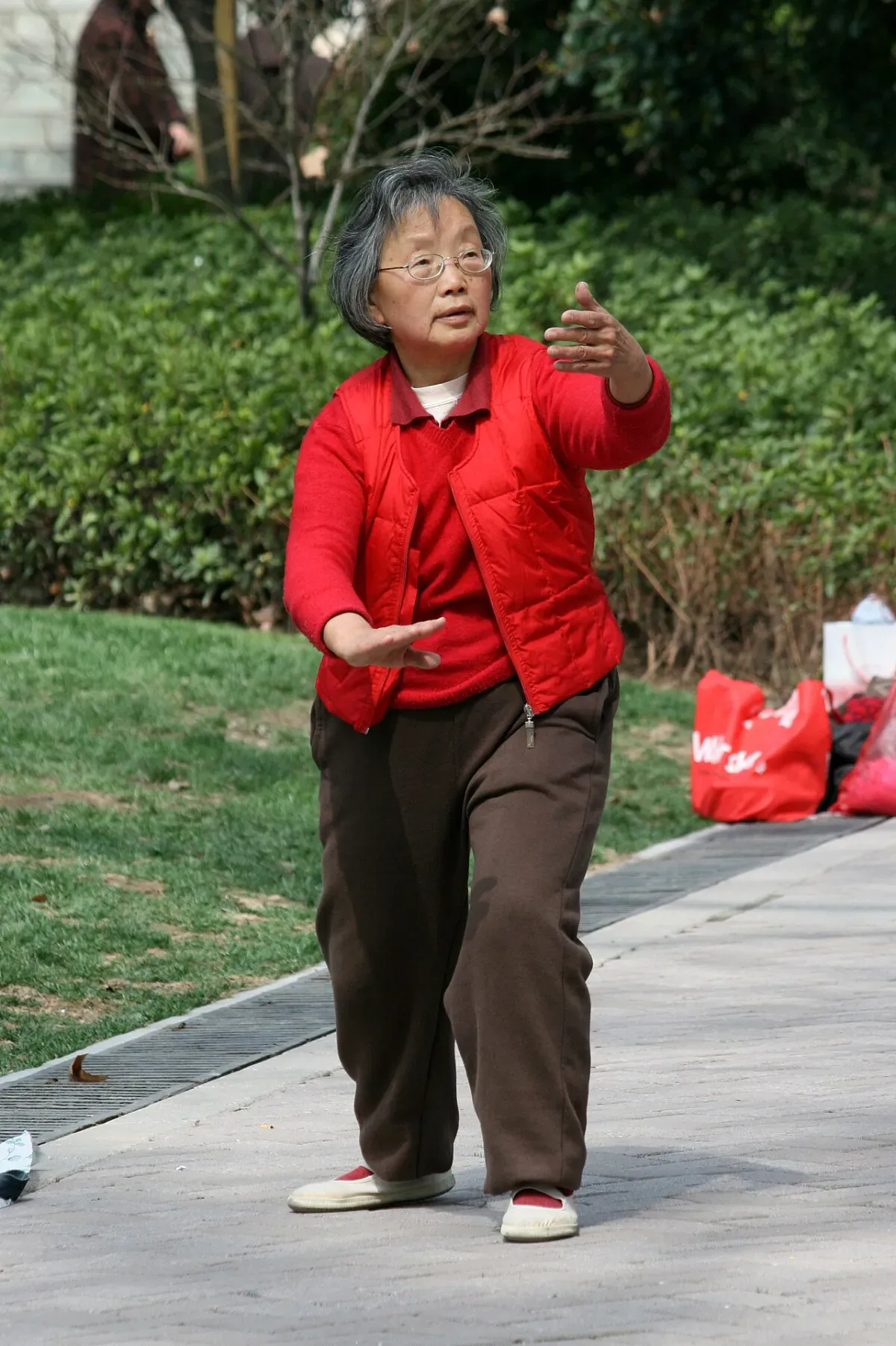 Photo: Tom Thai from shanghai, china / Wikimedia Commons (CC BY 2.0)
Tai chi walking for weight loss: the honest numbers
Calories burned, calculated with METs
The calorie estimates below use Metabolic Equivalent of Task (MET) values from the Compendium of Physical Activities. General tai chi and qi gong are rated at 3.3 METs. The Compendium has no separate entry for the walking drill, so the general tai chi value is the closest available estimate. The formula for calories burned is METs multiplied by hours multiplied by body weight in kilograms.
Tai chi walking vs normal walking: comparison table
Using the walking values from the Compendium, here is how the calorie burn compares for a 70 kg adult doing 30 minutes of activity. A heavier body burns proportionally more calories.
| Activity | METs (Compendium code) | kcal per 30 min at 70 kg |
|---|---|---|
| Strolling under 2.0 mph | 2.3 (17151) | 81 kcal |
| Slow walk 2.0-2.4 mph | 2.8 (17152) | 98 kcal |
| Walking 2.5 mph | 3.0 (17170) | 105 kcal |
| Tai chi / qi gong general | 3.3 (15670) | 116 kcal |
| Moderate walk 2.8-3.4 mph | 3.8 (17190) | 133 kcal |
| Brisk walk 3.5-3.9 mph | 4.8 (17200) | 168 kcal |
| Very brisk 4.0-4.4 mph | 5.5 (17220) | 193 kcal |
Note: The Compendium also lists Yang-style tai chi chuan at 6.0 METs. This applies to a full, vigorous routine, not the slow walking drill.
Where it fits if weight loss is the goal
Tai chi walking is a light-to-moderate activity. It burns roughly what a 2.5 mph walk does, so 30 minutes uses about 100 to 120 kcal for a 70 kg adult. Harvard reviewer and tai chi instructor Stanwood Chang states clearly that claims of major weight loss or muscle gain from tai chi walking are false. Position it as the thing you can do on days you would otherwise do nothing, and as an entry point before you progress to a brisk walking pace.
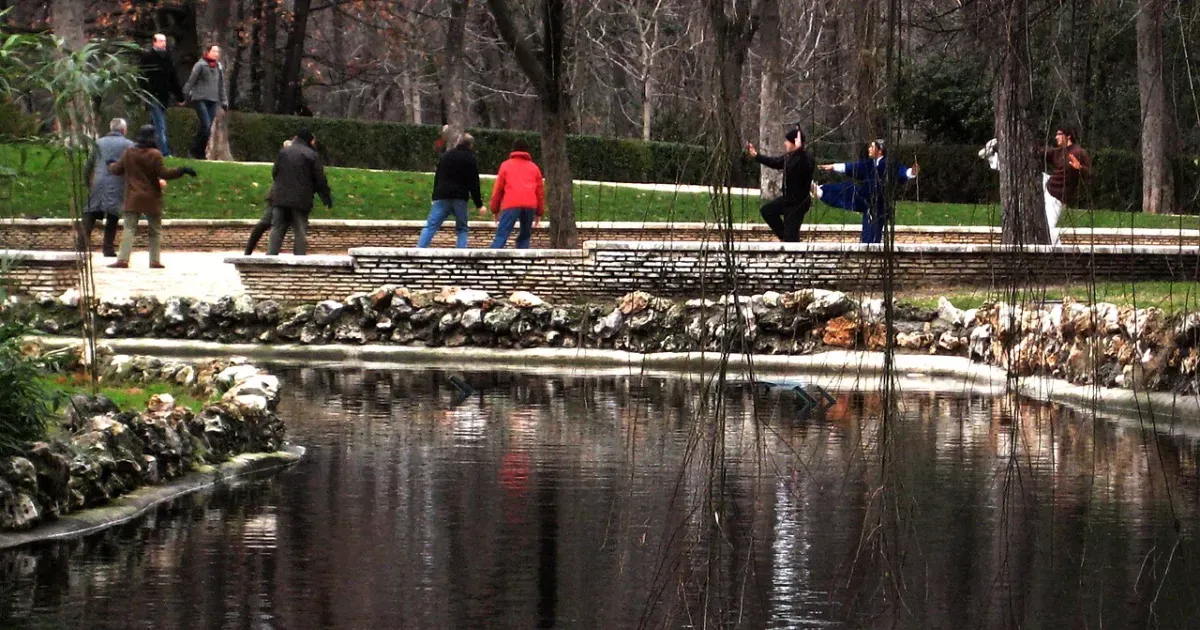 Photo: Borkur Sigurbjornsson from Barcelona / Wikimedia Commons (CC BY 2.0)
Tai chi walking vs regular walking: which one, when
What each one trains
Walking at 2.5 mph or faster counts as moderate intensity toward the CDC 150-minute weekly guideline (see is walking good exercise). At the general tai chi value of 3.3 METs, tai chi walking sits just over the 3.0 MET moderate threshold. The pace is slow enough that it makes more sense to treat it as supplemental balance work rather than your primary aerobic minutes. A normal mile is roughly 2,000 to 2,500 steps, but tai chi walking is not about distance at all (see how many steps in a mile).
| Feature | Regular brisk walking | Tai chi walking |
|---|---|---|
| Pace | 3.5 to 3.9 mph | 3 to 5 seconds per step |
| Intensity | 4.8 METs | 3.3 METs |
| Main benefit | Cardiovascular health | Balance and fall prevention (excellent evidence grade, from full tai chi programs) |
| Counts toward 150-min goal? | Yes | Best used as supplemental balance work |
| Best for | Aerobic fitness | Fall prevention and joint control |
| Time per session | 30+ minutes | 5 to 10 minutes |
A simple weekly split
Aim for three to five brisk walks a week. Add five to 10 minutes of tai chi walking on most days. It also works as a warm-up before you leave the house for your main walk.
Indoor walking videos and apps: how to use them without paying
You don’t need to buy a subscription to get started. Harvard’s written steps are enough to practice on your own. Many cities have free tai chi classes in a local park, and YouTube has plenty of free “tai chi indoor walking” follow-alongs. For tracking your regular walks, the free tiers of the apps in our best walking apps guide cover most people.
Common mistakes when starting
Stepping before the weight has moved
This is the most frequent error for beginners. If you feel yourself falling forward into the step, you are using momentum. Check the empty leg first. It should lift freely before it moves forward.
Locking the knee or letting it drift inward
Stiff joints reduce your overall stability. Keep your knees soft at all times. Make sure the front knee tracks directly over the toes as you slowly shift your weight.
Holding the breath
Deep concentration often makes people tense up. Maintain a continuous, relaxed breath through your nose as you step.
Rushing to the ‘advanced’ backward and turning steps
Stick to parallel forward steps initially. The Tai Chi for Health Institute strongly advises clearing all tripping hazards, wearing flat shoes, and using a non-slip floor. A gentle stretching routine pairs well with this practice. Try doing five minutes of tai chi walking in the hallway right after an eight-minute morning stretch routine or a session of basic stretching for beginners.
Frequently asked
- What is tai chi walking?
- It is the slow, deliberate stepping technique taken from traditional tai chi routines. Instead of using momentum to move forward, you wait until your body weight is fully supported on one leg before moving the other foot.
- Is tai chi walking good for weight loss?
- It is a light-to-moderate activity that burns about 100 to 120 calories in 30 minutes for a 70 kg person. It won't cause rapid weight loss on its own, but it is a low-impact habit that keeps you moving on days you would otherwise sit.
- Can I do tai chi walking indoors?
- Yes, you can easily practice it in a narrow hallway or a small living room. You only need enough space to take a few slow steps, and it is recommended to keep a wall or sturdy chair nearby for balance.