How Long Does It Take to Walk 10,000 Steps?

Walking 10,000 steps takes about 100 minutes if you keep a brisk, moderate pace of 100 steps per minute. You can figure out your own time with simple division. Just divide your target step count by your stepping rate.
That basic math is why walking times vary so much from person to person. A relaxed stroll at 80 steps per minute stretches the total to 125 minutes, and a power walk at 120 steps per minute brings it down to 83.
Most fitness guides answer this question in miles per hour. Cadence is the better tool. Miles per hour relies on guessing your stride length, which adds error for no reason. Cadence simply measures how often your feet hit the ground, and it’s the metric researchers use to study walking intensity in the lab.
How long 10,000 steps takes: the short answer
About 100 minutes at a brisk 100 steps per minute
Hitting 100 steps every 60 seconds makes the math easy. At this moderate pace, you accumulate 1,000 steps every ten minutes. Completing a full 10,000 steps requires exactly 100 minutes of total walking time.
You don’t need to do this all in one session. Those 100 minutes can be broken down into a 30-minute morning walk, a 20-minute lunch loop, and 50 minutes of incidental movement around your home and office.
Why cadence (steps per minute) beats mph for this question
If you search for how long 10,000 steps takes, you will often find answers ranging wildly from 70 to 150 minutes. Those contradictory numbers happen because most calculators attempt to convert steps into miles first. They assume 10,000 steps equals exactly 5 miles, and then they apply a speed like 3 miles per hour.
That method introduces hidden stride assumptions. Taller people take fewer steps to cover a mile. Shorter people take more. Calculating by cadence skips the distance variable completely: minutes equal total steps divided by steps per minute. Cadence is also the unit the major research on walking intensity uses. The Tudor-Locke narrative review, for example, reports its findings in steps per minute, not in miles per hour.
Where the 80 to 120 minute range comes from
Most healthy adults naturally fall somewhere between 80 and 120 steps per minute during their daily routines. If you are browsing a museum or wandering through a park, you’re probably moving at about 80 steps per minute, and 10,000 steps takes 125 minutes.
Late for a meeting, you might hit 120 steps per minute and clear 10,000 steps in about 83 minutes. Your daily average is usually a blend of the two.
Minutes to walk 10,000 steps by cadence
The cadence time table (80 to 140 steps per minute)
This table shows how long different step counts take at various cadences. The intensity labels follow the CADENCE-Adults study, which mapped stepping rates to metabolic equivalents (METs) in adults aged 21 to 40.
| Cadence (steps/min) | Intensity Label | Minutes for 5,000 steps | Minutes for 7,000 steps | Minutes for 10,000 steps |
|---|---|---|---|---|
| 80 | Easy stroll | 63 | 88 | 125 |
| 90 | Easy-brisk | 56 | 78 | 111 |
| 100 | Moderate | 50 | 70 | 100 |
| 110 | Moderate-brisk | 45 | 64 | 91 |
| 120 | Brisk | 42 | 58 | 83 |
| 130 | Vigorous | 38 | 54 | 77 |
| 140 | Very fast | 36 | 50 | 71 |
How to measure your own cadence in 15 seconds
You don’t need a watch for this, just a timer.
Start walking at your normal comfortable speed. Once you settle into a rhythm, start a 15-second timer on your phone and count every step you take. Multiply that number by four. If you counted 25 steps in 15 seconds, your cadence is 100 steps per minute. Alternatively, you can simply count your steps for a full 60 seconds while looking at a watch.
What each cadence feels like: slow, moderate, vigorous
Numbers on a page only go so far. The CDC guidelines for measuring physical activity intensity recommend the talk test as a practical gauge.
During a moderate-intensity walk (around 100 steps per minute), you can hold a conversation but you’d struggle to sing. Once you push into vigorous intensity (around 130 steps per minute or more), you can only get out a few words before you need to pause for breath.
Slow walk vs brisk walk: does pace change the benefit?
100 steps per minute is the moderate-intensity line
A cadence of 100 steps per minute is a consistent heuristic for moderate intensity. A 2018 narrative review of 38 studies by Tudor-Locke and colleagues found that this rate lines up with an energy expenditure of about 3 METs in adults.
Keep the scope of this data in mind. The CADENCE-Adults lab study tested 76 healthy adults aged 21 to 40 on a treadmill. Older walkers, or people managing joint and heart conditions, may hit moderate intensity at a lower cadence. If you’re older, treat the 100 steps per minute mark as a rough guide. Use the talk test to find your true moderate zone.
130 steps per minute is where walking becomes vigorous
In that same CADENCE-Adults treadmill study, researchers used indirect calorimetry to measure exactly how much energy participants burned. They found that walking reached vigorous intensity (6 METs) at a regression threshold of 129 steps per minute.
For simplicity, that’s rounded to a heuristic of 130 steps per minute. Walking this fast takes real effort and looks like power walking.
What the mortality data say about faster stepping
The evidence suggests that total volume matters most. A large meta-analysis by Paluch and colleagues (2022) looked at the daily steps of 47,471 adults. After adjusting for the total number of steps people took, the researchers found that a person’s peak 30-minute and 60-minute stepping rates were still associated with lower mortality (a hazard ratio of 0.67). However, the specific number of minutes spent walking at 100 or more steps per minute was not statistically significant. A brisk chunk of walking is a bonus. Obsessing over pace all day is optional.
Do you really need 10,000 steps?
Where the number came from and what the studies found
The 10,000 step goal is famous worldwide. Yet, as the Paluch 2022 meta-analysis points out in its background, the figure has been widely promoted with little evidence to support that specific number. Large observational studies now give a clearer picture, and you don’t have to hit five figures to see most of the benefit.
6,000 to 8,000 for over-60s, 8,000 to 10,000 under 60
The Paluch 2022 meta-analysis combined 15 different cohort studies, tracking 47,471 adults over a median follow-up of 7.1 years. They divided people into four quartiles based on their daily steps. The median steps for these groups were 3,553, 5,801, 7,842, and 10,901.
Compared to the lowest group, the higher step groups had adjusted hazard ratios of 0.60, 0.55, and 0.47 for all-cause mortality. The risk of death fell as step counts rose, but it eventually leveled off. For adults aged 60 and older, the risk plateaued between 6,000 and 8,000 steps per day. For adults under 60, the risk leveled out between 8,000 and 10,000 steps.
Every extra 1,000 steps still counts
If you currently walk very little, small increases matter most. A 2023 meta-analysis by Banach and colleagues analyzed 17 cohort studies involving 226,889 participants.
They found a nonlinear dose-response in which every extra 1,000 steps per day was associated with a 15% lower risk of all-cause mortality (HR 0.85). Every extra 500 steps per day was linked to a 7% lower risk of cardiovascular mortality (HR 0.93). The researchers observed visible health benefits starting above roughly 3,867 steps a day for all-cause mortality and 2,337 steps for cardiovascular mortality. These are observational cohorts. They show associations rather than guaranteed causes, but the direction is consistent across 17 cohorts.
How to fit 10,000 steps into a working day
Three sample schedules: commuter, desk worker, parent at home
Fitting 100 minutes of movement into a busy day feels daunting until you break it apart. Here’s how three routines can accumulate roughly 10,000 steps at a moderate pace of 100 steps per minute.
| Time Slot | Commuter Activity | Minutes | Approx Steps |
|---|---|---|---|
| Morning | Get off bus one stop early | 12 | 1,200 |
| Midday | Lunch break walking loop | 20 | 2,000 |
| Afternoon | Coffee run or errand | 10 | 1,000 |
| Evening | Dedicated neighborhood walk | 30 | 3,000 |
| All Day | Incidental (office, kitchen, stairs) | - | ~2,800 |
| Total | 72+ min | ~10,000 |
| Time Slot | Desk Worker (WFH) Activity | Minutes | Approx Steps |
|---|---|---|---|
| Morning | Walk before logging in | 20 | 2,000 |
| Midday | 3 x 5-min breaks + 15 min lunch | 30 | 3,000 |
| Evening | Dedicated neighborhood walk | 30 | 3,000 |
| All Day | Incidental movement at home | - | ~2,000 |
| Total | 80+ min | ~10,000 |
| Time Slot | Parent at Home Activity | Minutes | Approx Steps |
|---|---|---|---|
| Morning | School run on foot (both ways) | 24 | 2,400 |
| Midday | Playground or park visit | 25 | 2,500 |
| Evening | After-dinner walk | 20 | 2,000 |
| All Day | Chores and incidental movement | - | ~3,100 |
| Total | 69+ min | ~10,000 |
Short bouts count: the 10-minute rule was dropped in 2018
You don’t need long, continuous walks for the minutes to count. The US Department of Health and Human Services Physical Activity Guidelines (2nd edition, 2018) state that adults need 150 to 300 minutes of moderate-intensity aerobic activity per week.
The first edition of those guidelines stated that activity only counted if it was performed in bouts of at least 10 minutes. The 2018 update removed that requirement to encourage people to move more often throughout the day. A three-minute walk to the mailbox now counts toward the weekly total. For tiny habits like that, see our guide on one-minute exercise snacks to sprinkle movement into your workday.
Walking meetings, errands on foot, and the last stop early
Free-living adults spend most of the day barely moving. The Tudor-Locke 2018 review noted that people spend about 13.5 hours a day stepping at a rate below 60 steps per minute. The population’s mean daily cadence is a remarkably low 7.7 steps per minute.
The fix is to attach walking to tasks you already do: pace the room during phone meetings, walk to the pharmacy instead of driving, get off the train a stop early. These shifts add thousands of steps without a dedicated session.
If you do not have 100 minutes
Walk faster for 30 of them
Some days are packed. When you can’t spare 100 minutes, lean on intensity. Walk at a brisk 120 steps per minute for 30 minutes and you’ll bank 3,600 steps. Because that pace is above the 100 steps per minute threshold, the whole block counts as moderate-intensity activity.
Aim for 7,000 to 8,000 and stop feeling guilty
Perfectionism ruins good habits. If you consistently hit 7,500 steps, you’re in the range where mortality risk had largely leveled off in the Paluch 2022 analysis, at least for adults over 60, and close to it for younger adults. Don’t stress over the final 2,500 steps.
Trade some steps for something harder
Walking is good for your heart, but it doesn’t do everything. It provides little resistance, so it won’t build much strength. If you’re short on time, it may be smarter to stop at 7,000 steps and spend 20 minutes lifting weights. You can read more about what walking misses in our breakdown of whether walking is good exercise.
Counting and tracking without obsessing
Phone vs wrist tracker: both are fine for daily totals
Keeping a rough tally of your steps helps you stay honest. You don’t need a premium smartwatch. A phone in your pocket counts steps well enough for a daily total.
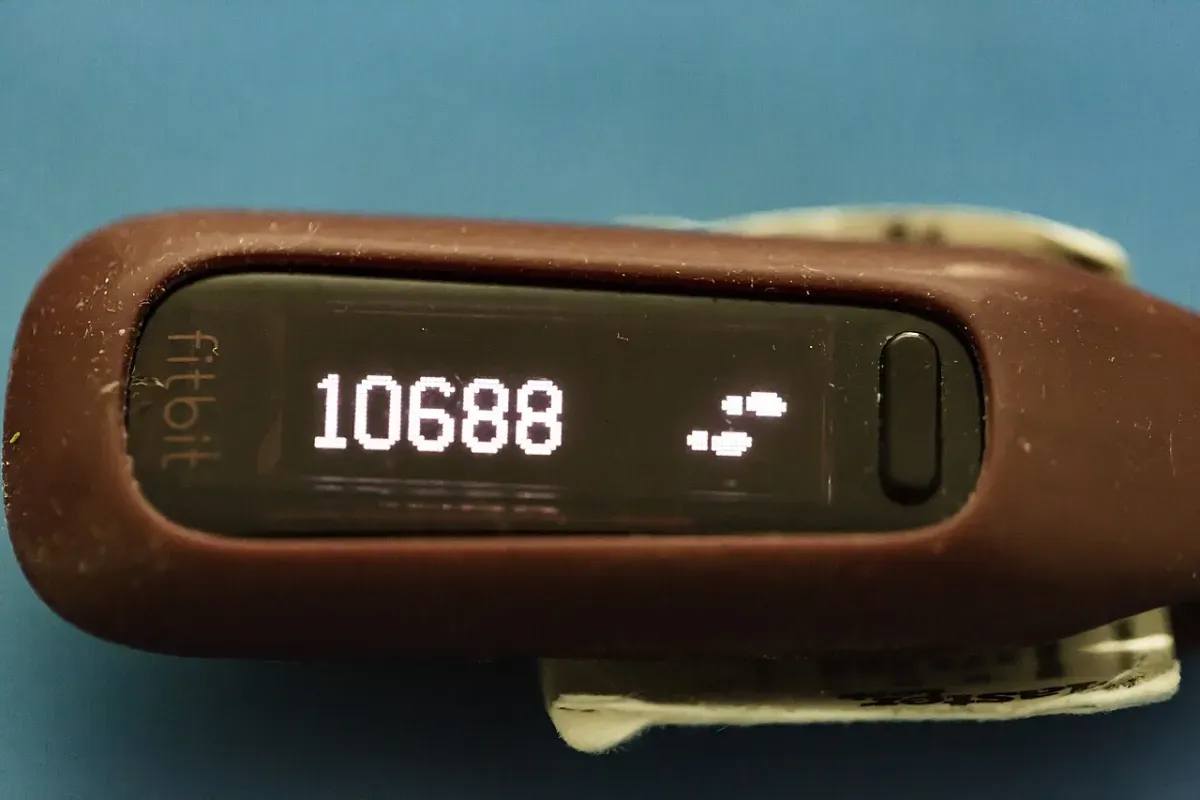 Photo: Thad Zajdowicz / Wikimedia Commons (CC BY 2.0)
If you tend to leave your phone on the desk while you move around the house, a basic wrist tracker fills the gap. We review the top options in our guide to the best walking apps and trackers.
Use cadence, not distance, when you are short on time
When your schedule is tight, steps per minute is more useful than a GPS map. Cadence tells you how hard you’re working right now.
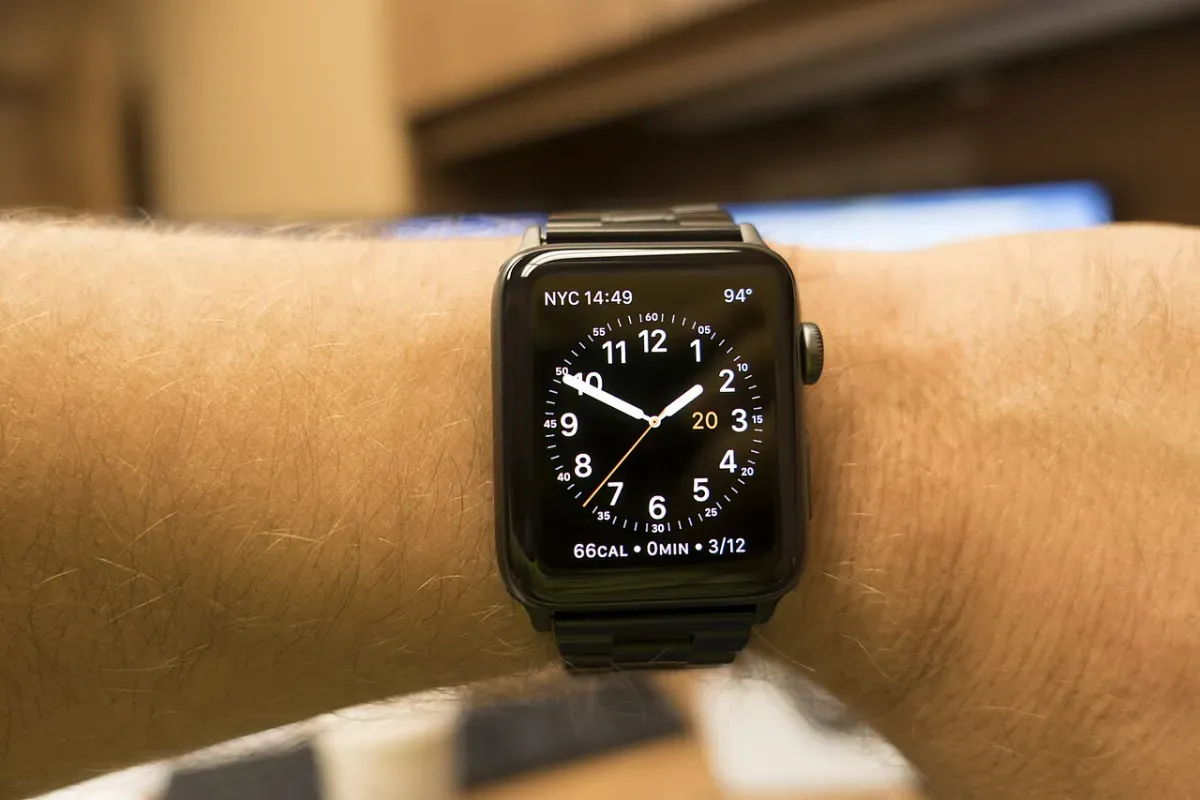 Photo: Jonathan Cutrer / Wikimedia Commons (CC BY 2.0)
A glance at cadence on a watch, or a quick 15-second manual count, confirms you’re at or above the 100 steps per minute moderate-intensity line.
Converting steps to miles if you want to
Some people prefer to think in distance. A good rule of thumb is that most adults take about 2,000 to 2,500 steps per mile.
This means 10,000 steps is roughly 4 to 5 miles of walking. You can find the exact math for your height in our guide on how many steps are in a mile. For how long a single mile takes at different paces, see how long it takes to walk a mile. That article answers the one-mile question. This one is about a day of steps, and the only number you need for that is your cadence.
Frequently asked
- How long does it take to walk 10,000 steps?
- It takes about 100 minutes to walk 10,000 steps at a moderate, brisk pace of 100 steps per minute. If you walk at a slower stroll of 80 steps per minute, it will take around 125 minutes.
- How many miles is 10,000 steps?
- For most adults, 10,000 steps is roughly 4 to 5 miles. The exact distance depends on your stride length and walking pace.
- Do I have to walk 10,000 steps all at once?
- No, you can split your steps throughout the day. Short bursts of walking count toward your daily total, and since 2018 the US activity guidelines no longer require bouts of 10 minutes or more.