How Many Miles Is 10,000 Steps? Height and Pace Charts
Walking 10,000 steps covers roughly 4 to 5 miles (6.5 to 8 kilometers) for most adults. The exact distance depends on your leg length and how fast you’re moving. Someone taking short, slow steps covers less ground to reach that goal. A tall person walking briskly covers noticeably more.
The most-cited measurement comes from a 2008 treadmill study by Hoeger and colleagues in ACSM’s Health & Fitness Journal. As summarized by Texas A&M AgriLife Extension, the men and women tested averaged 2,252 steps per mile at a 20-minute-mile pace. At that rate, 10,000 steps equals 4.4 miles. When the same walkers sped up to a 15-minute mile, their strides lengthened and the average fell to 1,935 steps per mile, as reported by Mental Floss. That pushes a 10,000-step walk to 5.2 miles.
You’ll often hear a simpler rule of thumb: 10,000 steps equals exactly 5 miles. That math assumes a clean 2,000 steps per mile, which needs a step length of 31.7 inches. By the 42 percent rule explained below, a 31.7-inch step belongs to someone about 6 feet 3 inches tall. For the rest of us, 10,000 steps usually falls a bit short of 5 miles.
How many miles is 10,000 steps?
Distance is step count multiplied by step length, so the mileage for a 10,000-step day varies from person to person. The published averages tell you roughly where you stand.
About 4.4 miles at an easy pace, closer to 5 at a brisk walk
At the 2,252-steps-per-mile average, 2,000 steps covers 0.9 miles, 5,000 steps is 2.2 miles, 7,000 is 3.1 miles, and 8,000 is 3.6 miles. Past the standard goal, 12,000 steps comes out to 5.3 miles, 15,000 to 6.7 miles, and 20,000 to 8.9 miles. Most adults take 2,000 to 2,500 steps per mile; the full breakdown is in our steps in a mile guide.
The formula: steps x step length / 63,360
If you know your step length, the rest is arithmetic. There are 63,360 inches in a mile. Multiply your total steps by your step length in inches, then divide by 63,360.
For example, a 28-inch step over 10,000 steps gives 280,000 inches. Divide that by 63,360 and you get 4.41 miles. If you measure your step length in feet, multiply steps by step length in feet and divide by 5,280 instead.
10,000 steps in kilometers
To convert, multiply miles by 1.609. An easy walk of 4.4 miles is 7.1 kilometers. A brisk walk covering 5.2 miles is 8.3 kilometers.
10,000 steps to miles by height and pace
Why height sets the baseline
A 2017 narrative review in Sports Medicine by Bassett and colleagues notes that step length at a self-selected pace is roughly proportional to height, at approximately 42 percent of it. That gives a workable estimate for everyday walking. When you walk faster for exercise, your step lengthens and the percentage rises.
Height chart: easy pace vs brisk pace (cm and inches)
The table below uses the 42 percent rule to estimate step length, then divides 63,360 by that step length for steps per mile. The easy pace column divides 10,000 by the resulting steps per mile. The brisk pace column divides the easy distance by 0.859, which is the Hoeger 15-minute-mile count (1,935) divided by the 20-minute-mile count (2,252).
These numbers are estimates. Terrain, footwear, and individual joint mobility will alter your actual stride.
| Height (ft/in and cm) | Est. step length (42% of height, in and cm) | Steps per mile | 10,000 steps, easy pace (mi and km) | 10,000 steps, brisk pace (mi and km) |
|---|---|---|---|---|
| 4’10” (147 cm) | 24.4 in (62 cm) | 2,601 | 3.8 mi (6.2 km) | 4.5 mi (7.2 km) |
| 5’0” (152 cm) | 25.2 in (64 cm) | 2,514 | 4.0 mi (6.4 km) | 4.6 mi (7.4 km) |
| 5’2” (157 cm) | 26.0 in (66 cm) | 2,433 | 4.1 mi (6.6 km) | 4.8 mi (7.7 km) |
| 5’4” (163 cm) | 26.9 in (68 cm) | 2,357 | 4.2 mi (6.8 km) | 4.9 mi (7.9 km) |
| 5’6” (168 cm) | 27.7 in (70 cm) | 2,286 | 4.4 mi (7.0 km) | 5.1 mi (8.2 km) |
| 5’8” (173 cm) | 28.6 in (73 cm) | 2,218 | 4.5 mi (7.3 km) | 5.2 mi (8.4 km) |
| 5’10” (178 cm) | 29.4 in (75 cm) | 2,155 | 4.6 mi (7.5 km) | 5.4 mi (8.7 km) |
| 6’0” (183 cm) | 30.2 in (77 cm) | 2,095 | 4.8 mi (7.7 km) | 5.6 mi (8.9 km) |
| 6’2” (188 cm) | 31.1 in (79 cm) | 2,039 | 4.9 mi (7.9 km) | 5.7 mi (9.2 km) |
| 6’4” (193 cm) | 31.9 in (81 cm) | 1,985 | 5.0 mi (8.1 km) | 5.9 mi (9.4 km) |
Men vs women: it is mostly height, not sex
The 2008 treadmill study did log separate averages for men and women. At a 20-minute mile, women averaged 2,310 steps and men 2,176, as reported by Mental Floss. At a 15-minute mile, the counts fell to 1,987 for women and 1,868 for men. Running an 8-minute mile took about 1,400 steps.
The gap between the male and female averages is roughly 6 percent, close to the average height gap between men and women. The data don’t point to a sex difference beyond leg length, so your height is the better starting point.
How long does it take to walk 10,000 steps?
Time at 2 to 4 mph
It depends on your speed, and the range is wide. The table divides the 4.4-mile easy distance and the 5.2-mile brisk distance by common walking speeds. In practice the two columns pair up with the speeds: a slow walker takes short steps and lands in the 4.4-mile column, while a fast walker takes long steps and lands in the 5.2-mile column. Read that way, 10,000 steps takes roughly 1 hour 10 minutes at 4 mph to about 2 hours 15 minutes at 2 mph.
| Speed (mph / km/h) | Time for 10,000 steps at 4.4 mi | Time for 10,000 steps at 5.2 mi |
|---|---|---|
| 2.0 mph (3.2 km/h) | 133 min | 155 min |
| 2.5 mph (4.0 km/h) | 107 min | 124 min |
| 3.0 mph (4.8 km/h) | 89 min | 103 min |
| 3.5 mph (5.6 km/h) | 76 min | 89 min |
| 4.0 mph (6.4 km/h) | 67 min | 78 min |
What a ‘normal’ walking speed actually is
It helps to know how fast people walk when they aren’t thinking about exercise. A meta-analysis of 41 studies covering 23,111 healthy adults measured normal walking speed over short courses of 3 to 30 meters.
Mean speed was 143.4 centimeters per second (about 3.2 mph) for men in their 40s and fell with age to 94.3 centimeters per second (about 2.1 mph) for women aged 80 to 99. The authors caution that these short walkway figures may not hold for walks from a standing start or on a course with turns, so treat them as a reference rather than a target. For pace by age in mile terms, see our guide on how long it takes to walk a mile.
Splitting it across the day
Most people don’t walk 10,000 steps in one continuous session. A dedicated 30-minute brisk walk at 100 or more steps per minute covers about 3,000 to 3,500 steps. The remaining 6,500 or so come from incidental movement: grocery shopping, walking to the car, moving around the house.
Where the 10,000-step number came from
The number didn’t come out of a medical laboratory.
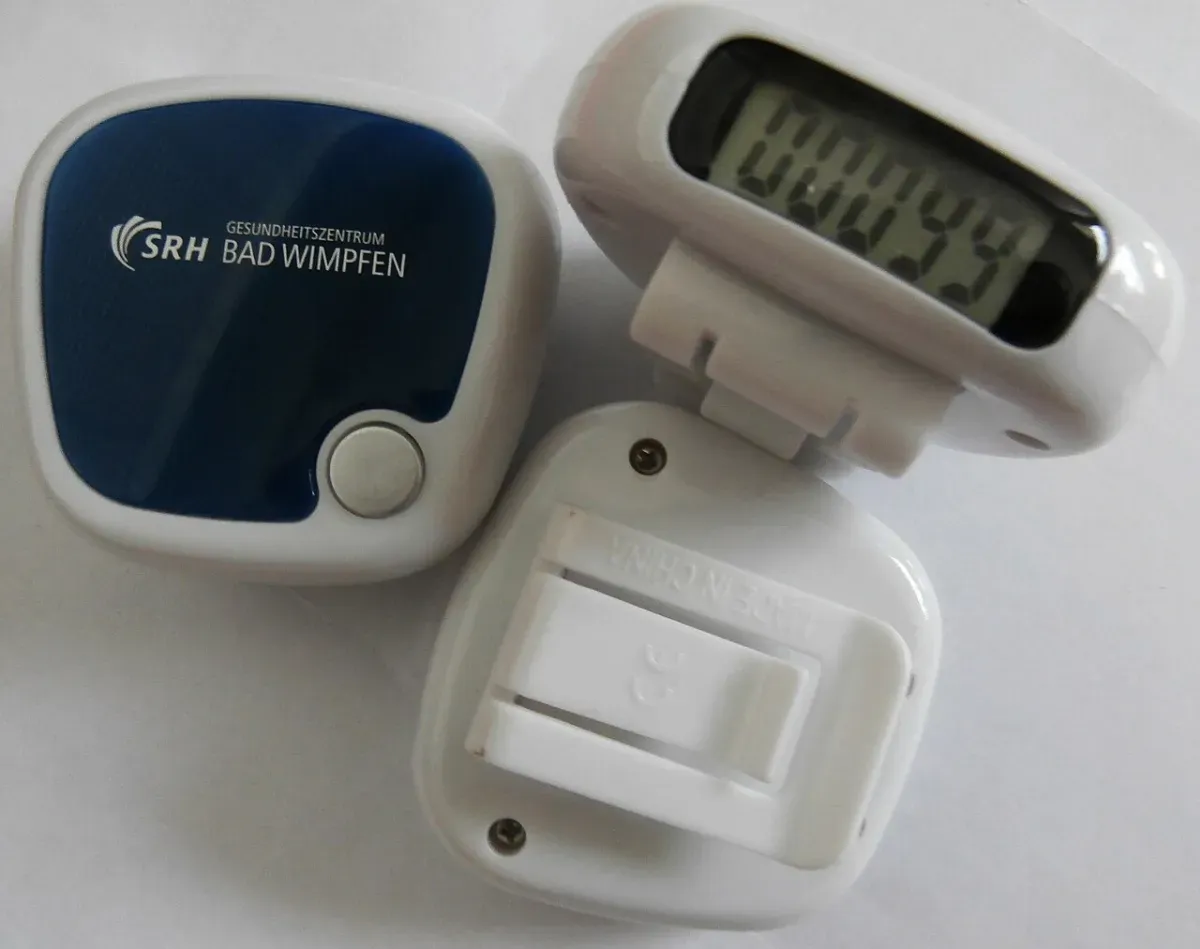 Photo: Sarang / Wikimedia Commons (Public domain)
A 1965 pedometer called the manpo-kei
According to the 2017 Sports Medicine review, the 10,000-step slogan originated in Japan around 1965, shortly after the Tokyo Olympics. A Japanese company called Yamasa designed an early pedometer and named it the manpo-kei, which translates as “10,000 steps meter.”
What the evidence said then
Nobody had tested the figure against health outcomes at the time. A Central Michigan University Q&A with exercise scientist Rachael Nelson notes the origin is debated and the number may simply have been the device maker’s pick. Only decades later did researchers test whether it lined up with health outcomes.
Tudor-Locke’s step bands: sedentary to highly active
In 2004, a review of pedometer indices by Tudor-Locke and Bassett traced the 10,000 figure to Japanese walking clubs and a business slogan from more than 30 years earlier. The authors proposed preliminary bands for healthy adults: under 5,000 steps a day as sedentary, 5,000 to 7,499 as low active, 7,500 to 9,999 as somewhat active, 10,000 or more as active, and over 12,500 as highly active. They noted that 10,000 may not be sustainable for older adults or people with chronic disease.
Is 10,000 steps the right goal? What the research says
Recent cohort research suggests most of the protective association with step count is already in place well before 10,000.
All of these findings come from observational cohorts. They show an association between higher step counts and better health, not proof that adding steps causes a lower mortality rate. People with heart conditions, joint pain, or balance problems should build up gradually and check with a clinician before large increases in daily activity.
7,000 steps captures most of the benefit
A 2025 systematic review in The Lancet Public Health by Ding and colleagues covered 57 studies from 35 cohorts, with meta-analyses on 31 of them. Compared with 2,000 steps a day, 7,000 steps was associated with 47 percent lower all-cause mortality.
The same 7,000-step mark was associated with 25 percent lower cardiovascular disease incidence and 47 percent lower cardiovascular mortality, 38 percent lower dementia, 22 percent lower depressive symptoms, 14 percent lower type 2 diabetes, and 28 percent fewer falls. The authors describe inflection points around 5,000 to 7,000 steps for mortality, cardiovascular disease, dementia, and falls, and rate the evidence as moderate certainty for most outcomes and very low for falls.
The University of Sydney news release accompanying the study frames it plainly: the meaningful gains come from moving from 2,000 steps up to the 5,000-to-7,000 range, and gains beyond 7,000 are modest for most outcomes.
The age split: 6,000-8,000 for over-60s, 8,000-10,000 under 60
A 2022 meta-analysis of 15 international cohorts by Paluch and colleagues pooled 47,471 adults over a median follow-up of 7.1 years. Mortality risk fell as steps increased, but the curve flattened at different points depending on age.
For adults 60 and older, the risk leveled off at about 6,000 to 8,000 steps a day. For adults under 60, it kept falling until about 8,000 to 10,000. The highest quartile of walkers (median 10,901 steps) had a hazard ratio of 0.47 compared with the lowest quartile (median 3,553 steps).
More is still a little better for some outcomes
If 10,000 steps already feels easy, there’s no reason to cut back. The 2025 review’s authors write that 10,000 remains a viable goal for the more active, while 7,000 may be more realistic for others. For type 2 diabetes, cancer mortality, and depressive symptoms, the association kept improving in a roughly linear way beyond 7,000 steps.
A separate prospective cohort, the CARDIA study published in 2021, followed 2,110 Black and White adults aged 38 to 50 for a mean of 10.8 years. Compared with fewer than 7,000 steps, those logging 7,000 to 9,999 steps had a hazard ratio for all-cause mortality of 0.28, and those at 10,000 or more had 0.45. Stepping intensity wasn’t associated with mortality once total steps were accounted for. With only 72 deaths in the cohort, the confidence intervals are wide.
What these studies cannot tell you
The authors of both meta-analyses name residual confounding and reverse causation as limitations. Healthier people may simply walk more, so the studies can’t separate how much of the pattern is walking itself. Step counts also say nothing about strength, which the CDC treats as a separate target. We cover where daily walking falls short on strength in our article on whether walking is good exercise.
How to find your own steps-per-mile number
Testing your own step length takes a few minutes and a tape measure.
 Photo: LR.127 / Wikimedia Commons (CC BY 4.0)
Measure 20 steps, divide, convert
Mark a start line on flat ground, walk 20 normal steps at your everyday pace, and mark where your front foot lands on the 20th step. Measure the distance between the marks in inches and divide by 20 for your step length. Then divide 63,360 by that number for your steps per mile.
Walk a known distance and read your counter
Simpler still: walk a set distance wearing your tracker. A standard outdoor running track is 400 meters on the inside lane, which is 0.2485 miles, so four laps come to just under a mile. Note your step count before you start and right after you finish the fourth lap.
Why your phone and watch disagree
A phone in a pocket, bag, or hand moves differently from a wrist swinging freely, so it often counts differently than a watch. If your device estimates distance without GPS, it’s multiplying your step count by an assumed step length. If that default doesn’t match your stride, the mileage will be off. We cover apps that use GPS distance versus step-based estimates in our guide to walking apps.
Getting to 10,000 (or 7,000) without a two-hour walk
Add 500 to 1,000 steps a week, not 5,000 overnight
Nobody needs to find two continuous hours. In the Central Michigan University Q&A, Rachael Nelson says the benefits come in increments, and adding 500 to 1,000 steps a day is a reasonable next target. If you currently average 5,000 steps, aim for 6,000. Going straight from 5,000 to 10,000 is a doubling, and most people don’t hold onto a doubling.
Short walks that add up
A 10-minute walk after each meal adds up quickly. At a moderate 100 to 120 steps per minute, a 10-minute walk is roughly 1,000 to 1,200 steps (that’s arithmetic, not a study result). Three of them cover a third of a 10,000-step day. We look at this habit in our guides to walking after eating and one-minute exercise snacks.
Count the brisk minutes too
Step totals are useful, but intensity matters for cardiovascular fitness. The CDC’s intensity guide classifies brisk walking at 2.5 mph or faster as moderate intensity. You’re in that zone if you can talk but not sing.
The CDC recommends 150 minutes of moderate-intensity aerobic activity a week, plus muscle strengthening on two or more days. A step total alone doesn’t guarantee you spent any of it at moderate intensity.
Seven thousand steps is a well-supported floor. Ten thousand is fine if it’s already comfortable. Pick the goal that fits your body, not the one a 1965 pedometer picked for you.
Frequently asked
- How many miles is 10,000 steps for an average adult?
- For most adults, 10,000 steps equals about 4.4 miles at an easy walking pace. If you walk briskly, your stride lengthens and the same number of steps covers about 5.2 miles.
- How long does it take to walk 10,000 steps?
- It generally takes between 1 hour 10 minutes and 2 hours 15 minutes to walk 10,000 steps. A person walking at a moderate 3.0 mph pace will finish in about 90 minutes.
- Do you have to walk 10,000 steps at once?
- You do not need to do it all in one session. Most people gather a few thousand steps through normal daily tasks and make up the rest with a dedicated 30-minute or 45-minute walk.