Ankle Mobility Exercises: How to Fix Stiff Ankles
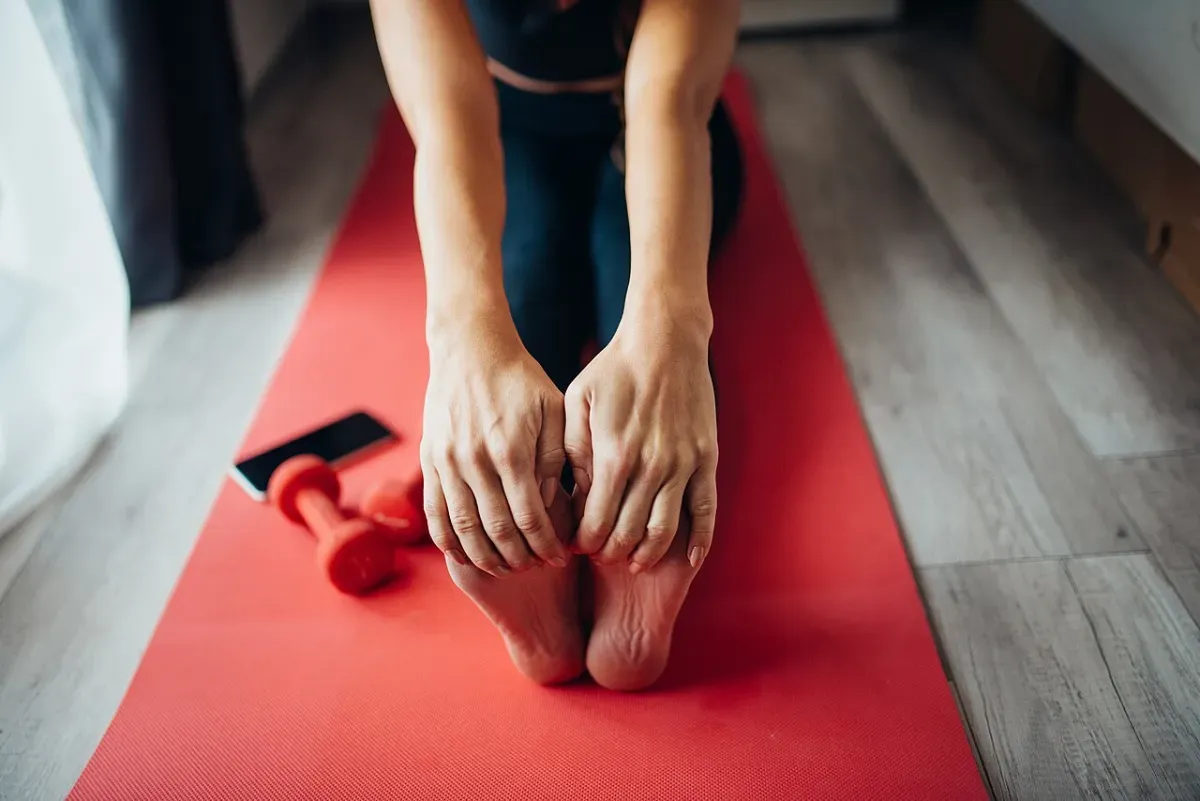
Ten minutes a day on your ankles is worth it, because when they stop moving your knees and hips pay for it. If an ankle loses its ability to fold forward, your body steals the missing range of motion from neighbouring areas. The knee might cave inward to find a path of least resistance. You might notice your lower back rounding at the bottom of a squat. Often the arches of your feet collapse entirely to cheat the movement. Restoring flexibility to your lower leg protects your knees and hips from carrying loads they aren’t designed for.
Most of us sit at desks with our feet resting flat on the floor. We wear shoes with elevated heels that keep the calf in a shortened position all day. Over years of this routine, the tissues adapt to this limited demand. The muscles on the back of the leg tighten. The joint capsule itself gets stiff. When you finally ask your ankle to bend deeply during a gym session or a run, the joint physically can’t do it.
This restriction doesn’t just affect athletes on a field. It changes how you navigate a steep staircase and how you crouch to pick a box up off the floor. Improving how your shin bone glides over your foot is one of the most effective ways to upgrade your movement quality across the board.
Stiff ankles quietly change the way you move
Human movement relies on a predictable sequence of joint actions. The ankle sits at the foundation of this chain. When it functions poorly, the resulting compensations are immediate and they travel upwards.
What dorsiflexion actually is
Dorsiflexion is the mechanical action of closing the angle between your foot and your shin. If you sit on the floor and pull your toes toward your face, you’re performing open-chain dorsiflexion. That specific movement clears your foot off the ground when you walk so you don’t trip over your own toes. Going downstairs requires a bit more range to lower your body under control while balancing on one leg.
In a closed-chain movement like a squat, your foot is glued to the floor. Dorsiflexion looks different here. Instead of the toes coming up, your shin bone travels forward over the middle of your foot. The steeper the angle of your shin relative to the floor, the more dorsiflexion you’re currently using. Catching a heavy barbell clean or absorbing the impact of a high jump demands a lot of this forward knee travel. If you don’t have it, your body finds a workaround.
What a stiff ankle does to your squat and your landing
A restricted ankle forces severe compromises during athletic movement. Taylor et al. tracked 19 female athletes through drop jumps for a 2021 paper in Sports Health. Less available dorsiflexion went with less knee and hip flexion on landing. The sharper finding was about usage rather than range: athletes who used less of the dorsiflexion they already had landed with more knee abduction. It is a small cross-sectional sample, so read it as an association rather than a mechanism.
Knee abduction means the knee collapses inward toward the midline of the body. That inward collapse is the exact position ACLs get hurt in. If your shin can’t glide forward because the calf is too tight, your body bypasses the restriction by flattening the foot arch and driving the knee inside.
You’ll also struggle to keep your torso upright during a squat. The lack of forward knee travel forces your hips backward. To stop yourself falling over, you end up folding at the hips and dropping your chest toward the floor. This posture shifts the mechanical load away from your quadriceps and dumps it straight into your lower back.
Test your ankles before you stretch them
You need a baseline. Guessing whether your ankles are tight isn’t helpful when a simple measurement exists. Testing gives you a concrete number to track over time.
The knee-to-wall test, step by step
The knee-to-wall test isolates ankle dorsiflexion while keeping the heel firmly planted. You’ll need a blank wall, a tape measure and bare feet.
Lay the tape flat on the floor so it extends outward from the skirting board. Place your right foot beside the tape, aligning your big toe with the markings. Drop your left knee to the floor behind you so you’re in a comfortable half-kneeling posture.
Lunge your weight forward. Your goal is to touch your right kneecap to the wall without your right heel lifting off the floor even a millimetre.
Watch your foot arch carefully. People often let their foot collapse inward to sneak their knee closer to the wall. Keep your weight distributed evenly across your foot. If your knee touches the wall and your heel stays flat, slide your foot backwards one centimetre and try again. Keep moving backwards until you find the exact distance where your knee can graze the wall but your heel is right on the brink of lifting. Record this number. Repeat the process on the left side.
Reading your result
Ten centimetres is the number you will see quoted most often as a floor for comfortable daily movement. Past twelve and you have room for a deep, upright squat. These are rules of thumb rather than validated cut-offs, so treat them as orientation, not a diagnosis.
If your score is below 8 centimetres, ankle stiffness is almost certainly altering your movement patterns. You might notice your heels peeling off the floor at the bottom of a squat. Walking downstairs might feel heavy or clumsy. Runners with scores this low often experience premature fatigue in their calves because the muscle has to work much harder to cycle the leg through each stride.
Comparing left and right
Absolute numbers matter. Asymmetry often causes more immediate problems. A discrepancy of two centimetres or more between your left and right ankle requires your attention.
During a bilateral movement like a barbell squat, your body hits the bottom of the range on the tight side first. The looser side continues to travel. This creates a pelvic shift under load. Your hips will hitch up or twist toward the tighter ankle to accommodate the lack of space. The spine then has to curve to keep your head level. Fixing side-to-side differences should be your first priority.
Stretches that add range
A 2013 systematic review by Young and colleagues in the Journal of Foot and Ankle Research pooled 23 studies covering 717 participants. Static stretching on its own produced standardised mean differences of 0.70 to 1.69 in healthy groups, which is a real change in range. The authors were careful with their wording though, calling it some evidence of efficacy rather than a settled case. Consistency is doing most of the work here.
Straight-leg wall calf stretch
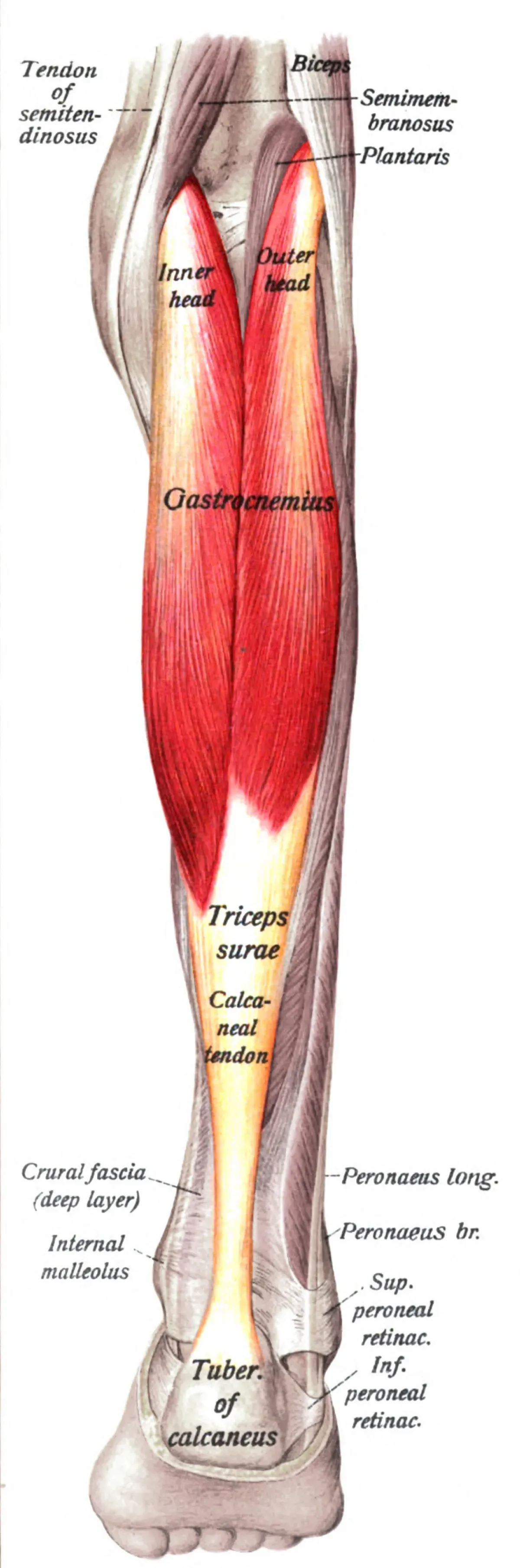 Photo: Dr. Johannes Sobotta / Wikimedia Commons (Public domain)
The gastrocnemius is the large, visible muscle on the back of your lower leg. It crosses both the ankle joint and the knee joint. Because it spans two joints, your knee must be locked completely straight to stretch it effectively.
Stand facing a wall with your hands resting against it for support. Step your target leg backwards. Plant the heel firmly into the floor. Ensure your toes point perfectly straight ahead. If you turn your foot out like a duck, the tension shifts away from the target tissues. Lean your hips forward toward the wall while keeping that back knee straight.
You should feel a deep pull high up in the belly of the calf. Hold this position for 60 seconds. Breathe deeply. Do not bounce.
Half-kneeling ankle rock
Drop down onto your left knee while planting your right foot flat on the floor in front of you. This dynamic stretch mobilises the joint capsule and warms up the surrounding tissues. It mimics the exact position of the knee-to-wall test.
Shift your body weight forward. Drive your right knee out over your middle toes. Push the range until you feel a stretch in the lower calf or a tight sensation deep in the ankle joint itself. Hold the end position for two seconds, then rock backward to release the tension.
Perform 15 smooth repetitions per leg. Keep the heel pinned to the floor the entire time. Ensure your knee tracks in line with your toes rather than caving inward.
Bent-knee soleus stretch
The soleus is a flat muscle lying underneath the gastrocnemius. It crosses the ankle but it doesn’t cross the knee. If you only perform straight-leg calf stretches, your soleus will remain restricted.
Stand facing a wall with a staggered stance. Bring your back foot much closer to the wall this time. Bend both knees, sinking your weight downward. Drive the back knee toward the floor while keeping the back heel pinned down. You’ll feel this stretch much lower in the leg, right down near the Achilles tendon.
Hold this position for 60 seconds. The soleus is stubborn, so give it time under tension.
Drills that teach you to use the range
Having range of motion and actually using it are two separate things. Athletes frequently possess passive dorsiflexion range they don’t access during dynamic tasks. Motor control matters just as much as flexibility. You have to teach your nervous system to trust the new ranges you unlock.
Banded ankle mobilisation
 Photo: Shixart1985 / Wikimedia Commons (CC BY 2.0)
Sometimes a stiff ankle is a joint articulation problem rather than a muscle length problem. The tibia and fibula form a mortise joint that sits over the talus bone in your foot. For the shin bone to glide forward smoothly, the joint needs clear space. If it gets stuck, you’ll feel a hard, bony pinch at the front of your ankle when you bend it.
Secure a thick resistance band to a heavy rack near floor level. Step inside the loop. Place the band over the very front of your ankle joint. It must sit below the knobbly ankle bones, resting directly over the crease of the joint. If you place it too high on the shin, it won’t work.
Step away from the anchor point to create heavy tension. Lunge forward, driving your knee over your toes. People frequently report that the band relieves the pinching sensation, creating a sense of space in the joint capsule. Perform 15 repetitions of this forward glide.
Deep squat hold
Once you stretch the tissues, you have to load them in a functional pattern. The deep squat hold forces your brain to integrate the new ankle range into a complex movement.
Take a kettlebell or a light weight plate and hold it in front of your chest. Drop down into the deepest squat you can manage. Keep your chest tall. The weight acts as a counterbalance, stopping you from falling backward and allowing you to sit upright. Focus entirely on your ankles. Actively try to pull your shins forward over your toes. Hold this bottom position for 30 to 45 seconds.
Full-range calf raises off a step
Strength at the end range of motion secures your mobility long-term. Adding load to a stretch forces your muscles to work at their maximum length. Training a muscle near its longest position tends to hold range better than stretching alone. Why that is remains argued over. Strength at end range is the part you can actually observe.
Stand on the edge of a sturdy step with your heels hanging off. Hold a weight in one hand and use the wall for balance with the other. Slowly lower your heels toward the floor. Take a full four seconds to sink into the absolute bottom of the stretch. Pause for a second, then drive back up to the top. Perform three sets of ten repetitions.
How to fit ankle work into a week
Consistency dictates your results. A single marathon stretching session does very little. Small, frequent doses remodel tissue effectively.
Frequency and hold times
Do not expect the 60-second holds to fix your ankles if you only do them once a month. You should perform light dynamic movements like the half-kneeling ankle rock daily. For the static stretches, aim for three dedicated sessions a week.
A 10-second stretch is a waste of time if your goal is structural change. Accumulate a minimum of 60 seconds per stretch, per leg. You can break this into two 30-second sets if the discomfort is distracting. If you’re new to structured mobility work, read our guide on stretching for beginners to understand how to manage stretch tolerance. The same weekly rhythm suits hip mobility exercises and quad stretches, which sit directly above the ankle in the same chain.
Before training or after
Do not do the 60-second holds ten minutes before you squat heavy.
Research by Behm and Chaouachi in the European Journal of Applied Physiology (2011) provides a blueprint for preparing the body. A warm-up should begin with submaximal aerobic work to raise tissue temperature. You should follow this with large-amplitude dynamic stretching, and finally integrate sport-specific drills.
The researchers noted that long static holds before athletic performance can impair explosive power and maximum strength. Save the 60-second static stretches and the loaded calf raises for the end of your workout. You can also perform them in a separate session entirely. Keep your pre-workout ankle work dynamic.
When stiffness is something else
Most tight ankles respond well to consistent stretching and load. Sometimes restricted movement is a structural issue requiring professional advice.
When to see a physio
Don’t force movement through pain. A stretch should feel like a warm pull in the muscle belly. It shouldn’t feel sharp.
Ankle pain that persists long after a session finishes is a warning sign. Swelling around the joint capsule is abnormal. If your joint frequently feels unstable or gives way unexpectedly following an old sprain, you need a clinical assessment. A physiotherapist can diagnose underlying ligament damage or bony blockages that no amount of stretching will cure.
Frequently asked
- How long does it take to improve ankle mobility?
- Noticeable changes in tissue tolerance usually take four to six weeks of consistent work. Getting those results requires stretching the calves and performing loaded mobility drills at least three times a week.
- Why do I feel a pinch at the front of my ankle when I stretch?
- A pinching sensation at the front of the joint is often anterior impingement. Bones or tissues are compressing before the calf muscle actually stretches. You want to avoid forcing movement through a hard pinch. Stick to ranges that produce a pulling sensation in the back of the leg instead.
- Should I wear lifting shoes to compensate for bad ankles?
- Weightlifting shoes with a raised heel act as a temporary fix by reducing the ankle range required to squat deeply. While you work on your mobility in separate sessions, lifting shoes are an excellent tool for training the legs safely. Just remember they don't solve the underlying stiffness.