Achilles Stretches: What Actually Helps

Achilles stretches are an excellent way to address calf tension and morning ankle stiffness. If you want lasting relief from tendon pain, you’ll need progressive loading exercises. Passive stretching addresses mobility in the calf muscles and the ankle joint. Tendinopathy is fundamentally a load-tolerance problem. Clinical recovery pathways focus on the tendon itself through graded calf loading over several months.
This article provides general wellness information and does not constitute medical advice. You should be aware of the red flags for a tendon rupture before starting any routine. The Achilles tendon is the thickest and strongest tendon in the human body. It absorbs massive forces during athletic movements. Acute ruptures often present with a sudden onset of pain. You might hear a snapping or an audible pop at the back of your ankle. You’ll likely feel like you’ve been kicked or struck in the lower leg.
Following a rupture, you won’t be able to stand on your toes. You will demonstrate significant weakness when trying to point your foot downward. These symptoms require a same-day urgent assessment. Over 20 percent of Achilles tendon ruptures are misdiagnosed. They are frequently mistaken for a simple ankle sprain. A sudden-onset injury deserves a proper clinical look even if you can still walk.
You should also see a clinician before starting an exercise protocol if you have diabetes. The same applies if you are currently taking fluoroquinolone antibiotics or have a history of previous tendon injuries. Pain at the bony attachment on the back of the heel behaves differently from pain in the mid-tendon. Anyone whose pain is at the heel bone should not force deep ankle stretches or full step heel-drops without professional guidance. Seek medical review if your pain is not improving over a few months.
The short answer: stretch for tightness, load for tendon pain
Stretching feels productive. When the back of your ankle feels stiff in the morning, pulling the foot back provides immediate relief. The distinction between tight muscles and painful tendons dictates how you should approach your recovery. You have to identify what is actually restricting your movement.
What an Achilles stretch actually reaches
When you perform an Achilles stretch, you are primarily lengthening the gastrocnemius and soleus muscles. The gastrocnemius originates above the knee joint. The soleus originates below the knee. These two large calf muscles merge to form the Achilles tendon. Muscular tension limits how far your ankle can bend. Releasing that tightness gives the joint more freedom to move.
A thorough routine of calf stretches covers this tissue from multiple angles. This improves your baseline ankle mobility. If your heel refuses to stay down during a wall stretch, the restriction often sits in the ankle joint itself. Targeted ankle mobility exercises can help resolve that specific limitation. You can spend weeks stretching your calves without improving your joint mobility if you target the wrong structure.
When stretching falls short
Stretching is an incomplete tool for tendon recovery. Tendons adapt to the physical loads placed upon them. When an Achilles tendon develops tendinopathy, its capacity to handle the stress of walking or running has dropped below the demands you place on it.
Passive stretching does not build load capacity. It pulls on the fibers. It does not demand that the tendon generate or absorb force. Clinical pathways treat tendon pain with graded calf loading. This involves lifting and lowering your body weight deliberately over time. Loading exercises signal the tissue to adapt and rebuild its structural tolerance.
How to tell which situation you are in
If your ankle feels stiff when you get out of bed but loosens up after a hot shower and a short walk, you’re likely dealing with standard tightness. Stretching is a great tool for this scenario. It clears the stiffness and helps you move normally.
If you feel a sharp, localized ache during or after exercise that persists for days, you are likely dealing with a load-tolerance issue. Stretching may ease the discomfort for a while. The underlying pain returns when you load the tendon again. You need to begin a loading program to rebuild the tendon.
Where your Achilles hurts changes what you should do
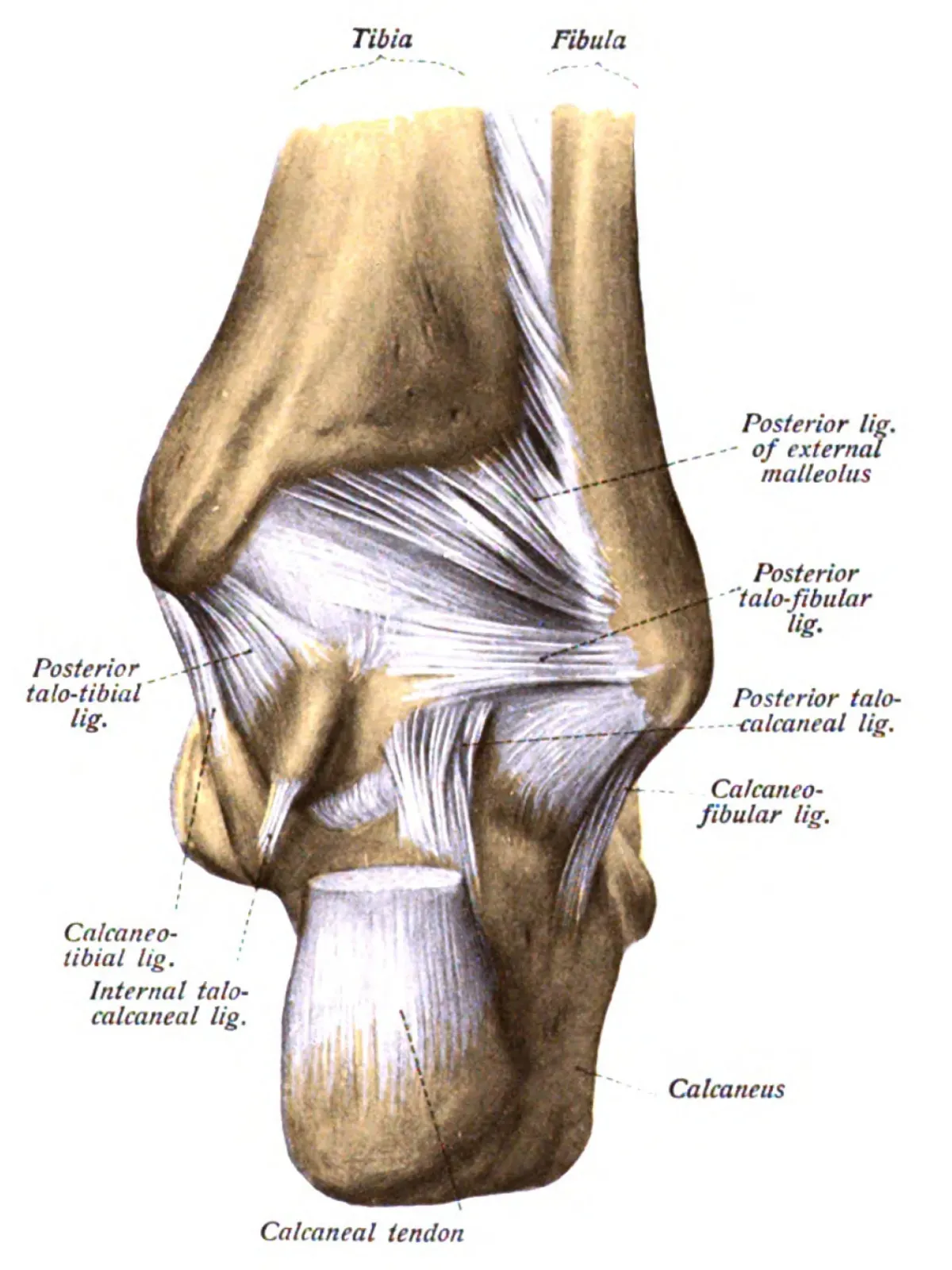 credit: Illustration by Johannes Sobotta via Wikimedia Commons (Public domain)
Locating your pain is the first practical step in choosing the right exercises. The Achilles tendon is long. Where the fibers are irritated changes how much you should let your ankle bend during your recovery routine.
Midportion: pain an inch or two above your heel
According to StatPearls on Achilles Tendinopathy, noninsertional Achilles tendinopathy occurs in the middle to proximal third of the tendon. This is located 2 to 6 cm proximal to the insertion point. If you pinch the tendon an inch or two above your heel and feel pain, you are dealing with a midportion issue.
Midportion tendinopathy is the most commonly studied form of this condition. The famous Alfredson eccentric heel-drop protocol was developed and tested specifically in midportion patients. These loading protocols form the basis for most clinical recommendations.
Insertional: pain right where the tendon meets the heel bone
Insertional Achilles tendinopathy affects the osseous attachment of the tendon to the posterior calcaneus. The pain sits exactly where the tendon merges into the back of the heel bone.
This location is easily compressed. When you stretch your calf deeply, the tendon pulls tightly against the heel bone. You have to manage this compression carefully to avoid aggravating the attachment point.
Why this changes how far the heel should drop
An NHS insertional Achilles pathway from the Royal United Hospitals Bath prescribes eight specific exercises. The routine includes seated and standing heel raises. It also incorporates static holds, single knee dips, and mini hops. The leaflet does not include a single passive stretch.
For insertional pain, the NHS step exercise is a static hold. You stand with your heels off the edge of a step. The instructions explicitly state to start with the heel off the edge and not let the heels drop down. Every other exercise in the leaflet starts with the heel flat on the ground. The NHS insertional leaflet deliberately keeps the heel at or above level to manage compression.
Four Achilles stretches worth doing
When tightness is your main problem, a few specific stretches provide reliable relief. Execution makes a huge difference.
Wall calf stretch, knee straight
The American Academy of Orthopaedic Surgeons details a standard wall calf stretch in their OrthoInfo guide to Achilles Tendinitis. You lean forward against a wall with one knee straight and the heel on the ground. You push the hips toward the wall in a controlled fashion. Hold the position for 30 seconds and relax. Repeat this 10 times for each foot.
The physical cues require attention. Keep your back heel flat and pointing straight ahead. Do not bounce. Move slowly and stop short of sharp pain. A stretch should feel like broad tension in the calf. You want to avoid any pinching sensation at the heel.
Bent-knee wall stretch for the soleus
The straight-leg stretch targets the gastrocnemius muscle. The soleus muscle sits deeper in the leg and requires a bent knee to stretch effectively. You need to address both muscles to fully release the lower leg.
Stand in the same staggered stance facing a wall. Keep both heels flat on the floor. Bend both knees slightly and sink your hips straight down. Bending the knee introduces slack to the gastrocnemius. This forces the deeper soleus muscle to absorb the stretch. You will feel the tension shift lower down your calf. It moves closer to the Achilles tendon itself. Lower-leg pain from running is often mislocated. A comprehensive routine of shin splint stretches covers the front-of-shin counterpart to this deep calf tension.
Step stretch, and when to skip it
Standing on a step and letting your heels drop below the edge provides a large stretch to the entire lower leg. It uses your full body weight to force the ankle into deep dorsiflexion. This is a common movement in fitness classes and post-run cool downs.
You must skip the step stretch if you have insertional pain. Chasing a deeper stretch when pain is at the heel bone compresses the irritated tissue against the calcaneus. Stick to flat-ground stretches if your pain sits at the very bottom of the tendon.
Seated toe-and-towel stretch for stiff mornings
Morning stiffness is a hallmark of Achilles issues. Before you put weight on your feet, sit on the edge of your bed. Loop a rolled towel around the ball of your foot. Keep your knee straight and gently pull the towel toward you.
This provides a mild stretch without bearing any body weight. It warms the tissue up for the day ahead. When you eventually go back to running, what you do beforehand matters greatly. Adding dynamic stretches before running bridges the gap between morning stiffness and athletic performance.
The loading work that actually changes a tendon
To change the structural capacity of a tendon, you have to load it heavily. You also have to repeat this stimulus consistently.
The Alfredson heel-drop protocol, exactly as studied
The most famous loading program is the Alfredson protocol. The Alfredson versus Silbernagel study protocol outlines the exact requirements. The routine consists of 3 sets of 15 repetitions with the knee straight. You follow this with 3 sets of 15 with the knee bent. You perform this sequence twice daily for 12 weeks.
That equals 180 repetitions every day.
Participants perform eccentric heel-drops on their injured side. They use the uninjured limb to concentrically return to the start position. You lower yourself down on the bad leg. You push yourself back up using only the good leg. This isolates the downward phase on the injured tissue.
Alfredson was developed and tested in midportion patients. Participants with insertional Achilles tendinopathy were excluded from the trial. The sheer volume is a massive adherence burden. Doing 180 slow repetitions takes serious daily dedication. Many patients struggle to maintain this schedule.
A gentler starting point: floor-level heel raises
Many people cannot tolerate the Alfredson protocol initially. The NHS insertional leaflet provides a more accessible entry point using floor-level heel raises. You stand on flat ground instead of a step.
The NHS heel-raise tempo is highly specific. You raise your heels up as far as you can while moving slowly. Take 3 seconds to lift up. Hold at the top for 2 seconds. Lower back down slowly for 3 seconds.
The NHS pathway also includes a seated heel raise. You sit on a chair with your knees bent and feet flat on the floor. You slowly push up onto your toes, hold the top position, and lower back down. This seated variation places more emphasis on the soleus muscle while keeping the overall load much lower than standing exercises.
Rushing the lowering phase is a frequent error. Counting the seconds forces you to control the descent. You have to respect the timing to get the intended physical benefit from the exercise.
Heavy slow resistance as an alternative
If 180 daily bodyweight repetitions sounds impossible, there are alternatives. Heavy slow resistance training using gym equipment leads to equally good clinical improvement compared with the Alfredson program.
This matters for anyone who cannot face the daily volume of Alfredson. Heavy slow resistance involves using a leg press or calf raise machine with significant weight. You move very slowly through the repetitions. It provides the necessary mechanical stress without the relentless daily frequency of the bodyweight protocol.
What the evidence supports, and what it does not
Clinical research on Achilles tendinopathy has evolved rapidly. The current evidence presents a nuanced picture of how tendons respond to exercise.
Eccentric versus concentric protocols
An eccentric muscle contraction occurs when the muscle lengthens under tension. The lowering phase of a heel drop is an eccentric movement. A concentric contraction occurs when the muscle shortens. Pushing up onto your toes is a concentric movement.
According to StatPearls, moderate-level evidence favors eccentric exercise over concentric exercise for reducing tendinopathy pain. You will often see physical therapists prioritize the downward portion of a calf raise for this reason.
However, mixed approaches exist. The Silbernagel protocol offers a different approach to loading. It combines concentric, eccentric, and plyometric exercises. Unlike the Alfredson method which isolates the eccentric phase, a mixed approach allows patients to perform both the lifting and lowering phases of a calf raise.
Why no protocol being clearly best helps you
Despite the popularity of specific eccentric programs, a systematic review and meta-analysis looked at 12 randomized trials involving 543 participants.
The meta-analysis evaluated outcomes using the VISA-A score. This is a standardized questionnaire that measures pain and function in patients with Achilles tendinopathy. The researchers tracked these scores across short-term, mid-term, and long-term follow-ups.
The meta-analysis of trials comparing different types of exercise loading protocols showed no significant differences in the short, mid or long term with regard to pain and function. The researchers concluded that the data did not highlight the superiority of one treatment over another for midportion Achilles tendinopathy.
This means you do not have to stress over finding a flawless routine. Consistency matters more than protocol choice. Pick a progressive loading protocol you will actually repeat for months.
Where stretching genuinely fits
The same meta-analysis noted that passive interventions resulted in greater pain reduction in the short term compared with eccentric loading protocols.
This gives stretching an honest, modest role. Passive interventions do better on short-term pain. Stretching is a valid tool to manage daily discomfort and ease morning stiffness. It helps maintain your baseline joint mobility while your loading exercises slowly rebuild the tendon’s capacity over the long term.
Setting expectations for the months ahead
Tendon rehabilitation is notoriously slow. The tissue has a poor blood supply and a low metabolic rate. It adapts sluggishly to new physical demands.
Timeline for recovery
Tendon change takes months. The NHS insertional leaflet recommends keeping up the exercises for at least 3 to 4 months. Most people experience gradual improvement and recover over 12 months or less.
The AAOS notes that it may take a few months for symptoms to improve significantly. Even with early treatment, the pain may last longer than 3 months. Quitting at three weeks because nothing has changed yet is a common error. You have to commit to a consistent loading habit for a full season.
How to gauge pain with the 24-hour rule
You do not need to avoid pain completely while exercising. Tendon rehab is rarely pain-free.
The NHS leaflet provides a reliable metric called the 24-hour rule. Any pain that increases with exercise should settle within a few hours. If your pain spikes during a heel-raise session but returns to its baseline ache by that evening, the load was appropriate.
If your Achilles is throbbing violently the next morning, you did too much. Reduce the repetitions or the weight for the next session.
Footwear and load management
Your daily environment impacts tendon recovery. Footwear matters significantly, especially for insertional pain. Softer heel cups that do not rub or put pressure on the back of the heel can be very helpful. Stiff leather dress shoes or rigid running shoe counters often irritate the attachment point.
The AAOS suggests that heel lifts can be very helpful for patients with insertional Achilles tendinitis. Placing a custom lift inside your shoe elevates the heel slightly. This reduces the amount of stretch applied to the tendon during normal walking. Silicone heel pads provide cushioning and elevate the heel, which decreases tension on the insertion point.
When you feel ready to increase your activity, patience is critical. Distance and speed should be increased gradually by no more than 10 percent per week. Spiking your running mileage just because your Achilles felt good on a Tuesday is a guaranteed path to a setback.
When to stop and get it checked
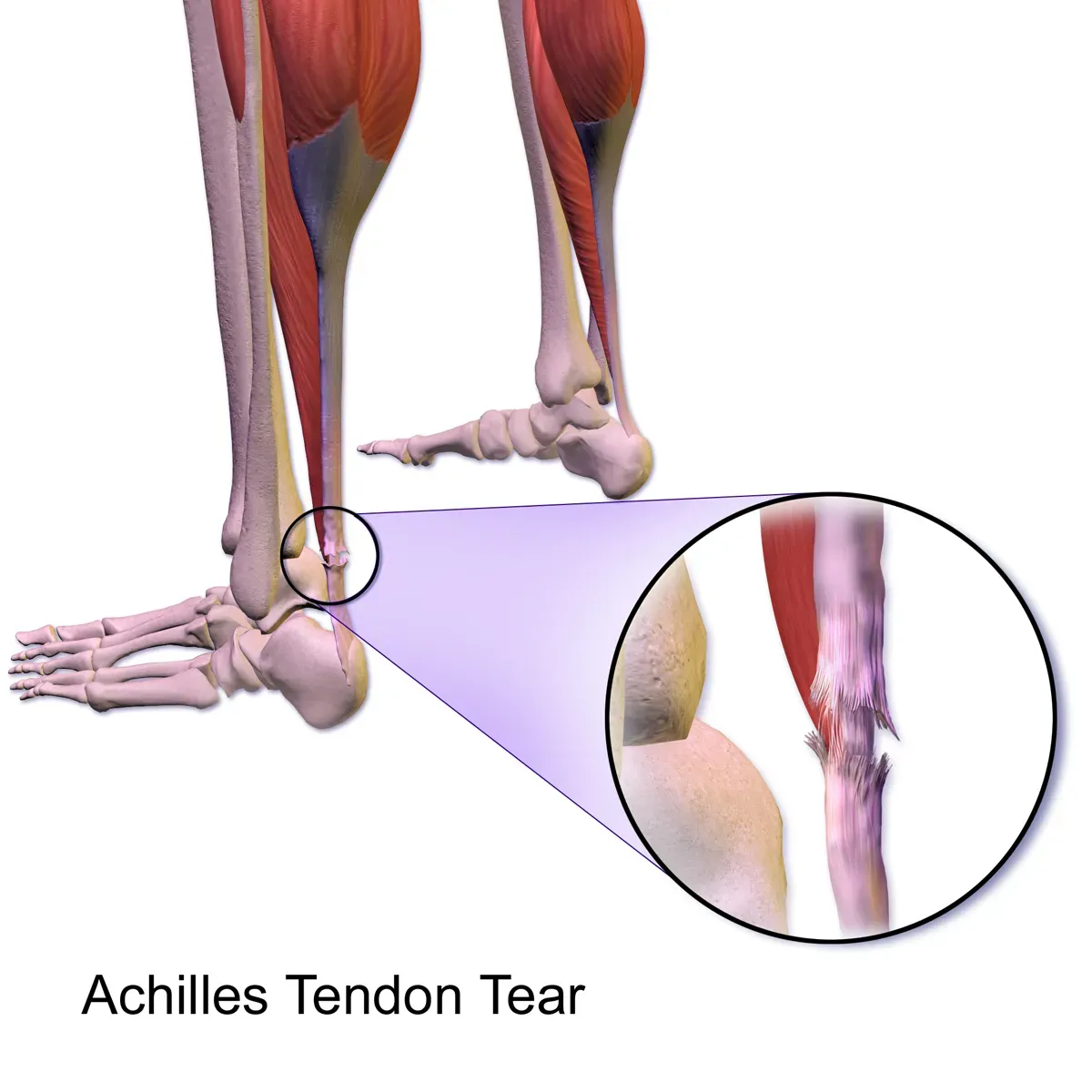 credit: Illustration by BruceBlaus via Wikimedia Commons (CC BY-SA 4.0)
Not every Achilles issue can be rehabilitated at home. You must recognize when a professional assessment is mandatory.
Signs of a severe injury
An Achilles tendon rupture requires immediate medical attention. As mentioned earlier, a sudden pop or snap followed by severe weakness means you need urgent care.
If you suspect a tear, stop all activity immediately. Do not attempt to stretch the tendon to see how it feels. Go straight to an urgent care clinic or emergency department. Remember that over 20 percent of these injuries are misdiagnosed initially. Advocate for a thorough clinical assessment to rule out a complete tear.
Pain that is not settling
If you have been performing progressive loading exercises consistently for three months and your pain levels remain unchanged, seek professional review. An orthopedic specialist or physical therapist can assess your gait and check for structural abnormalities.
Tendons are resilient. They require the right mechanical stimulus to heal. If your home routine is failing to produce results after a full season of effort, step back. Book an appointment with a clinician. Adjust your load management and find a sustainable baseline.
Frequently asked
- How long should I hold an Achilles stretch?
- The American Academy of Orthopaedic Surgeons suggests holding a static wall stretch for 30 seconds. You should move into the position in a controlled manner without bouncing.
- Can I stretch a painful Achilles tendon?
- Stretching eases tightness, but it is not what rebuilds the tendon's load tolerance. Progressive calf loading exercises are required to build physical capacity. If your pain is located exactly at the heel bone, you should avoid stretches that drop your heel below ground level.
- How long does Achilles tendon pain take to heal?
- Tendon recovery requires significant patience. It generally takes at least three to four months of consistent exercise to see changes. Complete recovery often takes up to 12 months.