Knee Stretches for Stiff and Achy Knees
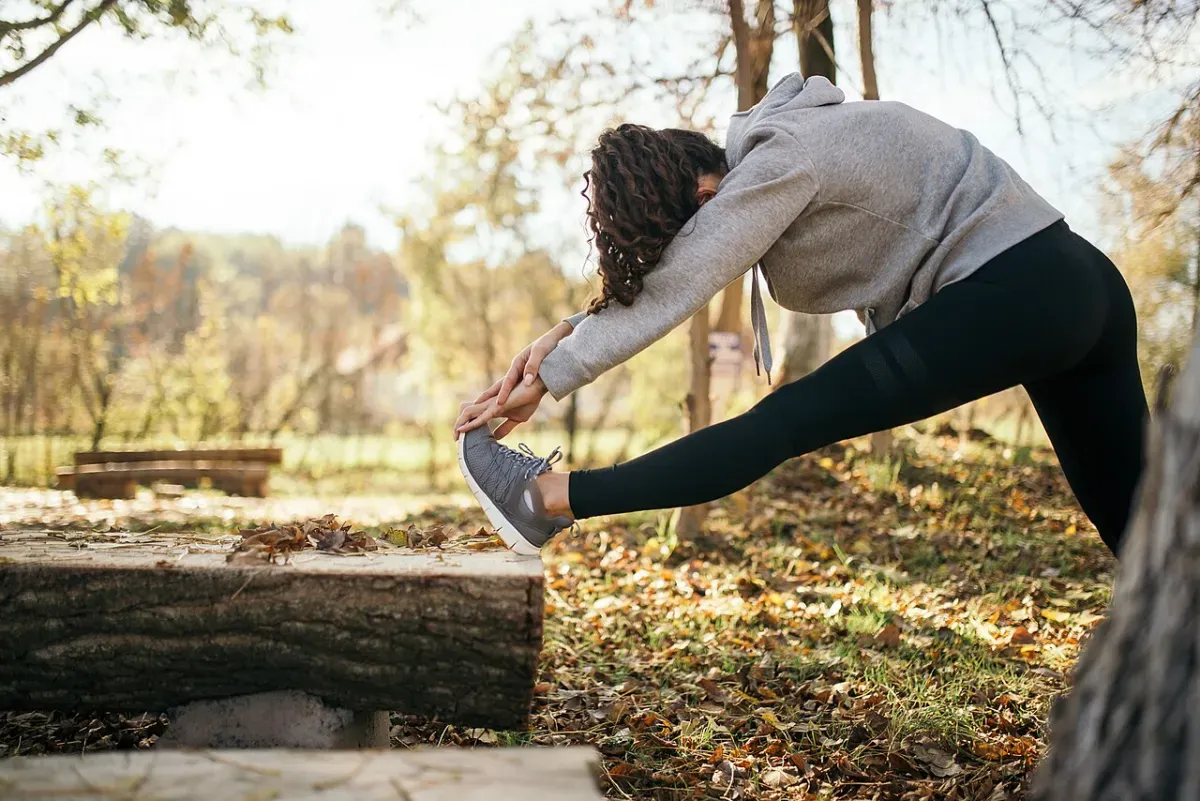
Stretching is cheap, low-risk, and worth doing consistently. A daily routine targeting your hamstrings, calves, quadriceps, hip flexors, and glutes addresses the mechanical tension placed on your lower body. You cannot stretch the joint itself. You can only stretch the muscles that cross it.
This habit focuses purely on releasing tight leg muscles to improve your everyday mobility. You will need to dedicate time to this practice four to five days a week to see meaningful changes in your flexibility. Expect to feel a noticeable difference in your range of motion within roughly three weeks of consistent effort.
Before you begin pulling on a cold muscle, you must prepare the tissues. A brisk walk or a short session on a stationary bicycle increases blood flow.
A complete flexibility routine for the lower body
Seven stretches, one per muscle group that moves or loads the knee
Here is the complete flexibility sequence. You should perform these movements in this exact order to address every major muscle group influencing the mechanics of your legs. We have included two alternate movements for people who need different setups.
- Supine hamstring stretch with a strap
- Standing hamstring stretch on a step (alternate)
- Wall calf stretch
- Standing quad stretch
- Half-kneeling hip flexor stretch
- Standing cross-over stretch for the outer thigh (alternate)
- Figure-4 glute stretch
This program is strictly a flexibility intervention. It aims to reduce the resting tension on your tendons. Strength training performs a separate, equally vital function for your lower body. You will eventually need both.
How to manage the dose and the time commitment
According to the Knee Conditioning Program published by the American Academy of Orthopaedic Surgeons, you should hold your standing quadriceps and supine hamstring stretches for 30 to 60 seconds. Complete two to three repetitions of each stretch. You need to do this four to five days a week.
For the heel cord stretch targeting your calves, the recommended dose is slightly different. Hold the stretch for 30 seconds. Relax for 30 seconds. Complete two sets of four repetitions.
A single round of 30 seconds per side takes roughly ten minutes to complete. If you perform the full prescribed dose of multiple sets with adequate rest, the routine will take closer to half an hour. Run this entire program consistently for four to six weeks before judging its effectiveness on your daily comfort.
Warm up for 5 to 10 minutes first
Dynamic movement belongs before a workout. Static stretching belongs after a workout. Muscles respond much better to being lengthened when they are already warm and pliable. If you are doing this routine on a rest day, you must prepare your body first.
Spend five to 10 minutes on a low-impact activity. Walking at a brisk pace works perfectly. Riding a stationary bicycle with light resistance is another excellent option. You want to feel a slight increase in your body temperature and heart rate. A warm shower also helps raise your tissue temperature if you are exercising at home. Avoid forcing a deep static hold on a stiff joint first thing in the morning. You can find more details on how to structure a safe session in our guide to stretching for beginners.
Anatomy and the mechanics of the joint
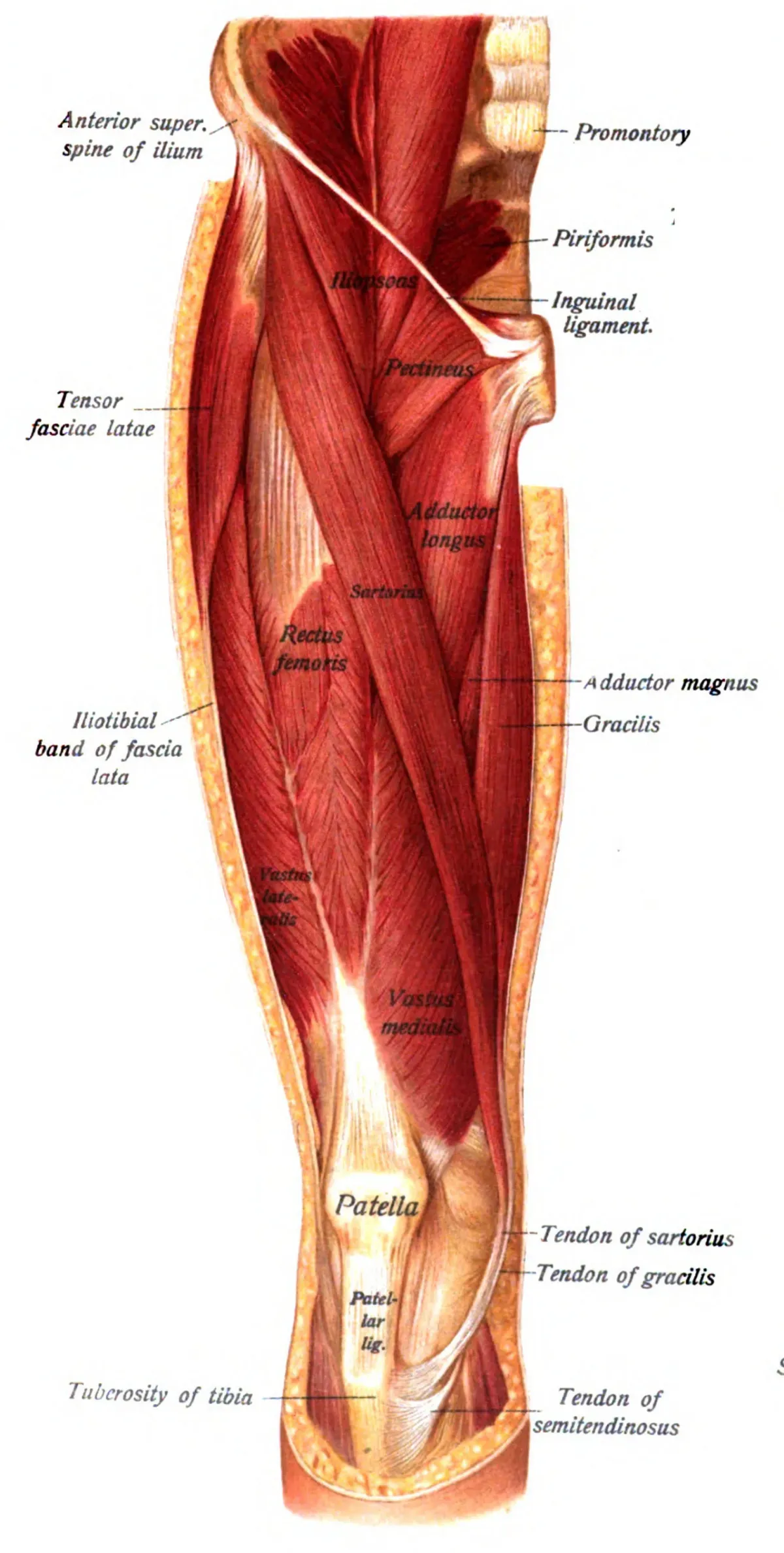 Illustration by Johannes Sobotta via Wikimedia Commons (Public domain)
The knee functions as a hinge joint
The knee is primarily a hinge joint allowing leg flexion and extension. It bends and it straightens. Secondary movements like internal and external rotation are possible, but only to a very limited extent. According to a review of knee anatomy published in StatPearls, it is the largest synovial joint in the human body. Because you cannot stretch the joint itself, you must focus entirely on lengthening the muscles crossing it.
The muscle groups that control the leg
Knee extension comes primarily from the quadriceps femoris. These muscles run down the front of the thigh and merge to form the quadriceps tendon. They attach directly to the kneecap. The rectus femoris is the one quadriceps head that crosses the hip as well as the knee.
The flexors run down the back of the leg. These include the semimembranosus and the biceps femoris in the hamstrings. The gracilis runs down the inner thigh to assist with flexion. The gastrocnemius is a major calf muscle that crosses the back of the knee. This anatomical reality explains why a proper calf routine directly influences the joint.
What tension does to the tendons and the kneecap
Tight muscles behave like a stiff rubber band. According to 3 stretches to relieve knee pain from Harvard Health Publishing, it takes more force to extend a tight muscle. This puts extra pressure on the tendons attaching those muscles to the bone. This extra pressure can lead to pain. Harvard Health also notes that weak hip and leg muscles can stop the kneecap from gliding smoothly on its intended track.
You are addressing muscle tension with these exercises. You are not lengthening a ligament. Ligaments connect bone to bone and are built to resist movement, not to yield to it. Any practitioner promising to stretch your actual ligaments is worth questioning.
The back of the leg: hamstrings and calves
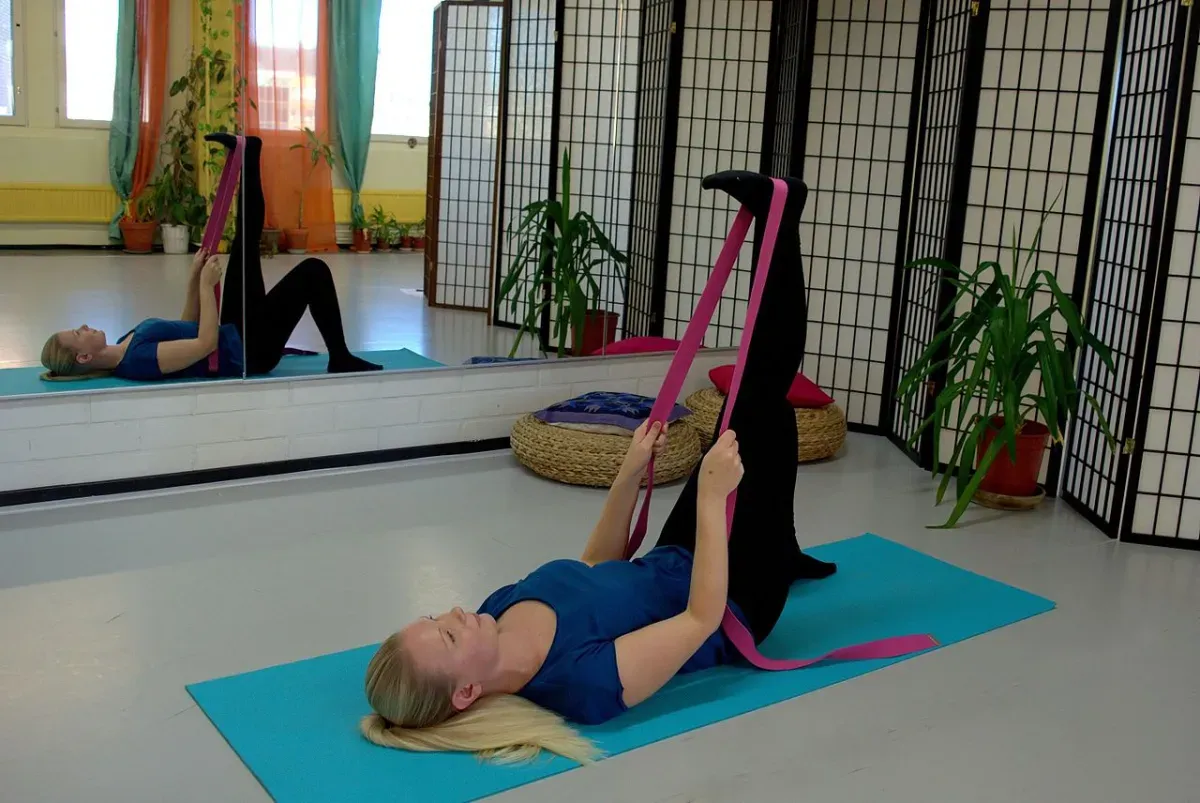 Photo by Helisusa on Wikimedia Commons (CC BY-SA 4.0)
Supine hamstring stretch with a strap
We start with the back of the leg. Most people carry chronic tightness in their hamstrings from prolonged sitting. Lying down is the lowest-risk position for an irritable lower body.
Lie flat on your back on a comfortable exercise mat. Leave your non-stretching leg completely straight on the floor. Take a rigid leather belt, a yoga strap, or a rolled bath towel. Loop your chosen prop around the ball of your stretching foot. Secure your grip with both hands.
Slowly pull your leg straight up toward the ceiling. Keep the knee of your stretching leg as straight as you comfortably can. Stop lifting when you feel a distinct pull in the muscle belly at the back of your thigh. The sensation should feel like a four to six out of ten in intensity. You should never feel a sharp pain in the joint line.
Hold this static position for 30 to 60 seconds per side. Complete two to three repetitions. A common error involves rounding the lower back to force the leg higher. This simply shifts the tension into your lumbar spine. Keep your pelvis heavy and flat against the floor. You can explore a fuller set of variations in our guide to hamstring stretches.
Standing hamstring stretch on a step (alternate)
If you do not have space to lie down, you can stretch your hamstrings using a low step. A stable street curb also works well.
Stand tall and place the heel of your stretching leg on the step in front of you. Keep that leg straight with your toes pointing straight up at the sky. Bend your supporting knee slightly to establish your balance. Hinge forward from your hips while keeping your back completely flat.
Find the edge of the stretch and hold it for 30 to 60 seconds per side. Complete two to three repetitions. Bouncing instead of holding is a frequent error here. Do not pulse up and down. Breathe steadily. Holding your breath makes the muscle contract and fights the stretch.
Wall calf stretch: straight knee, then bent knee
Stand facing a wall. Position yourself slightly further than arm’s length away. Step one foot forward and leave the other foot behind you. Place both hands flat against the wall for support. Keep your back heel firmly glued to the floor and point your toes straight ahead.
First, keep your back knee completely straight and lean your hips forward toward the wall. A straight back knee targets the gastrocnemius. This large muscle crosses the back of the knee joint. Hold this position for 30 seconds. Relax for 30 seconds. Complete two sets of four repetitions per side.
Next, slightly bend your back knee while keeping the heel firmly planted on the floor. Bending the knee shifts the stretch into the soleus. This is a deeper calf muscle that does not cross the knee. These are two different stretches. Do both to release the entire lower leg. For more targeted techniques, read our breakdown of calf stretches.
The front: quadriceps and hip flexors
Standing quad stretch
Stand next to a wall or a sturdy chair. You will need this for balance. Bend your stretching knee and bring your heel up behind you. Reach back with your hand and grasp your ankle. Keep your knees close together. Stand tall and gently pull your heel closer to your glutes until you feel a deep stretch in the front of your thigh.
Hold this for 30 to 60 seconds per side. Complete two to three repetitions.
A deep standing quad stretch presses the kneecap directly against the femur. Forcing this movement when the front of your joint is already highly irritated can make the pain worse. If you have an active flare-up, use a side-lying version instead. Lie on your side and rest your head on your bottom arm. Pull your top ankle behind you. This allows you to control the range of motion without bearing any weight. You can find modifications that keep pressure off the kneecap in our dedicated guide to quad stretches.
Half-kneeling hip flexor stretch
Kneel on the floor with one knee down and the other foot planted flat in front of you. This creates a 90-degree angle with both legs. Place a thick cushion or a folded towel under your resting knee for comfort.
Squeeze the glute of your kneeling leg. Keep your hips square and your shoulders level. Gently shift your weight forward just an inch or two. Stop when you feel a stretch in the front of the kneeling hip.
Hold this position for 30 to 60 seconds per side. Complete two to three repetitions.
The most common mistake is letting the pelvis tip forward and severely arching the lower back. Arching the low back takes the stretch out of the hip flexor. Stay perfectly upright. Keep your glutes engaged to anchor the pelvis. We cover more ways to release this area in our article on hip flexor stretches.
The outside: outer hip, glutes and the IT band
Standing cross-over stretch for the outer thigh (alternate)
Stand tall and cross your stretching leg strictly behind your other leg. Keep both feet flat on the floor. Lean your weight gently away from the side of the crossed back leg. Push your hip out sideways until you feel a stretch running down the outside of your thigh and hip.
You will likely need to hold onto a doorframe or a wall for balance. Hold the stretch for 30 to 60 seconds per side. Complete two to three repetitions.
Figure-4 glute stretch
Lie on your back with both knees bent and your feet flat on the floor. Cross the ankle of your stretching leg over the opposite knee. This creates a shape resembling the number four. Reach your hands around the back of your uncrossed thigh. Pull it gently toward your chest.
Hold this for 30 to 60 seconds per side. Complete two to three repetitions.
If getting onto the floor is difficult, sit in a sturdy chair. Cross your stretching ankle over your opposite knee. Sit incredibly tall. Hinge forward slightly at the hips and keep your chest lifted. Stop when you feel a stretch in your glutes. You can learn more seated variations in our guide to glute stretches.
Addressing the IT band
The IT band is a thick tract of dense connective tissue running down the outside of the thigh. You cannot stretch it in the way you stretch a hamstring. Frame your goal as reducing the muscular pull on the IT band by stretching the tensor fasciae latae and the glutes. We explain this mechanism further in our specific guide to IT band stretches.
Stretching or strengthening: finding what your knee needs
Range of motion versus shock absorption
Stretching buys you range of motion. It provides a reduction in resting stiffness. It will not build the muscle required to take heavy physical loads off your joint.
When you walk down a flight of stairs, your quadriceps and hamstrings must brake your body weight. If those muscles are weak, they brake less of that load, and the joint takes more of it. You must eventually incorporate strength training to build the capacity that flexibility work cannot provide.
When to shift your focus to strength
A sustainable weekly schedule separates the routines to avoid fatiguing your legs. Stretch most days of the week. Do this ideally after activity or in the evening when your tissues are warm.
If four to six weeks of dedicated stretching yields no improvement in your daily comfort, you may need to shift your focus. Building robust lower body muscles is a proven way to improve joint capacity over time. Read our guide to knee strengthening exercises to learn how to load your quadriceps, hamstrings, glutes, and calves safely.
What stretching cannot fix, and when to get help
Structural problems and osteoarthritis
Be realistic about what exercise can achieve. Stretching will not mend a ruptured ligament or replace lost cartilage.
The knee is one of the joints most often affected by osteoarthritis. According to the NHS guide on osteoarthritis, it is a long-term condition and cannot be cured. The NHS also notes that it doesn’t necessarily get any worse over time, and it can sometimes gradually improve. Managing the tension of the surrounding muscles is one part of managing the symptoms.
How strong the evidence actually is
The evidence for exercise therapy in knee osteoarthritis is weaker than most fitness writing admits. A 2025 overview of systematic reviews on exercise therapy in knee osteoarthritis published in BMJ Open examined the available data thoroughly.
The researchers found that 87.4 percent of the 58 included systematic reviews were of critically low quality. They concluded that current evidence on exercise therapy for knee osteoarthritis is inadequate. They still stated it can be considered for conservative treatment, but patients should understand the limitations of the data.
Red flags and stopping points
This is a wellness routine. It is not a substitute for clinical care. See a GP first if your pain does not improve within a few weeks of conservative management. Let a doctor rule out serious structural issues before you commit to months of independent exercise.
The NHS guide to knee pain lists clear red flags. Stop stretching and get urgent advice (NHS 111 in the UK, or your local urgent care service) if your knee is very painful. Seek immediate help if you cannot move the joint or put any weight on it. Get medical attention if the knee is badly swollen or has changed shape.
Stop immediately if the joint locks, gives way, or painfully clicks. You also need urgent advice if you have a very high temperature accompanied by redness and heat around the joint. Respect your physical limits and let medical professionals handle structural injuries.
Frequently asked
- Can stretching cure my knee pain?
- Stretching provides a comfort and range-of-motion intervention. It eases the mechanical tension pulling on your kneecap and tendons, which can help relieve daily aching. It cannot fix a torn meniscus or reverse structural damage.
- How long should I hold a knee stretch?
- Hold static stretches for the quadriceps, hips, and hamstrings for 30 to 60 seconds per side, completing two to three repetitions. For the calves, hold for 30 seconds, rest for 30 seconds, and complete two sets of four repetitions.
- Should I stretch my knees before or after a workout?
- Stretch your legs after a workout or a warm shower. Tissues respond best to static holds when they are already warm and pliable. Before a workout, rely on five to ten minutes of low-impact activity like walking.