Mid Back Stretches for a Stiff Thoracic Spine
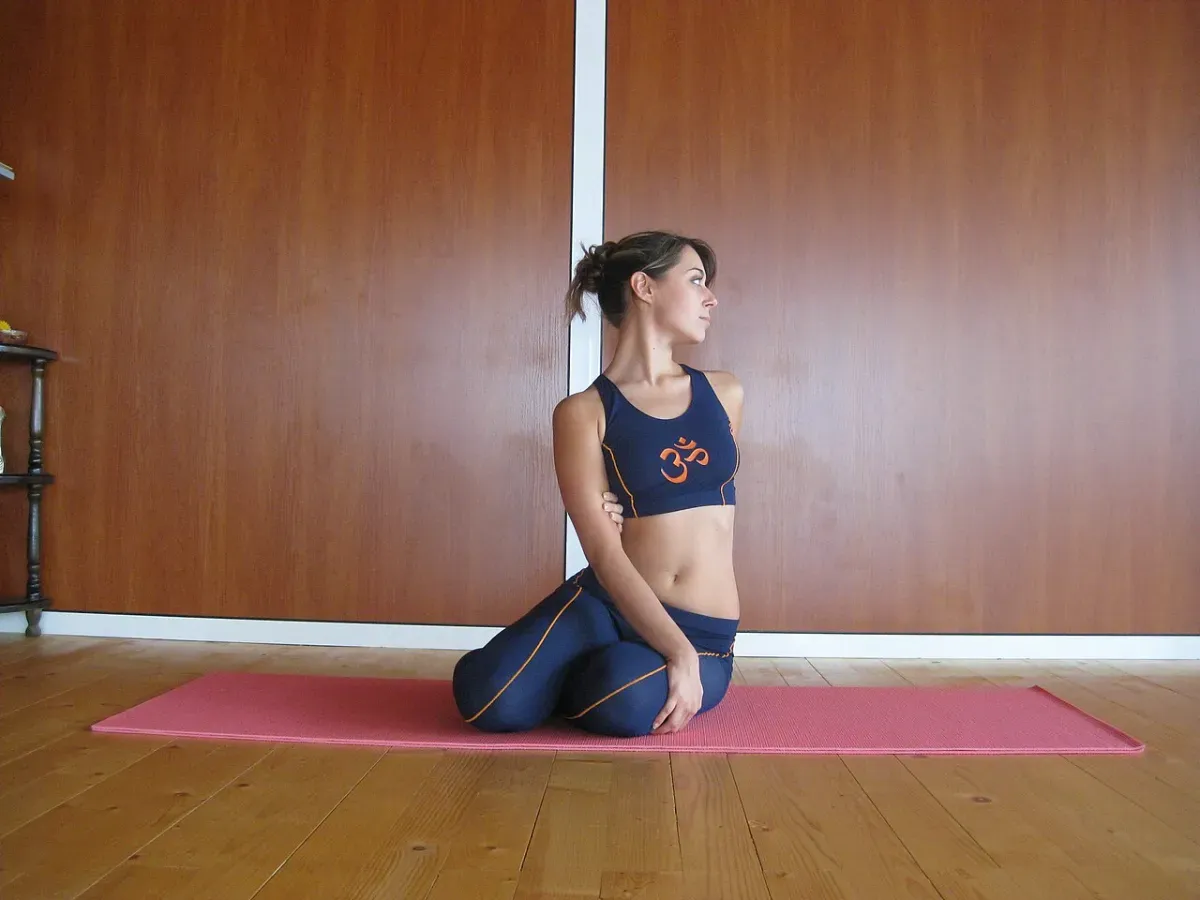
Most mid back stiffness responds well to gentle rotation. The thoracic spine is physically anchored to your rib cage. This unique architecture naturally limits how far you can bend backwards, while allowing for substantial twisting. A daily habit of just five minutes is enough to make a difference. Because research indicates that total weekly stretching volume does not heavily influence range of motion gains, a short daily dose is a practical choice for long-term adherence.
The most common error people make with these movements is bypassing the mid back. Because the rib cage makes the thoracic spine naturally rigid, people often compensate by moving other areas. When attempting to move the middle back, it is easy to hinge at the lower back instead. This creates a sharp pinch near the belt line and leaves the mid back stiff. Fixing your form requires keeping the lower back still while the ribs and middle spine do the actual work.
Stiffness in this region rarely stays isolated. You might notice it when turning to check a blind spot while driving, or as a dull ache after a long day at a desk. Because the mid back acts as the mechanical bridge between your neck and your lower back, a lack of movement here forces those adjacent areas to work harder. Restoring simple rotational movement to the thoracic spine often relieves pressure across the entire upper body kinetic chain.
The short answer
Rotation over extension
Your mid back is built to twist. While it can bend forward and slightly backwards, rotation is the direction this segment actually has, so it is where most people find room to move. When the muscles surrounding this area become rigid from prolonged sitting or standing, twisting is a practical way to mobilise the tissue. You don’t have to force the joints against their natural mechanical limits. Twisting simply uses the space that is already available.
Many people assume that because they spend all day hunched forward, they must aggressively bend backwards to reverse the damage. That approach often leads to frustration and discomfort. Starting with gentle rotation warms up the surrounding muscles and introduces movement without compressing the joints. It feels safer. It helps build confidence in your body’s ability to move freely.
Five minutes most days
You don’t need a lengthy, complicated routine to see results. A brief session performed most days of the week helps establish a lasting habit. Spending five minutes a day twisting and breathing deliberately is a sensible approach. The evidence suggests that total stretching duration and weekly frequency do not significantly change the resulting range of motion.
This means you aren’t failing if you skip a long weekend mobility class. A few minutes of daily movement is a legitimate strategy. It fits easily between meetings or right before bed. Small, consistent efforts keep the joints moving through their full available range, which is exactly what a stiff back requires.
Which page you actually want
Pinpointing where you hurt dictates how you stretch. The thoracic spine is the central segment of your back. It starts at the base of your neck and ends just above the curve of your lower back. If the stiffness you feel is concentrated in the tight muscular band right between your shoulder blades, you may want to review our upper back stretches.
The movements below are exclusively for the 12 vertebrae in the middle. If bending forward to tie your shoes triggers a deep ache near your pelvis, the thoracic stretches here will not address the root of the problem. For pain situated below the ribs, you should look into movements that target the lumbar spine directly.
Where your mid back actually is and how it moves
Twelve vertebrae tied to your ribs
The thoracic region contains 12 individual vertebrae, designated T1 through T12. A review of thoracic vertebrae anatomy in StatPearls notes that this segment is structurally unique. Thoracic vertebrae contain costal facets, including demifacets where the head of a rib rests between two adjacent vertebrae.
The mid back is the only spinal region physically tied to the rib cage. This means that any movement of the mid back requires the rib cage to move with it. You can’t stretch the thoracic spine without also stretching the muscles between the ribs. This structural link creates a very stable region of the body. It also means that stiffness in the rib cage directly limits how well your spine can move.
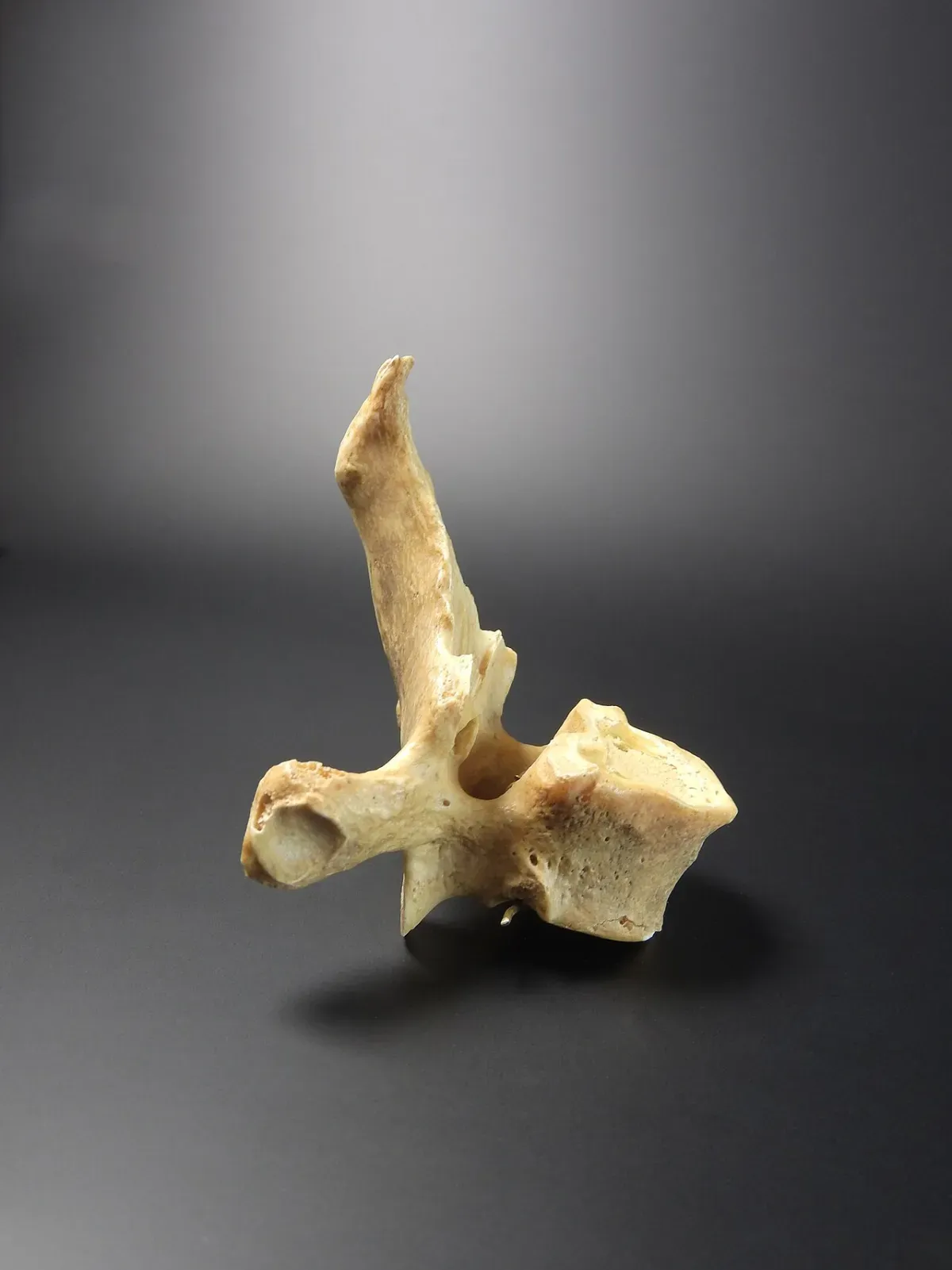 A single thoracic vertebra shown tipped so the long spinous process points up the frame; in the body it angles down over the vertebra below. Photo by MAKY.OREL via Wikimedia Commons (CC0)
Why rotation is its main move
The shape of the bones determines how they can move. As noted in the StatPearls anatomy data, the orientation of the ribs and the specific morphology of the spinous processes substantially limit flexion and extension within the thoracic spine. The spinous processes are the bony bumps you can feel down the centre of your back. In the thoracic region, they angle downward.
Vertebrae T5 to T8 demonstrate the greatest rotational capacity within the thoracic region. The joints here are angled perfectly to slide past one another as you twist. If you try to bend backwards, the downward angle of the bones physically restricts the movement. Rotation is the natural path of least resistance for these specific joints.
How the mid back differs from the upper and lower back
Your spine is a continuous chain, but its links serve different purposes. The cervical spine in your neck is highly mobile in all directions. The lumbar spine in your lower back is built for bearing heavy loads and bending forward or backwards. The thoracic spine sits between them as a stable, twisting transition zone.
Understanding these differences stops you from forcing a movement your joints can’t safely perform. People often expect their mid back to arch like a gymnast’s lower back. When it refuses to do so, they push harder. Recognising that the thoracic spine has a different job allows you to stretch it according to its own mechanical rules.
What sitting has to do with a stiff mid back
What the evidence supports
Thoracic pain is back pain that occurs in the thoracic spine, located at the back of the chest and mostly between the shoulder blades. The NHS Ayrshire and Arran mid back pain portal addresses this clearly. It used to be thought that poor posture or carrying backpacks led to thoracic pain, though the research does not really back this up. Instead, it is now thought that prolonged postures of any type may lead to pain. Holding any single position for hours at a time is associated with surrounding tissues becoming stiff and sensitive.
Mid back pain is a common condition in the general population, yet it receives surprisingly little scientific attention. A systematic review published in BMC Musculoskeletal Disorders found that point prevalence data for thoracic spine pain ranged from 4.0 to 72.0 percent. The lifetime prevalence sits between 15.6 and 19.5 percent. Despite these numbers, the thoracic spine has received less attention in terms of clinical, genetic, and epidemiologic research compared to the lumbar and cervical spine.
Hours seated and minutes moved
The NHS guidance highlights that people who sit for more than seven hours per day tend to have more stiffness and pain in the thoracic spine. Similarly, being active for less than 150 minutes per week is associated with mid back discomfort. The best advice is simply not to remain in any one position for too long.
Breaking up your sitting time with brief walks or stretches is a sensible approach. You don’t need to quit your desk job or invest in expensive ergonomic chairs. Small, frequent changes in position keep the tissues from settling into a rigid state. Even standing up to get a glass of water interrupts the static posture.
How breathing quietly mobilises your mid back
Because the ribs connect to the thoracic vertebrae via costal facets, the simple act of breathing is a mobility exercise. When you inhale deeply, the rib cage expands, subtly forcing the thoracic vertebrae to adjust. When you stretch, you can use this mechanical connection to your advantage.
Sit tall. As you exhale, allow the back of the rib cage to soften and rotate just a few millimetres further into the stretch. A slow, controlled exhale does more to improve your range of motion than pulling aggressively with your arms. Think of your breath as a tool to explore the stretch from the inside out.
Six mid back stretches
Kneeling thoracic rotation
This first movement isolates the mid back by locking the hips in place. Kneel on the floor and sit back entirely onto your heels. Place your left forearm flat on the ground directly in front of your knees. Place your right hand gently behind your head.
Inhale deeply. As you exhale, slowly rotate your right elbow up towards the ceiling, turning your chest to the right. Your eyes should follow your elbow. You should feel a deep stretch wrapping around the middle of your ribs. Hold the top position for two seconds, then slowly return to the start. Perform 8 to 10 slow, controlled repetitions on one side before switching to the other.
Sitting on your heels prevents your pelvis from shifting, ensuring the twist happens exactly where it should.
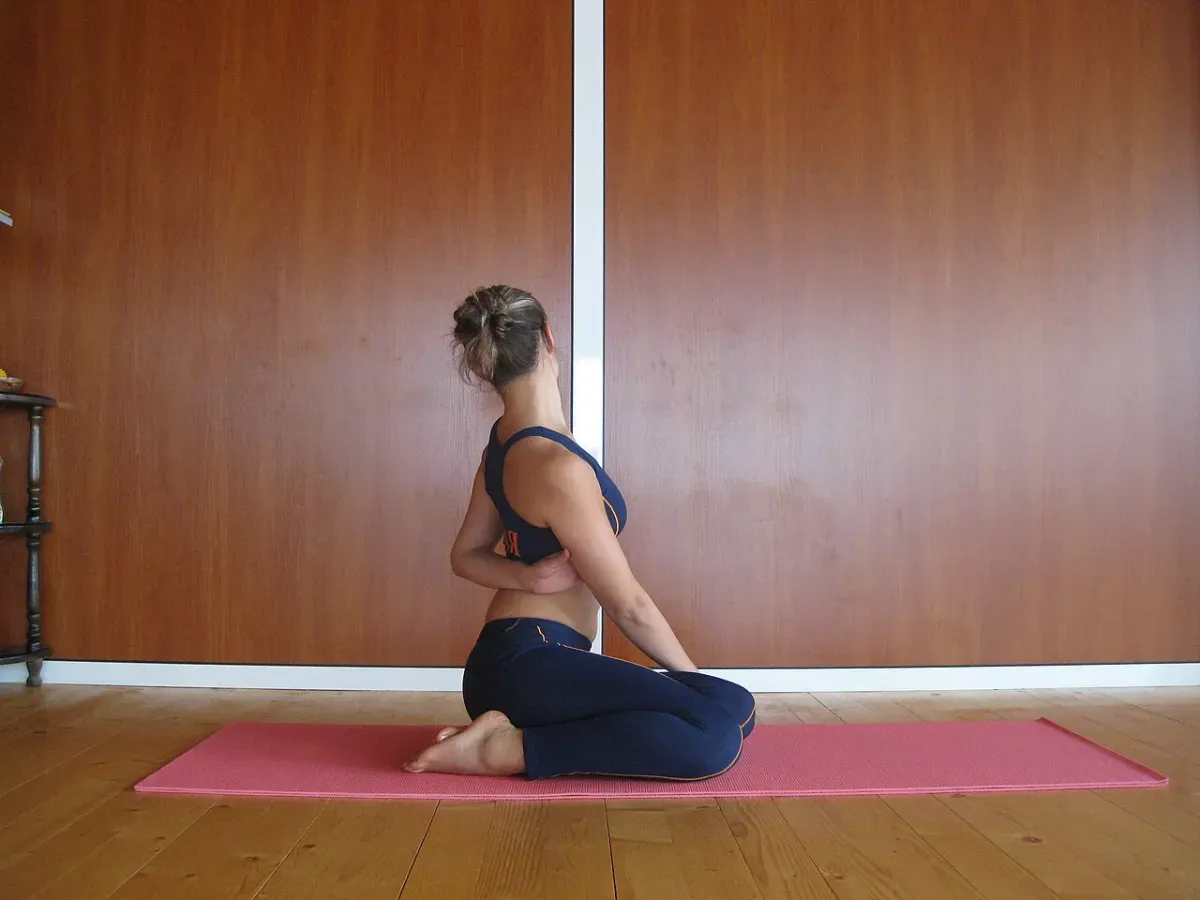 Photo by Iveto via Wikimedia Commons (CC BY-SA 4.0)
Side-lying open book
Lie on your side with your knees bent at a 90-degree angle, resting one on top of the other. Rest your head on a small pillow so your neck is neutral. Extend both arms straight out in front of you, palms touching.
Keeping your knees glued together and anchored to the floor, lift your top arm and trace a wide arc across your body. Open your chest towards the ceiling as if opening the pages of a book. Let your head turn to follow your moving hand. Go only as far as you can while keeping your knees stacked.
Hold the open position for 20 to 30 seconds, breathing deeply into the exposed side of your rib cage. Repeat on the other side. If your shoulder does not reach the floor, let it hover.
Side-lying windmill
For the third stretch, we modify the previous posture to target the rotational joints from a different angle. Stay in the exact same starting position on your side, knees stacked and arms extended.
Instead of opening your arm straight across, sweep your top hand in a large circle up above your head, grazing the floor with your fingertips. Continue the circle until your arm is extended behind you, then sweep it back over your hips to the start.
Perform 8 slow circles per arm. Track your moving hand with your eyes to encourage your neck and upper back to rotate together. Move slowly through any sticky spots.
Supported segmental extension over a rolled towel
While backward bending is mechanically limited, restoring whatever extension you do have is beneficial. A foam roller is often too aggressive for a stiff mid back. The NHS Ayrshire and Arran rolled towel extension offers an honest, low-force alternative.
Take a bath towel and roll it into a firm cylinder. Lie on your back with your knees bent and place the towel horizontally across your mid back, roughly at the level of your shoulder blades. Support the weight of your head with your hands. Slowly bend your shoulders and head backwards over the towel, then return to a neutral position.
The NHS protocol prescribes 20 repetitions, three times daily for this specific rehabilitation exercise. If you prefer to scale this down to match a general mobility routine, our suggestion is to start with 10 repetitions once a day. You should feel a gentle stretch in the chest and mid back. Stop if you feel any pinching in the lower back.
Supine 90/90 rotation
Lie flat on your back and pull both knees up towards your chest until your hips and knees are bent to 90 degrees. Place a firm cushion or a folded towel between your knees and squeeze it gently. Extend your arms out to the sides in a T-shape.
Slowly lower both knees down to the right side, keeping the cushion squeezed between them. Your goal is to keep your left shoulder blade pinned to the floor as your legs move. Only drop your knees as far as you can without that opposite shoulder lifting.
Hold the position for 20 to 30 seconds, breathing steadily. Bring the knees back to the centre and repeat on the left side. Squeezing the cushion ensures your pelvis moves as a single unit.
Standing doorway chest opener
The sixth stretch focuses on the tissues of the chest wall that connect to the rib cage. Stand inside a doorway facing the frame. Raise your right arm to shoulder height and grip the doorframe. Step your left foot forward into a split stance.
Square your pelvis forward. Slowly rotate your ribcage only to the left, turning your chest away from your gripped hand. You will feel a strong stretch across your chest and into the front of your rib cage.
Hold this position for 20 to 30 seconds. Stop short of anything sharp or pinching in the shoulder joint itself. This is an excellent counter-movement for anyone who spends long hours hunched over a keyboard.
The mistake that keeps mid backs stiff: arching from the lumbar spine
How to tell where the movement is actually coming from
Because thoracic extension is mechanically blocked by the downward-pointing spinous processes, people naturally seek the path of least resistance. When told to arch your mid back, you will likely create a hinge at the thoracolumbar junction. This is the exact spot where the stiff thoracic spine meets the highly mobile lumbar spine.
You can perform a simple self-check to see if you are making this error. Rest one hand on your lower front ribs. Try to arch your mid back. If you feel your front ribs flare upward or your belt line tilt forward, your lumbar spine is doing the work.
The mid back has been entirely bypassed. A sharp pinch low in the back is the clearest tell that you have missed the target. To address pain in that specific area, you would need dedicated lower back stretches.
Ribs down, chin level
To correct this, you must lock the lower back in a neutral position. Gently pull your front ribs down towards your pelvis and hold them there. Keep your chin level with the floor. Now attempt the mid back stretch again.
It will feel restrictive. You will feel as though you can barely move. This is normal. You’re forcing the stiff thoracic joints to do their own work instead of relying on the lower back to compensate.
The same logic applies to twisting. In seated and kneeling twists, it is very common to turn the hips instead of the mid back. You must anchor the pelvis. Sitting back on your heels ensures that the rotation has to come from above the waist. If your knees slide past one another as you turn, the thoracic spine is being bypassed.
Why more range is rarely the goal
Chasing a larger range of motion often ruins a stretch. If you force a twist further than your mid back can naturally go, your body will recruit the lower back or the shoulders to finish the movement. The goal is to isolate the thoracic vertebrae.
A tiny, isolated movement in the correct joint provides better targeted stimulus than a sprawling movement that relies on compensation. It is better to move two inches purely from the mid back than to move two feet by twisting your knees and hips. Focus on the quality of the isolation rather than the visual size of the stretch.
When a stiff mid back shows up as neck or shoulder pain
What a randomised trial found
A stiff thoracic spine rarely hurts in isolation. It frequently refers pain upward into the neck. A randomised trial published in BMC Musculoskeletal Disorders investigated this connection in people with forward head posture. The researchers divided 32 participants into two groups over a four-week treatment period.
One group received upper cervical spine mobilisation and stabilisation exercise. The other group received upper thoracic spine mobilisation and mobility exercise. Participants in the thoracic group demonstrated significant improvements in their craniovertebral angle, cervical extension, numeric pain rating scale, and neck disability index at the six-week follow-up compared with those in the cervical group.
In this trial, treating the mid back outperformed treating the neck. It is important to state the caveats clearly. This was a small sample of 32 people, the results were tracked over a short term, and the intervention used manual therapy combined with exercise rather than stretching alone. However, the mechanical principle remains sound. A rigid foundation forces the structures above it to overwork.
When the problem is below the shoulders
The same principle applies to the shoulders. A stiff thoracic spine limits your ability to reach overhead. When the mid back refuses to extend, it may restrict the shoulder blades from tilting backwards to make room for the arm bones.
If you are struggling with overhead reaching, improving your mid back is often the necessary first step before moving on to dedicated shoulder mobility exercises. Your shoulders sit on top of your rib cage. If the rib cage is stuck in a rounded posture, the shoulders simply don’t have the mechanical clearance to move freely.
How often to do this, and when to get it checked
Consistency and volume
The science of stretching provides a clear answer regarding the ideal dose. A massive meta-analysis published in the Journal of Sport and Health Science reviewed 77 studies and 186 effect sizes. The researchers found a significant overall effect indicating that stretch training over two weeks or more reliably increases range of motion with a moderate effect compared to controls.
When they ran a meta-regression, they found no relationship between the effect sizes and total stretch duration or stretch frequency per week. Neither volume, intensity, nor frequency of stretching were found to play a significant role in range-of-motion yields. Stretching with a high volume or high weekly frequency might not be mandatory to maximise gains in the general population.
A five-minute version for a working day
This data shows that a small daily dose is a legitimate choice based on adherence. You can easily slot five minutes of mid back rotation into a morning stretch routine before the sitting starts. The NHS Ayrshire and Arran guidance sets a realistic timeline, noting that these exercises can take up to 12 weeks for you to notice a great improvement, although you may notice a difference sooner.
Follow the NHS pain rule closely. Aim to keep your pain under five out of 10 during the exercise. Your pain or other symptoms should return to your pre-exercise baseline within 30 minutes of exercising. You should not feel an increase in your pain or stiffness the next morning. If you are new to this, a quick review of the basics in our stretching for beginners guide will help you pace yourself.
Signs that need a professional
Zen-labo provides general information, not a medical service. Mid back pain is occasionally referred from an internal organ rather than a spinal joint. The NHS states that problems from the stomach, pancreas, oesophagus, and gallbladder can also cause pain in this spinal area. A very useful practical discriminator is movement. Pain that doesn’t change at all when you move, twist, or change position is a strong reason to get checked by a doctor.
The NHS advises seeking an urgent assessment if your stiffness is accompanied by specific warning signs. You should be evaluated if you experience severe night pain or night sweats, rapid unexplained weight loss, or severe pain if you have a diagnosis of osteoporosis. Seek care if the pain starts for no reason and you are under 20 or over 50.
A history of cancer, a poor immune system, or taking steroids for six months or more requires professional oversight. Feeling generally unwell with a high temperature, a recent infection, pain failing to improve over two to four weeks, or severe morning stiffness lasting one to two hours or more are also reasons to see a doctor. Finally, a change in the shape of the spine, new lumps, or pins and needles and numbness increasing in both arms or both legs at the same time demand that you seek urgent assessment. Any recent physical trauma, such as a fall or a car crash, means you must be assessed and cleared before you begin stretching.
Frequently asked
- Why is my mid back so stiff?
- People who sit for more than seven hours a day or move for less than 150 minutes a week tend to have more stiffness and pain in the thoracic spine. The back responds poorly to prolonged static positions. The NHS advises breaking up static postures and simply not staying in any one position for too long.
- How often should I stretch my thoracic spine?
- Consistency helps build a habit. A daily five-minute routine is a legitimate choice because research shows total volume and weekly frequency do not significantly alter the range of motion gained. The NHS recommends up to three daily sessions for specific rehabilitation exercises.
- Should I feel mid back stretches in my lower back?
- You should avoid feeling a pinch in your lower back. Because the rib cage limits how far the mid back can bend backwards, people often accidentally arch their lumbar spine instead. If you feel the movement low down, tuck your ribs and reduce the range of motion.