Exercise Snacks: What They Are and How Many to Do
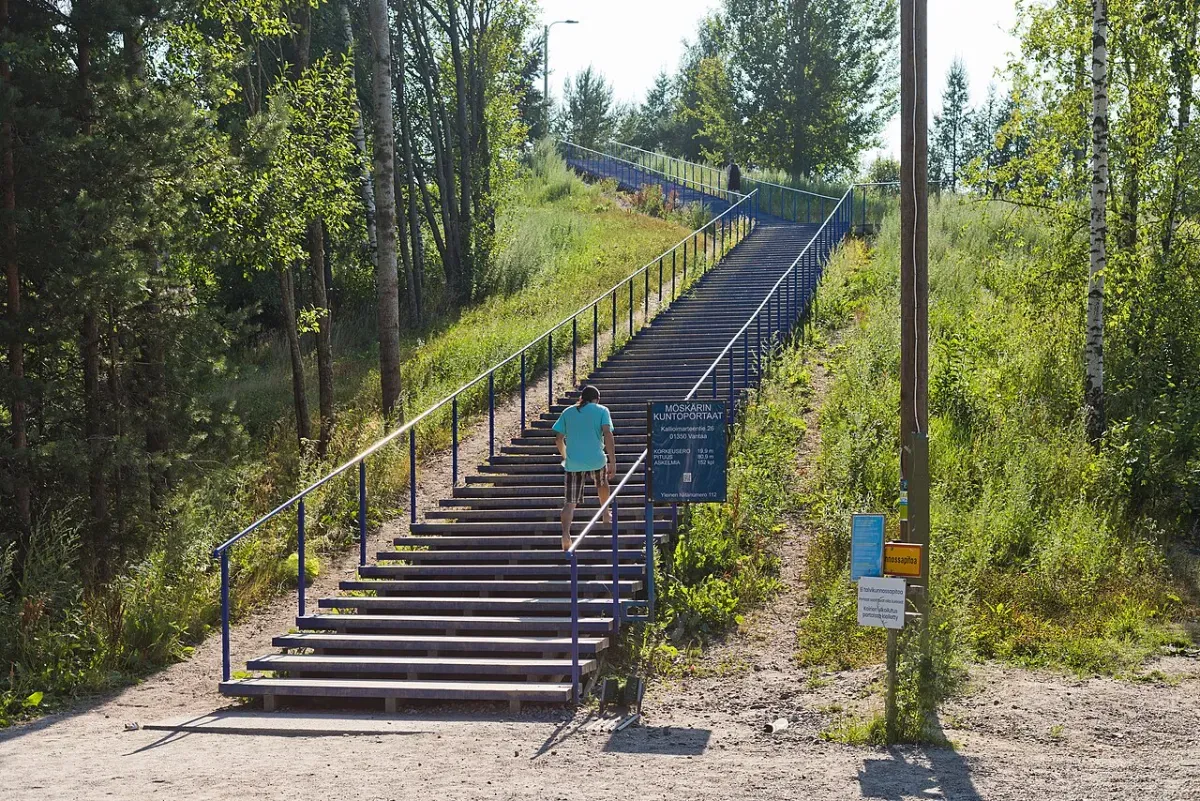
Exercise snacks are short bursts of vigorous movement lasting a minute or so that you repeat a few times through the day. The best evidence so far shows modest fitness gains in small trials and, in one large observational study, an association with a lower risk of dying early among people who don’t otherwise exercise. You should aim for about three a day. They need to be hard enough that talking in full sentences becomes difficult. Good options include taking the stairs, doing bodyweight squats, pushing up against a kitchen counter, or breaking into a very fast walk.
These short bursts are an accessible way to break up a sedentary lifestyle. In a 2022 review, Hashim Islam, Martin Gibala and Jonathan Little define them as isolated ≤1-min bouts of vigorous exercise performed periodically throughout the day. They are separate from your regular gym routine. There’s no changing clothes or driving to a gym. You stand up, work hard for sixty seconds, and go back to what you were doing.
The appeal is that it sidesteps the time problem. Most people can find a minute, even on a packed day. Start with a brisk version of an exercise to get your joints used to the movement. Once that feels comfortable, push the pace until you’re breathing heavily.
What exercise snacks are, and what they aren’t
The research definition: a minute or less, done hard
That definition comes from a short review paper rather than a trial. The authors put forward the idea as a hypothesis: that snacks are feasible, well tolerated and a time-efficient way to improve cardiorespiratory fitness. The critical word here is vigorous. You can’t casually walk to the kitchen and count it as a snack. You have to push your body hard enough to demand oxygen quickly.
Exercise snacks vs movement breaks vs a short workout
A 2025 meta-analysis draws a line between exercise snacks, movement breaks, and high-intensity interval training (HIIT). By that definition, a five- or ten-minute bout is a short workout, whatever some health sites call it.
A movement break is light-to-moderate activity that interrupts your sitting time. A slow stroll to the printer or a stretch at your desk is a movement break. These are still worth doing. They just serve a different purpose. The word snack only makes sense if the bite is small and the effort is real. HIIT involves multiple hard intervals done back-to-back in a single dedicated session. Exercise snacks take those intervals and scatter them across your entire day.
Why short bouts officially count now
Until 2018, the US guidelines counted only bouts of at least ten minutes toward the weekly target, so an eight-minute run didn’t count toward your total. That advice has changed.
The second edition of the US Physical Activity Guidelines explicitly removed the ten-minute bout requirement. The updated guidelines state that any amount of physical activity has some health benefits. They still recommend adults get 150 to 300 minutes of moderate-intensity aerobic activity a week. The first key guideline for adults is simply to move more and sit less. Immediate benefits include reduced anxiety, reduced blood pressure, improved sleep quality, and improved insulin sensitivity. The guideline is about moderate-to-vigorous activity in general rather than exercise snacks specifically.
What the research actually shows
The VILPA study: 25,241 people who don’t exercise
The largest dataset on short vigorous bursts comes from a 2022 Nature Medicine study by Emmanuel Stamatakis and colleagues on vigorous intermittent lifestyle physical activity, or VILPA. Researchers analyzed 7-day wrist accelerometer data from 25,241 non-exercisers in the UK Biobank. These were people who did no leisure-time exercise and took at most one recreational walk per week. Their mean age was 61.8.
VILPA refers to brief, sporadic bouts of up to one or two minutes of vigorous activity in daily life. The authors use examples like very fast walking while commuting or climbing stairs. That makes VILPA a close cousin of deliberate exercise snacks rather than the same thing: it’s the hard bits of ordinary life, not a planned one-minute effort. Over a mean follow-up of 6.9 years, there were 852 deaths.
 Photo: Alex Proimos from Sydney, Australia / Wikimedia Commons (CC BY 2.0)
A median frequency of three VILPA bouts per day was associated with a 38 to 40 percent reduction in all-cause and cancer mortality risk. It was also associated with a 48 to 49 percent reduction in cardiovascular disease mortality risk. A median of 4.4 minutes per day was associated with 26 to 30 percent lower all-cause and cancer mortality risk and 32 to 34 percent lower cardiovascular mortality risk. The authors’ minimal dose, the amount linked to half of the largest risk reduction, was about 1.5 one-minute bouts per day, which corresponded to a hazard ratio of 0.75 for all-cause mortality. Even fewer than two bouts a day were associated with a 24 to 26 percent reduction in all-cause and cancer mortality.
Read these numbers with care. This is an observational study. The authors say they can’t entirely rule out reverse causation: people who are already unwell tend to move less, which can make activity look more protective than it is. Only 5.5 percent of people invited to the UK Biobank took part, so the sample isn’t representative, and 96.2 percent of this group was White. The authors’ own conclusion is measured: VILPA ‘may be a suitable physical activity target, especially in people not able or willing to exercise.’ More VILPA went along with fewer deaths over about seven years. The study can’t show that the bursts themselves caused that.
Stair-climbing snacks and fitness
After cycling, stairs are the most tested snack: four of the 27 studies in the 2025 meta-analysis used stair climbing. In a 2019 randomized trial by Jenkins and colleagues, 12 sedentary young adults vigorously climbed a three-flight, 60-step stairwell three times a day. They rested one to four hours between bouts and did this three days a week for six weeks.
Compared to a non-training control group, the climbers improved their peak oxygen uptake significantly (p = 0.003). The authors note that the absolute increase in fitness was modest. It’s a small study, but it suggests that a few hard climbs spaced hours apart can nudge fitness up.
The 2025 meta-analysis of 27 trials
A 2025 meta-analysis by Chen and colleagues in Frontiers in Cardiovascular Medicine pooled 27 studies featuring 970 adults across 12 countries. Bouts ranged from about 6 seconds up to a full minute. Interventions lasted between 2 and 15 weeks, though most were 8 to 12 weeks.
Compared with control groups, exercise snacks improved cardiorespiratory fitness, measured as VO2max (standardized mean difference, or SMD, 0.63; SMD is a pooled effect size, not a percentage). Systolic blood pressure (SMD -0.67) and diastolic blood pressure (SMD -0.34) fell, and so did fasting glucose (SMD -0.40). Blood fats also moved in the right direction: total cholesterol -0.39, LDL -0.30, HDL +0.26. Body fat percentage dropped slightly (SMD -0.21). Body mass and triglycerides didn’t change significantly.
What the evidence can’t tell you yet
Of the 27 studies in that 2025 meta-analysis, only four were rated high quality. Eleven were moderate and twelve were low quality. Most trials were short. The authors note that the long-term effects remain unknown. The 2022 Islam, Gibala and Little review says efficacy so far comes from small proof-of-concept studies.
In plain terms, the fitness benefit is reasonably supported, the mortality link is promising but observational, and nothing so far shows that snacks on their own lead to weight loss, since body mass didn’t change significantly in the meta-analysis.
How hard should an exercise snack feel?
The talk test you can use anywhere
You don’t need a heart rate monitor to do this right. By the end of your one-minute snack, you should be breathing hard enough that speaking in full sentences is difficult. You can still get out a few words at a time, but not a full sentence without stopping for breath. You shouldn’t feel dizzy or wiped out.
What ‘vigorous’ means in the studies
Researchers use specific metrics to define vigorous. The 2025 meta-analysis defines it as hitting at least 64 percent of your peak oxygen uptake (VO2peak) or at least 77 percent of your maximal heart rate.
In the actual trials, participants usually went all-out, frequently hitting 80 to 95 percent of their peak heart rate. Most of the trials used exercise bikes, and the review describes the bouts as supervised.
Starting from very unfit
Since those all-out protocols were usually supervised cycling, beginners at home should build up slowly. Don’t sprint up a flight of stairs directly from your office chair on day one.
Start with a brisk version for a few weeks. Walk fast down the hall. Climb the stairs slowly while holding the rail. Give your legs and joints time to get used to the effort. Push the pace only when the movement feels easy.
An exercise snack menu you can do today
Stairs: the best-studied snack
Stairs have the most direct everyday evidence: their own randomized trials, including the six-week study above, and a place as one of the two everyday examples in the VILPA paper. If you have a staircase at home or at work, start there.
Squats and sit-to-stands
Bodyweight squats require zero equipment and recruit the largest muscles in your body, from your glutes to your quads. If a full squat is too difficult, you can do sit-to-stands from a sturdy dining chair. If you want to check your form, our leg workout at home guide walks through the bodyweight squat step by step.
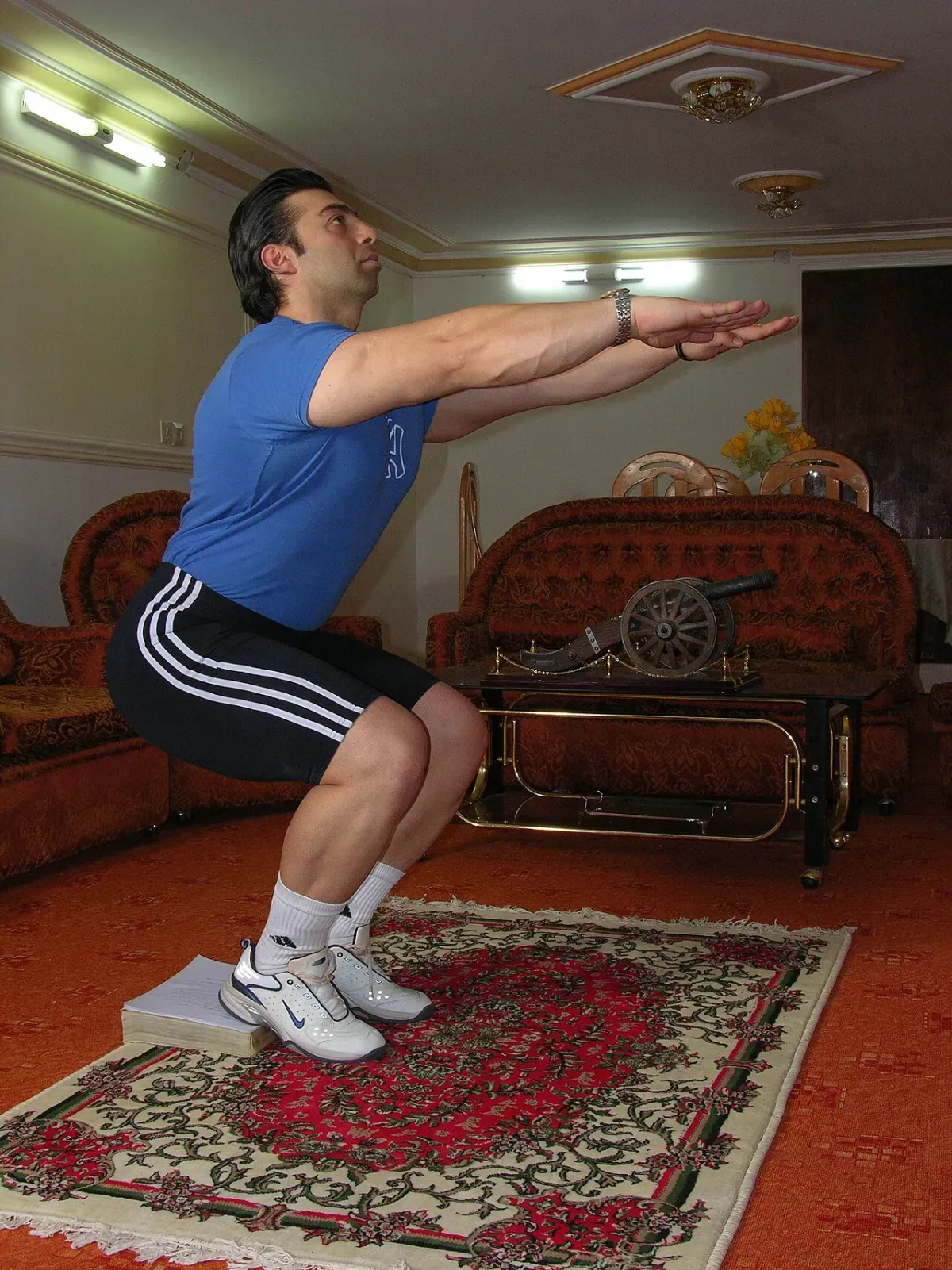 Photo: Mahdi Mousavi / Wikimedia Commons (CC BY-SA 4.0)
Counter or wall push-ups
Floor push-ups aren’t practical in work clothes, so elevating your hands on a sturdy desk, a kitchen counter, or a solid wall makes sense. This reduces the load while still elevating your heart rate. Standing up to push against a wall keeps your clothes clean, too. Our push-up workout guide lays out the ladder from wall and counter push-ups to full floor reps.
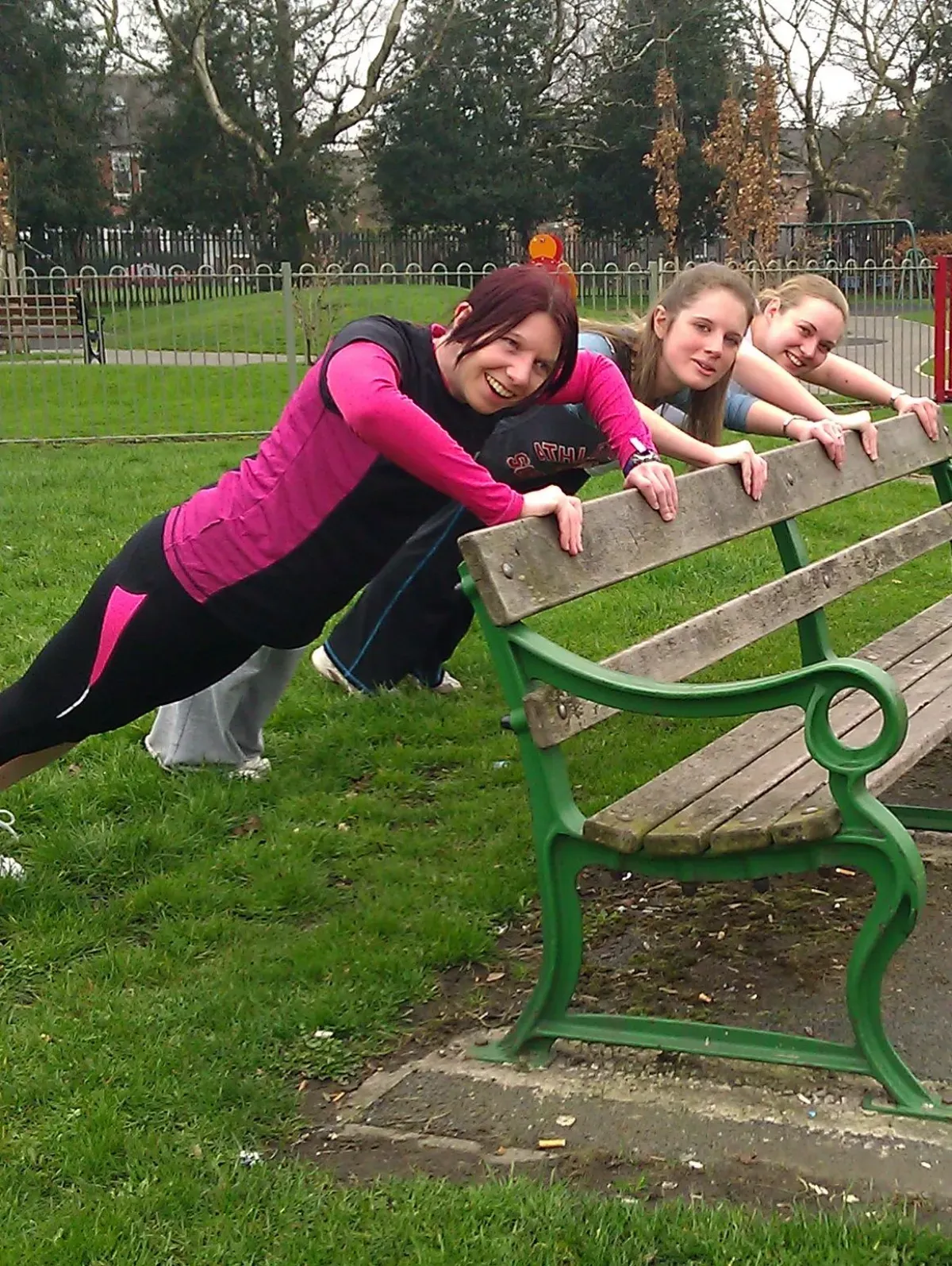 Photo: Pam loves pie / Wikimedia Commons (CC BY 3.0)
Brisk walking bursts and other options
You don’t always need stairs or squats. The VILPA study specifically highlights bursts of very fast walking while commuting. You can also march or jog in place, or do jumping jacks if your joints allow it.
| Snack | How to do it | Where it fits | Make it harder |
|---|---|---|---|
| Stair climb | Climb one to three flights at a pace that leaves you breathing hard (the stair trial used three flights, 60 steps). | Office stairwell, apartment building, subway station. | Take two steps at a time or increase your speed. |
| Bodyweight squats | Lower your hips back and down, then stand back up. Repeat for about a minute. | Living room, home office, break room. | Jump slightly at the top of each repetition. |
| Sit-to-stand | Sit on a sturdy chair, stand up fully, and sit back down without using your hands. | A sturdy chair without wheels, dining table. | Hold a heavy book or water jug against your chest. |
| Incline push-ups | Place hands on a kitchen counter or wall. Lower your chest, then press back up. | Kitchen while boiling the kettle, bathroom wall. | Move your hands to a lower surface like a bench. |
| Fast walking burst | Walk as fast as you can without breaking into a run for one minute. | Commute, walking the dog, grocery store parking lot. | Walk up a steep hill or carry heavy bags. |
| Marching in place | Lift your knees high and pump your arms vigorously. | Next to your desk, watching television. | Transition into light jogging in place or jumping jacks. |
How many exercise snacks per day?
Three a day is a good default
The median VILPA frequency in the UK Biobank study was three bouts per day. The minimal-dose estimate was about 1.5 one-minute bouts per day, the amount linked to roughly half of the largest risk reduction in the study. The stair-climbing trial also used three climbs per day.
Start with two or three snacks on your workdays. Add a fourth only once the first three feel automatic.
Spread them out
The academic definition requires snacks to be performed periodically throughout the day. In the stair trial, participants rested for one to four hours between bouts. You want to space them out to repeatedly break up your sedentary time.
A sample day
Anchoring your snacks to existing events makes them easier to remember.
Here’s how a realistic day might look.
- Morning: After your coffee, climb the stairs in your building for one minute.
- Midday: Right before you eat lunch, do one minute of bodyweight squats.
- Afternoon: During the 3:00 PM slump, do a minute of counter push-ups.
- Evening (optional fourth): While walking home from the bus, do one fast stretch of walking for sixty seconds.
Three one-minute snacks a day come to about 15 minutes of hard effort over a five-day workweek, or 21 if you do them every day. That falls well short of the 150 to 300 minutes of moderate activity recommended in the US guidelines. Think of these snacks as a floor for your daily activity rather than your entire fitness plan.
How to make exercise snacks a habit
Tie each snack to something you already do
According to a 2012 review in the British Journal of General Practice, habits are actions that are triggered automatically in response to contextual cues. Its core advice is to repeat one simple action in the same context until it becomes automatic.
The researchers suggest using cues like “after breakfast” or “when I go on my lunch break”. Write your plan down as an if-then statement. “After I turn on the kettle, I will do counter push-ups.” Choose cues that happen every single day. A bathroom trip, the end of a regular meeting, or getting off the bus are all excellent triggers. Our guide on how to motivate yourself to workout has more on if-then plans.
Expect it to take weeks, not days
Forget the myth that a habit takes 21 days to build. A study by Phillippa Lally and colleagues, cited in that review, found that automaticity plateaued after an average of 66 days. There was considerable variation between people and behaviors.
The researchers suggest telling people to expect the process to take around 10 weeks. They also found that missing an occasional opportunity didn’t seriously impair habit formation. If you forget your afternoon squats on a Tuesday, your habit isn’t ruined. Just do them on Wednesday.
Make the trigger visible
Put the cue where you’ll trip over it. A sticky note on the kettle or a pair of shoes by the stairs does more than a reminder buried in your phone. A simple checklist on the fridge helps too, because a row of ticks is easier to keep going than to start.
Who should be careful with exercise snacks
Exercise snacks are vigorous by definition. The trials summarized earlier were mostly small, short, and often supervised. The 2025 meta-analysis also reports no safety analysis. Those studies don’t tell us much about the risks of sudden, hard exertion at home.
Heart conditions and warning symptoms
Anyone with a heart condition, uncontrolled high blood pressure, or a recent surgery should check with a clinician before adding vigorous bursts to their day. Stop immediately and seek medical help if you experience chest pain or pressure, unusual breathlessness, dizziness, or palpitations.
Knees, joints and stairs
Going from a cold, seated position to an all-out sprint is hard on your joints. Take a few easy steps or slow reps first. If your hips or knees ache on stairs, hold the rail and take the steps at a normal walking pace. If stairs hurt too much, swap them out entirely for counter push-ups and fast walking on flat ground.
Pregnancy, older age and new conditions
If you’re pregnant, have been told by a doctor to limit exertion, or have a new diagnosis you haven’t discussed with a clinician yet, check with them before adding hard bursts. Age on its own isn’t a reason to skip snacks: the VILPA participants averaged almost 62. Older beginners should simply spend longer on the brisk version and hold a rail on stairs.
Where exercise snacks fit in a bigger plan
Why snacks can’t be the whole plan
Exercise snacks are the best answer for people who currently do nothing. They also suit anyone whose days are swallowed entirely by sitting at a desk. They aren’t a replacement for dedicated strength training.
The US guidelines still recommend muscle-strengthening activities on at least two days a week, alongside your aerobic minutes. A minute of squats is useful, but it won’t build the robust strength you need for healthy aging.
Using snacks as a bridge to real workouts
Use snacks to build the habit of daily movement. Once you consistently do your three minutes a day on workdays, you can add more.
You might add two short bodyweight sessions a week using the full-body routine in our calisthenics for beginners guide. You can also start walking more deliberately. Check out our thoughts on whether walking counts as real exercise or the blood sugar benefits of walking after eating.
Your next step is simple. Pick one cue and one snack for tomorrow. When you finish your morning coffee, climb one flight of stairs fast.
Frequently asked
- Do exercise snacks really work?
- For fitness, the early evidence says yes. A 2025 meta-analysis of 27 small trials found improvements in cardiorespiratory fitness, blood pressure and fasting blood sugar, though most trials were short and 12 of the 27 were rated low quality.
- How many exercise snacks a day?
- About three one-minute snacks spread through the day is a sensible target. Three bouts a day was the median in the UK Biobank VILPA study, where it was associated with lower mortality, and the stair-climbing trial that improved fitness also used three climbs a day.
- Can exercise snacks help you lose weight?
- Probably not on their own. A 2025 meta-analysis found no significant change in body mass, though body fat percentage fell slightly compared with control groups.