Quad Exercises at Home: A Practical Progression
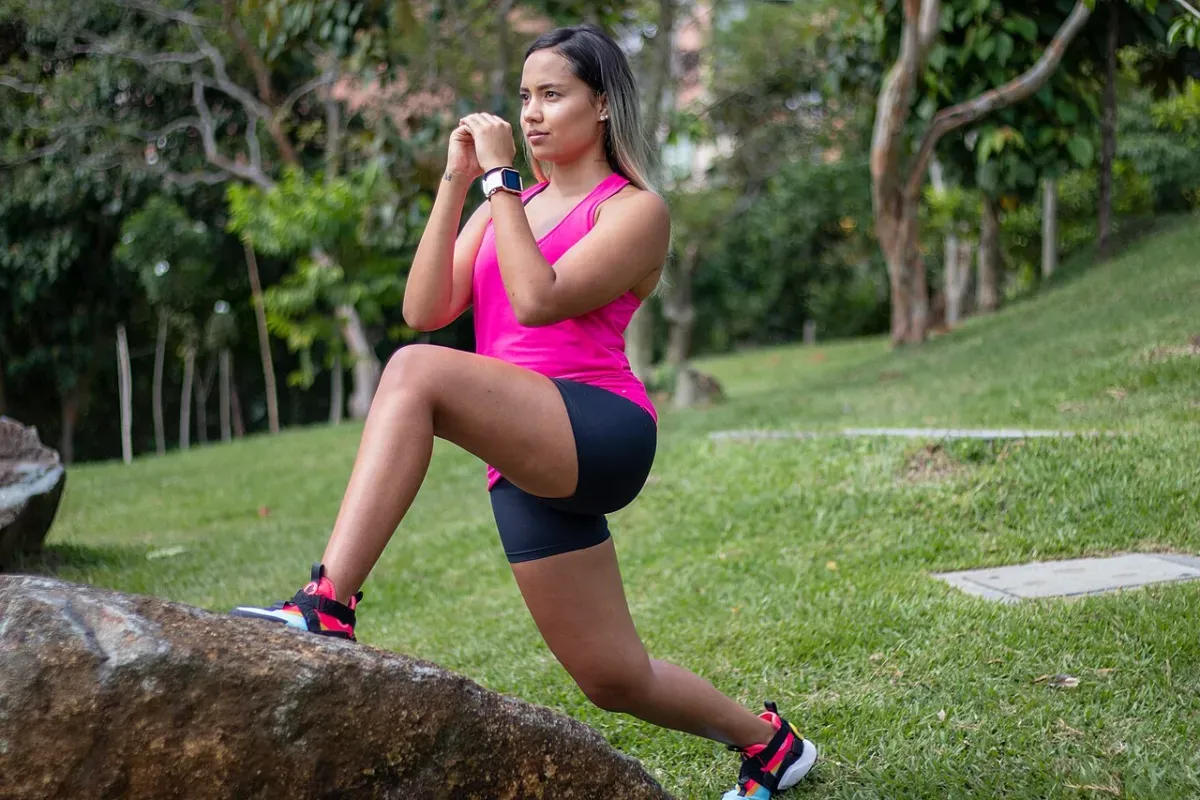
Building your quads at home requires picking two or three knee-dominant movements and training them twice a week. You will need to stop one to three reps short of muscular failure on every single set. Spend your effort on achieving full depth. Sinking low into a squat stretches the muscle under load and provides a powerful stimulus for growth. When the movement inevitably gets too easy, you progress by making the exercise mechanically harder.
Bodyweight training can build the front of your thighs effectively. You just have to follow strict rules about how the knee bends under tension. A bodyweight squat only trains the quadriceps if the knees travel forward and the torso stays upright. If you sit your hips back and lean forward, you turn a quad exercise into a glute exercise. Mechanics dictate the result.
Getting noticeable leg growth without heavy equipment demands high effort. You have to push the muscle close to its physical limit. The goal is to stop a few repetitions short of absolute failure, providing a robust stimulus for adaptation without generating fatigue that ruins the rest of your session. Keep it simple. Master the basic movements, push the sets hard, and recover.
The core rules of home leg training
Two or three movements, twice a week
You don’t need a sprawling menu of different exercises to see results. A home training block only requires two or three carefully chosen movements that load the knee joint through a deep range of motion. Performing these exercises twice a week provides an adequate stimulus for muscle growth while leaving enough time for local tissue recovery. The total volume should sit somewhere between six and twelve hard sets per week.
Effort over sheer exhaustion
Getting results in your living room means you have to work hard. You must push the muscle close to its limit. However, you don’t need to collapse on the floor after every set. The goal is to stop approximately one to three repetitions short of absolute failure. Pushing your legs to this exact proximity is difficult to judge at first. Over time, you will learn what it feels like when the muscle genuinely has only two reps left in the tank.
Progress by making it harder
A common trap for home workouts is the endless repetition loop. Pushing a set of fifty bodyweight squats close to absolute failure will certainly build muscle, but it takes immense cardiovascular effort to get there. Progress relies on increasing the mechanical difficulty of the movement so you reach that same muscular limit in fewer reps. You do this by increasing the range of motion, slowing down the tempo, or shifting the load to a single leg. Buying range and leverage is a reliable long-term solution.
What your quads actually do
Four muscles, one job: straightening the knee
The quadriceps femoris is a group of distinct muscles located on the front of the thigh. The accepted anatomy includes four heads, though some clinical texts now describe a fifth deep layer. The primary four are the rectus femoris, vastus lateralis, vastus medialis, and vastus intermedius. The StatPearls anatomical overview notes that their synergistic action is to extend the knee. In plain terms, their biological function is to straighten the leg from a bent position.
The one head that crosses the hip
Three of those quad muscles originate on the femur itself. They only cross the knee joint. The rectus femoris is the exception. It originates higher up on the pelvis, meaning it crosses both the hip and the knee. Because of this unique routing, the rectus femoris can flex the hip while also helping extend the knee. Hip position therefore directly changes how long or short this specific muscle head is during an exercise. If the front of your thigh feels excessively tight, targeted quad stretches can help address this specific tension.
Joint angles determine the working muscle
If the knee doesn’t bend and straighten significantly under load, the movement simply isn’t a quad exercise. This is a vital distinction for home training. You can perform a squat by bending deeply at the knees while keeping your chest high, which heavily loads the quadriceps. You can also perform a squat by pushing your hips far back and leaning your chest forward, which shifts the leverage heavily onto the glutes and hamstrings. The way your joints move dictates which muscles do the work.
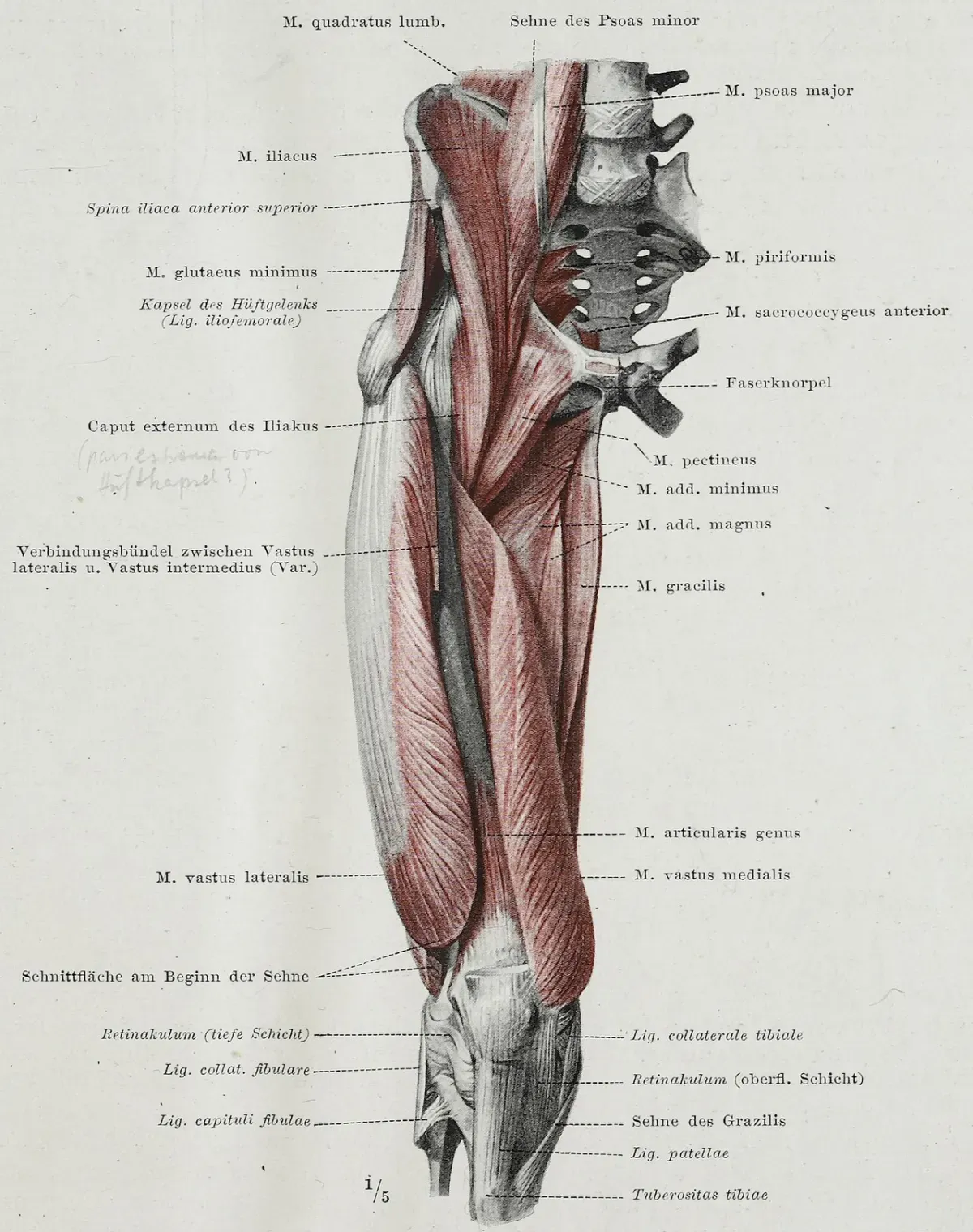 Illustration by Hermann Braus via Wikimedia Commons (Public domain)
Can bodyweight really build quads?
What the low-load research shows
The traditional view of resistance training insists that heavy weights are mandatory for building muscle. Bodyweight training inherently involves lower loads, which leads many to question if home workouts are worth the effort. A 2017 meta-analysis by Schoenfeld and colleagues published in the Journal of Strength and Conditioning Research investigated this directly by comparing low-load training to high-load training. The researchers found that changes in measures of muscle hypertrophy were similar between conditions. Whether people trained at or below 60 percent of their one-repetition maximum, or above it, muscle growth was comparable. This is the bedrock evidence that bodyweight squats and lunges can genuinely build leg size, provided you take those sets close to muscular failure.
The fine print on proximity to failure
That optimistic finding comes with an essential caveat. In the 2017 meta-analysis, every included study took all sets to momentary muscular failure. The low-load subjects had to push until they literally couldn’t complete another repetition. For a time, this suggested that bodyweight training only works if you grind yourself into the ground on every single set.
More recent data softens this requirement. A 2023 meta-analysis in Sports Medicine examined proximity to failure. The researchers concluded there is no evidence to support that resistance training performed to momentary muscular failure is superior to non-failure training for muscle hypertrophy. The results provide evidence for a potential non-linear relationship between proximity to failure and growth. This means your sets must be genuinely hard, but they need not be maximal. Stopping one to three repetitions shy of failure is sufficient to drive adaptation.
Where bodyweight genuinely falls short
Bodyweight quad work builds muscle highly effectively when sets are taken close to failure. Heavy loading remains superior for maximal strength. The 2017 data showed that gains in one-repetition maximum strength were significantly greater in favour of high-load training. If your goal is to compete in a maximal single lift, bodyweight alone isn’t the best tool. You should judge a home quad plan on the effort applied and the depth achieved.
How to make a bodyweight squat into a quad exercise
Let the knees travel forward
Quad bias is fundamentally a mechanics problem. To force the quadriceps to work, you have to increase the demands placed on the knee joint. The simplest way to achieve this is an upright torso with knees travelling forward over the toes. This specific posture lengthens the knee moment arm and shortens the hip moment arm. The further forward your knees travel while your heels stay planted, the harder your quads have to work to straighten the leg.
Elevate your heels
Many people lack the ankle mobility required to push their knees far forward while keeping their feet flat on the floor. Their heels naturally lift, or they fall backward. Elevating the heels one to two inches on a sturdy book or a doorstep provides an instant mechanical fix. This artificial elevation increases potential knee flexion and permits more forward knee travel. It rescues people whose stiff ankles limit their squat depth.
Stay tall, stop sitting back
The natural instinct for most beginners is to push their hips backward when they start to squat. This feels safer and more balanced. Unfortunately, sitting the hips back with a forward torso lean quietly transfers the workload away from the quads. The glutes and hamstrings take over the heavy lifting. To keep the tension on the front of your thighs, fight the urge to bow forward. Keep your chest facing the wall in front of you, drop your hips straight down toward your heels, and let your knees drift forward. Go deep. Stay tall.
Depth is your primary tool
Cutting your range of motion short robs you of the most effective portion of the exercise. A 2022 study in the European Journal of Sport Science measured muscle growth in 45 untrained women performing machine knee extensions. The group training only in the initial, stretched part of the range presented a greater relative increase in quad size at 70 percent of femur length than all other groups. At 50 and 60 percent of femur length, their increases were greater than the full-range and non-training control groups.
While this was a machine knee-extension study in untrained women, it suggests that training the muscle at long lengths is a powerful stimulus. Sinking deeply into a squat stretches the quadriceps under tension. Depth is the primary lever you have for home hypertrophy.
Eight quad exercises at home, ordered by knee demand
Chair squat
The chair squat offers a safe environment to practice upright mechanics. Stand a few inches in front of a sturdy chair. Keep your chest up. Lower your hips slowly until you lightly touch the seat, and immediately drive back up. Do not relax your weight onto the chair at the bottom. This movement works well in the 8 to 20 repetition range, cueing the quads gently before you advance.
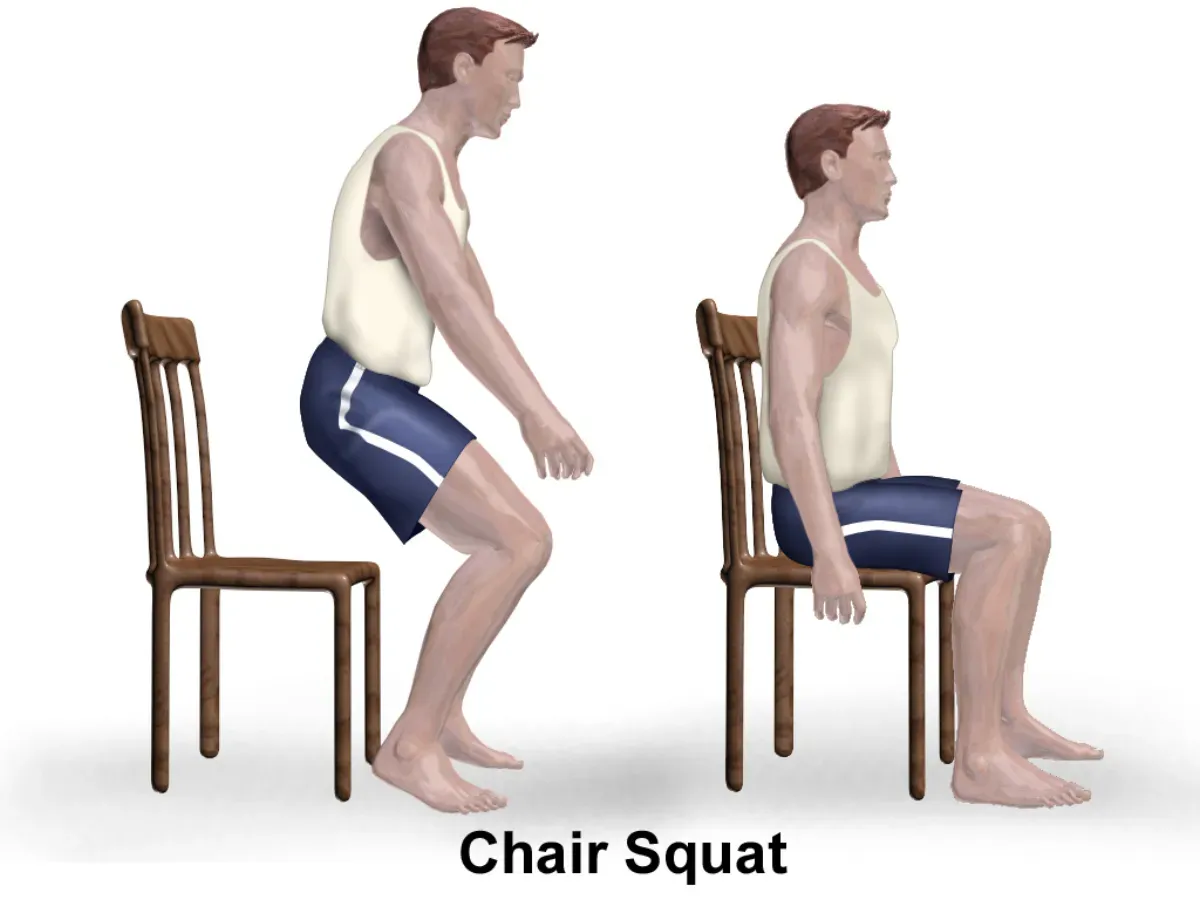 Illustration by BruceBlaus via Wikimedia Commons (CC BY-SA 4.0)
Wall sit
The wall sit provides a static alternative. Put your back flat against a wall and slide down until your thighs are parallel to the floor. Keep your shins vertical. Hold this position to build baseline endurance. Continue the hold until severe burning or leg shaking starts, then carefully stand up.
Heel-elevated squat
Once you can manage basic depth, escalate the knee demand. Place a two-inch book under your heels to allow maximum forward knee travel while you maintain a perfectly vertical torso. Drop your hips straight down. This artificial lift forces the quadriceps to manage the entire load through a deep bend.
Split squat
The split squat places one foot forward and one foot back. Take a moderate stride. Keep your chest high. Drop your rear knee straight down toward the floor. Most of your weight should sit on the front leg. This shifts a larger percentage of your body weight onto a single limb.
Bulgarian split squat
Elevating your rear foot on a chair or sofa turns the standard split squat into a Bulgarian split squat. Hop your front foot forward. Lower yourself slowly. The elevated back leg forces the front thigh to do almost all the work and tests your balance heavily. It will quickly fatigue the quads even without extra weight.
Slow step-down
Stand sideways on a sturdy box or a bottom stair. Hover one foot off the edge. Bend your standing knee slowly. Take three full seconds to lower your free heel to the floor, then push back up. Focus entirely on controlling your pelvis and keeping the standing knee tracking over the toes.
Reverse Nordic
Kneel on a soft pad with your hips fully extended and your torso in a straight line from knee to shoulder. Lean backward slowly. Pull yourself back upright. Because the hip remains extended, this loads the rectus femoris at a long length. The reverse Nordic isolates the knee perfectly. Remember that the hamstrings, glutes and calves live next door; a complete lower body routine must address them too. We cover the entire leg in our leg workout at home.
Sissy squat
The sissy squat is an advanced standing variation. Stand next to a doorframe for balance. Lean your torso backward while driving your knees far forward over your toes, keeping your hips locked in extension. Your heels will naturally lift. Pull yourself back to the start. This targets the front of the thigh directly.
Progressing when you cannot add weight
The order that matters for quads: range, then tempo, then one leg
When a barbell is unavailable, you have to apply mechanical disadvantages to keep your workouts challenging. For the quadriceps, the specific order of these variables matters immensely. Your first priority is always to buy range of motion. Fix your depth and ensure your heels are elevated if necessary before you alter anything else.
Once your depth is maximized, manipulate tempo. Introduce a three-second lowering phase, add a brief pause at the bottom to remove momentum, and eventually wear a loaded backpack. We cover this exact sequence in our complete guide to a leg workout at home.
When to move up a rung
You need a clear decision rule for advancement. Move up a progression rung when you hit the top of the rep range at your target effort for two sessions running. If your goal is 15 repetitions stopping two reps shy of failure, and you successfully hit 15 deep, paused squats for multiple sets on Tuesday and Friday, it is time to progress. Shift to a split squat or a step-down.
Why single-leg work is the bridge to advanced strength
Range and tempo eventually reach their logical limits. You can only squat so deep, and moving too slowly eventually turns a strength exercise into an endurance test. Shifting to single-leg work sharply increases the share of bodyweight the working thigh carries. It bridges the gap between beginner calisthenics and advanced strength training.
A two-day quad plan for a living room
This framework provides 12 hard quad sets per week across two sessions on non-consecutive days. Aim for the 8 to 20 repetition range. Stop roughly one to three reps short of failure. Rest for 90 to 120 seconds between sets to allow the muscle to recover its force production capacity. Rushing your rest periods turns a strength workout into a cardio circuit. This specific quad block is designed to be bolted onto an existing training week, acting as a complementary piece to foundational calisthenics for beginners.
Day A: Depth Focus
This initial session prioritizes bilateral loading and maximal knee travel. Focus on sinking deeply into the repetitions and controlling the descent.
| Exercise | Sets | Reps / Time | Notes |
|---|---|---|---|
| Heel-Elevated Squat | 2 | 10 to 15 reps | Three seconds lowering, one-second pause at the bottom. |
| Reverse Nordic Curl | 2 | 8 to 12 reps | Keep the hips fully extended. Move slowly. |
| Wall Sit | 2 | Hold to limit | Stop when severe burning or leg shaking starts. |
Day B: Single-Leg Focus
The second session shifts the mechanical tension to one leg at a time. This challenges stability while dramatically increasing the weight borne by each quadriceps.
| Exercise | Sets | Reps / Time | Notes |
|---|---|---|---|
| Bulgarian Split Squat | 2 | 8 to 12 per leg | Torso upright, front knee travelling forward. |
| Slow Step-Down | 2 | 8 to 12 per leg | Focus entirely on a smooth, controlled lowering phase. |
| Chair Squat | 2 | 15 to 20 reps | Use this as a lighter finishing movement. |
Common movement errors and safety signals
Losing depth and dropping the chest
The most pervasive mistake in home leg training is the quarter squat. Stopping the descent early robs the quadriceps of the deep stretch required for optimal growth. Compounding this error is the tendency to sit the hips far back while dropping the chest. This mechanical shift transfers the tension away from the front of the thigh and places it onto the glutes and lower back. If you want to train your quads, stay tall and go deep.
Allowing the knees to collapse inward
As fatigue mounts during a tough set, the knees often collapse inward toward each other. This inward caving compromises the alignment of the leg and shifts the tension away from the quadriceps. Your knees should track directly over your toes throughout the entire movement. If they consistently collapse inward, the variation is too difficult, or you’re pushing too close to total failure. Drop to an easier exercise.
Avoiding single-leg loading
Many trainees spend years performing high-repetition bodyweight squats without ever progressing. Never moving past two-legged variations leaves a tremendous amount of potential muscle growth on the table. Bilateral squats are an excellent starting point. They are rarely a good endpoint. Embrace the difficulty of single-leg training to force the muscle to adapt to higher loads.
When to back off and see a clinician
Soreness in the front of the thigh a day or two after a hard session is perfectly ordinary. Pain inside the knee itself, during the rep, is not the same thing as soreness the next day. The AAOS OrthoInfo patient guidance on patellofemoral pain syndrome notes that weak or imbalanced quadriceps and hip muscles can cause poor tracking of the kneecap within the groove. Repeated knee bending in activities like squatting, stair climbing, running and jumping typically aggravates this condition. AAOS tells patients to stop the activities that make the knee hurt, and to see a doctor if the pain persists.
From a practical standpoint, listen to acute signals. Sharp or pinpoint pain at the front, bottom or side of the kneecap during a repetition is a clear signal to reduce your depth or switch to a shallower variation. Do not try to push through joint discomfort. Swelling, the knee locking or giving way, or pain that is still present after a timeframe between a few weeks and six weeks of sensible training is a definitive reason to see a clinician. Anyone with an existing knee diagnosis, a recent injury, or a return from surgery should obtain individual medical advice before loading the joint. If your knee is already irritable and you need gentler, rehab-oriented routines, start with dedicated knee strengthening exercises.
Frequently asked
- Can you build quad muscles without weights?
- Yes, bodyweight training can build the quadriceps effectively if you take your sets close to muscular failure. You need to use knee-dominant exercises and focus on deep ranges of motion to challenge the muscle.
- Why do my glutes hurt instead of my quads when I squat?
- Sitting your hips backward and leaning your chest forward shifts the leverage onto the glutes and hamstrings. To target the quads, keep your torso upright and let your knees travel forward over your toes.
- How many times a week should I do quad exercises at home?
- Training your quads twice a week on non-consecutive days provides an excellent stimulus for growth while allowing tissues to recover. Aim for a total of six to twelve hard sets per week across those two sessions.