Back Workout at Home: No Equipment Needed
A real back workout at home is harder to put together than a chest or ab routine, and it helps to say why up front. Your back is mostly a pulling muscle group. Push-ups, planks, and squats all push or brace against the floor, and the floor is always there. Pulling needs something to pull toward you, and a living room has very little of that. So the honest version of this guide splits in two: the spinal muscles you can hammer with nothing but a floor, and the lats and mid-back that need a towel, a backpack, a band, or a table to load at all.
Skip that distinction and you end up doing a hundred supermans, wondering why your upper back never changes. Here is a back routine you can actually run at home, scaled from total beginner to a point where you’ll forget you don’t own a cable machine.
The short answer
Train your back two or three times a week. Each session, pick one or two floor moves for the muscles along your spine and one or two pulling moves for your lats and mid-back. Do three or four sets of eight to fifteen reps, and stop each set a rep or two before your form falls apart.
If you own nothing, the floor work still happens, and you improvise the pulling with a wrung-out towel and a doorframe or a backpack stuffed with books. The single best upgrade, and it costs nothing, is finding a sturdy table to do inverted rows under. That one move covers the part of your back that floor exercises miss.
The rest is just running that without the common mistakes that quietly waste the effort.
What your back actually is
Two groups, and they behave differently, which is the whole reason home back training is awkward.
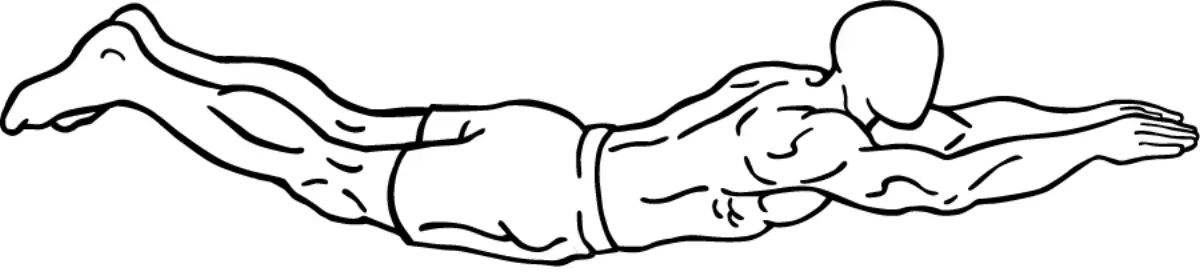 Illustration by Everkinetic via Wikimedia Commons (CC BY-SA 3.0)
The first group runs along your spine: the erector spinae, plus the smaller stabilizers and the lower fibers of the trapezius and rhomboids between your shoulder blades. These extend your spine and hold your posture upright. You load them by lifting your chest and limbs off the floor against gravity, which is why superman-style moves work with zero equipment.
The second group is the pulling machinery: the latissimus dorsi (the broad muscles that give a back its width), the rhomboids and mid-traps that pinch your shoulder blades together, and the rear deltoids. These shorten when you pull something toward you or pull yourself up to something. There is no floor exercise that loads them properly, because gravity pulls you down, not back. This is the half people neglect, and it’s the half that makes a back look trained.
A complete session touches both. Floor work alone gives you a stronger lower back and better posture but a flat upper back. Pulling alone skips the spinal endurance that keeps you upright at a desk all day.
No-equipment back exercises (the floor work)
Everything here needs a floor and maybe a rolled towel under your forehead. Start with whichever you can do for clean reps and build from there.
Superman
Lie face down, arms stretched overhead. Lift your arms, chest, and legs off the floor at the same time, hold for a second at the top, lower under control. Don’t crank your neck back, keep your gaze down so your head stays in line with your spine. This is the foundation move for the erector spinae. Three sets of ten to fifteen, with a one-second hold, is plenty to start.
Prone Y-T-W raises
Same face-down position, but now you target the mid and lower trapezius that pull your shoulder blades down and back, the muscles that fight a rounded, hunched posture. Lift your chest slightly, then move your arms through three shapes:
- Y: arms overhead in a narrow V, thumbs up.
- T: arms straight out to the sides, squeezing your shoulder blades together.
- W: elbows bent and pulled down toward your ribs, like racking a bar behind you.
Do five to eight slow reps of each letter. These look easy and aren’t. The point is the squeeze, not the height.
Reverse snow angel
Lie face down with arms by your sides, palms down, chest lifted an inch off the floor. Sweep your arms along the floor up overhead and back down, keeping your hands low and your shoulder blades working the whole time. It’s a snow angel done face down, and it lights up the upper back with no load at all. Two sets of ten.
Bird-dog
On hands and knees, extend your opposite arm and leg until they’re level with your torso, hold, then switch sides. The goal is not how high you can reach, it’s keeping your spine and hips perfectly still while a limb moves. ACE describes the bird-dog as an excellent exercise to train the body to stabilize the lower back during arm and leg movement, and warns against letting the low back move at all (ACE Exercise Library, bird-dog). Slow and controlled beats fast and sloppy every time. Eight to ten reps per side.
Pulling exercises with minimal gear
This is the half that needs something to pull against. You can build all of it from things you already own.
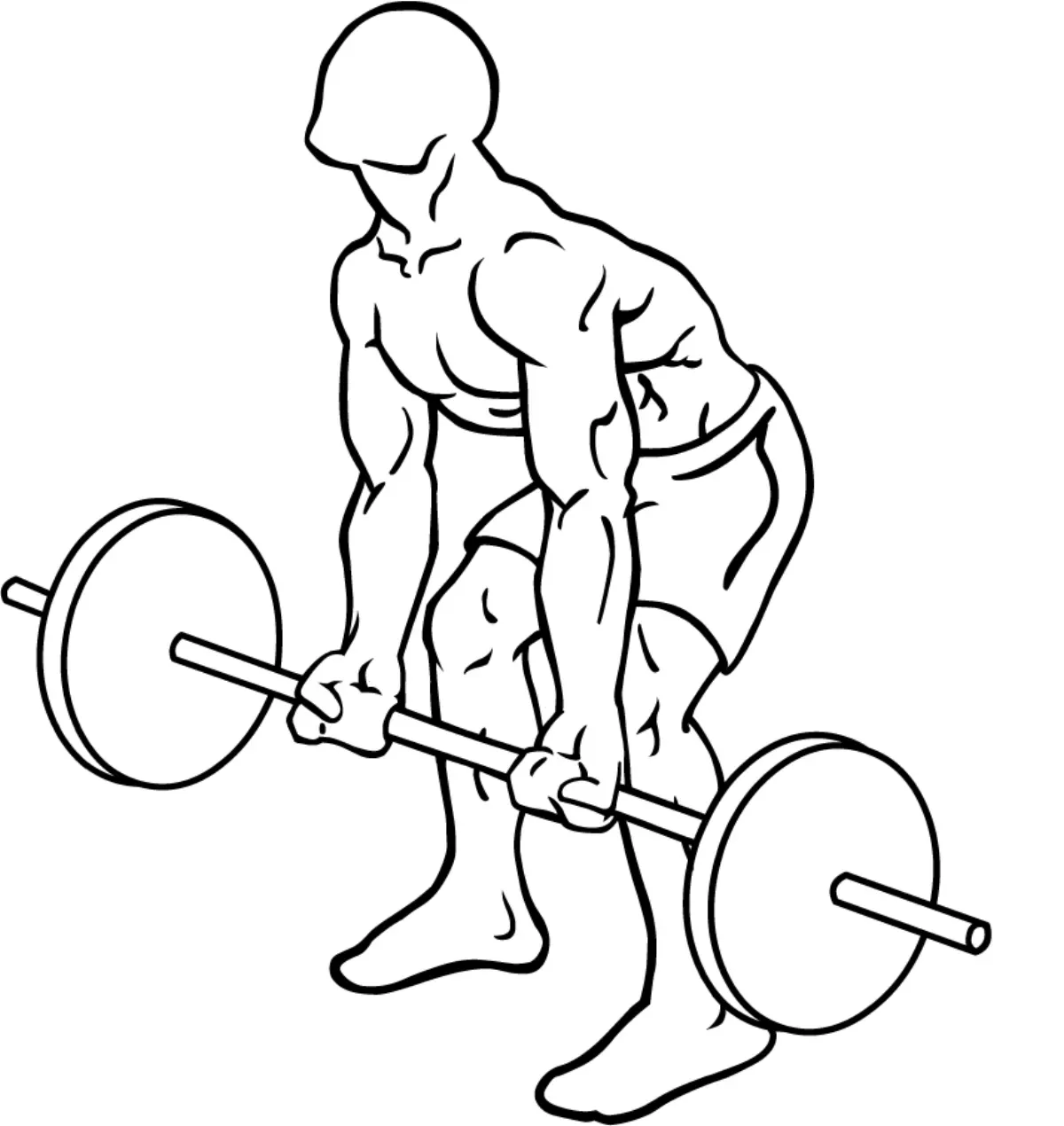 Illustration by Everkinetic via Wikimedia Commons (CC BY-SA 3.0)
Towel row
Loop a towel around a fixed post, a closed door’s handle on both sides, or a railing. Hold an end in each hand, lean back so your arms are straight and your weight hangs off the towel, then pull your chest toward your hands by driving your elbows back and squeezing your shoulder blades. Walk your feet forward to make it harder, back to make it easier. It’s a self-spotting row: you supply exactly as much load as you can handle by changing your angle.
Backpack or band row
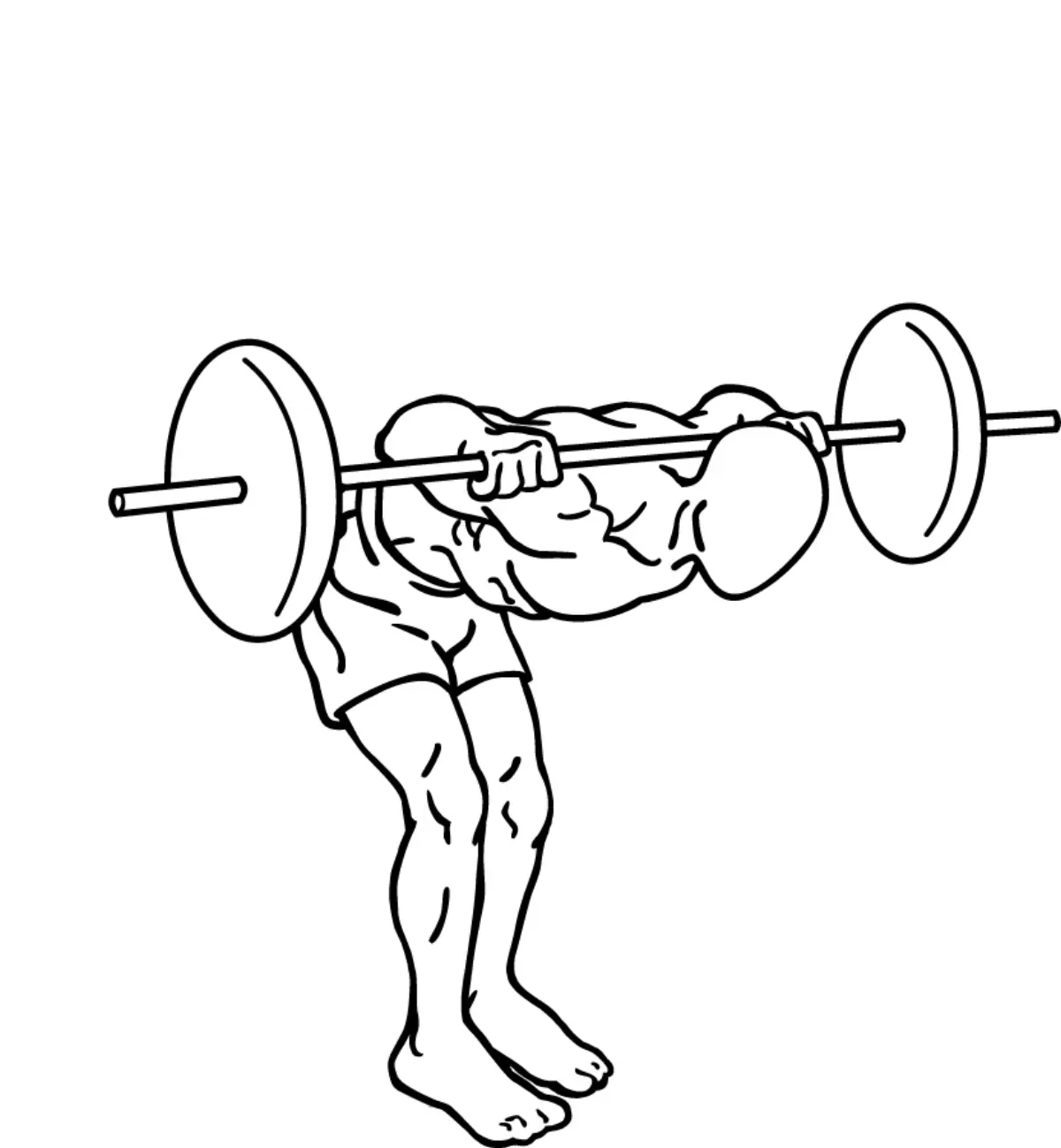
Load a backpack with books or water bottles. Hinge at the hips with a flat back, let the bag hang from one hand, and row it up to your ribs, then the other side. A resistance band pinned under both feet and pulled to your waist does the same job and is easy to scale by shortening your grip. Both train the lats and mid-back through a real range, and a backpack is trivial to make heavier as you get stronger.
Doorway or table inverted row
This is the best fully bodyweight pulling move, and the reason is in the research. When scientists compared an inverted row against a bent-over row and a one-armed cable row, the inverted row produced the highest activation in the latissimus dorsi and upper-back muscles of the three (Fenwick, Brown & McGill, 2009).
Find a sturdy table that won’t tip. Lie underneath it, reach up and grip the edge, then pull your chest up to the table while keeping your body in a straight plank line from heels to head. Bend your knees and plant your feet to make it easier, straighten your legs out to make it harder. No suitable table? A broomstick resting across two solid chairs works, as long as both chairs are braced against a wall or weighted so nothing slides.
Doorframe pull (last resort)
If you have nothing else, stand close to an open doorway, grip both sides of the frame at chest height, and pull your chest toward the frame while leaning your weight back through your heels. It’s a weak substitute for a real row, but it teaches the pulling pattern and engages the lats when you’ve got literally no gear. Use it as a starter, not a destination.
A simple weekly plan
Train back two or three days a week, never back to back, because the muscle rebuilds on the rest days. The WHO recommends muscle-strengthening activity involving the major muscle groups on two or more days a week for adults, which a couple of focused back sessions covers easily (WHO physical activity fact sheet).
Here’s a beginner-to-intermediate week you can run in a bedroom:
- Day 1 (spine and posture focus): Superman, 3 sets of 12. Prone Y-T-W raises, 2 rounds. Bird-dog, 3 sets of 8 per side. Rest 60 seconds between sets.
- Day 2 (rest or other muscles): Walk, train legs, or work elsewhere. Our leg workout at home and ab workout at home routines slot in here cleanly.
- Day 3 (pulling focus): Table inverted rows, 4 sets to a couple of reps short of failure. Backpack rows, 3 sets of 12 per side. Reverse snow angel, 2 sets of 10.
- Day 4 (rest).
- Day 5 (mixed): One floor move and one pulling move, four sets each, picking whatever felt weakest this week.
When inverted rows start feeling easy, straighten your legs and elevate your feet rather than just adding reps. For the backpack rows, add weight. Your back grows because the pulling got harder, not because you racked up volume on easy versions. A balanced upper body pairs this with pressing work, so our chest workout at home and push-up workout guides make a sensible counterpart on non-back days.
Why a strong back is worth the trouble
The visible payoff is width and an upright frame. The bigger one is posture. Most of us spend the day rounded over a phone or a keyboard, and the muscles that pull the shoulder blades back, the mid-traps and rhomboids, quietly weaken from disuse. Training them is the direct fix for that hunched, shoulders-forward look, and the spinal erectors you build with supermans are what let you sit and stand without slumping by mid-afternoon.
The bird-dog and the row patterns also reinforce the bracing you use everywhere else, from carrying groceries to deadlifting if you ever do pick up weights. A back you’ve trained is a back that complains less. If you’re building a full bodyweight base, our calisthenics for beginners guide ties the back work into the rest of a balanced routine.
Common mistakes
A few errors cancel out most home back training. Fix these before anything else.
- Doing only floor work. Supermans and snow angels are great for your spine and posture, but they barely touch the lats and mid-back. If your whole back routine happens face down on the floor, you’re training half your back. Get a pulling move in every session.
- Using your arms instead of your back on rows. On any row, lead with your elbows and consciously squeeze your shoulder blades together before your arms bend. If you feel it only in your biceps, slow down and start the pull from the squeeze.
- Yanking your neck back on the superman. Cranking your head up to lift higher strains your neck and adds nothing. Keep your gaze at the floor so your head trails your spine.
- Skipping the squeeze. The back responds to the contraction, not the swing. A short pause and a hard shoulder-blade squeeze at the top of every rep is worth more than two extra sloppy reps.
- An unsafe table or chairs. An inverted row only works if the surface won’t move. Test it with your full weight before you trust it, and brace chairs against a wall. A collapsing setup is the one way this routine can actually hurt you.
Keep showing up on the days you don’t feel like it
The moves are the easy part. The hard part is doing them on a quiet Tuesday when nothing forces you to crawl under a table and pull. Consistency, not the perfect program, is what separates the people who build a back at home from the people who quit after a week of sore shoulders.
That’s where a little outside accountability helps. A streak you’d rather not break, or a vague intention turned into a small concrete reason to do the work today, is often enough to get you onto the floor on a low-motivation day.
If the real obstacle is starting at all, our piece on fitness gamification digs into why a small daily nudge beats waiting to feel inspired. Pick one floor move and one pulling move, do three sets of each, and put it back on the calendar two days out. The back catches up from there.
Frequently asked
- Can you train your back at home without any equipment?
- Partly. Floor moves like the superman, prone Y-T-W raises, reverse snow angels, and bird-dogs need nothing and strengthen the muscles along your spine. The hard part is the pulling muscles, your lats and mid-back, because you need something to pull against. A towel, a loaded backpack, or a sturdy table fixes that for free, so a genuine back workout at home is very doable with almost no gear.
- What is the best no-equipment back exercise at home?
- For the muscles along your spine, the superman and the bird-dog are the most useful, and a physiotherapy review by ACE describes the bird-dog as an excellent way to stabilize the lower back. For the pulling muscles, you need light resistance, so an inverted row under a sturdy table is the strongest fully bodyweight option once you can hold a plank.
- How often should I do a home back workout?
- Two to three sessions a week, with at least one rest day between them. That lines up with the WHO guidance to do muscle-strengthening activity on two or more days a week. Eight to fifteen reps per set, three or four sets per exercise, stopping a rep or two before your form breaks down.