Shin Splint Stretches to Ease Lower Leg Pain
Adjusting your exercise volume is the most reliable way to recover from shin splints. Stretching the muscles of your lower leg can ease the immediate feeling of tightness and make walking comfortable again. While mobility work helps the leg feel better in the short term, managing your training load is the primary driver of long-term recovery.
According to the American Academy of Orthopaedic Surgeons (AAOS), this condition develops when muscle and bone tissue in the lower leg get overworked by repetitive activity. You might stretch diligently every single morning. If you return to your normal mileage too quickly, the ache will likely return.
Healing requires a careful balance between rest and tissue adaptation. The goal isn’t just to silence the discomfort for a few hours. You want to build enough structural tolerance in your lower legs to handle the demands of your sport.
The anatomy of lower leg pain
Shin splints act as a catch-all term for exercise-induced leg pain, but the discomfort usually stems from specific structural issues. The pain generally appears as a dull ache along the shinbone. It is an overuse injury that develops when you ask your lower legs to absorb more impact than they can currently tolerate.
Distinguishing the types of shin pain
When runners talk about this injury, they are typically referring to one of two different presentations. Medial tibial stress syndrome (MTSS) is the most common. This causes pain along the inner edge of the lower half of your tibia. The second presentation involves pain on the outside front of the leg. This anterior shin pain usually involves the tibialis anterior muscle working too hard to control your foot as it strikes the ground.
Historically, medical professionals thought shin splints were simply a case of periostitis, an inflammation of the thin connective tissue wrapping the bone. Modern histology suggests the condition is more complex. MTSS involves a spectrum of bone stress and structural remodelling along the inner edge of the tibia.
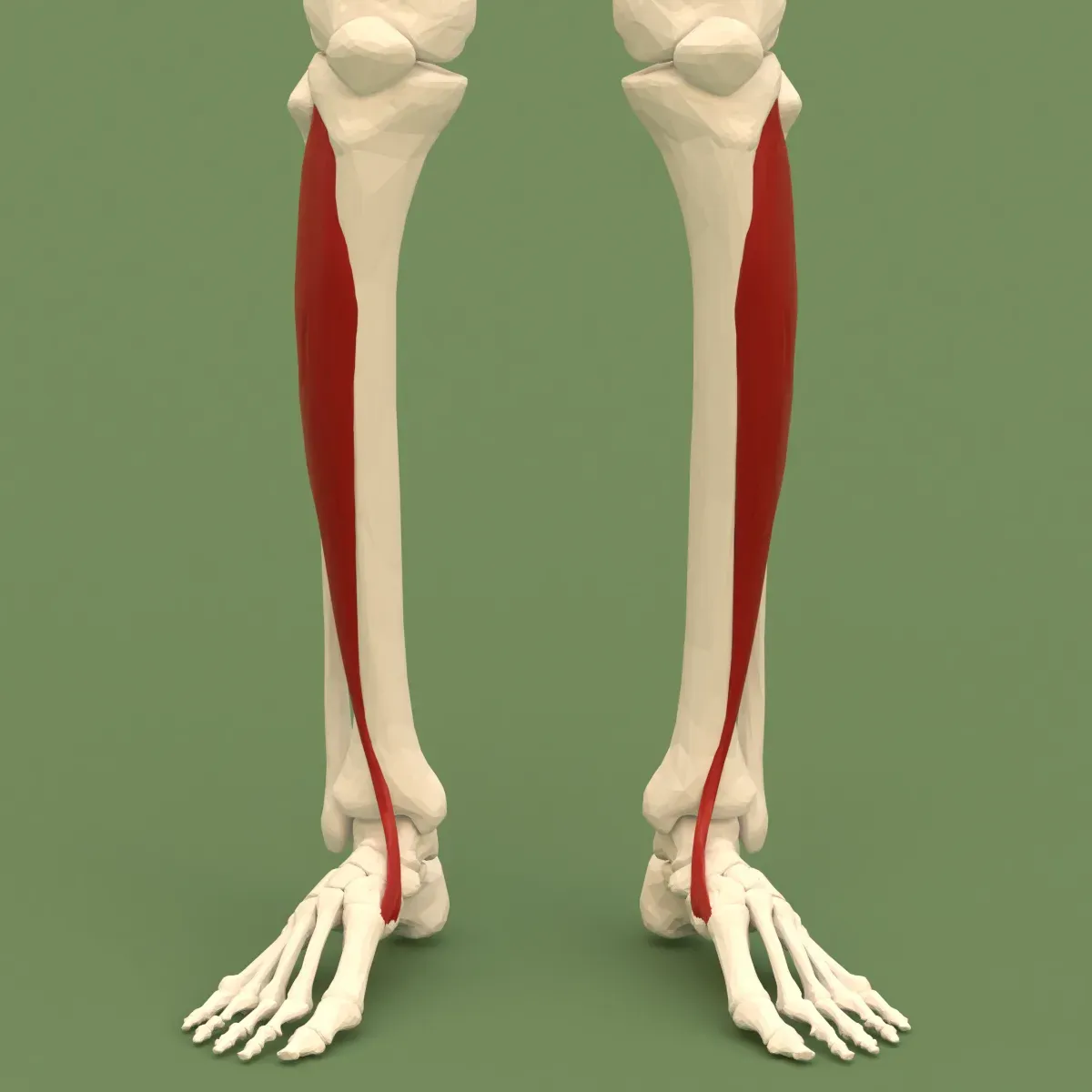 Photo: Database Center for Life Science / Wikimedia Commons (CC BY-SA 2.1 jp)
Bone remodelling in athletes
Bones are living tissues that constantly rebuild themselves in response to mechanical stress. When you run, your tibia bends microscopically with every footfall. This mild stress stimulates cells called osteoclasts to clear away older, micro-damaged bone tissue. A different group of cells called osteoblasts then lay down fresh bone in its place. That new bone is less mineralised at first, which is exactly why the remodelling window is the vulnerable one.
This remodelling process takes time. If you run too frequently, the clearing away of old bone outpaces the rebuilding of new bone. The outer layer of the tibia becomes weakened and irritated.
Why ramping up mileage triggers the ache
Your bones and muscles are highly adaptable, but they adapt at different rates. Your cardiovascular system might adapt to a sudden spike in mileage within a few weeks, but your lower leg bones need much longer to reinforce themselves.
The AAOS notes that the risk for shin splints rises with sudden changes in the frequency, duration, or intensity of exercise. The repetitive impact of your foot hitting the pavement overwhelms the skeletal structures before they have a chance to strengthen. Other common risk factors include running in worn-out footwear and having flat feet, both of which alter how impact forces travel up your leg.
Stretches for the front of the leg and the calf
Tightness in the back of your leg directly affects the mechanics of the front of your leg. If your calf muscles are stiff, your anterior shin muscles have to work harder to lift your toes and clear the ground. A comprehensive mobility routine targets both areas. You can find more detailed ideas in our guide to calf stretches.
1. Seated tibialis anterior stretch
The tibialis anterior is the large muscle running down the outside of your shin. It is responsible for pulling your toes upward toward your knee. To stretch it, you need to point your toes downward in plantar flexion.
- Sit comfortably on a chair with your back straight.
- Cross your painful leg over your opposite knee, resting your ankle on your thigh.
- Reach down and place your hand over the top of your foot and your toes.
- Gently pull your toes and foot downward, pointing them away from your knee.
- Hold this position for 30 to 45 seconds while breathing normally.
- Perform three sets on each leg.
2. Kneeling shin stretch
This movement provides a deep stretch for the entire front of the lower leg. It requires a fair amount of knee flexion, so skip this one if you have a history of knee joint pain.
- Find a soft surface like a yoga mat or a carpeted floor.
- Kneel down with your legs together.
- Point your toes straight back so the tops of your feet rest flat against the floor.
- Slowly lower your hips backward until you are sitting on your heels.
- Keep your torso upright and let your body weight create the tension.
- Hold the stretch for 30 to 45 seconds.
If this causes too much pressure on your ankles, place a rolled-up towel under them for support.
3. Straight-leg gastrocnemius wall stretch
Your calf comprises two main muscles. The gastrocnemius is the large, visible muscle that crosses behind your knee joint. To stretch it effectively, your leg must remain straight.
- Stand facing a wall about two feet away.
- Place both hands flat against the wall at shoulder height.
- Step your painful leg back.
- Keep that back knee straight and press your back heel firmly into the floor.
- Bend your front knee and lean your weight forward toward the wall.
- Hold this position for 30 to 45 seconds.
- Complete three repetitions on each side.
4. Bent-knee soleus stretch
The soleus is the second major calf muscle. It sits underneath the gastrocnemius and only crosses the ankle joint. You must bend your knee to target the soleus. If you leave your knee straight, the gastrocnemius takes all the tension.
- Return to the same wall stretch position.
- Step your painful leg back and plant your heel on the floor.
- Bend your back knee slightly.
- Lower your hips toward the floor while keeping your back heel completely flat.
- You will feel the stretch shift lower down your leg, closer to your Achilles tendon.
- Hold this bent-knee position for 30 to 45 seconds.
5. Toe walks and heel walks
Static stretching is helpful for relaxing tight tissue, but dynamic movement is useful for restoring normal blood flow. Toe walks and heel walks engage the lower leg muscles through their full range of motion.
- Clear a short path in your hallway.
- Rise up onto the balls of your feet.
- Walk forward for 20 steps while staying as high on your toes as possible.
- Turn around and lift your toes completely off the floor.
- Balance only on your heels and walk back to your starting point.
This active contraction forces the shin and calf muscles to coordinate, keeping them working together as you move.
What foam rolling can do (and what it cannot fix)
Runners frequently use foam rollers and massage guns on their tight calves and shins. The sensation of deep pressure often feels therapeutic. It helps to understand the physical limits of these recovery tools.
Soft tissue work and perception
Foam rolling may make a tight calf feel looser for a while, but the mechanism is not settled.
It is worth noting that robust clinical trials on stretching and rolling specifically for medial tibial stress syndrome are lacking. Much of the evidence we rely on comes from general muscle soreness research. A 2025 scoping review by Di Lorenzo et al. in the Journal of Functional Morphology and Kinesiology found the pain-relieving effects of foam rolling inconsistent across trials, concluding its role is probably more mechanical than analgesic. The same review found low-intensity active recovery does help, and that static stretching showed limited benefit for soreness and was not recommended as a primary strategy. That last line is worth sitting with, given it applies to the five stretches above. None of this evidence is about bone, and neither rolling nor stretching does anything for the tibia itself.
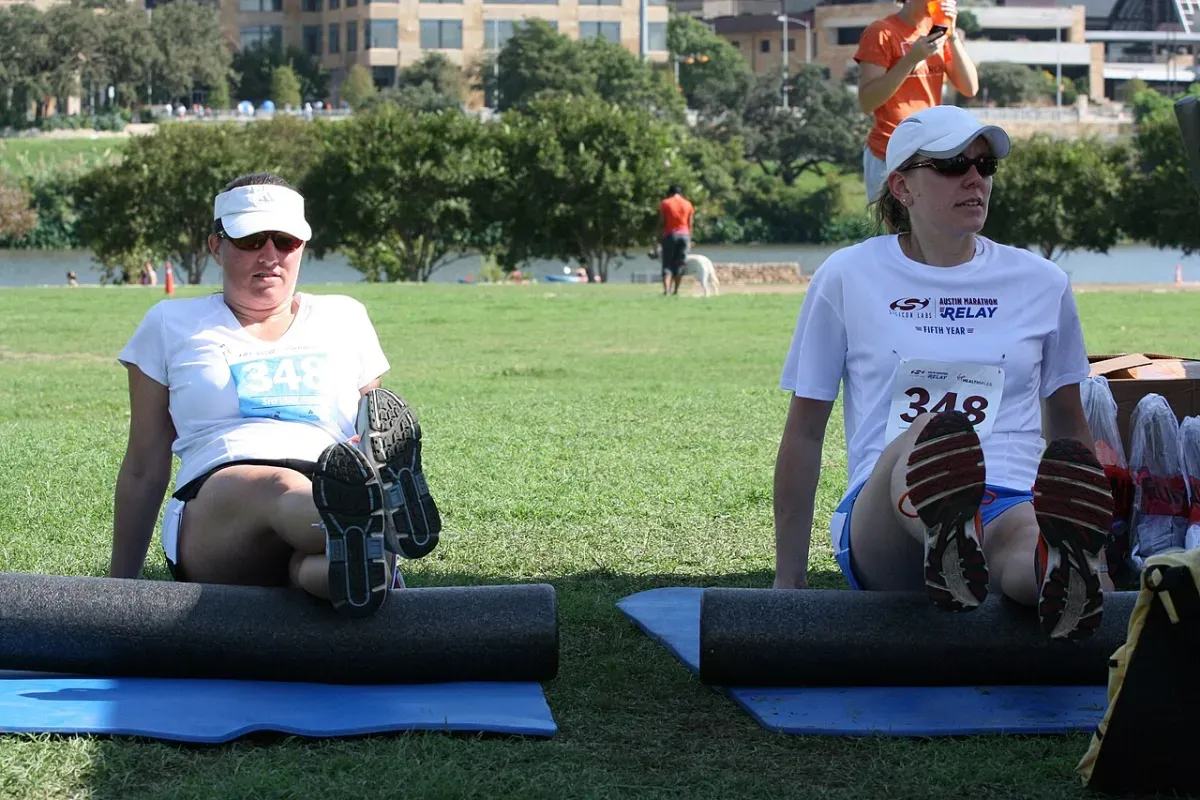 Photo: Roger Mommaerts / Wikimedia Commons (CC BY-SA 2.0)
The role of ice for pain relief
Soft tissue work cannot heal a bone stress injury. Stretching and rolling may feel nice, but they do not reverse the structural fatigue caused by overuse.
For acute pain relief, the NHS suggests applying ice to the painful area for up to 20 minutes every 2 to 3 hours. Wrap the ice pack in a towel to protect your skin. Ice is effective at managing local pain and numbing the area during a bad flare-up.
Why mobility work needs load management
A stretching routine is just one component of injury recovery. If you stretch your calves diligently but continue to make training errors, your shin splints will persist. You have to change how you load the leg.
Progressing your running volume
You need a framework for increasing your running volume safely. Many running coaches rely on the 10 percent rule, advising runners to add no more than 10 percent to their total weekly mileage each week.
This is a rough heuristic rather than a strict biological law. When it was actually tested, it did not hold up: Buist and colleagues randomised novice runners to a graded 13-week build or a standard 8-week one for the American Journal of Sports Medicine in 2008, and found no difference in injury rates between them. It simply serves as a useful reminder to avoid sudden spikes in your training. If you ran 10 miles last week, jumping to 20 miles this week is risky. A slow, steady progression gives your tibia the time it needs to absorb the impact and adapt.
Shoes and running surfaces
The environment you run in matters. Hard surfaces like asphalt and concrete pavements force your lower legs to absorb significant amounts of shock. The NHS highlights running on hard surfaces as a key trigger for shin splints. Switching your routes to softer terrain like grass parks, woodland trails, or synthetic running tracks can reduce the impact on your skeleton.
Your footwear plays an equally important role. The AAOS specifically lists worn shoes as a major risk factor. The commonly quoted range is 300 to 500 miles, though the evidence behind that number is thin. Midsole foam does compress with mileage. If your shoes are old, replacing them is a simple way to reduce the stress on your shins. If you have flat feet, try using prefabricated insoles with arch support before committing to expensive custom orthotics.
Calf and foot strength
Muscles act as shock absorbers for your bones. When your foot hits the ground, your calf muscles and the intrinsic muscles of your feet contract to control the landing.
If these muscles are weak, they fatigue early in your run. Once the muscles tire out, the impact forces bypass them and transfer directly into the shinbone. Building strength in your lower legs increases your overall tissue capacity. Heavy, slow calf raises are an excellent way to build this resilience. Walking barefoot on safe, flat surfaces can also strengthen the small muscles in your feet, though you should avoid barefoot walking if you suspect a bone stress injury.
Getting back to running
Patience is the hardest part of shin splint recovery. The temptation to run the moment your legs feel slightly better is strong. Giving in to that temptation usually restarts the entire injury cycle.
The two-week pain-free rule
You must let the tissues calm down completely. The AAOS advises that you should be entirely pain-free for at least two weeks before resuming your repetitive activity.
This means walking without discomfort. Pressing on your shinbone shouldn’t hurt, and hopping on one leg needs to feel entirely normal. Two weeks feels like a long time, but it allows the bone remodelling process to catch up. When you do start running again, begin with short intervals of jogging mixed with walking. Do not attempt to run your previous distances right away.
What to cross-train with
You don’t have to sit on the couch for weeks. The NHS advises switching to gentler exercise while your shins recover.
Swimming and cycling both work. You can push the cardiovascular side as hard as your legs tolerate without loading the tibia the way running does. Keep the effort moderate at first and let symptoms, not the clock, set the ceiling.
You can also use this time to work on total body mobility. Exploring quad stretches and hamstring stretches can improve your upper leg mechanics. You might also want to look at IT band stretches. Setting up a routine of stretching for beginners keeps your joints moving well during this downtime.
When shin pain might be a stress fracture
Sometimes, pain in the front of the leg is more severe than standard medial tibial stress syndrome. A stress fracture is a tiny crack in the bone caused by repetitive force. You need to know the difference between the two conditions.
Warning signs that require a doctor
Shin splint pain typically covers a broad area along the bone. It feels diffuse and often warms up, feeling slightly better as you continue to move. A stress fracture behaves differently. The pain is highly localized.
- You can point to one specific spot on the bone that hurts intensely when touched.
- The pain carries on at rest and doesn’t fade when you sit down.
- The ache in your leg wakes you up in the middle of the night.
The NHS advises seeing a GP if your shin pain is getting worse or isn’t improving with rest and ice. A medical professional can arrange an X-ray or an MRI to check the structural integrity of your tibia. If you suspect a stress fracture, stop all high-impact activity immediately. Bone cracks require medical supervision and strict rest periods to heal properly.
Frequently asked
- How long should you hold a stretch for shin splints?
- Aim for 30 to 45 seconds per stretch. That is long enough for the tissue to give and short enough that you are not irritating an already angry shin. Three rounds per leg.
- Can I run through shin splint pain?
- Running through medial tibial pain typically worsens the injury. The safest approach is to stop running until you have been completely pain-free for two weeks. You can cycle or swim to maintain fitness in the meantime.
- Do calf stretches help with front shin pain?
- Yes. The calf muscles and the anterior lower leg muscles coordinate to control your foot. If your calves are exceptionally tight, they alter your landing mechanics, which can place extra stress on the shinbone.