How to Do IT Band Stretches Safely
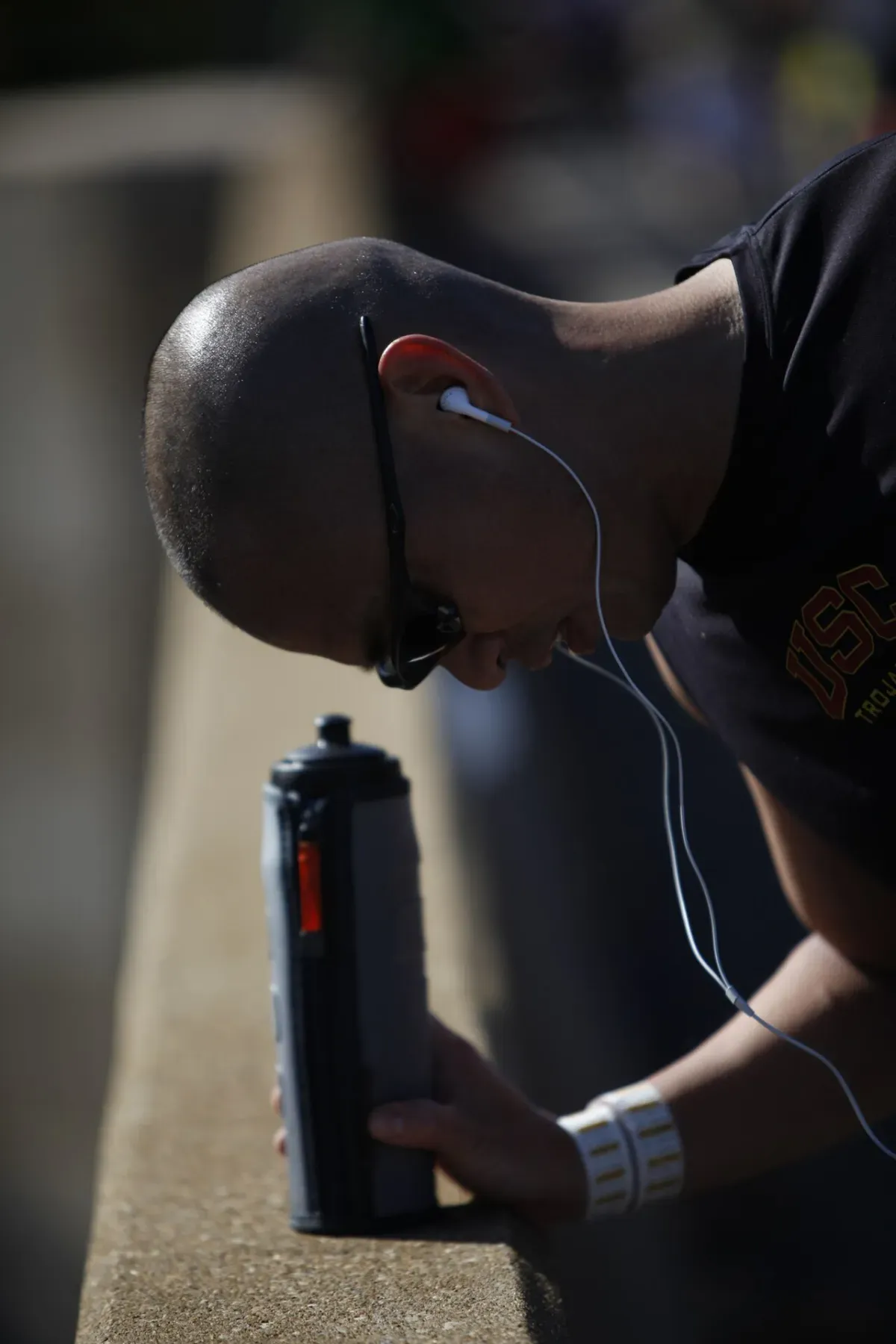
You cannot permanently lengthen your iliotibial band by stretching it. The most effective approach to outer knee pain involves a mix of targeted hip strengthening, careful mileage management, and mobility work that eases the pull without reshaping the band. The IT band is a massive, thick strip of connective tissue built to act like a steel cable stabilizing your leg. Aggressive pulling will rarely solve the problem. Just keep your expectations realistic. A stretch can provide temporary relief from a feeling of tightness. It will not cure an underlying mechanical weakness in your running stride.
The truth about IT band stretches
Why you cannot stretch fascia
People often treat the side of their leg like a tight hamstring. They assume pulling on the tissue will physically create length. The iliotibial band strongly resists that kind of manipulation. A 2021 randomized controlled trial published in PubMed Central measured the effects of single bouts of foam rolling and stretching on IT band stiffness. Researchers used specialized ultrasound technology called shear-wave elastography to look closely at the tissue properties. They found these interventions did not significantly change stiffness. The fibrous band is too strong to meaningfully lengthen with a standard stretch. Your own body weight is entirely insufficient to deform this kind of dense connective material.
What you are actually stretching
When you lean into a wall and feel a pull down your outer thigh, something is definitely happening. The stretch instead targets the muscles connected to the fascia. The tensor fasciae latae sits near your front pocket. Your gluteus maximus makes up your backside. Both of these muscular structures feed directly into the top of the IT band. Releasing tension in these muscular anchors can help your entire leg feel better. This is exactly why incorporating glute and hip-strengthening stretches is highly beneficial. You relieve the tension upstream at the hip joint.
Realistic mobility goals
Knowing that the structural tissue will not lengthen should change your daily routine. Spend less time trying to force your leg into painful contortions. Make the surrounding muscles more compliant. A basic mobility routine can improve how your hip joint moves through its natural range of motion. This reduces the mechanical tugging sensation traveling down the side of your leg. Consistency matters far more than intensity. Gentle daily movement provides better long-term results than aggressively yanking on a sore knee once a week.
Anatomy of the iliotibial band
The largest piece of fascia
Fascia is a continuous web of connective tissue that wraps around muscles and organs throughout your entire body. According to the Cleveland Clinic’s guide on IT Band Stretches, the IT band is the largest piece of fascia in the human body. It is incredibly thick and resilient. That immense tensile strength makes it virtually impossible to stretch like a normal muscle.
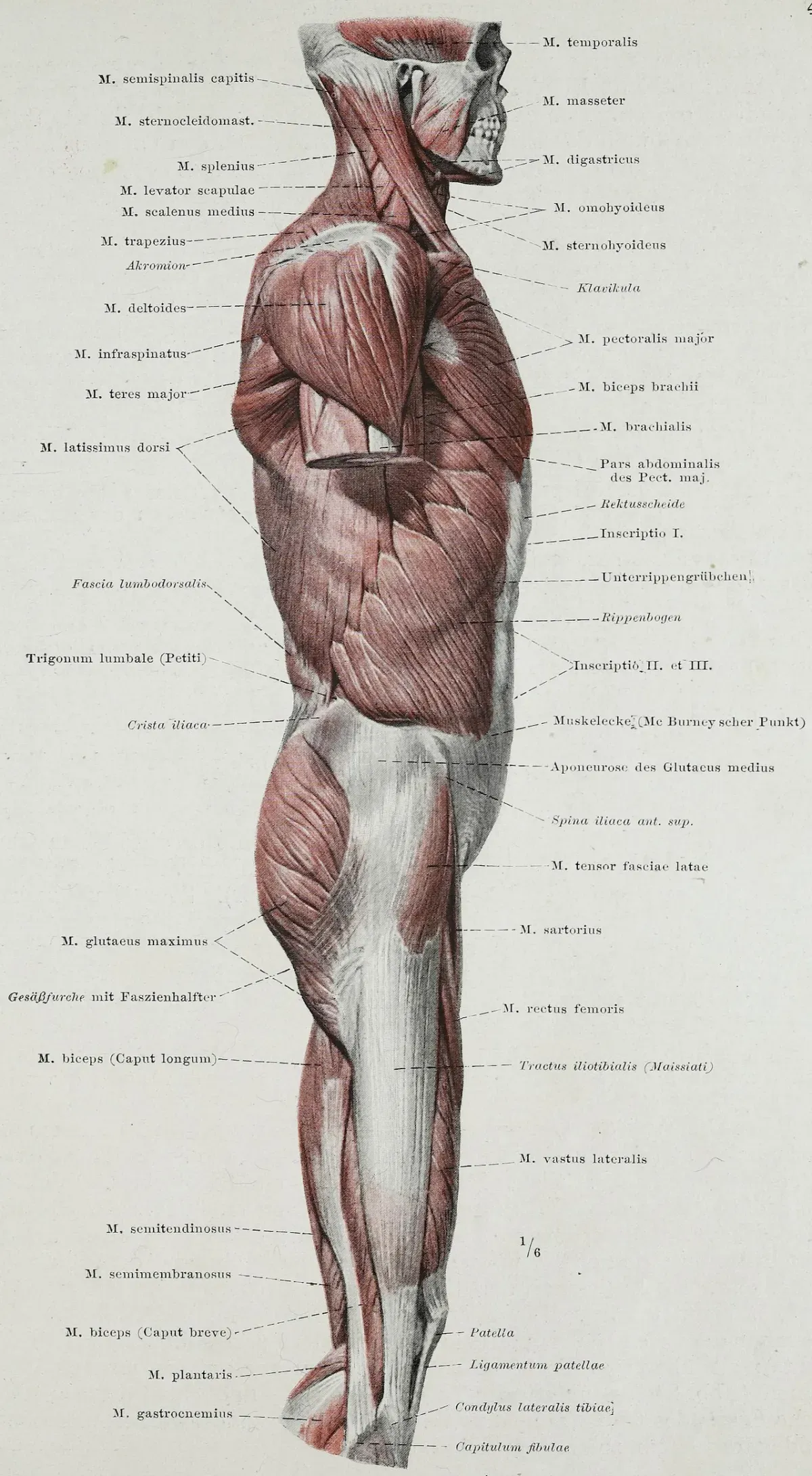 Illustration by Braus, Hermann via Wikimedia Commons (Public domain)
How it connects the hip and knee
The anatomical path of this tissue explains why it causes athletes so much trouble. The Cleveland Clinic overview of Iliotibial Band Syndrome notes that the band runs from the hip and pelvis down the outer thigh to the knee. It bridges two major joints. Every time you take a step, the band engages to help stabilize your knee. It prevents your leg from collapsing inward under the weight of your body. This dual-joint connection means a mechanical problem originating at your hip often manifests as sharp pain lower down the leg.
The mechanics of friction
As your knee bends and straightens, the lower portion of the IT band shifts slightly forward and backward. It moves over a bony prominence on the outside of your knee joint called the lateral femoral epicondyle. This repeated sliding is normally frictionless. A small sac of fluid called a bursa acts as a biological cushion between the bone and the band. Poor running mechanics or sheer repetitive volume can compress this area tightly. The resulting friction leads directly to inflammation and swelling.
How to perform the standing IT band stretch
Stance setup
You can target the muscles attaching to the IT band with a simple standing movement. Find a wall or a sturdy chair to use for balance. Stand upright on a flat surface. Bring your feet close together. You want a highly stable base before crossing your legs and shifting your center of gravity. Good balance prevents your nervous system from tensing up the exact hip muscles you want to relax.
The standing cross-leg movement
The Cleveland Clinic’s instructions for IT band stretching recommend crossing one leg behind the other. If you want to stretch your right side, cross your right leg behind your left. Plant both feet firmly on the floor. Lean your upper body weight gently toward the wall or chair for lateral support. You should feel a stretch along the outer hip and thigh of the back leg. Keep your breathing steady and deep. Push your hip out slightly to the side to deepen the sensation.
Stretch timing
Hold this standing cross-leg stretch for 30 seconds. Release the tension slowly by standing back up straight. The Cleveland Clinic’s guide on IT Band Stretches suggests you repeat the movement five times on the affected side. You can perform this routine daily as part of your cool-down. If you are building a larger routine, you might combine this with stretching fundamentals to ensure your whole lower body gets proper attention. Do not push into sharp pain. A mild pulling sensation is the only target.
Foam rolling the outer thigh correctly
Body placement
Foam rolling is a popular way to address perceived thigh tightness. The setup requires some basic core strength to do safely. Lie on your side and place the foam roller under your outer thigh. Stack your legs on top of each other. The Cleveland Clinic advises using your arms and your top leg to control the pressure. Plant your hands flat on the floor. Bend your top leg and place that foot flat on the ground in front of your bottom knee.
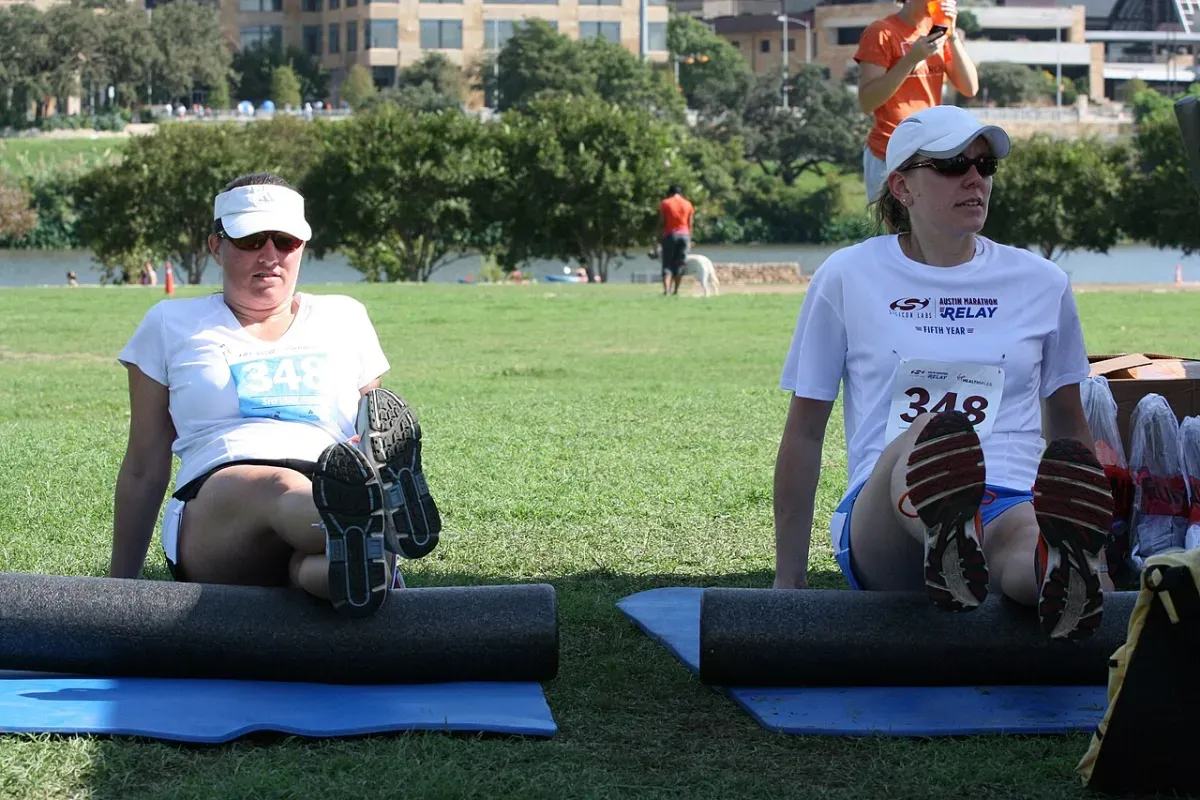 Photo by Roger Mommaerts via Wikimedia Commons (CC BY-SA 2.0)
Pressure control
Your outer thigh is highly sensitive to compression. Putting your entire body weight on a hard foam cylinder will likely hurt immensely. Use your planted foot and hands to lift some of your body weight off the roller. You dictate exactly how intense the massage becomes. Start with very light pressure. The goal is to encourage blood flow and relax the local nervous system. Bruising your own leg by pressing too hard will only set back your recovery.
Rolling boundaries
Roll slowly along the muscular side of your leg. The Cleveland Clinic recommends rolling from just above the outside of the knee up to the outer hip. Never roll directly over the knee joint itself. Stop before you hit the bony point of your hip joint. Spend extra time on the fleshy muscle mass near your front pocket. If you find a particularly tender spot, pause there for a few seconds and breathe deeply to encourage relaxation.
Understanding IT band syndrome (ITBS)
The hallmark symptom
When the IT band becomes irritated, the resulting pain is usually highly specific. The Cleveland Clinic’s guide to ITBS states that the hallmark symptom is pain on the outside of the knee. This irritation happens exactly where the band rubs against the bone at either the hip or the knee. The pain often starts as a dull ache early in a workout. It typically sharpens into a stabbing sensation after a specific distance or time spent running.
Why endurance athletes are vulnerable
This condition rarely affects sedentary people. It is a classic repetitive strain injury. According to the Cleveland Clinic, runners and cyclists are at the highest risk. Cyclists experience this friction as they pedal through thousands of revolutions locked into a fixed position. Runners deal with the added element of heavy impact forces. The knee bends just enough during the stance phase of running to create maximum tension on the fibrous band.
A highly common running injury
If you run regularly, you will likely encounter this issue or know a training partner who has. The Cleveland Clinic notes that IT band syndrome accounts for roughly 12 percent of all running injuries. It is one of the most common causes of lateral knee pain in endurance athletes. You are in very crowded company if your outer knee hurts after a long weekend jog.
Common causes of lateral knee pain
Weak hip abductors
Your knee pain is probably a hip problem in disguise. The muscles on the side of your hip are called abductors. They keep your pelvis level when you stand on one leg. If these muscles are weak, your hip drops slightly every time your foot strikes the ground. The Cleveland Clinic lists hip-abductor weakness as a primary cause of ITBS. The IT band has to work overtime to stabilize a dropping pelvis. This extra workload leads to tightness and damaging friction. Addressing tight hip flexors and weak glutes is mandatory for long-term relief.
Downhill and cambered running
Your physical environment plays a massive role in your injury risk. Downhill running forces your knees to absorb significantly more shock while braking against gravity. This sharply increases the friction on the outer knee. Running on a cambered surface introduces a completely different problem. Roads are usually sloped toward the gutter for water drainage. If you always run on the same side of the road, one leg is constantly reaching lower than the other. The Cleveland Clinic highlights both downhill and cambered running as major contributing factors to IT band irritation.
Sudden mileage increases
General overuse is the classic trap for new runners. You feel great on a Saturday, so you double your usual weekend long run. Your cardiovascular system might handle the jump perfectly well. Your connective tissue cannot adapt that quickly. The Cleveland Clinic warns that sudden mileage increases often trigger ITBS. Tendons and fascia need gradual loading over several months to grow stronger. Spiking your volume guarantees that the weakest link in your kinetic chain will eventually fail.
When to see a professional
Medical red flags
Home remedies have absolute limits. You must know when to stop stretching and seek professional medical help. See a healthcare provider if outer-knee or hip pain does not improve after a few weeks or gets noticeably worse. Persistent lateral knee pain is not something you should try to run through. Continuing to exercise on an inflamed knee bursa will severely prolong your recovery time. A doctor can rule out other structural issues like meniscus tears or underlying cartilage damage.
Professional physical therapy
A physical therapist will look at your entire kinetic chain to find the true source of the problem. They will watch you walk, squat and perform single-leg balances. Persistent IT band syndrome is usually best managed with professional guidance. A specialist can identify the exact mechanical flaws causing your knee pain. They might find that your ankles are collapsing inward during your stride. They might measure a severe strength deficit in your left glute. This provides a targeted recovery plan to replace generic stretching routines.
The transition to strength work
The final phase of overcoming IT band pain rarely involves stretching. It requires building true physical resilience. You will eventually transition to exercises like side planks or banded clamshells alongside single-leg deadlifts. Hip-strengthening is vastly superior to aggressive stretching for managing this specific condition. A strong muscle can absorb heavy impact. A weak muscle forces your connective tissue to take the beating instead. You might also want to look at calf stretches for runners to ensure your lower leg mechanics are sound. Build a strong foundation from the ground up.
Frequently asked
- Can you actually stretch your IT band?
- You cannot significantly lengthen the IT band itself because it is a rigid piece of fascia. Stretches targeting this area actually pull on the muscles attached to it, like the glutes and tensor fasciae latae. To relieve tension, it helps to focus on strengthening the surrounding hip muscles instead.
- How long should I hold an IT band stretch?
- A standard standing cross-leg stretch should be held for 30 seconds. You can repeat this movement five times on each side. Consistency is more useful than holding a single stretch for several minutes.
- Is foam rolling good for a tight IT band?
- Foam rolling can temporarily relieve perceived tension in the outer thigh. You should roll from just above the outside of your knee up to your outer hip. Use your arms and opposite leg to control the pressure so it remains comfortable.