Psoas Stretches: Method, Anatomy, and Myth
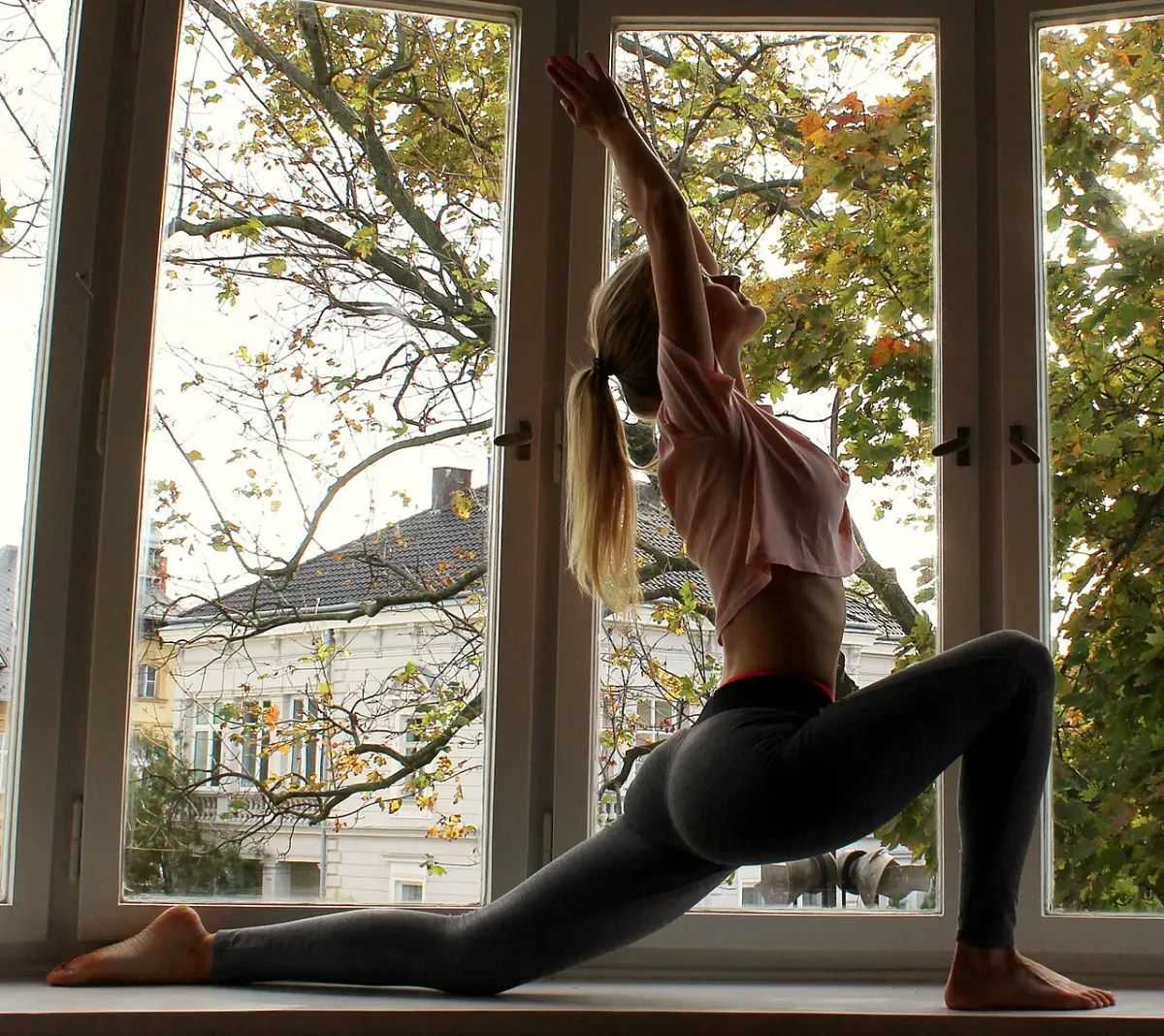
To stretch the psoas muscle, you must bring your leg into true hip extension while keeping your pelvis securely locked in a strict posterior tilt. It’s a subtle and mechanically demanding movement. The tissue sits deep behind your abdominal contents. You’ll never feel it stretch the way a hamstring or a calf muscle stretches. A working psoas stretch feels like a broad, low-intensity pull high in the front of the hip. Success comes from strict alignment and daily repetition. Hold the position for about 30 seconds, three times, most days.
The human body rarely allows us to target one specific strand of tissue in isolation. We’ll start with the underlying mechanics to explain why this area is so difficult to release. The psoas shares a dense tendon with the iliacus, forming a combined structural unit. Any movement targeting one pulls equally on the other. You can’t force immediate changes in this thick connective tissue. Physical progress requires quiet, gentle repetition over weeks and months.
If you’re looking for a general lower body routine, the standing lunge and the couch stretch live in our separate guide to hip flexor stretches.
What the psoas actually is
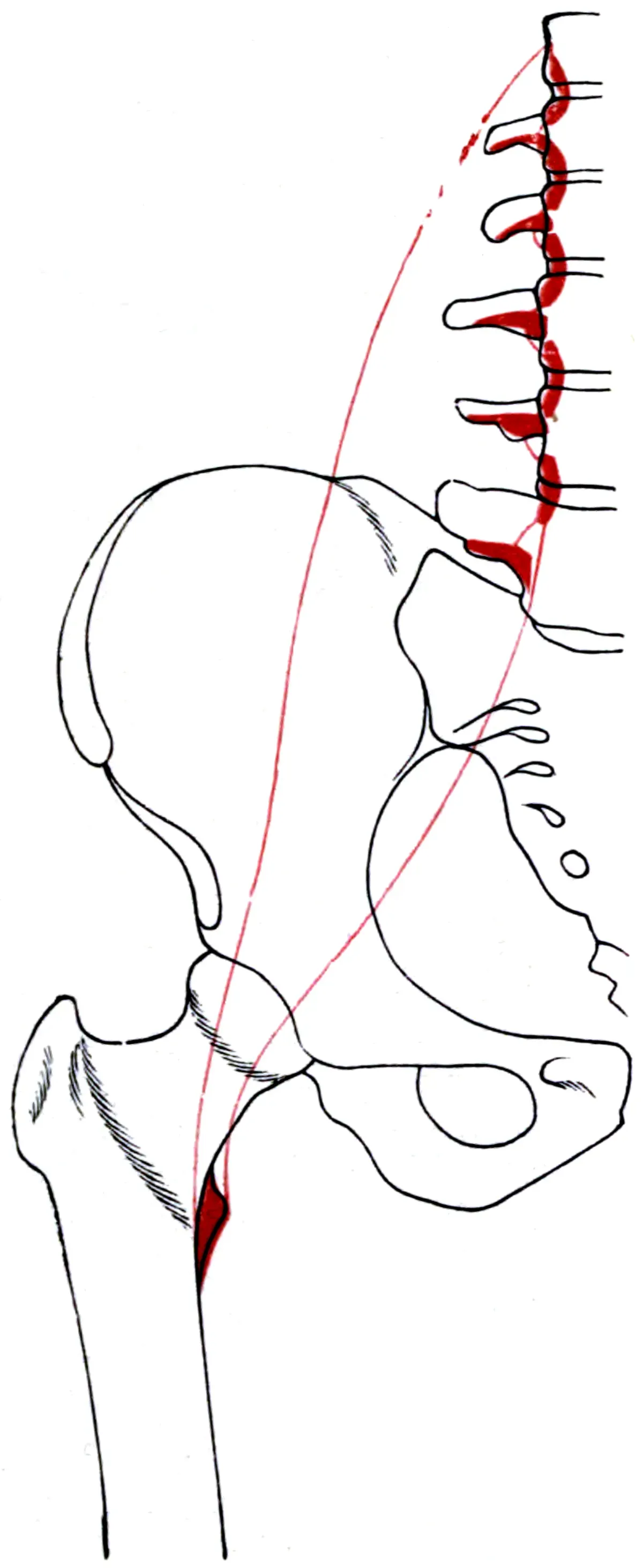 Illustration by Frederick Henry Gerrish via Wikimedia Commons (Public domain)
The only muscle that connects your spine to your leg
The psoas major is structurally unique. According to the anatomical literature in StatPearls, the muscle originates from the transverse processes and lateral surfaces of the first four lumbar vertebrae. It also anchors to the last thoracic vertebra. From this high attachment point on your spine, the muscle travels all the way down through the dense structure of the pelvis. It eventually attaches to the top of the thigh bone. This specific path makes it the only muscle in the human body that connects the lumbar spine directly to the leg.
The Cleveland Clinic describes the psoas as a long, ribbon-shaped muscle. In most adults, the tissue measures around 16 inches in length. It weaves deep through the core of your body, interacting constantly with your posture and your daily movement mechanics.
Psoas, iliacus, and the combined iliopsoas unit
The terminology often confuses people who are trying to learn about their own hips. The psoas major is the long spinal muscle. The iliacus is a broad, flat muscle that originates from the upper two-thirds of the iliac fossa. The iliac fossa is the smooth inside bowl of your pelvis.
These two distinct muscle bundles travel downward and converge deep to the inguinal ligament. They insert via a robust tendon onto the lesser trochanter of the femur. Because they join together at this common tendon, medical professionals and physiotherapists refer to them collectively as the iliopsoas musculotendinous unit. The combined unit functions together to move the leg.
It stabilises as well as flexes, so do not chase slack
The iliopsoas is the primary flexor of the thigh. It lifts the knee to the chest. It contributes to the external rotation of the leg. It also provides vital stabilization for the hip joint and the lumbar spine.
If you think of the psoas purely as a stiff rubber band that needs aggressive pulling, you’ll likely overdo your stretches. Overstretching a primary spinal stabiliser is a bad idea. The body relies on that resting tension to keep the lower back secure during complex movements. You want to restore a comfortable range of motion. You don’t want to remove the muscle’s ability to hold the spine steady.
Why the hip flexor is genuinely hard to stretch
The range you need is hip extension
Stretching a flexor requires extension. To lengthen the psoas, you must push the leg backward behind the line of your torso. The human body prefers the path of least resistance. When the hip joint runs out of true extension, adjacent joints take over the movement.
The actual working range for a psoas stretch is incredibly small. A 2022 study published in Cureus measured hip extension in a group of patients with lumbar hyper-lordosis. Their baseline right hip extension measured about 10 to 15 degrees. Those numbers come from a symptomatic group. Treat them as an illustration of the mechanics. The underlying point holds for healthy populations too. True hip extension is a small range, and it runs out long before the physical sensation does.
How the lower back steals the movement
Once you pass that natural limit of 10 or 15 degrees, the pelvis tips forward. The lumbar spine arches heavily. You experience this mechanical cheating as going deeper into a stretch. You might feel a profound sense of reaching a new physical limit while the actual angle of your hip joint hasn’t changed at all. The lumbar spine simply stole the movement.
Because of the deep internal placement behind the abdominal contents, there is no reliable local stretch sensation to steer by. Pushing until you feel a loud burning sensation usually means you’ve pushed past the hip entirely. You have to accept a quiet, subtle sensation high in the groin.
Three positions that bypass the lower back
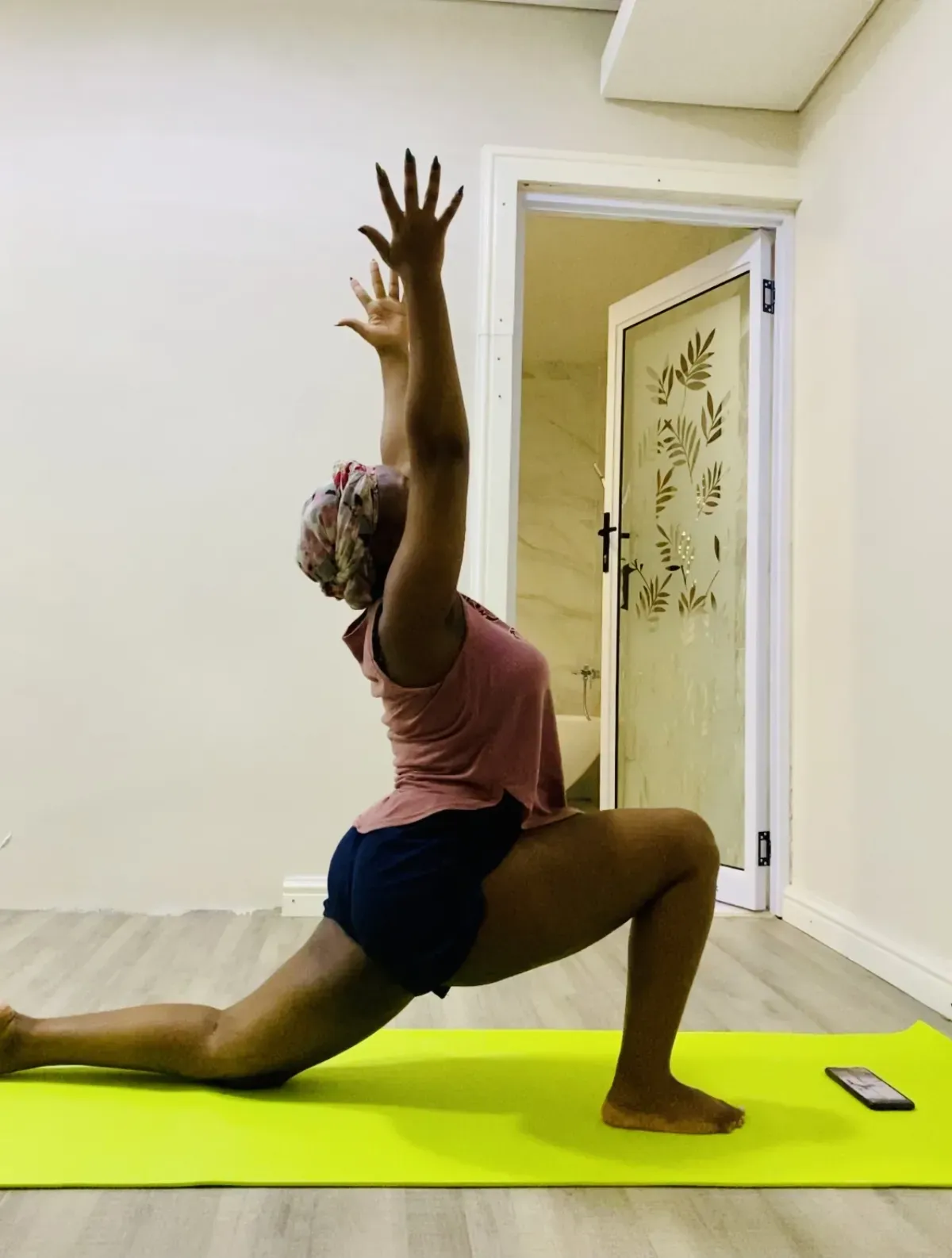 Photo by BameSanah88 via Wikimedia Commons (CC BY-SA 4.0)
Half-kneeling with a posterior pelvic tilt
Begin in a half-kneeling position on a padded surface. The instep of your back foot should rest flat on the floor. The vital step is locking the pelvis. Tuck your tailbone under into a strict posterior pelvic tilt before you shift any weight forward.
This single adjustment is the psoas-specific element that makes the movement work. By locking the pelvis into a posterior tilt first, you force the hip joint to do the actual work of extending the leg. Most people find the stretch arrives before they have moved forward at all. For a complete breakdown of the foot placement and torso alignment, see our main guide to hip flexor stretches.
The supine table-edge hang
The supine table-edge hang uses gravity to do the work of the pelvic tuck for you. You need a sturdy table or a firm, high bed to perform this correctly. Lie flat on your back and shuffle your body down until your hips rest right at the absolute edge of the surface. Pull both of your knees tightly into your chest.
Wrap your arms around one knee and hug it firmly against your torso. This specific action flattens your lower back hard against the table. Pinning the lumbar spine down locks the pelvis into a secure position. Slowly let your free leg drop off the edge of the table toward the floor. Gravity pulls the heavy weight of your thigh down into extension. Because your arms are actively holding your opposite knee, your lower back cannot arch to cheat the movement. The hip joint is isolated completely. Hold that position and breathe.
Side-lying with the top knee drawn back
If kneeling causes knee pain, the side-lying position is a reliable alternative. Lie on your side on the floor. Bend your bottom knee up toward your chest to anchor your pelvis. This protects your lower back.
Reach behind you and grab the ankle of your top leg. Gently draw the top knee backward into extension. Keep the knee perfectly level with your hip. Focus entirely on pushing the hip bone forward as the knee travels backward. The movement is tiny. Stop the moment you feel your lower back begin to arch.
Mistakes that ruin the alignment
Arching the lower back to chase depth
Pushing your hips aggressively forward forces the lumbar spine to hinge, creating a pinch in the lower back. If you notice this pinching frequently, start with lower back stretches to gently address the spinal tension first.
Flaring the ribs on the inhale
Breathing deeply aids muscle relaxation. Lifting the front ribs toward the ceiling ruins the alignment of the stretch. When the front ribs lift, the pelvis tilts forward in response. You immediately lose the posterior pelvic tilt. Keep your lower ribs pulled down and knit together. Breathe wide into the sides of your ribcage.
Pushing the front knee far past the ankle
Proper form is always better than extreme depth. The Cleveland Clinic advises that angry muscles will not tolerate stretches, noting that psoas syndrome is a rare condition that often happens without a known cause and usually causes symptoms of other conditions. Pushing the front knee far past the front ankle in a lunge bypasses the hip extension. You end up resting heavy body weight on the joint capsules. Back up. Reset the pelvis. Find the tension early.
How long, how often, and what to expect
Hold times and weekly dose
Effective stretching requires patience. Official guidance from the Worcestershire Acute Hospitals NHS Trust recommends holding each stretch for at least 30 seconds to allow the muscle to relax. Repeat the movement three times. Ensure all movements are slow and smooth. Applying force too quickly makes the muscle respond with a strong contraction, increasing discomfort. Daily repetition beats a single intense weekly stretching session.
Change takes time to stabilize at home. Clinical interventions can produce rapid numbers under supervision. The 2022 Cureus study tracked right hip extension in patients receiving a proprioceptive neuromuscular facilitation (PNF) technique. The PNF group saw their hip extension move from 14.84 degrees to 25.06 degrees in one session. The study’s muscle energy technique arm also saw improvements, moving from 14.84 degrees to 20.14 degrees.
The researchers measured resting spinal posture alongside the hip mobility data. The PNF group saw their resting lumbar lordosis decrease from 46.86 degrees to 40.36 degrees. These measurements show that the hip flexor clearly has a say in the resting curve of the back. A tight psoas pulls the lumbar spine forward. Releasing that tension allows the spine to settle back into a more neutral alignment.
Loading the new range
A flexible hip needs strength to function properly. You have to load the newly acquired range of motion. A 2024 review in the Journal of Clinical Medicine examined hip flexor muscle activation in detail. Iliopsoas activation becomes increasingly prominent through 30 to 60 degrees of hip flexion.
Performing an active straight leg raise around 60 degrees of flexion drives over 60 percent of Maximum Voluntary Isometric Contraction. This is a substantial muscular load. Exercises involving increased hip flexion provide greater activation of the iliopsoas than exercises where the trunk moves on the legs. If you want a hip that works well in daily life, you must build strength alongside flexibility. Specific loading strategies are detailed in our guide to hip mobility exercises.
Psoas release claims versus anatomical reality
What the anatomy does support
The psoas major sits in a highly complex anatomical neighborhood. According to StatPearls, the muscle sits in a posterior relationship to the diaphragm. Because of this close physical proximity, your breathing mechanics and your hip position genuinely interact. The physical interplay between the breath and the hips is a real phenomenon backed by structural science.
What the “psoas holds trauma” idea actually claims
Wellness writing frequently claims the psoas stores suppressed memories or emotional trauma. The narrative suggests that modern stress locks the muscle in permanent fear. Proponents claim a specific deep-tissue release will allow the emotion to escape. It provides a comforting explanation for chronic tension. It suggests a simple physical stretch can resolve complex emotional burdens.
What we can learn from the trapezius muscle
The idea that localized muscles hold emotional memory lacks empirical support. We can look at the research on the trapezius muscle, another area famous for holding stress. A 2009 study in BMC Musculoskeletal Disorders measured physiological responses to a controlled psychosocial stress test.
The study found increased muscle activity during uninstructed rest in the painful muscle of women with trapezius myalgia. During the actual stress test itself, trapezius muscle activity decreased. The researchers could not confirm the hypothesis that chronic trapezius myalgia is associated with increased sympathetic activity. They stated that the suggestion of autonomic imbalance needs further investigation.
No equivalent measurement exists for the psoas muscle. The trauma-storage claim runs well ahead of anything anyone has measured. If a deep hip stretch leaves someone feeling unexpectedly emotional, that experience is real and worth taking seriously. It just isn’t evidence that a specific muscle belly was storing a memory.
A note on pressing into your abdomen
What is anatomically in the way
Some fitness guides teach people to press their fingers deep into their own belly to release the psoas by hand. They instruct readers to dig a few inches to the side of the navel and apply heavy pressure. You really shouldn’t do this.
The psoas sits far behind the abdominal contents. To touch the muscle belly from the front of your body, you must press your hands through a dense network of vital anatomy. The inferior vena cava runs along the right medial margin of the muscle. The aorta runs along its left medial margin. The kidney, the renal vessels, the ureter, and the gonadal vessels all lie directly in front of the tissue. Branches of the lumbar plexus cross the surface. The femoral nerve runs along the anteromedial side.
What to do with this information
We couldn’t find published injury data from manual psoas release either way. This is a caution based purely on what is anatomically in the way. The physical structures involved are simply not trivial.
The upside of digging into your own abdomen is unproven. Position-based stretching gets the exact same hip extension without requiring you to press heavily near your own aorta. Hands-on assessment belongs with a licensed clinician who can properly palpate the tissue and rule things out safely.
Please note that zen-labo is not a medical site and this article provides general information only. Hip or groin pain that doesn’t settle is a warning sign. Pain accompanied by fever or severe abdominal pain is a reason to see a doctor. Numbness travelling down the leg also requires immediate medical attention.
Frequently asked
- How do I know if my psoas is tight?
- You might feel a broad restriction in the front of your hip when trying to extend your leg backward. A pinch in your lower back usually means your spine is supplying the range while your hip joint remains completely rigid.
- Can I stretch just the psoas muscle?
- You cannot isolate it because the psoas major and iliacus muscles converge into a single tendon. Every stretch targeting this area will lengthen the entire iliopsoas unit.
- How long should I hold a psoas stretch?
- Hold each stretch for at least 30 seconds to allow the muscle to relax. Repeat this three times in a smooth, gradual motion without applying force.