Quad Stretches for Tight Quads: An Evidence-Based Guide

Stretching your quadriceps requires consistency rather than extreme intensity. You do not need to endure painful, ten-minute mobility sessions to see real changes in your tissue. A practical protocol of thirty-second holds, performed three days a week, is enough to significantly improve your range of motion over a few months. The key is understanding how these muscles function. A targeted, evidence-backed approach is all you need to lengthen them safely.
The Anatomy of Your Front Thigh
To stretch a muscle effectively, you need to understand where it sits and what joints it crosses. The front of your thigh is dominated by a massive, powerful structure that dictates how you walk, run, and stand.
The Five Distinct Muscles
According to the Cleveland Clinic, the quadriceps is a group of five muscles located on the front of the thigh, just above the knee. Historically, anatomy textbooks listed four muscles in this group: the rectus femoris, the vastus lateralis, the vastus medialis, and the vastus intermedius. Today, clinical texts often include a fifth layer. Together, this complex group forms the main bulk of your anterior leg.
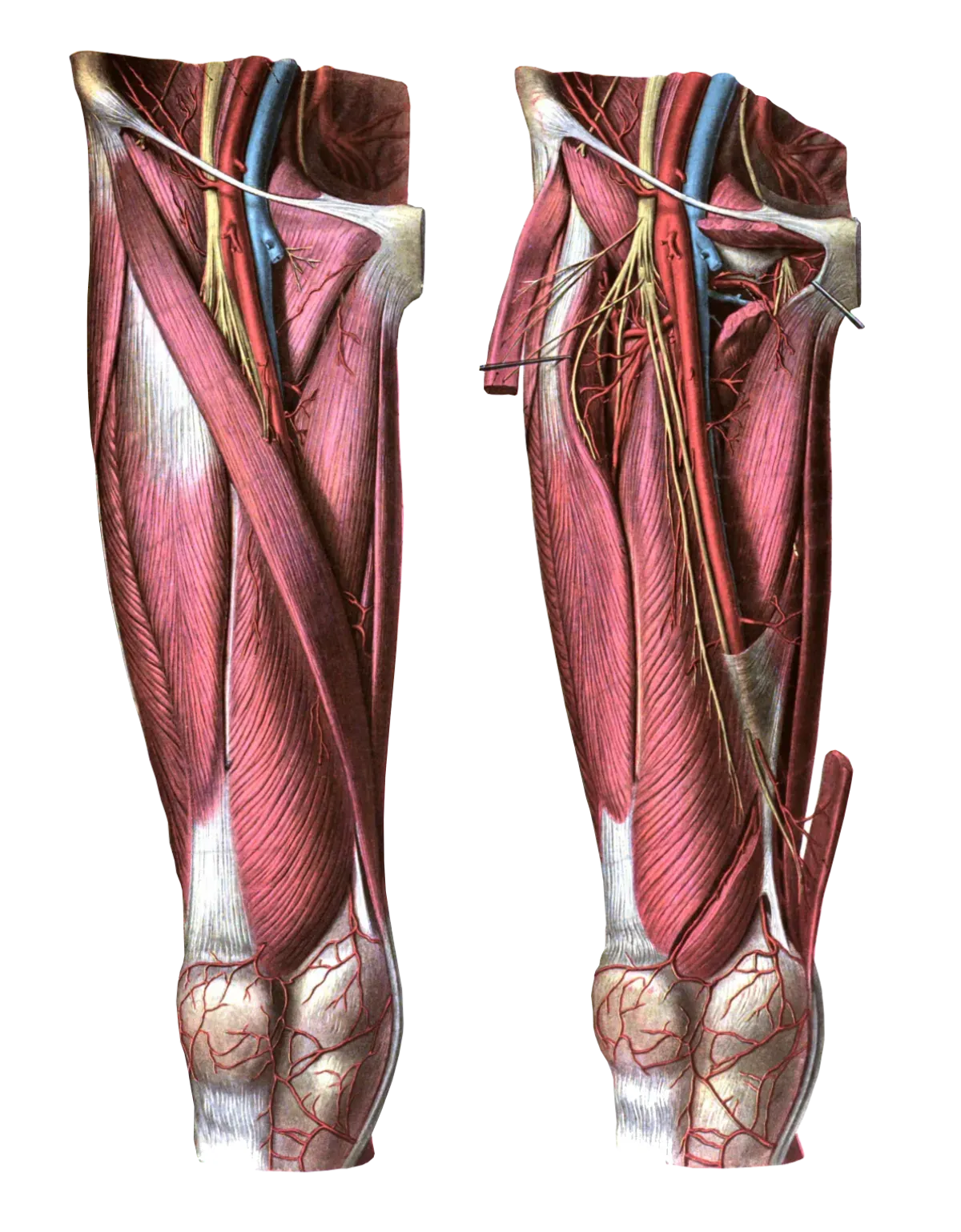 Illustration by Dr. Johannes Sobotta. Lines and labels removed by Mikael Häg via Wikimedia Commons (Public domain)
Anatomy Dictates Movement
The primary job of the quadriceps is to straighten, or extend, the knee joint. Every time you kick a ball or stand up from a chair, your quads are contracting to straighten your leg. The same applies to pushing the pedal of a bicycle. Because the rectus femoris specifically attaches above the hip joint on the pelvis, the quadriceps also help flex the hip. This dual role makes the muscle group highly active when lifting your leg forward during a stride.
Your Quads Absorb Force
Your quads do much more than just move your bones. They act as your body’s primary shock absorbers. The Cleveland Clinic notes that the quadriceps absorb force at heel strike, the exact moment your foot hits the ground when walking or running. They eccentrically contract to slow down the bending of your knee, preventing your leg from buckling under your body weight. The tendons of the vastus muscles also wrap around the patella, working together to stabilize the kneecap and keep it tracking smoothly in its groove.
Causes of Muscle Tightness
Most people experience tight quads for two entirely opposite reasons. Either they are moving too much in highly specific, repetitive ways, or they are barely moving at all.
The Modern Sitting Epidemic
Physical inactivity places the body in positions that shorten the muscles over time. The Cleveland Clinic reports that nearly 1 in 4 American adults sit for more than eight hours a day. This behavior is a key driver of tight hip flexors and quads. When you sit at a desk or commute in a car, your hips remain in a flexed position. Relaxing on a sofa has the same effect. The rectus femoris adapts to this shortened state. When you finally stand, the muscle pulls against your pelvis, creating a sensation of profound stiffness.
Running Demands More from Your Legs
Active individuals face their own set of challenges. Because the rectus femoris crosses both the hip and the knee, it is highly susceptible to mechanical overload. The Cleveland Clinic points out that quad strains are most common in athletes who run, jump, or perform heavy kicking. The repetitive eccentric loading required to absorb impact on the pavement or field causes micro-tears in the muscle fibers. As these fibers repair, they can become tight and dense. The risk of these strains also rises noticeably after age 40.
When Tightness is Actually an Injury
Tightness is normal. Sharp pain is a warning. Sudden thigh pain, swelling, bruising, or a distinct ‘pop’ can signal a quad strain or tear. Being unable to straighten the knee or bear weight is another red flag. Stop stretching immediately and see a physical therapist. Pulling on a torn muscle will only widen the tear and delay your recovery.
The Evidence Behind Stretching Protocols
Many fitness resources promote conflicting advice on how long to hold a stretch. Some suggest rapid, bouncing movements. Others advocate for grueling two-minute holds. Clinical research provides a much clearer, more achievable standard.
The Optimal Hold Time
In a 12-week randomized trial published in 2010, researchers tested different stretching durations to see what actually works. They found that holds of 15, 30, and 45 seconds produced no statistically significant difference in range-of-motion gains. This is a highly practical piece of data. It means you do not need to endure long, uncomfortable holds to change your tissue length. A 30-second hold is an evidence-backed target that maximizes benefits without wasting your time.
Total Weekly Volume
The same 12-week randomized trial demonstrated that total weekly volume matters. Participants stretching 3 days a week for 180 seconds a day increased their passive hip-flexion range of motion by about 15 degrees. In contrast, the control group of non-stretchers saw almost no change. Accumulating 180 seconds a day is simple. It requires just three minutes of total work. You can break this down into three 30-second holds per leg.
Tangible Physical Improvements
Gaining 15 degrees of passive range of motion is a massive functional improvement. In practical terms, this extra flexibility allows runners to achieve a longer stride without arching their lower back to compensate. It allows office workers to stand up completely straight without feeling a pulling sensation in their pelvis. Progress in flexibility takes time. You will likely not notice a difference after week one, but by week twelve, the structural changes become obvious.
How to Perform the Couch Stretch
If you want to target both the hip flexors and the quadriceps simultaneously, the couch stretch is arguably the most effective movement available. It places the body in a deep lunge while elevating the rear foot, forcing the rectus femoris to lengthen across both the knee and the hip.
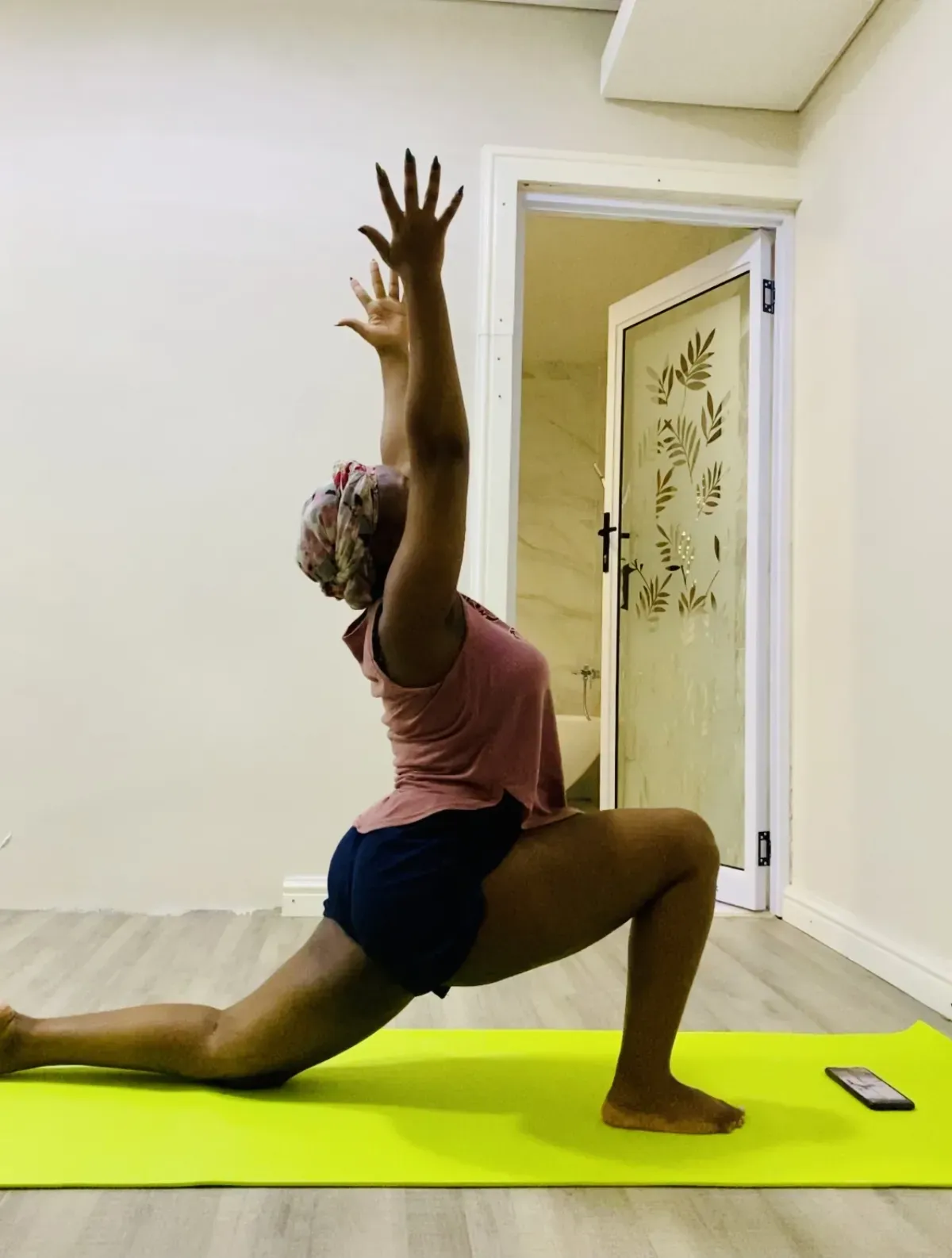 Photo by BameSanah88 via Wikimedia Commons (CC BY-SA 4.0)
Setting the Foundation
You will need a stable surface like a couch, a padded bench, or a sturdy chair placed against a wall. The Cleveland Clinic provides clear instructions for this technique. Rest the top of your rear foot on a couch or bench. Step your other foot forward into a kneeling lunge position. Keep your front knee stacked directly over your front ankle. Ensure your torso remains upright instead of leaning heavily forward over your front thigh.
Drop Your Hips Forward
Once you have established your base, lower your back knee toward the floor and sink your hips forward until you feel the stretch in the front of your elevated leg. The sensation should be a dull, broad pull across the thigh. If you feel a sharp pinching in your lower back, you are likely arching your spine to compensate for tight hips. Squeeze the glute of your rear leg slightly to tuck your pelvis under. This will intensify the stretch in the quad while protecting your lumbar spine.
Let Your Breath Guide the Depth
Instead of counting seconds rigidly, you can measure this stretch through respiration. Hold the position for 5 to 8 slow, controlled breaths per side. Deep breathing helps your body relax into the stretch rather than fighting the tension. If the pressure on your back kneecap is uncomfortable against the floor, place a soft pillow under the knee.
Alternative Movements for Flexibility
The couch stretch is intense. It is not suitable for everyone, especially those with severe mobility limitations or balance issues. Having a few alternative stretches ensures you can still accumulate your weekly volume.
The Classic Standing Pull
The standing quad stretch is the most common variation for a good reason. It requires no equipment and can be done anywhere. Stand tall next to a wall or chair for balance. Bend one knee, bringing your heel toward your glutes, and grasp your ankle with your hand. Keep your knees close together. A common mistake is letting the stretched leg drift out to the side, which reduces the effectiveness of the movement. Stand straight, tuck your pelvis slightly, and hold for 30 seconds.
The Side-Lying Variation
If standing balance is an issue, take the movement to the floor. Lie on your side with your bottom leg slightly bent for stability. Reach back and pull your top heel toward your glutes. This side-lying position removes the need to balance, allowing you to focus entirely on relaxing the quadriceps muscle. It is an excellent option for a cool-down session after a run or a long day of standing.
The Kneeling Lunge
For those who find elevating the rear foot too intense, a standard kneeling lunge provides a milder alternative. Kneel on one knee with the other foot flat on the floor in front of you. Shift your weight forward slightly while keeping your torso tall. While this primarily targets the upper hip flexors, you will still feel a gentle lengthening in the upper fibers of the quadriceps.
Balancing the Lower Body
Focusing solely on the front of your thighs is an incomplete strategy. The human body operates through antagonistic muscle pairs and interconnected fascial chains. If one side of a joint is tight, the opposing side is often weak or overstretched.
Tight Quads Affect the Glutes
Because the quads are deeply integrated with the mechanics of the pelvis, you must look at the surrounding musculature. If you have spent years sitting at a desk, your hips need dedicated attention. Exploring hip flexor stretches will help release the deep psoas and iliacus muscles that sit higher up in the pelvis. Beyond that, tight quads often inhibit the muscles on the back of the pelvis. Incorporating glute stretches ensures your posterior chain remains mobile and capable of generating power when you walk.
The Hamstring Connection
The hamstrings run down the back of your thigh, directly opposing the action of the quadriceps. When your quads contract to straighten the knee, your hamstrings must lengthen. If your quads are chronically tight, they can alter the resting position of your pelvis, pulling it into an anterior tilt. This pelvic tilt places the hamstrings in a constant state of tension. Balancing your routine with dedicated hamstring stretches helps restore the neutral alignment of your pelvis and reduces the feeling of tightness in the back of your legs.
Lower Leg Mechanics
The kinetic chain extends below the knee. The way your foot strikes the ground influences the forces traveling up into your thigh. Tightness in the lower leg can alter your gait, forcing the quadriceps to work harder to stabilize the knee during movement. Adding calf stretches to your routine ensures that the entire leg operates smoothly, distributing impact forces evenly across the ankle, knee, and hip joints.
Building a Sustainable Routine
Knowledge of anatomy and clinical hold times only matters if you actually do the work. The goal is to build a habit that fits easily into your life.
Build the Habit into Your Day
You do not need to drive to a gym to stretch. The standing quad stretch can be done while waiting for coffee to brew. The couch stretch can be performed while watching television in the evening. By attaching these 30-second holds to existing daily habits, you remove the friction of starting a formal workout. Three days a week is the target. Monday, Wednesday, and Friday is a simple schedule that provides adequate frequency to change the tissue.
Tissue Needs Time to Recover
More stretching is not always better. Tissue needs time to recover and adapt to the new lengths you are demanding of it. If your thighs feel excessively sore or bruised after a stretching session, you are pulling too hard. The sensation should be a mild discomfort, never a sharp pain. Give your body rest days between intense mobility sessions to allow the nervous system to consolidate the gains in range of motion.
Advice for Complete Novices
If you have never followed a mobility program before, jumping straight into deep couch stretches might feel overwhelming. Your nervous system may react by tightening the muscles further to protect the joints. If you are new to flexibility work, start with the simplest variations. Use the standing quad stretch with a wall for support. Focus on your breathing. Learn how it feels to gently coax a muscle to relax before attempting more complex, loaded positions.
Adapting the Practice to Your Body
Every skeleton is different. Joint angles vary widely from person to person, and a history of previous injuries usually leaves behind stiff scar tissue. A good stretching protocol adapts to the individual rather than forcing the individual to fit a rigid mold.
Fix Limited Reach with a Strap
Many people simply cannot reach their ankle to perform a standing or side-lying quad stretch. This is common and easily fixed. Loop a yoga strap, a rolled-up towel, or even a dog leash around your ankle. Hold the ends of the strap with your hand and gently pull. This allows you to keep your torso upright and your shoulder relaxed while still applying the necessary leverage to lengthen the thigh muscles.
Always Cushion the Kneecap
The patella is a floating bone suspended in a network of tendons. Pressing it directly into a hard floor during kneeling stretches can cause immediate, sharp pain that has nothing to do with muscle tightness. Always prioritize joint comfort. Fold a yoga mat over twice to create a thick cushion. Alternatively, you might grab a garden kneeling pad or place a firm couch pillow under your knee. If the joint itself hurts, the muscle will not relax.
Consistency drives physical change. By committing to brief, targeted holds three times a week, you provide your body with the exact stimulus it needs to undo the stiffness of modern life. Always protect your joints first. Breathe slowly through the tension. From there, let the clinical evidence guide your routine.
Frequently asked
- How long should I hold a quad stretch?
- Research shows that holding a stretch for 30 seconds is highly effective for increasing flexibility. Longer holds of 45 seconds do not provide significantly better results, so 30 seconds is a practical target.
- Why do my quads feel tight after sitting all day?
- Sitting keeps your hips in a flexed position for hours at a time. This constant state of flexion shortens the muscles on the front of your thigh and pelvis, making them feel rigid when you finally stand up.
- Can I stretch my quads if my knees hurt?
- You should avoid pulling your heel forcefully toward your glutes if it causes knee joint pain. Modifying your position with yoga straps or placing a soft pillow under your knee during kneeling stretches can reduce joint pressure.