How Many Steps Is 3 Miles? Paces, Heights and Times

Walking 3 miles is roughly 6,300 to 7,500 steps. Your exact total moves up or down with your height and your pace, but the math behind it is simple. Step out the door, walk for an hour at a moderate clip, and you’ll log close to 6,750 steps.
Distances scale cleanly from there. A shorter 2-mile walk yields about 4,200 to 5,000 steps. Pushing on to 4 miles gets you up around 8,400 to 10,100 steps. A 5-mile trek usually crosses the 10,500 to 12,600 step mark. These figures assume a standard walking gait on relatively flat ground.
The conversion matters if you plan routes by distance but track progress in steps. Once you know your own number, you can map a loop that hits your daily goal without checking your wrist every few minutes. Two inputs do most of the work: a published study average, and a formula based on your height.
How many steps is 3 miles?
Roughly 6,300 to 7,500 walking steps
A widely cited baseline comes from a study by Hoeger et al. 2008 published in ACSM’s Health & Fitness Journal. As summarized by the Texas A&M AgriLife Extension, the tested men and women averaged 2,252 steps per mile.
Multiply that single-mile average by three and you get 6,756 steps for a 3-mile walk. Multiply it by two, and a 2-mile walk is 4,504 steps. A 4-mile walk sits at 9,008 steps. Five miles brings the total to 11,260.
Why the number moves: step length, height and pace
That 6,756 figure is a study average. Your personal step count depends on how much ground you cover with each footfall.
A comprehensive review by Bassett et al. 2017 in Sports Medicine found that walking step length at a self-selected pace is roughly proportional to your height. Your step length is usually about 42% of your total height. Taller people take longer steps, so they need fewer of them to cover the same mile. Shorter people take smaller steps and accumulate more of them over the same distance.
The quick formula: 15,840 feet divided by your step length
The underlying math is straightforward. One mile is exactly 5,280 feet. That means 3 miles is 15,840 feet.
To find out exactly how many steps are in one mile or three, you convert the distance to inches. Three miles is 190,080 inches. You then divide that massive number by your personal step length in inches. The result is your total step count for the route.
Steps for 2, 3, 4 and 5 miles by height (walking)
The chart
Using the 42% rule from the Bassett review, we calculated the expected walking steps for five heights. The step length in inches equals height in inches multiplied by 0.42. We then divided the inches in a mile (63,360) by that step length to find the steps per mile.
The rows below show our arithmetic for specific heights alongside the flat study average.
| Height | Steps per mile | 2 miles | 3 miles | 4 miles | 5 miles |
|---|---|---|---|---|---|
| 5’0” (25.2 in step) | 2,514 | 5,029 | 7,543 | 10,057 | 12,571 |
| 5’3” (26.5 in step) | 2,395 | 4,789 | 7,184 | 9,578 | 11,973 |
| 5’6” (27.7 in step) | 2,286 | 4,571 | 6,857 | 9,143 | 11,429 |
| 5’9” (29.0 in step) | 2,186 | 4,373 | 6,559 | 8,745 | 10,932 |
| 6’0” (30.2 in step) | 2,095 | 4,190 | 6,286 | 8,381 | 10,476 |
| Study Average | 2,252 | 4,504 | 6,756 | 9,008 | 11,260 |
How to read your row
Pick the height closest to your own. If you’re 5’6”, expect a 3-mile walk to take about 6,860 steps. If you’re closer to six feet tall, that same loop will only cost you about 6,300.
These height rows are our own arithmetic from the 42% rule, not measured values from the Hoeger study. They are still estimates, but they get closer to your number than a single flat average applied to everyone.
Men vs women: it is mostly height
Step counts differ between men and women mostly because of average height differences. According to CDC NHANES body measurement data from 2021 to 2023, the average adult man in the US is 68.9 inches tall (about 5’9”). The average adult woman is 63.5 inches tall (about 5’3.5”).
Because women are generally shorter, they tend to take more steps to cover 3 miles than men do. Plugging those average heights into the same formula, a typical woman would log around 7,100 steps on a 3-mile route, while a typical man would log around 6,600.
Running 2 to 5 miles takes far fewer steps
Steps per mile at 10:00, 8:00 and 7:00 pace
Running changes the math completely. Each running step covers more ground than a walking step, so your total for a 3-mile run comes in well below the walking figure.
A 2025 study by Leacox et al. in the International Journal of Sports Physical Therapy measured running cadence on an instrumented treadmill. They tested 30 experienced runners (19 men and 11 women, aged 21 to 49, all running at least 15 miles a week). At a 10:00 per mile pace, the mean cadence was 169.2 steps per minute. At an 8:00 pace, it rose to 174.3. At a fast 7:00 pace, it hit 177.9.
The paper reports cadence. We did the multiplication to find the steps per mile. A 10:00 mile takes 10 minutes, so 10 times 169.2 equals about 1,692 steps per mile.
Run chart for 2, 3, 4 and 5 miles
Using our per-mile multiplication from the Leacox cadence data, here is how many steps experienced runners take over these distances.
| Pace per mile | Steps per mile | 2 miles | 3 miles | 4 miles | 5 miles |
|---|---|---|---|---|---|
| 10:00 pace | 1,692 | 3,384 | 5,076 | 6,768 | 8,460 |
| 8:00 pace | 1,394 | 2,789 | 4,183 | 5,578 | 6,972 |
| 7:00 pace | 1,245 | 2,491 | 3,736 | 4,981 | 6,226 |
A 3-mile run at a 10-minute pace takes just over 5,000 steps. That is roughly 1,700 fewer steps than walking the exact same route.
Jogging slower than 10:00 sits between the walk and run numbers
If you are jogging at an 11:00 or 12:00 per mile pace, your step count will fall between the walking chart and the running chart. Your stride is longer than a walk but shorter than a fast run.
Keep in mind the Leacox data comes from experienced runners on a treadmill. The figures may not hold for beginners or for running outdoors.
How long does it take to walk 2, 3, 4 or 5 miles?
Time chart at 2.5, 3 and 4 mph
Distance and speed determine your time. A moderate walking pace for a healthy adult is usually around 3 miles per hour (mph). A brisk, purposeful walk hits about 4 mph.
Here is the basic arithmetic for how long it takes to walk a mile and beyond at different speeds.
| Speed | 2 miles | 3 miles | 4 miles | 5 miles |
|---|---|---|---|---|
| 2.5 mph | 48 min | 72 min | 96 min | 120 min |
| 3.0 mph | 40 min | 60 min | 80 min | 100 min |
| 4.0 mph | 30 min | 45 min | 60 min | 75 min |
Walking 3 miles takes exactly one hour at a 3 mph pace.
 Photo: W.carter / Wikimedia Commons (CC BY 4.0)
Does walking faster change the step count?
Yes, slightly. When you walk faster, your steps get a little longer, so you take somewhat fewer of them per mile at 4 mph than at 2.5 mph. The difference isn’t anywhere near the jump from walking to running, but a faster pace does trim the total.
Hills, trails and stop-and-go streets
Terrain disrupts the math. If your 3-mile route involves steep hills, your step length shortens on the climbs. You will take more steps to reach the top. Hiking on rocky trails forces you to take shorter, uneven steps to keep your balance. Stop-and-go city walking requires frequent acceleration and deceleration, which also alters your natural stride length. The charts assume steady walking on a flat surface.
Is 3 miles a day a good target?
What 6,000 to 7,500 steps looks like in the mortality data
Walking 3 miles puts you at roughly 6,750 steps before you count anything else you did that day. That lands in an interesting part of the step-count research. A 2022 meta-analysis by Paluch et al. in the Lancet Public Health looked at 15 international cohorts totaling 47,471 adults.
Participants were split into four quartiles by daily steps, with quartile medians of 3,553, 5,801, 7,842 and 10,901 steps. Compared with the lowest quartile, the adjusted hazard ratio for all-cause mortality was 0.60 in the second quartile, 0.55 in the third and 0.47 in the highest.
The researchers noted that the risk reduction kept falling until it levelled off at 6,000 to 8,000 steps a day for adults 60 and older. For adults under 60, it levelled off at 8,000 to 10,000 steps.
Two caveats. These are observational associations from adult cohorts, not proof that walking a set distance prevents death. And anyone new to exercise or with a heart condition should start shorter and build up. With that said, a 3-mile walk added to ordinary daily movement puts most adults in the third or fourth quartile of that analysis.
How 3 miles stacks up against 10,000 steps
You don’t have to hit 10,000 steps to see results. A 2011 review by Tudor-Locke et al. found that healthy adults typically take between 4,000 and 18,000 steps a day. They concluded that 10,000 steps is a reasonable target for healthy adults.
The same review puts a direct estimate of the minimum moderate-to-vigorous physical activity (MVPA) accumulated in free living at about 7,000 to 8,000 steps a day, and gives 100 steps per minute as a reasonable floor for moderate intensity. It also notes that exercise interventions typically add about 2,000 to 2,500 steps to a person’s day. A 3-mile walk adds about 6,750.
If you are wondering whether walking is good exercise, a dedicated 3-mile route at a brisk pace clears the bar comfortably.
Counting it toward the 150-minute guideline
The CDC physical activity guidelines recommend that adults get 150 minutes of moderate-intensity aerobic activity every week. Brisk walking counts. The guidelines also recommend muscle-strengthening activities on at least two days a week.
Because a 3-mile walk at 3 mph takes exactly 60 minutes, three of these walks per week give you 180 minutes of moderate activity. That clears the 150-minute aerobic target with three walks, and five walks put you well past it.
Turning a distance goal into a daily route
Build a 1.5-mile out-and-back
The easiest way to map a 3-mile route is to find a path you enjoy and walk 1.5 miles away from your front door. Turn around and walk back. You don’t need to engineer a perfect loop. Out-and-back routes remove the stress of navigating new intersections and let you focus on your pace.
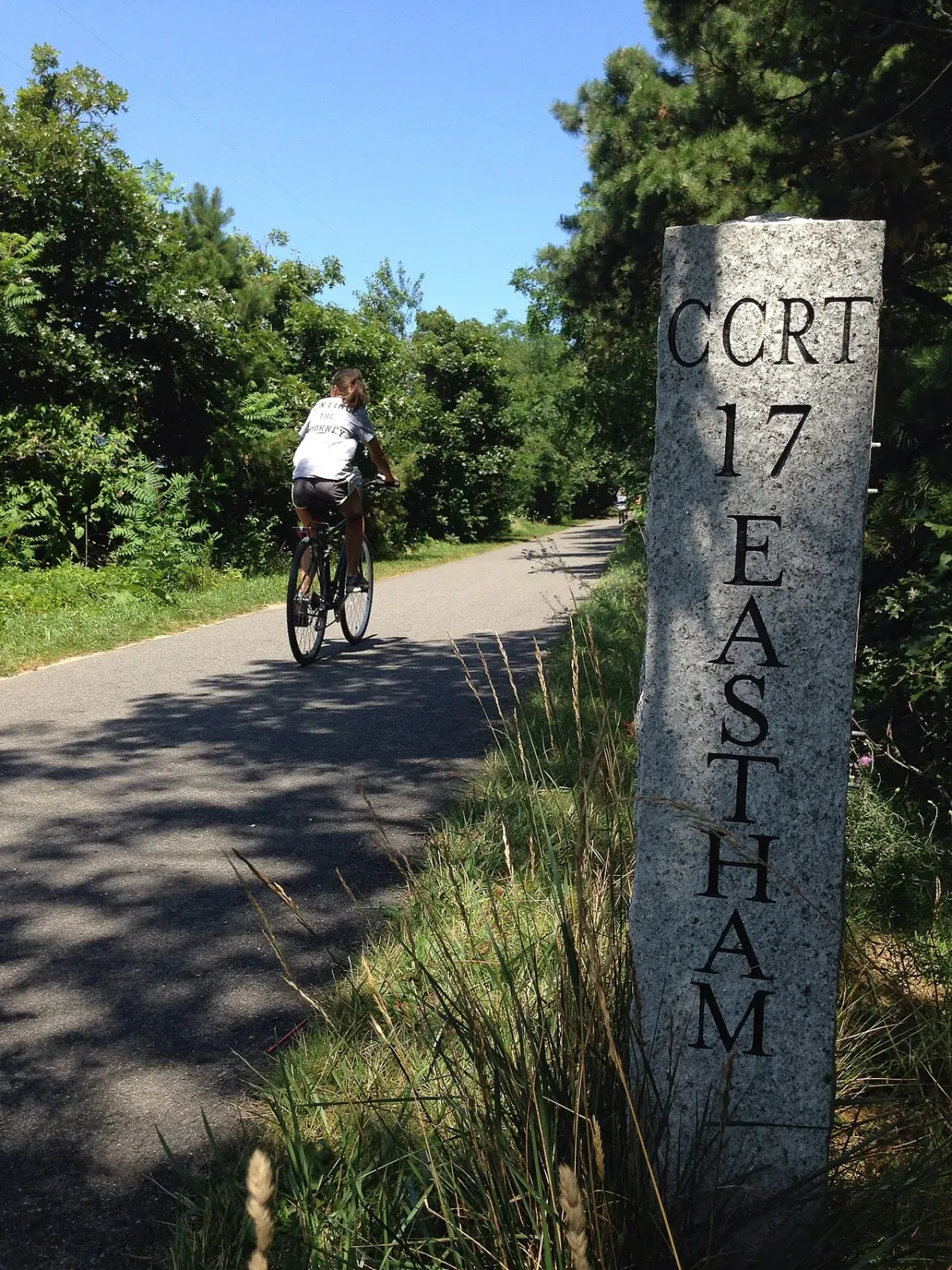 Photo: Kenneth C. Zirkel / Wikimedia Commons (CC BY-SA 4.0)
Use mile markers and trail posts to calibrate your watch
If you want to know exactly how many steps you take per mile, test yourself. Go to a local trail with physical mile markers. Walk one measured mile at your normal pace and check your step counter.
You can also use a standard running track. Four laps in lane one of a 400-meter track is roughly 0.99 miles. Walk the four laps and count your steps. Once you have your total steps for one mile, divide 63,360 by that number. The result is your exact walking step length in inches.
There are plenty of walking apps that track steps and map GPS routes, but manually calibrating your stride once gives you a reliable baseline you can trust without a phone.
Split 3 miles into two walks when the day is full
Finding a continuous hour can be hard on a busy weekday. You don’t have to do all 3 miles at once.
Walking 1.5 miles in the morning takes 30 minutes. Taking a short walk after eating dinner can easily cover the remaining 1.5 miles. You still accumulate the same 6,750 steps. You still cover 3 miles. Splitting the distance keeps the habit alive on days when a full hour feels impossible.
Frequently asked
- How many steps is a 3-mile walk?
- Walking 3 miles takes roughly 6,300 to 7,500 steps for most adults. The exact number depends on your height and stride length, but an average estimate is about 6,750 steps.
- How long does it take to walk 3 miles?
- At a standard walking pace of 3 miles per hour, it takes 60 minutes to cover 3 miles. If you walk at a brisk 4 miles per hour, you will finish in 45 minutes.
- Is walking 3 miles a day enough exercise?
- For most adults, yes. A 3-mile walk at 3 mph is 60 minutes of moderate activity, so three of them a week already clear the CDC's 150-minute weekly guideline. Walking 3 miles daily, on top of ordinary movement, also puts most people in the daily step range where the mortality benefit in the Paluch 2022 meta-analysis begins to level off: 6,000 to 8,000 steps for adults 60 and older, 8,000 to 10,000 for younger adults.