Sciatica Stretches That Help (and What They Cannot Fix)
Sciatica is a symptom, not a standalone disease. It happens when the sciatic nerve gets compressed or irritated, usually near the lower spine. A herniated disk or a bone spur is the usual culprit. The sharp, electric ache down your leg is frightening, but the most comforting fact about this condition is its natural trajectory. Most sciatica resolves on its own over time.
Stretching your legs and lower back won’t push a herniated disk back into place. It cannot dissolve a bone spur. What gentle movement actually does is provide temporary comfort while your body does the slow work of healing. You stretch to alter the environment around the irritated nerve. Reducing muscle tension in the lower back and glutes often eases the mechanical pressure on the nerve pathway, making your daily life a little more tolerable.
This guide outlines a simple, evidence-based stretching routine for mild to moderate sciatica. It also covers the strict limits of what home care can achieve. Knowing when to rest, when to move, and when to seek professional medical help is just as important as the stretches themselves. You don’t need to force your body into painful positions to find relief.
The Short Answer: What Stretching Can and Cannot Do for Sciatica
Stretching eases symptoms; it doesn’t fix the cause
When you experience a sudden flare-up of nerve pain, you naturally want to fix it immediately. You might assume that a tight muscle is causing the problem and that stretching it out will cure the condition. This is rarely how sciatica works. The irritation is usually happening deep inside your back.
A stretching routine provides temporary relief from the sharp, shooting pain or the dull ache that runs down your thigh and calf. You stretch to make the long healing process more comfortable. You do not stretch to cure the root mechanical issue. Recognizing this distinction helps you approach your physical therapy with patience. You won’t feel like you are failing if the pain returns a few hours after your yoga session. The relief is meant to be temporary.
What the research actually shows: small short-term benefit
Online fitness content often presents stretching as a miracle cure for nerve pain. The scientific literature paints a much calmer picture. A 2015 Spine meta-analysis looked closely at how exercise compares to simply staying active for people with leg pain associated with back problems.
The researchers found a small short-term effect favoring structured exercise over basic advice to stay active. People felt slightly better in the immediate weeks after starting an exercise routine. However, the study found moderate-quality evidence showing no difference in leg pain or disability in the long term. Doing specific stretches might give you a mild edge for immediate pain relief today. In the long run, the person who simply keeps walking and avoids bed rest will likely end up in much the same place.
The reassuring part: most sciatica improves on its own
Nerve pain feels electric and unpredictable. It can severely disrupt your sleep, your mood, and your ability to work. Despite how intense it feels, the body is remarkably good at healing nerve irritation over time.
The NHS advises that sciatica usually gets better in a few weeks to a few months, though it can sometimes last longer. The American Academy of Orthopaedic Surgeons (AAOS) provides similar reassurance. They note that approximately 80 to 90 percent of patients with sciatica get better over time without surgery. This typically happens within several weeks when the cause is a herniated disk. Time is your primary treatment.
Red Flags That Mean You Should See a Doctor First
Emergency signs: saddle numbness, bladder or bowel changes, worsening leg weakness
Certain symptoms indicate a medical emergency. You must never try to stretch these away. The NHS warns that a rare but serious condition called cauda equina syndrome requires immediate medical care. This occurs when the bundle of nerves at the very bottom of the spinal cord becomes severely compressed.
You must go to an emergency department immediately if you experience numbness around your genitals or anus. This area is often called the saddle region. Loss of bladder or bowel control is another absolute red flag. Severe or worsening weakness or numbness in both legs also requires urgent medical intervention. Do not wait to see if these settle on their own. Go straight to an emergency department.
Non-emergency reasons to book an appointment
Other warning signs are less immediately catastrophic but still mean you should skip the yoga mat and see a doctor. The Hospital for Special Surgery (HSS) outlines specific symptoms that require a medical consultation when they accompany back or leg pain.
Book an appointment if your sciatica is accompanied by fevers, chills, or night sweats. Severe pain, numbness, or weakness in your legs also warrants a professional look, as do any changes in your bladder or bowel function. A doctor needs to rule out infections or other underlying medical conditions before you begin a physical therapy routine.
When home stretching is a reasonable first step
You can comfortably start a home stretching routine if your symptoms fit the standard profile. This usually means a pain that radiates down one leg. The ache might be sharp when you sit a certain way or dull when you stand. You have no fever. You have full control of your bathroom habits. You can feel your saddle region normally.
In this scenario, the AAOS advises starting stretching exercises as soon as possible. You don’t need a doctor’s permission to do a gentle knee-to-chest stretch if your only symptom is a familiar, annoying ache down your left thigh. Use common sense. If the pain feels mechanical and matches previous flare-ups, gentle movement is a safe starting point.
The 5-Move Home Routine
Figure-4 piriformis stretch (30s hold, 3x each side, twice a day)
The piriformis is a small muscle located deep in your buttocks. The Cleveland Clinic explains that the sciatic nerve runs directly beneath this muscle. A tight piriformis can easily aggravate the sciatic nerve and mimic a spinal disc issue.
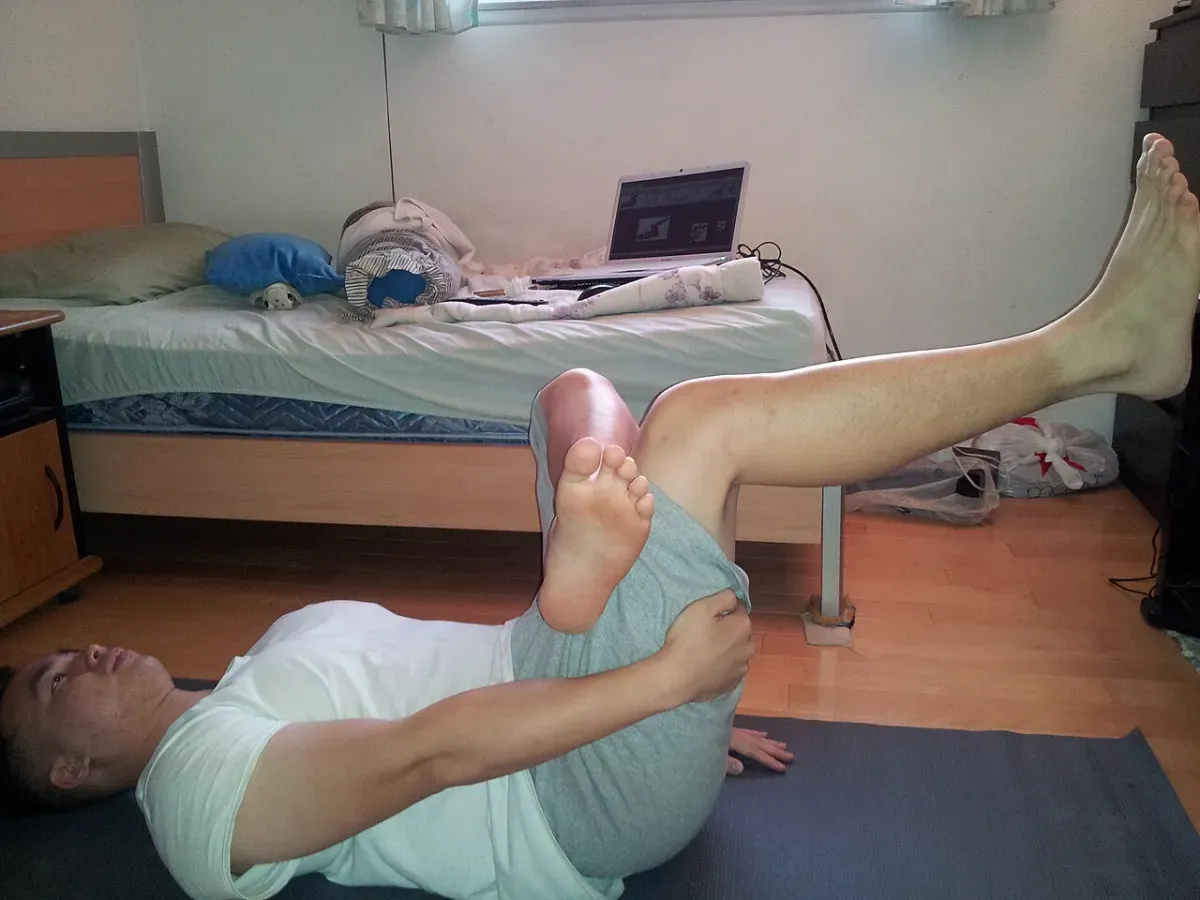
To stretch this area, lie flat on your back on a comfortable mat. Bend both knees and place your feet flat on the floor. Cross your right ankle over your left knee. You will now have a triangle shape between your legs. Reach your hands through that triangle and grab the back of your left thigh. Gently pull your left thigh toward your chest. You should feel a deep, broad stretch in your right glute.
Hold this position for 30 seconds while breathing normally. Lower your leg slowly. Repeat this 3 times on each side. The Cleveland Clinic recommends doing this routine twice a day. If you struggle to reach your thigh, you can use a towel wrapped around your leg to help pull. For more variations on targeting this specific area, read our guide to glute stretches.
Knee-to-chest stretch (10-30s holds)
This is one of the most accessible movements for lower back tension. It gently rounds the lower back and takes tension off the muscles alongside the spine.
Lie on your back with your legs straight or knees bent. Gently pull one knee toward your chest using your hands. Stop pulling when you feel a mild stretch in your lower back or upper glute. Harvard Health suggests holding this gentle stretch for 10 to 30 seconds. The HSS advises a slightly varied approach of 5 to 30 second holds for 8 to 10 repetitions.
Choose the duration that feels best for your body. The goal is mild tension. Keep your shoulders flat on the floor. Do not curl your neck up to meet your knee, as this creates unnecessary strain. Allow your head to rest heavily on the mat. You can find similar gentle movements in our comprehensive overview of lower back stretches, and if the backs of your thighs feel just as tight as your back, our hamstring stretches pair well with this one.
Sciatic nerve glides: what they are and the honest evidence caveat
Nerve glides look quite different from traditional stretching. You move a limb slowly to tension and release the nerve pathway, rather than holding a static position. The idea is to gently mobilize the nerve through the surrounding tissue without stretching it like a rubber band.
The evidence for this practice is mixed. A 2017 systematic review looked at neural mobilization techniques for back and neck pain. The researchers noted that benefits have been reported by some patients. However, they concluded that the overall evidence remains limited and of varying quality. Nerve glides might feel excellent for your specific leg pain. They might also do very little. Move slowly if you try them, and never push into a sharp, zinging pain.
Gentle strength to support the back: glute bridge and bird-dog
Stretching alone is rarely enough. The HSS PT-designed routine includes specific strengthening movements to support the spine.
The glute bridge activates the muscles on the back of your legs and pelvis. Lie on your back with your knees bent and feet flat on the floor. Push through your heels. Lift your hips toward the ceiling until your body forms a straight line from your shoulders to your knees. Squeeze your glutes at the top. Lower down slowly.
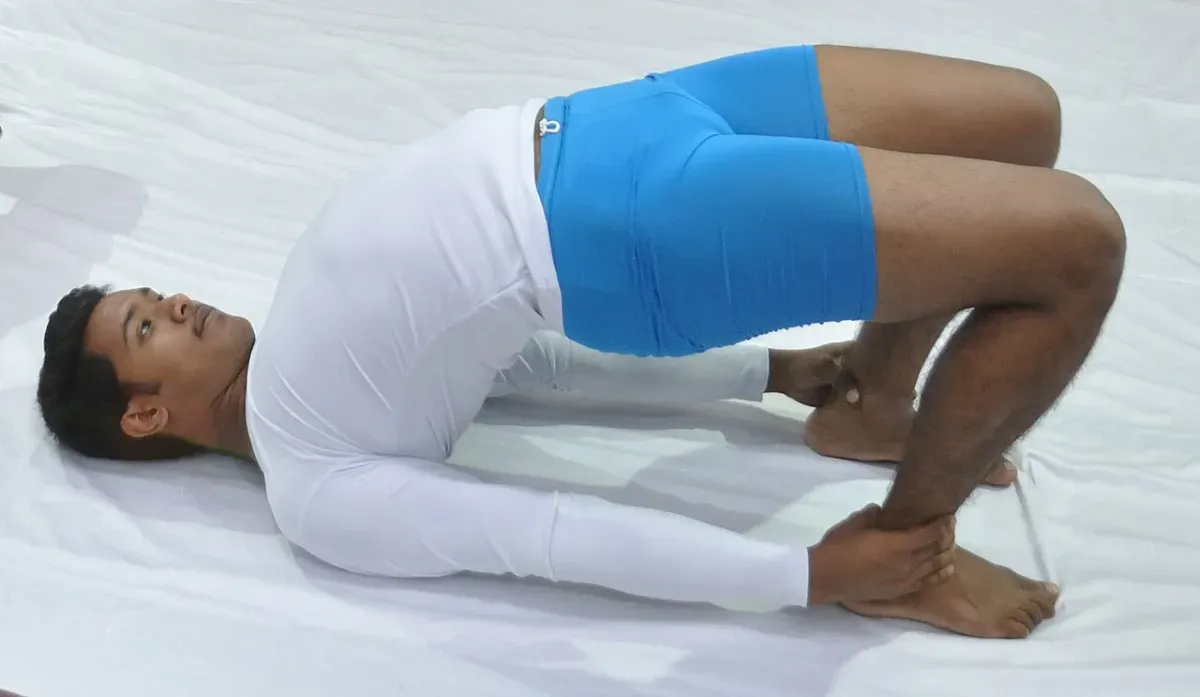 Photo by Biswarup Ganguly on Wikimedia Commons (CC BY 3.0)
The bird-dog challenges your core stability. Start on your hands and knees. Keep your back flat like a table. Slowly extend your right arm forward while simultaneously kicking your left leg straight back. Keep your hips level with the floor. Hold for a second, then return to the starting position. Switch sides.
The HSS routine also suggests the clamshell exercise for hip strength, a cobra pose held for 30 seconds for gentle spinal extension, and resting in child’s pose to finish the session. To rest in child’s pose, simply kneel on the floor, sit back onto your heels, reach your arms far forward on the mat, and let your forehead rest gently on the ground.
Your Week at a Glance: A Simple Schedule
A sample week: at least twice, daily if it feels good
Building a habit requires a clear plan. The HSS recommends performing these exercises at least twice a week. You can do them daily if the routine feels good and reduces your stiffness. Here is a basic template to structure your week without overwhelming your schedule.
| Day | Focus Area | Example Movements | Duration |
|---|---|---|---|
| Monday | Full Routine | Figure-4, Knee-to-chest, Bridge, Bird-dog | ~10-15 min |
| Tuesday | Rest or Light Activity | Walking, normal daily chores | N/A |
| Wednesday | Full Routine | Figure-4, Knee-to-chest, Bridge, Bird-dog | ~10-15 min |
| Thursday | Gentle Mobility | Knee-to-chest, Child’s pose | ~5 min |
| Friday | Full Routine | Figure-4, Knee-to-chest, Bridge, Bird-dog | ~10-15 min |
| Saturday | Active Recovery | Walking around the neighborhood | N/A |
| Sunday | Rest | Heat application, relaxation | N/A |
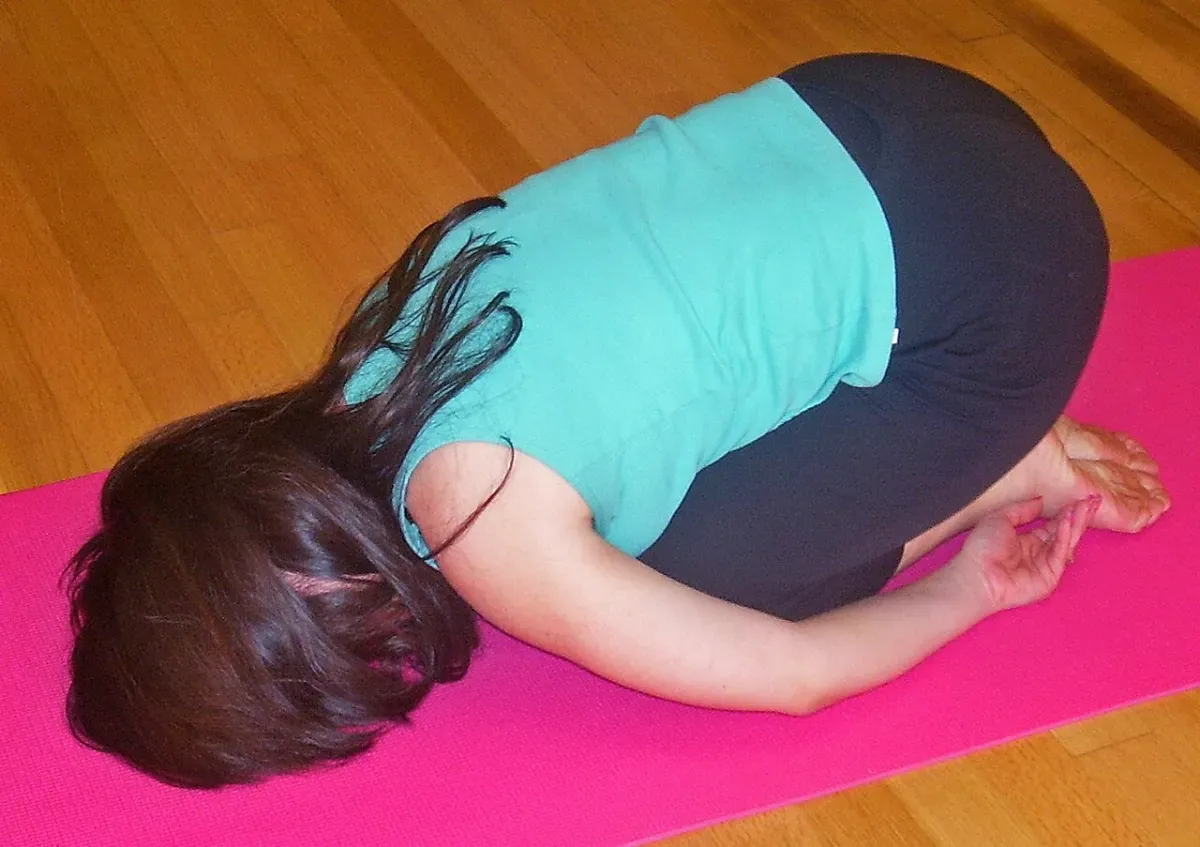 Photo by Daniel Case on Wikimedia Commons (CC BY-SA 3.0)
The pain rules: mild stretch is fine, more pain means stop
Knowing how to interpret pain during a stretch is vital. A mild, pulling sensation in the muscle belly is entirely acceptable. It means you are applying tension to tight tissue.
The HSS provides a strict rule for nerve pain. These exercises should not cause more pain. Stop right away if they do. You are irritating the nerve further if you feel a sharp, electrical shock or a sudden increase in numbness down your calf. Harvard Health echoes this, stating that you must consult a healthcare provider if stretching worsens your pain. Back off the depth of the movement. Reduce the hold time. Stop the exercise completely if the pain persists.
What to avoid early on: deep stretches, heavy lifting, twisting
The first few days of a sciatica flare-up require caution. Your nerve is highly sensitive. The surrounding muscles are likely in spasm to protect the area.
Harvard Health warns that you must avoid aggressive or deep stretches in early-stage sciatica. Pushing hard into a forward fold to touch your toes will likely aggravate a compromised lumbar disk. You should also avoid heavy lifting entirely. Don’t try to move furniture or lift heavy boxes while your leg is radiating pain. Twisting movements under load are equally dangerous. Keep your spine relatively neutral. Turn your whole body with your feet rather than twisting at the waist when you need to look behind you.
Why Staying Active Beats Bed Rest
What the NHS and AAOS say about staying in bed
When your leg is throbbing, your instinct is to lie down and stay there. Decades ago, doctors routinely prescribed weeks of strict bed rest for back pain. Medical science has completely reversed this stance.
The NHS explicitly advises that you should not sit or lie down for long periods. The AAOS agrees, firmly advising patients not to remain in bed. They want you to start stretching exercises as soon as possible. Total inactivity does not accelerate the healing of a compressed nerve, and it often leaves you feeling stiffer and more miserable than before.
Normal daily activity is part of the treatment
You don’t need to run a marathon to be active. The NHS self-care advice tells patients to carry on with normal activities as much as possible.
Normal activity means walking to the kitchen to make tea. It means standing up from your desk every twenty minutes to pace the room. It includes light vacuuming or watering the plants. These small, low-impact movements keep your joints moving and prevent your muscles from locking up entirely.
The NHS also recommends trying regular sciatica exercises alongside these daily habits. You can use heat packs on your lower back to soothe muscle spasms before you move. Combining gentle warmth with basic daily chores forms a sensible baseline. If you are entirely new to purposeful movement, reading a guide on stretching for beginners can help you build confidence.
Where physical therapy fits if home care isn’t enough
Home care is enough for most people, because most sciatica resolves on its own. Sometimes, however, the pain remains stubborn. You might struggle to figure out which exact movements relieve your symptoms.
This is where formal physical therapy becomes valuable. A physical therapist can assess your specific biomechanics. They will watch how you walk. They can test your hip flexibility and your core strength. They will then design a routine tailored to your exact presentation of sciatica. If the HSS home routine provides no relief after several weeks, a professional assessment is the logical next step. They offer structured, personalized guidance that a general online article simply cannot provide.
Honest Limitations: What We Don’t Know
The evidence for stretching is thinner than most fitness sites imply
We must be realistic about the scientific backing for these routines. A quick internet search will yield thousands of videos promising instant sciatica relief through specific contortions. The data does not support these confident claims.
Returning to the 2015 Spine meta-analysis, structured exercise provides only a small short-term effect for leg pain. The moderate-quality evidence showing no long-term difference between exercise and general activity advice is sobering. Stretching is a tool for comfort. It is a way to feel proactive when you are in pain. Managing your expectations will prevent frustration when a stretch fails to instantly banish your symptoms.
Piriformis stretches help most when the piriformis is the irritant
Context dictates success. The Figure-4 stretch is incredibly popular for sciatica. It only works well if the piriformis muscle is the actual source of the problem.
The Cleveland Clinic highlights the physical relationship between the piriformis and the sciatic nerve. If your nerve is being pinched by a herniated disk at the spine itself, stretching your glute muscle will do very little to relieve the compression. It might feel nice, but it misses the target. Stretching helps most when the tension is located exactly where the stretch is applied. This diagnostic uncertainty is why a generic home routine will work brilliantly for one person and fail entirely for another.
How long to self-treat before getting assessed
Patience is mandatory with nerve pain. You must give your body time to heal. You also must know when to stop waiting.
The timeline is clear. Sciatica typically improves within a few weeks to a few months according to the NHS. The AAOS states that most patients recover within several weeks. You should stick to your home routine of gentle stretching, normal daily activity, and heat application during this window.
If you’re past the “few months” end of the NHS timeline with no improvement, or the pain is steadily getting worse, stop self-treating and get assessed. Home stretching is an excellent first-line defense for a fresh flare-up. It is never a substitute for medical diagnostics when the natural healing timeline runs out.
Frequently asked
- How often should I stretch for sciatica?
- You should aim for gentle movements at least twice a week. If the stretches feel good and actually provide relief, you're fine to do them daily. Just remember to stop immediately if any movement makes your pain worse.
- Should I rest in bed if my sciatica is severe?
- Medical guidelines strongly advise against staying in bed. Try to carry on with your normal daily routine as much as you can, since gentle movement supports recovery far better than total rest.
- How long does sciatica usually take to go away?
- Most cases improve naturally within a few weeks to a few months. Surgery isn't typically needed for early-stage sciatica. However, if your pain steadily worsens or doesn't improve over time, you should get checked by a doctor.