Trap Stretches for Tight Shoulders and a Stiff Neck
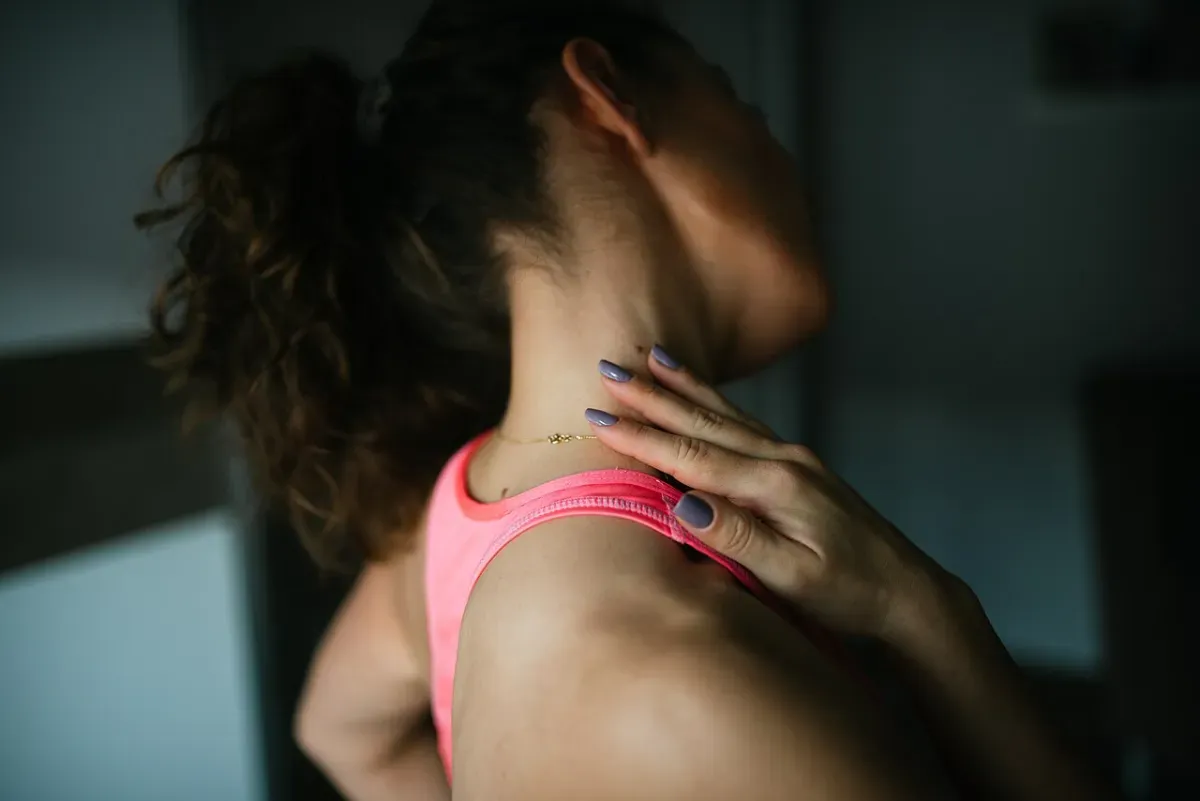
When your upper back feels like a rigid sheet of plywood, your first instinct is to pull on the tight muscles. Gentle stretching absolutely provides immediate relief for a stiff neck and aching shoulders. You restore a normal range of motion and give your nervous system a chance to calm down. But to keep that pain from returning the moment you sit back down at your keyboard, you must pair those temporary stretches with targeted endurance work.
A clinical trial of female office workers demonstrated that performing a single set of elastic-band shoulder raises to muscular fatigue on workdays cut neck and shoulder pain by roughly 40 percent. The protocol takes a maximum of two minutes per day. Stretching manages the immediate discomfort, while building muscular endurance ensures your upper back can actually handle the physical demands of your desk job.
The trapezius is a massive muscle complex that governs shoulder movement. Modern desk work forces it into a grueling marathon it was never meant to run. By understanding exactly how your workspace affects this muscle, you can use specific movements to break the cycle of daily stiffness.
Tight traps are usually overworked rather than short
When a muscle feels stiff, we tend to assume it has physically shortened and needs to be lengthened like a tight rubber band. The reality of desk-induced shoulder pain is more complex. A muscle can feel tight simply because it is exhausted.
What the upper trapezius does all day
Your trapezius is a large diamond-shaped muscle covering your upper back and neck. It is divided into three distinct functional sections. The upper fibers run from the base of your skull down to your collarbone and the top of your shoulder blade. These fibers are primarily responsible for shrugging the shoulders upward and extending the neck. The middle fibers pull the shoulder blades together, while the lower fibers pull the shoulder blades down.
When you sit at a desk, the middle and lower fibers often become weak and inactive. The upper fibers end up taking on almost all the mechanical stress.
An adult arm weighs three to four kilograms. When you type without decent elbow support, your arms hover, gravity pulls them down, and your upper traps fire continuously to hold them up. Contractions this low and this long are thought to keep the same small motor units working for hours, which is one reason the muscle can ache without ever having done anything strenuous.
Beyond holding up your arms, the upper trapezius serves as an accessory breathing muscle. When you are relaxed, your primary breathing muscle is the diaphragm. It sits below your lungs and draws air deep into your belly. However, modern desk work is often stressful. Psychological stress triggers shallow chest breathing. When you breathe into your upper chest, your scalenes and upper traps must physically lift your ribcage to make room for the air. The average person takes roughly 20,000 breaths a day. If you are stressed and chest-breathing, your upper traps are performing tens of thousands of tiny shrugs on top of supporting the weight of your arms.
Why the tightness returns an hour after you stretch
You feel this mounting tension and you decide to stretch. You grab your head, tilt it to the side, and lengthen the muscle. Hold the position and it starts to feel easier within about twenty seconds. Most of that is your tolerance changing rather than the muscle physically lengthening.
The tension melts away. You feel cured.
Then you sit back down at your desk. You raise your hands to the keyboard, and the upper traps immediately resume their job of holding up dead arm weight. Within an hour, the familiar stiffness often returns as your nervous system braces the tired tissue to protect it from further exhaustion. Stretching provides a powerful neurological reset. To fix an exhausted muscle permanently, you must build its physical endurance.
Five trap stretches
Before building that endurance, you need to clear the immediate stiffness. Static stretching is the best tool for this job.
There is a time and a place for different stretching modalities. According to research by Behm and Chaouachi, a proper warm-up for athletic activity should consist of submaximal aerobic work followed by large-amplitude dynamic stretching. They note that long static holds before physical performance can actually impair your strength. But you are not preparing for a heavy barbell session. You are trying to survive a Tuesday afternoon at the office. For pain relief and nervous system down-regulation, static holds are highly effective.
Move into these positions slowly. Never force the range of motion. Pay close attention to your breathing while you hold these positions. Taking slow, deep breaths from your diaphragm signals safety to your nervous system and allows the muscle to relax.
Seated lateral neck stretch
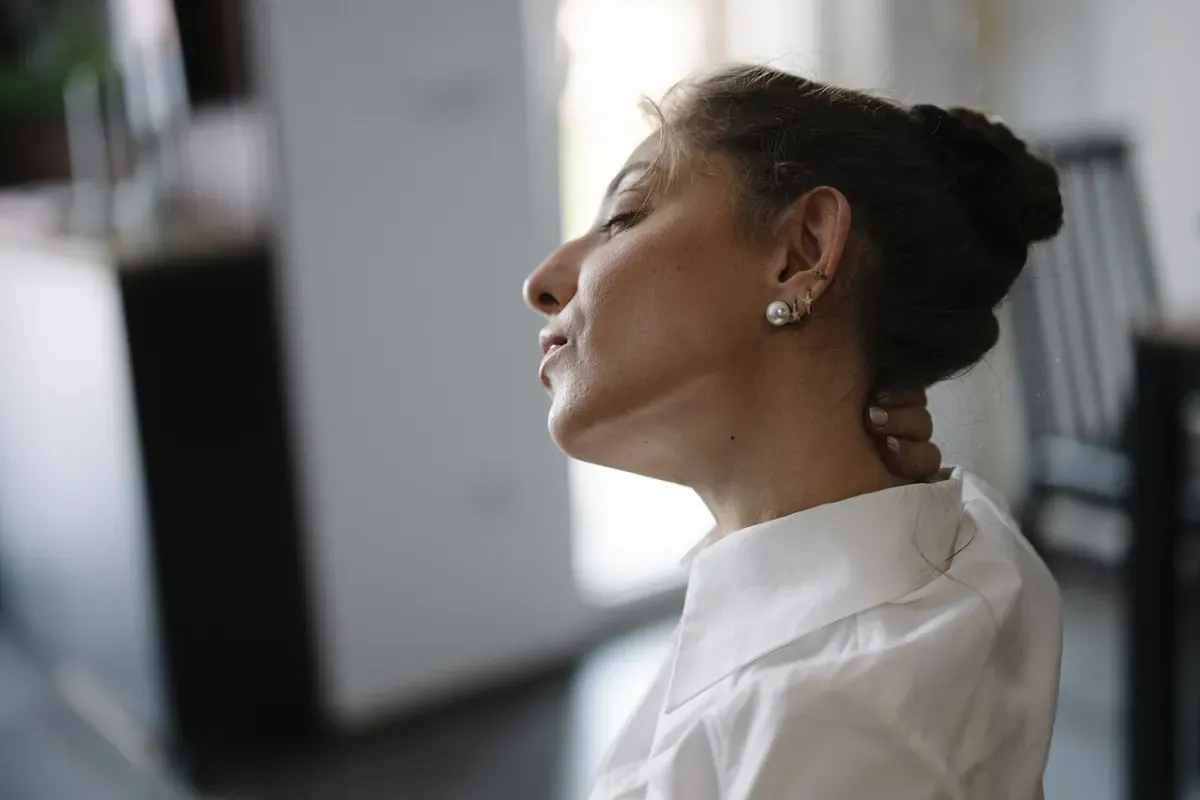 Photo: Shixart1985 / Wikimedia Commons (CC BY 2.0)
This heavily targets the upper trapezius. You must anchor your shoulder down to make it work. If your shoulder rises toward your ear, the stretch disappears.
Sit on a sturdy chair. Reach down and grip the bottom of the seat with your right hand to lock your right shoulder in place. Drop your left ear directly toward your left shoulder. Reach your left hand over your head and gently rest your fingers on your right ear. Do not pull your head down. The natural weight of your arm provides more than enough pressure. Take slow, deep breaths. Hold the position for 30 seconds. Switch sides.
Levator scapulae stretch
The levator scapulae works right alongside the upper traps. It attaches to the top corner of your shoulder blade and runs up the side of your neck. When one muscle hurts, the other usually joins in.
Sit up straight. Turn your head 45 degrees to the left. Imagine you are trying to look down at your left knee. Drop your chin down toward your chest. Place your left hand on the back of your head. Let the weight of your arm gently press your chin closer to your collarbone. You will feel a deep stretch traveling down the back of your neck and into the top of your shoulder blade. Hold for 30 seconds. Repeat on the right side.
Chin tuck with a side bend
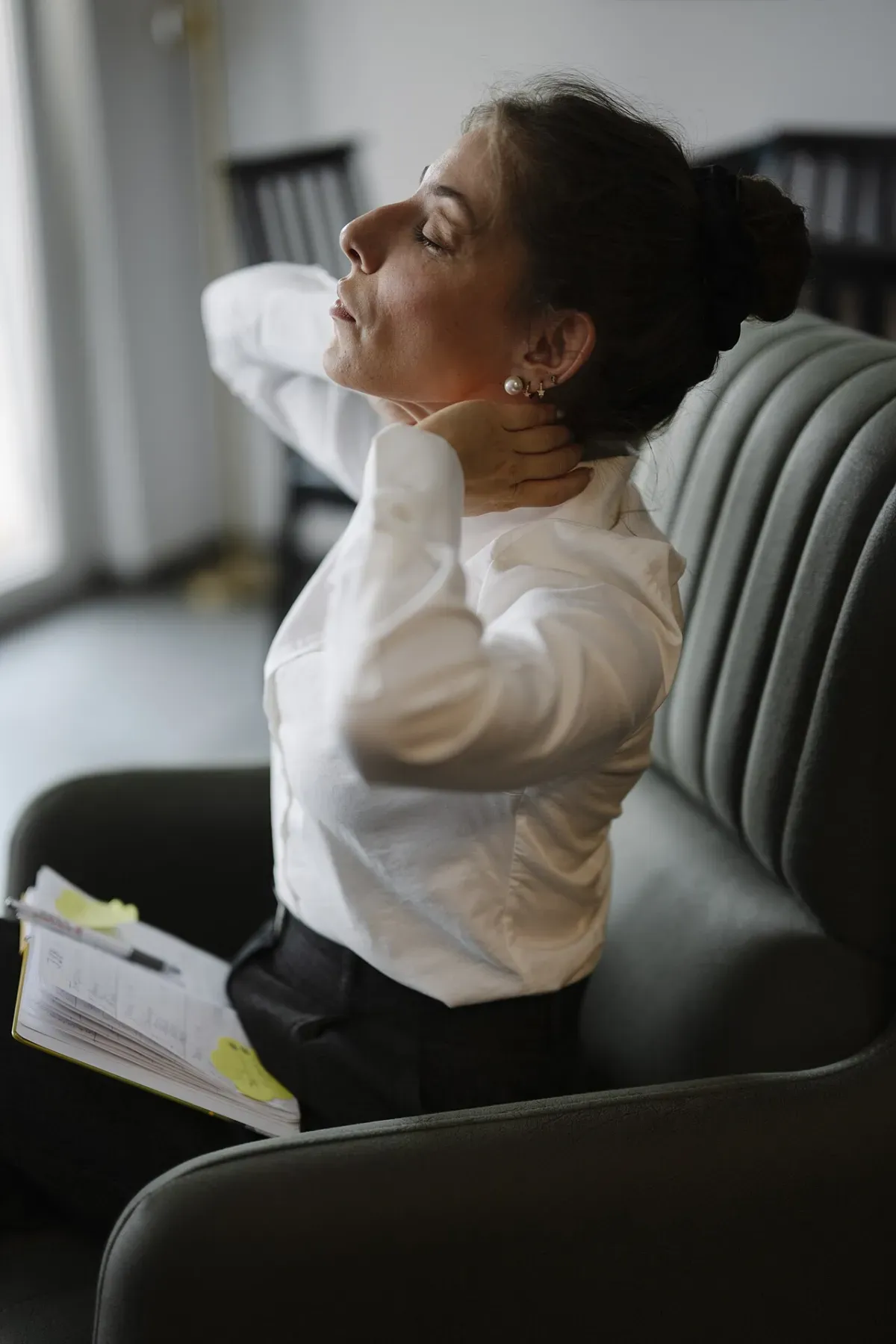 Photo: Shixart1985 / Wikimedia Commons (CC BY 2.0)
This variation targets the very top fibers of the upper trapezius where they attach to the base of the skull, as well as the tiny suboccipital muscles that govern head posture.
Start by making a double chin. Pull your head straight back without tilting your nose up or down. Once your neck is fully retracted, gently tilt your head to the side. It is a very subtle movement. Do not use your hands for this one. The muscular contraction required to hold the chin tuck deepens the stretch naturally while stabilizing the cervical spine. Hold for 20 seconds per side.
Behind-the-back shoulder stretch
Desk posture rounds your shoulders forward. Tight pectoral muscles pull your shoulder blades out of position, which puts the trapezius on a constant passive stretch. A muscle stuck in a lengthened position all day will feel tight and painful. Opening the chest allows the shoulder blades to return to a neutral position. If you look at popular shoulder stretches, you will find some version of this fundamental movement in nearly every routine.
Stand up. Clasp your hands together behind your lower back. Roll your shoulders back and drop them down away from your ears. Gently push your clasped hands toward the floor. Keep your chest lifted toward the ceiling. You should feel a stretch across the front of your shoulders and a sense of relief in the base of your neck. Hold for 30 to 45 seconds.
Cross-body shoulder stretch
This movement hits the posterior deltoid and the middle fibers of the trapezius. It is an excellent addition to any collection of upper back stretches.
Reach your right arm straight across your chest. Hook your left wrist under your right elbow. Gently pull the right arm closer to your body. Pay close attention to your right shoulder. It will instinctively try to creep up toward your ear. Actively pull the shoulder blade down. Keeping the shoulder depressed isolates the tension across the back of the joint. Hold for 30 seconds. Switch arms.
Building endurance with a two-minute band routine
Stretching manages the symptoms. Strength training manages the root cause.
A 2013 study by Lidegaard et al. looked at 30 female office workers suffering from chronic neck and shoulder pain. The researchers tested whether a micro-dose of targeted exercise could provide meaningful relief. The participants performed elastic-band shoulder abductions on workdays. The protocol was simple but intense. Participants completed a single set of as many repetitions as possible until they reached momentary muscular fatigue, with the set capped at a maximum of two minutes.
After 10 weeks, the participants saw their neck and shoulder pain intensity drop by roughly 40 percent. That was significantly better than the weekly general-health emails the control group received. What the researchers actually tracked was muscle rest: how often the upper trapezius fell quiet during a normal working day. After ten weeks of training, it got more of those pauses, and pain fell alongside.
Band shoulder abduction
This is the exact movement used in the study. You will need a simple elastic resistance band. Choosing the right resistance is crucial. If you can easily continue past two minutes, the band is too light. If you fail after 30 seconds, the band is too heavy.
Stand on the middle of the band with both feet. Hold one end of the band in each hand. Keep your arms straight and your thumbs pointing forward. Lift your arms out to the sides until your hands reach shoulder height. Lower them slowly and with control.
Tempo matters. Take two seconds to lift the band. Take two seconds to lower it. Do this continuously for up to two minutes. It will burn. The burning sensation is simply muscular fatigue accumulating as the tissue works hard. Breathe through the discomfort and keep moving until you can no longer lift your arms with good form.
Scapular retraction
Building endurance in the middle and lower trapezius takes the burden off the overworked upper trapezius.
Tie your resistance band to a sturdy object at chest height. Hold the ends with your arms straight out in front of you. Squeeze your shoulder blades together hard. Pull the band back so your hands end up beside your ribs. Focus entirely on the muscles between your shoulder blades. Your arms are just hooks. The back muscles must do the pulling. Perform 15 slow repetitions. Pair it with a few chest stretches and the rounded-shoulder position has less to pull against.
The desk setup causing the problem
You cannot out-stretch a terrible environment. The NHS points out that sleeping position and desk posture are the most common causes of neck pain. You spend a third of your life in bed and a massive portion of your waking hours at your desk. If your workstation is physically flawed, the tension will always return.
Monitor and armrest height
Your monitor must sit directly in front of you. The top of the screen needs to align with your eye level. Your head weighs four to five kilograms. Held over your shoulders it costs almost nothing to carry. Tip it forward to read a laptop screen and the weight moves out in front of the spine, so the muscles at the back of your neck have to hold it there for as long as you are looking down. The further forward, the worse it gets.
Laptops are ergonomically flawed by design. You cannot have the screen at eye level and the keyboard at elbow level simultaneously without using external peripherals. Prop the laptop monitor up on a stand or a stack of books. Buy a separate keyboard and mouse.
Next, fix your armrests. They must support the weight of your elbows. Adjust the height so your shoulders rest in a neutral position while you type. If your elbows hang freely, your traps carry the load. If the armrests are too high, your shoulders will be permanently shrugged.
Keyboard and mouse placement
Keep your keyboard and mouse close to the edge of the desk. When you place your input devices deep on the desk surface, you are forced to reach forward. Reaching forward pulls your shoulder blades away from your spine and stretches the trapezius. Bring the tools to you. Your elbows should sit vertically beneath your shoulders while you work.
Sleeping positions and pillows
Since you spend eight hours a day in bed, your sleeping posture dictates the baseline tension in your neck. Your pillow needs to keep your cervical spine in a neutral alignment.
If you sleep on your back, you need a relatively thin pillow to prevent your chin from being pushed toward your chest. If you sleep on your side, you need a thicker pillow to fill the exact gap between your ear and the mattress. Sleeping on your stomach forces your neck into maximum rotation for hours at a time, which virtually guarantees a stiff levator scapulae in the morning.
Breaking up long sitting
Joints stiffen when locked into a single posture.
Set a timer on your phone. Stand up every 45 minutes. Walk to the kitchen. Roll your shoulders. Do one of the trap stretches. The NHS explicitly advises keeping the neck moving rather than immobilising it. Wearing a rigid neck brace is counterproductive for ordinary postural stiffness. Keep the joints fluid. If you are new to daily movement, review the basics of stretching for beginners to build a safe and sustainable routine.
How often to do this
Consistency beats intensity. A few minutes most days will do more than an hour on a Sunday you end up skipping.
A realistic weekly dose
Build a habit with low friction. Perform the two-minute band exercise daily during the workweek. Combine it with a few stretches each afternoon to clear the accumulated stiffness.
| Day | Action | Duration |
|---|---|---|
| Monday | Band abductions & 2 stretches | 4 minutes |
| Tuesday | Band abductions & 2 stretches | 4 minutes |
| Wednesday | Band abductions & 2 stretches | 4 minutes |
| Thursday | Band abductions & 2 stretches | 4 minutes |
| Friday | Band abductions & all 5 stretches | 6 minutes |
Keep it manageable. If your forearms ache from typing, you can easily mix in some basic arm stretches during these short breaks. The goal is regular, high-quality movement that interrupts the static posture of your workday.
When to stop stretching and see a doctor
Sometimes a stiff neck is more than just desk fatigue. You need to know when to put the resistance band down and speak to a doctor.
What the NHS says
The NHS notes that most neck pain settles within a few weeks. It is rarely a sign of a serious underlying condition. You can usually manage it at home with gentle movement, painkillers, and adjustments to your posture.
See a GP if the pain has not shifted after a few weeks, if painkillers are not touching it, or if you get pins and needles or a cold feeling in your arm. The NHS flags that last one specifically. These neurological symptoms suggest a nerve might be compressed in your cervical spine. Shooting pain that travels past your elbow and into your hand is a clear signal to stop exercising. Never try to stretch through nerve pain. Get it evaluated by a professional to ensure your spine is healthy.
Frequently asked
- Why do my upper traps always feel tight?
- Your upper traps are likely overworked from holding the weight of your arms while typing. Hours of low-level contraction leave the muscle tired and stiff. Stretching a tired muscle only buys you an hour.
- How long should I hold a trap stretch?
- Hold each static stretch for 30 to 45 seconds. Breathe deeply and let the muscle relax naturally without forcing the range of motion. Doing this throughout the workday provides steady relief.
- Can strengthening my shoulders fix tight traps?
- Yes. Building strength in your shoulders and upper back increases your muscles' capacity to handle desk work. A 2013 study of female office workers showed that a single daily set of resistance band exercises can significantly reduce neck and shoulder pain.