Upper Back Stretches for Desk Tension

Releasing the tight band of tension between your shoulder blades requires two specific steps. You have to stretch the muscles for immediate relief. You also have to strengthen those same muscles so the relief actually lasts.
Most desk workers only do the first part. They stretch their upper back to chase away the burning sensation. They feel better for twenty minutes. Then they slump over their keyboard again. The tension returns before lunchtime. Breaking this cycle requires a tiny dose of daily resistance alongside your mobility work. A clinical trial by researchers including Lidegaard, published in BioMed Research International, found that completing just two minutes a day of elastic-band shoulder abduction for 10 weeks cut neck and shoulder pain intensity by about 40 percent in office workers.
You do not need a complicated gym routine to manage daily stiffness. You need a few targeted upper back stretches to restore your range of motion. You then need two minutes of targeted band work to build the muscular endurance required to hold your head high.
Why the space between your shoulder blades aches
The human body adapts to whatever position you hold most frequently. The modern office chair is a masterpiece of passive support. It holds your lumbar spine and cradles your arms. That support lets the muscles of your upper back go quiet.
When you spend eight hours a day peering at a monitor, your shoulders roll forward. Your chin juts out toward the screen. The muscles on the front of your chest shorten over time. Meanwhile, the muscles across your upper back stretch out like a worn elastic band.
This creates a constant tug-of-war across your ribcage. Your upper back aches because those muscles are exhausted. They are fighting a quiet, continuous battle against gravity to keep your eyes level with the horizon, and they are losing.
What the thoracic spine is supposed to do
Your spine has three main sections. The cervical spine is in your neck. The lumbar spine is in your lower back. The thoracic spine sits right in the middle. This central section contains 12 vertebrae that connect directly to your ribcage.
This part of your skeleton is built for rotation and extension. It allows you to twist to look behind you. It allows you to arch backward to reach an item on a high shelf. Modern life removes almost all demand for these movements. Sitting at a computer locks the thoracic spine into a static, slightly rounded posture for hours on end. The joints slowly lose their ability to move freely. When joints stop moving regularly, the surrounding tissues often stiffen as a secondary effect.
The hidden role of the ribcage
Breathing mechanics play a massive role in how your upper back feels. Every rib you have hinges onto a thoracic vertebra at a real joint, so a full breath moves your mid back whether you notice it or not.
Slumping forward compresses your abdomen and restricts your diaphragm. You are forced to take shallow breaths into the top of your chest. This locks the lower ribs in place and deprives your mid-back of the subtle, continuous movement that normal breathing provides. Restoring mobility to this area requires moving the spine while deliberately expanding the ribs.
Why the relief from stretching keeps wearing off
A common mistake is treating the tight feeling in the upper back as a sign of shortened muscles. Those muscles are usually overstretched. They are pulled taut across a rounded spine.
When you do traditional upper back stretches, you pull those overstretched muscles even further. This triggers a temporary neurological release. The nervous system relaxes the local area to prevent tearing, which provides a brief window of comfort. However, the underlying weakness remains. Gravity pulls your shoulders forward again the moment you sit down. The muscles strain to hold your head up. The familiar burning sensation returns.
To change how your back feels long-term, you have to follow up your mobility work with targeted strengthening.
Six upper back stretches
These movements focus on mobilizing the thoracic spine and releasing the surrounding tissues. You can perform them on a yoga mat or right in the middle of your living room. Move slowly. Direct your breath deeply into your back.
Cat-cow
This foundational movement gently moves the thoracic spine through a gentle range of flexion and extension. It teaches your nervous system that it is safe to move this part of your back again.
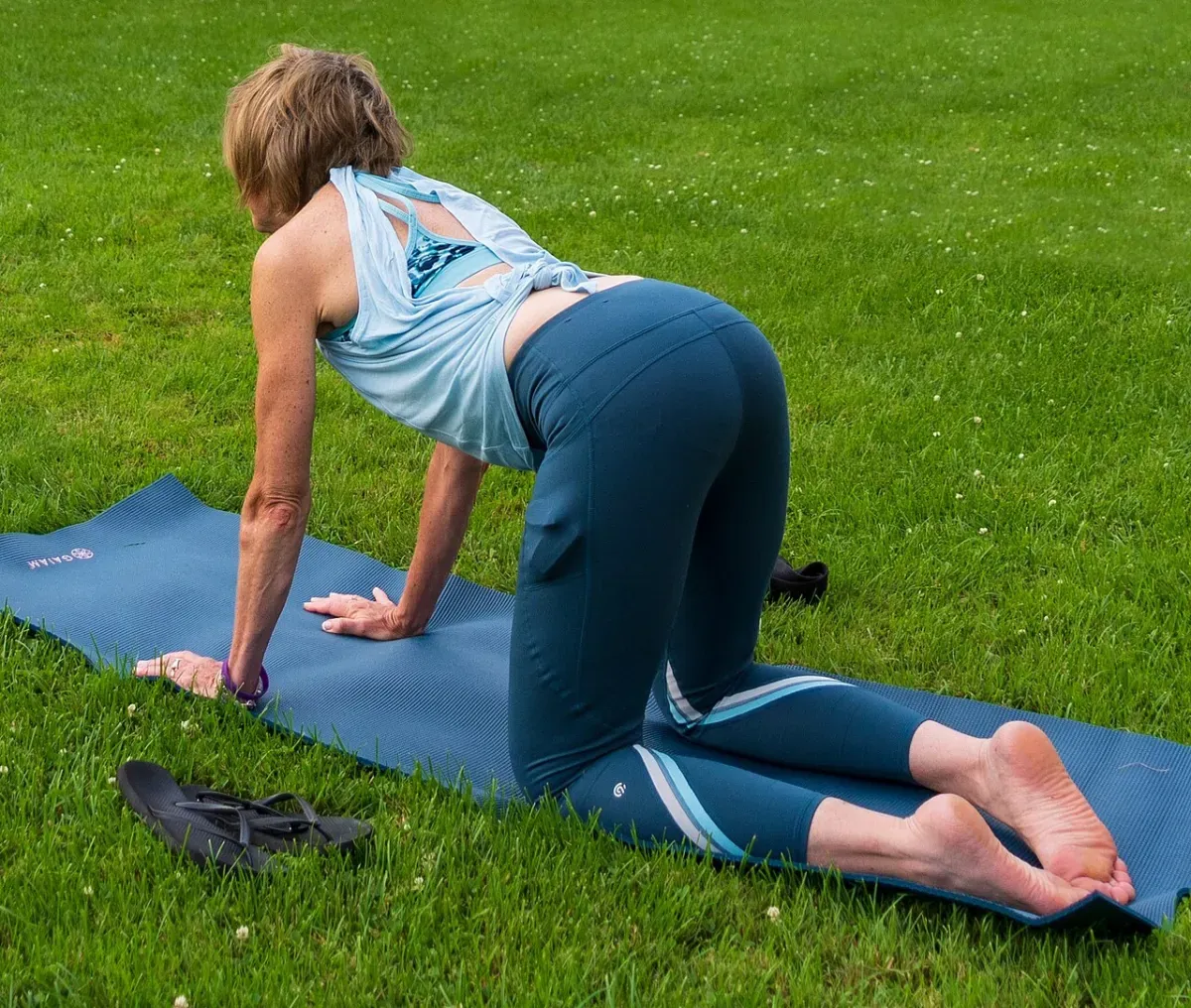 Photo: Mary O’Neill / Wikimedia Commons (Public domain)
Start on your hands and knees. Place your wrists directly under your shoulders and your knees under your hips. Inhale deeply while letting your belly drop toward the floor. Lift your chest and tailbone toward the ceiling for the cow position.
Exhale slowly. Press your hands firmly into the floor. Round your upper back toward the ceiling while tucking your chin to your chest for the cat position. Imagine pulling your shoulder blades as far apart as possible.
Move between these two shapes for one minute. Do not force the end ranges. Let the movement grow slightly larger with each repetition.
Thread the needle
This stretch targets the rotational capacity of the thoracic spine while opening up the rhomboid muscles between the shoulder blades.
Begin on all fours. Slide your right arm underneath your body. Reach across to the left side of the room. Lower your right shoulder and the right side of your head to the floor. Keep your hips elevated and relatively square to the ground.
Press your left hand lightly into the floor to deepen the twist. Hold this position for 30 seconds. Focus on expanding the back of your ribcage with every breath. Slowly untwist and repeat the movement on the left side.
Seated thoracic rotation
If you are stuck at work, you can use your office chair to mobilize your spine. This variation requires no extra equipment and takes minimal space.
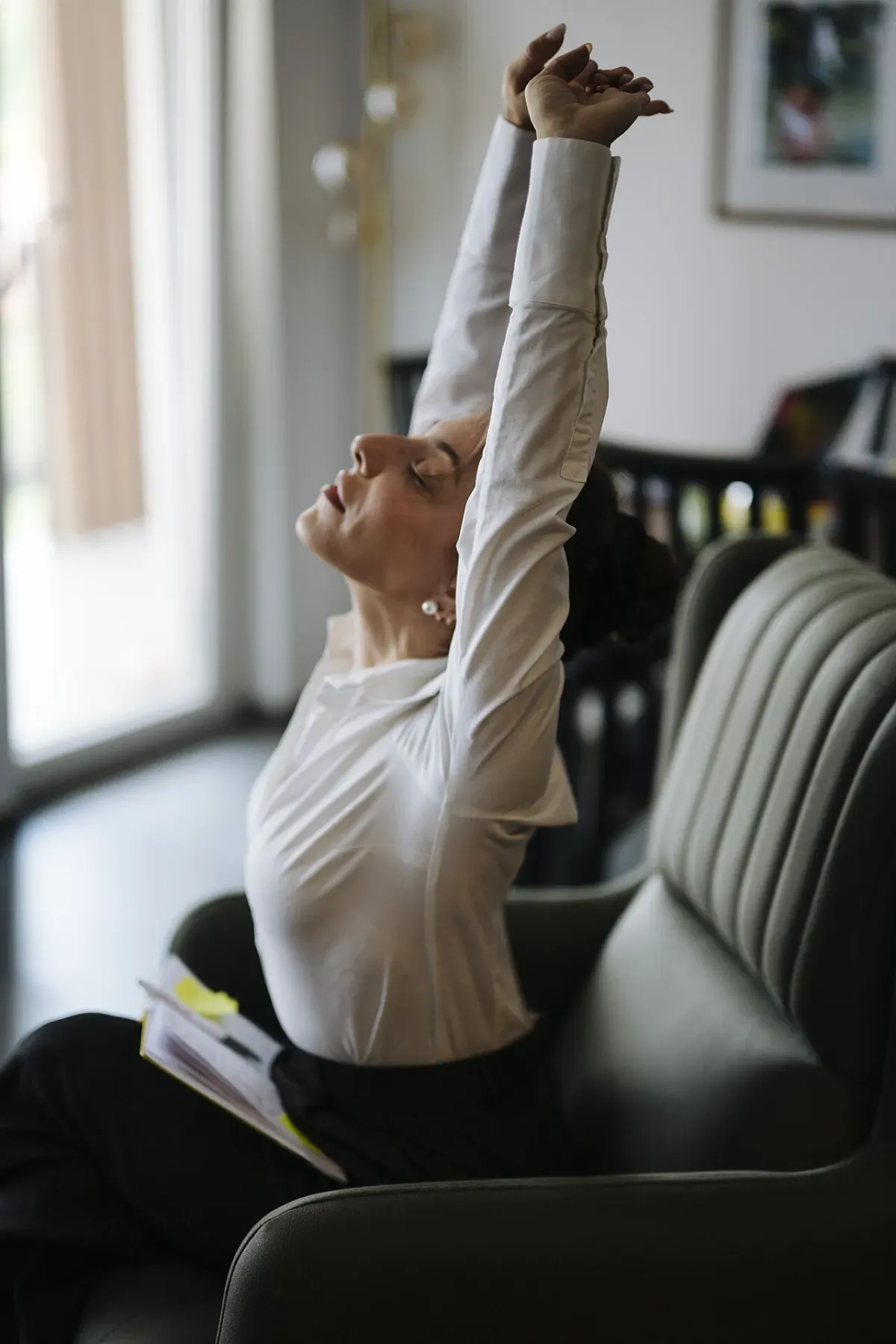 Photo: Shixart1985 / Wikimedia Commons (CC BY 2.0)
Sit sideways on a sturdy chair with your feet flat on the floor. Keep your knees pointing straight ahead. Sit tall. Lift the crown of your head toward the ceiling. Exhale and twist your torso toward the backrest of the chair.
Place both hands on the backrest. Use your arms to gently pull yourself deeper into the rotation. Hold this position for 30 seconds. Take three deep breaths. Try to sit slightly taller on each inhale and twist one millimeter further on each exhale. Switch sides by turning your body or moving the chair. If you feel a pinching sensation in your lower back, you have twisted too far.
Wall angels
While technically a stretch for your chest, wall angels force your upper back muscles to work actively against gravity. This makes them a perfect bridge between mobility and strength. They are deceptively difficult.
Stand with your back against a flat wall. Walk your feet about six inches forward. Press your lower back, upper back, and the back of your head firmly against the wall. Raise your arms out to the sides with your elbows bent at 90 degrees. Press your elbows and the backs of your wrists against the wall.
Slowly slide your arms upward toward the ceiling. Keep your lower back and your wrists in contact with the wall the entire time. Only go as high as you can without letting your ribs flare forward. Slide your arms back down. Complete 10 repetitions.
Child’s pose with a side reach
This variation of a classic yoga posture targets the latissimus dorsi. These large back muscles attach to the upper arm and span all the way down to the pelvis. When they get tight, they restrict shoulder movement and compress the mid back.
Kneel on the floor and sit back on your heels. Walk your hands forward until your arms are straight and your forehead rests on the ground. From this standard child’s pose, walk both hands over to the right side of your mat. Keep your hips sinking back toward your left heel.
Place your left hand on top of your right hand. Direct your breath deeply into the left side of your ribcage. Hold for 30 seconds. Allow your hips to sink deeper toward your heels as the seconds pass. Walk your hands to the left side and repeat.
Chair-supported extension
The most direct antidote to slumping forward is bending backward. Using a chair provides a fulcrum to isolate the thoracic spine.
Sit in a chair with a mid-height backrest. The top edge of the backrest should hit you right beneath your shoulder blades. Interlace your fingers behind your head to support your neck. Keep your elbows pointing forward.
Inhale and gently lean back over the top of the chair. Keep your lower back relatively neutral so the movement comes from your upper back. Exhale and return to the starting position. Five slow reps, about 30 seconds. If you feel this in your neck, you are likely throwing your head back instead of moving your spine.
The strength work that makes it stick
Once you have used the stretches above to unlock your spine, you need to give your back muscles the endurance to hold your new posture.
Two minutes a day with a band
That is the Lidegaard trial again: two minutes, ten weeks, forty percent less pain. The dose is the interesting part.
Buy a simple elastic resistance band. Stand tall. Hold the band in front of you with straight arms and your hands roughly shoulder-width apart. Keep your shoulders down away from your ears. Pull the band apart by squeezing your shoulder blades together. Pull until the band touches your chest. Slowly return to the starting position.
Set a timer for two minutes. Perform this movement continuously. Rest only when the burning sensation in your upper back forces you to stop. Resume as soon as you can. Doing this daily builds specific local muscular endurance.
Rowing movements for the mid back
If you want to progress beyond the resistance band, add rowing movements to your routine. Any exercise where you pull a weight toward your torso will strengthen the rhomboids and the middle trapezius.
You can use dumbbells, kettlebells, or a cable machine. The key is to initiate the movement by retracting your shoulder blades before your elbows bend. A proper back workout you can do at home will balance out the constant forward-reaching posture of daily life. Focus on feeling the muscles contract in the center of your back rather than just moving the weight.
Progression and progressive overload
Posture requires continuous adaptation. Your body will eventually get used to the resistance band. The two minutes will stop feeling difficult.
When you can complete the full two minutes of band pull-aparts without stopping to rest, you need to increase the stimulus. Move your hands an inch closer together on the band to increase the tension. Alternatively, buy a slightly thicker band. If you are using dumbbells for rows, increase the weight by one kilogram. Your muscles only grow stronger when you give them a reason to adapt.
A five-minute routine you can do at a desk
You do not need an hour of free time to manage desk stiffness.
The order to run it in
The order in which you perform your exercises matters. A review published in the European Journal of Applied Physiology details how movement sequences affect the body. The researchers recommend that a warm-up should begin with submaximal aerobic work, move into large-amplitude dynamic stretching, and finish with specific drills. They note that long static holds before performance can impair muscle function.
While this review focused on athletic performance, the underlying principle applies well to desk workers easing into movement. You should move the joints dynamically before settling into long static stretches.
| Movement | Type | Duration |
|---|---|---|
| Shoulder rolls (roll them up, back and down, slowly) | Dynamic warmup | 30 seconds |
| Cat-cow, or the same rounding and arching done seated | Dynamic stretch | 60 seconds |
| Seated thoracic rotation | Static hold | 30 seconds per side |
| Chair-supported extension | Dynamic stretch | 30 seconds |
| Band pull-aparts | Strength drill | 120 seconds |
The best time of day to run it
The best time to do this routine is right before your back usually starts hurting. If you always ache by 2:00 PM, run through the sequence at 1:00 PM.
Many people build a reliable habit by adding a short session to their morning stretch routine and then repeating the two minutes of band work in the mid-afternoon. Find a trigger in your workday to remind you. Do the movements right after your lunch break or immediately following a recurring daily meeting.
Mistakes that keep people stiff
Even with the right exercises, poor execution will limit your results. Watch out for these common errors that prevent the upper back from releasing.
Yanking the neck instead of the back
The cervical spine is highly mobile. The thoracic spine is often rigid. When you try to stretch your upper back, your body will instinctively seek the path of least resistance.
During extension movements, people often throw their head backward without actually moving their ribcage. This strains the neck joints and bypasses the tight space between the shoulder blades entirely. Keep your chin slightly tucked during upper back stretches. If you need specific relief for your neck and the tops of your shoulders, incorporate dedicated shoulder stretches instead of compromising your spinal mechanics.
Holding your breath
Every rib hinges onto a thoracic vertebra at a real joint. When you hold your breath during a stretch, you lock down the ribcage.
This stiffens the torso. You have to breathe continuously through every movement. Focus on expanding the sides and back of your ribs on the inhale. Sink deeper into the stretch on the exhale. Your breath is a mechanical tool to mobilize the spine from the inside out.
Stretching infrequently
Sitting at a desk for 40 hours a week provides a massive stimulus to your nervous system. A single 15-minute stretching session on a Saturday morning cannot compete with that volume of input.
You need high-frequency, low-intensity interventions. Stretching for beginners should focus on doing five minutes of movement every single day rather than an hour once a week. The body responds to daily habits.
Forcing the end ranges of motion
Pushing too hard into a stretch is counterproductive. Your nervous system monitors your muscles for sudden changes in length.
Force your spine into a deep rotation and the surrounding muscles tend to guard, which leaves you stiffer than when you started. Ease into the positions. Coax the tissue open rather than demanding it.
When upper back pain needs a professional
Pain between the shoulder blades warrants attention.
The typical mechanical causes
Desk posture, muscular weakness, and prolonged static positioning usually cause this discomfort. The heavy weight of your head shifts forward off its natural center of gravity. Most office-related upper back pain has a mechanical explanation like this one.
What the NHS flags
Medical guidelines clearly outline when to seek help. The NHS advises that normal back pain usually improves within a few weeks. They strongly recommend staying active rather than resting in bed, as movement speeds recovery.
However, the same guidelines specifically highlight upper back pain as a distinct reason to see a GP. While people frequently look up lower back stretches to manage common lumbar aches, pain located higher up between the shoulder blades warrants closer monitoring.
You should book an appointment with a doctor if your upper back pain persists for more than a few weeks. You must seek immediate medical advice if the pain is worse at night, if it wakes you up from sleep, or if it is accompanied by unexplained weight loss or a high temperature. These red flags mean the discomfort might not be coming from your muscles at all. Once a doctor rules out underlying conditions, you can safely return to your daily stretching and band work to build a more resilient spine.
Frequently asked
- How often should I stretch my upper back at work?
- You should aim for short movement breaks every hour or two. A minute of movement every hour beats one long stretching session on the weekend.
- Why does my upper back hurt when I breathe deeply?
- Your ribs attach to your thoracic spine in the upper back. Sitting in a rounded posture alters the mechanics of these joints. Expanding the ribcage during a deep breath pulls on those stiff tissues and causes discomfort.
- Can a tight upper back cause neck pain?
- Yes. The trapezius muscle runs from the middle of your back up to the base of your skull. Tension in the lower and middle sections often transfers upward along the muscle fibers, contributing to neck stiffness and tension headaches.