Plantar Fasciitis Stretches: The Proven Dose
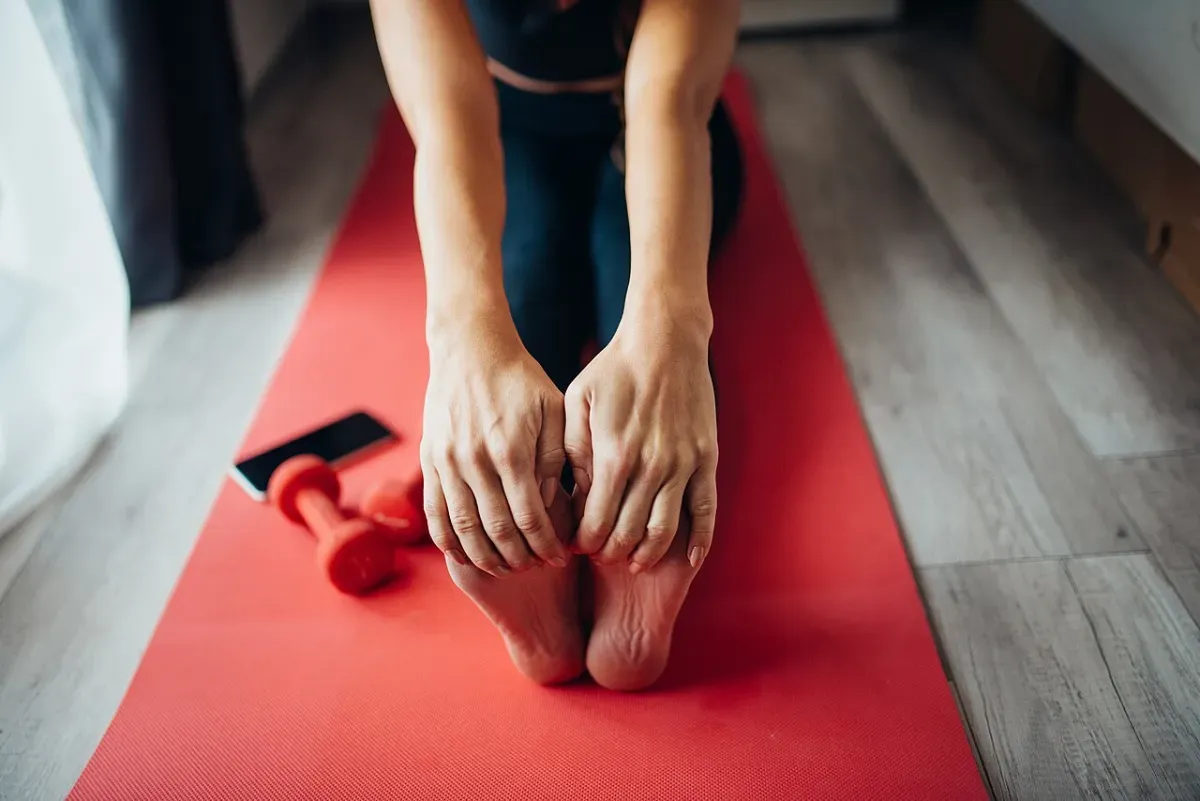
Sit down, cross the sore foot over your opposite knee, pull your toes back toward your shin, and hold that position for ten seconds. Repeat this ten times. Do the entire sequence three times a day. Make sure the first set happens before you take your first step out of bed in the morning. This specific sequence outperformed standard weight-bearing calf stretches at eight weeks in a 101-patient randomised trial.
More than 90 percent of patients improve within ten months of starting simple treatment methods like this one. That timeline is longer than most people want to hear. Yet the goal of a daily routine is to make those months manageable. We have solid clinical data on heel pain. The research points toward specific mechanical loading and targeted stretching. You don’t need a complex array of equipment to start. You just need a chair, consistency, and a towel.
The trial built this morning timing into the protocol, so the first-step result belongs to the whole package rather than to timing alone. Stretching helps you navigate the early stages of tissue repair. It gives you a practical tool to manage the morning pain. Consistency dictates your progress.
The short answer
The one stretch with the strongest trial evidence
The cornerstone of conservative treatment is a specific movement targeting the sole of the foot. In a randomised trial published in the Journal of Bone and Joint Surgery, researchers tested this seated movement against traditional weight-bearing calf stretches. The study involved 101 patients. These patients had been suffering from chronic proximal plantar fasciitis for at least ten months.
The group assigned to the non-weight-bearing stretch specific to the plantar fascia saw superior results at the eight-week mark. They recorded significantly better Foot Function Index scores for their worst daily pain. They also saw an improvement in the sharp pain associated with their first steps in the morning. The evidence points directly to targeting the connective tissue while seated, rather than relying solely on leaning against a wall to stretch the calf.
The dose that was actually tested
The trial protocol is specific about volume. Patients were instructed to hold the stretch for ten seconds and repeat it ten times per session. They completed three sessions every day. This equals about five minutes of total stretching per foot daily.
The American Academy of Orthopaedic Surgeons (AAOS) suggests a slightly different volume for the stretch. They recommend holding the position for ten seconds and repeating it twenty times per foot. Both doses are clinically supported. The Cleveland Clinic advises patients to aim for at least ten minutes of total stretching per day while actively treating the condition. You can easily close the gap between the trial’s five minutes and the clinic’s ten minutes by adding standard calf work and self-massage to your routine. They also stress the importance of continuing the routine long after you feel better.
The role of morning timing
The most critical instruction in the trial protocol was the clock. Patients were told to perform their very first set of stretches in the morning before taking a single step out of bed.
If you wait until you are in the shower or downstairs making coffee to do your first set of stretches, you have already loaded the fascia cold, which is the moment the trial protocol was built to get in front of. Pre-stretching the tissue gently while seated prepares it to bear your weight.
Why the first step out of bed is the worst one
What the plantar fascia actually is
The plantar fascia is a band of connective tissue. It runs down the length of the sole, connecting your heel bone to your toes. It acts as a shock absorber. It supports the foot during walking and running.
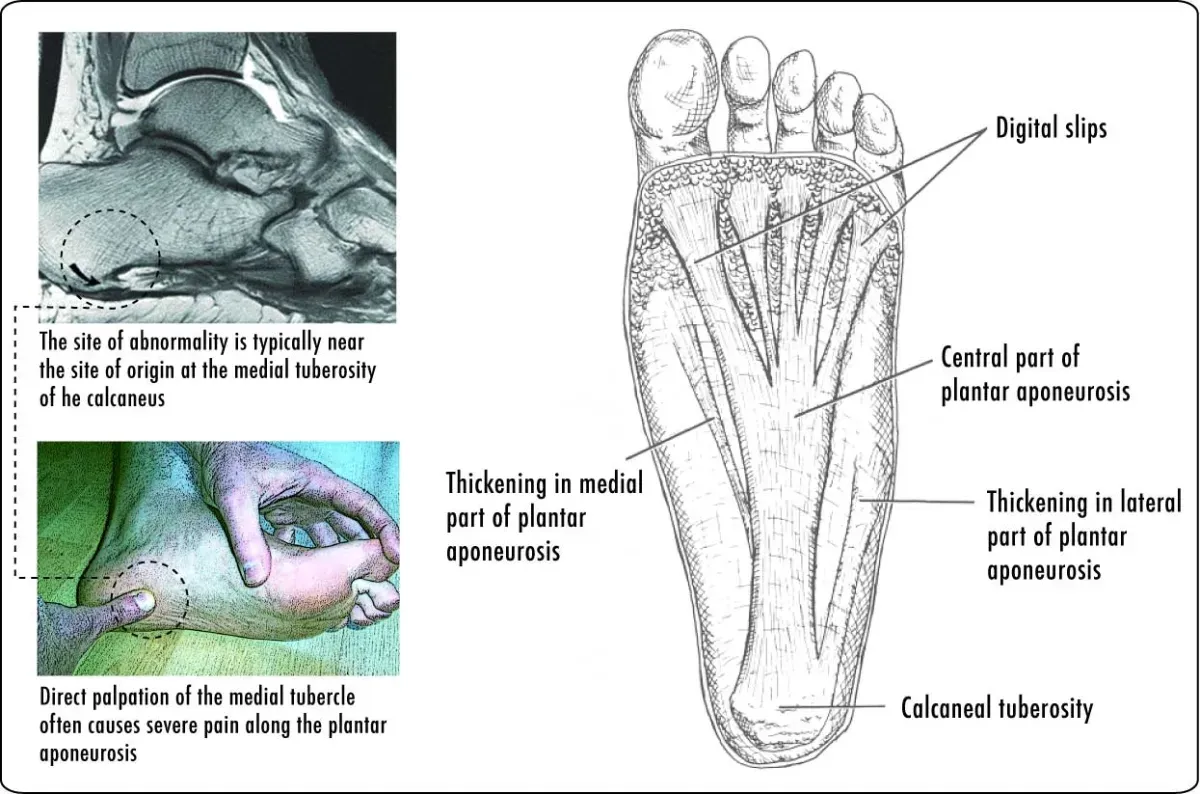 credit: Illustration via Wikimedia Commons (Public domain)
Despite the condition’s name ending in “-itis”, medical understanding has evolved. According to the StatPearls clinical overview, the physical changes in the tissue are degenerative rather than inflammatory. The collagen fibres break down and lose their organised structure due to repetitive micro-tears. This explains why anti-inflammatory medications rarely provide long-term cures for the condition.
The pattern of morning pain
The signature symptom is a sharp, stabbing heel pain. This pain is at its worst during the first few steps out of bed. As you walk around for a few minutes, the tissue gradually warms up. The pain often recedes to a dull ache.
However, the sharp pain reliably returns after long periods of sitting or standing. When you sit at a desk for a few hours, the foot rests. Standing up forces it to stretch rapidly under your full body weight. This recreates the mechanical stress you experience first thing in the morning.
Who tends to get it
This is a common mechanical failure. Plantar fasciitis accounts for roughly one million patient visits annually in the United States alone. It occurs in about 10 percent of the general population.
The demographics are concentrated. Roughly 83 percent of those affected are active working adults between the ages of 25 and 65. Documented risk factors include limited ankle dorsiflexion, flat feet, unusually high arches, prolonged standing on hard surfaces, and obesity. The AAOS notes that age between 40 and 60 is a significant risk factor in itself. A sudden, new, or increased load of high-impact repetitive activity frequently acts as the primary trigger.
The plantar fascia-specific stretch, step by step
The exact position from the trial
Replicating the results of the trial requires following the exact mechanics the patients used. Start by sitting in a chair. Cross your affected leg over your other leg so your ankle rests near your opposite knee.
Place your fingers directly across the base of your toes on the sore foot. Pull the toes back toward your shin. You must pull until you feel a distinct stretch down the length of the fascia, which runs from the heel bone forward to the toes. Hold this tension firmly for ten seconds. Release the toes, wait a moment, and repeat the pull. Complete ten repetitions to finish the set.
The towel variation for limited mobility
Many people lack the hip mobility to comfortably cross their leg over their knee and reach their toes. The AAOS provides an effective seated alternative.
Sit on the floor or a bed with your leg extended in front of you. Loop a rolled-up towel around your big toe and the ball of your foot. Hold one end of the towel in each hand. Pull the towel straight back toward your body, drawing your toes toward your shin. This achieves a stretch through the arch of the foot without requiring deep hip external rotation. It serves as a practical substitute if the crossed-leg position causes knee or hip discomfort.
Three mistakes that ruin the setup
Small deviations in technique compromise this routine. The first mistake is performing the stretch while standing. The trial specifically tested a non-weight-bearing position. Standing forces the foot to support your body mass, altering how the tissue responds to the stretch.
The second mistake is pulling from the tips of the toes. You must grasp the base of the toes. Pulling from the tips bends the toe joints themselves without transferring the necessary leverage down the length of the fascia, which runs from the heel bone forward to the toes.
The third mistake is skipping the morning set. Loading the tissue cold alters your recovery trajectory for the rest of the day.
Calf and Achilles work: the supporting cast
Wall calf stretch with the knee straight
While calf stretching lost to the fascia-specific stretch in head-to-head testing at eight weeks, it remains a vital part of the recovery process. Limited ankle dorsiflexion is a documented risk factor for plantar fasciitis. Tight calves restrict how far your ankle can bend.
The AAOS recommends a standard wall stretch to address this limitation. Lean forward against a wall with one foot in front of the other. Keep your back knee completely straight and ensure that heel stays firmly planted on the ground. Push your hips forward toward the wall until you feel a stretch in the upper calf of your back leg. Hold this position for ten seconds and repeat it twenty times per foot. Keeping the back knee straight specifically targets the larger gastrocnemius muscle.
The same stretch with the knee bent
You also need to stretch the deeper calf muscle. Assume the exact same staggered stance against the wall. This time, bend the knee of your back leg slightly while keeping the heel pressed into the floor.
This simple adjustment shifts the tension lower down the leg. It targets the soleus muscle. The soleus plays a major role in ankle mechanics. You can find detailed breakdowns of these positions in our comprehensive guide to calf stretches.
Step stretch, and how far down to go
A step stretch provides a deeper range of motion for the Achilles tendon and calf complex. Stand on the edge of a bottom stair with the balls of your feet firmly planted. Slowly let your heels drop below the level of the step.
You should only drop down until you feel a strong pull in the back of your lower leg. A stretch should register as a pull through the arch or calf, never a sharp or radiating pain. If your ankle barely bends during this movement, ankle mobility exercises cover the joint restrictions that stretching alone won’t resolve.
Rolling the arch, and the strength work alternative
Rolling the sole on a ball or frozen bottle
Self-massage is a standard adjunct to static stretching. The Cleveland Clinic recommends rolling the sole of your foot over a firm object for two to three minutes per foot, a few times a day.
You can use a golf ball, a tennis ball, or a frozen water bottle. The frozen bottle provides the added benefit of cold therapy. Press down firmly enough to feel deep pressure, but avoid pressing so hard that you cause yourself to wince in pain. This active rolling combined with calf work easily pushes your daily treatment time up to the ten-minute mark advised by clinics.
High-load heel raises as a replacement
Stretching improves flexibility, but the tissue ultimately needs to tolerate heavy loads again. A 2015 trial published in the Scandinavian Journal of Medicine and Science in Sports tested the substitution of progressive strength training. The researchers recruited 48 patients with ultrasonography-verified plantar fasciitis.
Both groups in the trial wore shoe inserts. One group performed daily plantar-specific stretching alongside wearing the inserts. The other group replaced the stretching routine with high-load unilateral heel raises every second day, while also wearing the inserts. They bunched a towel under their toes.
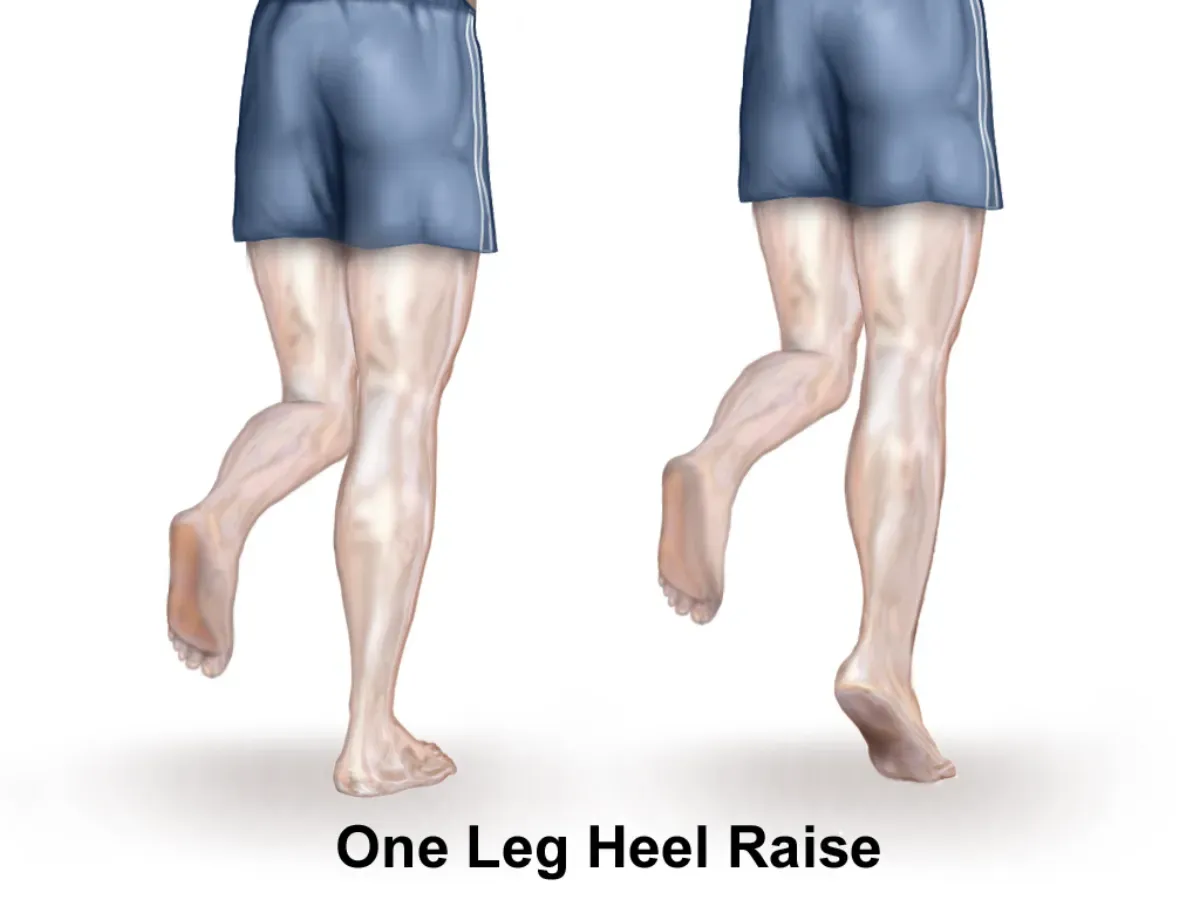 credit: Illustration by BruceBlaus via Wikimedia Commons (CC BY-SA 4.0)
At the three-month mark, the strength training group scored 29 Foot Function Index points lower than the stretching group, indicating significantly less pain and better function. Three months was the only time point with a gap. There were no differences between the groups at one, six, and twelve months. Loading the tissue buys you speed and comfort in the first three months.
How to progress without flaring it up
When introducing heel raises, tempo is your primary safeguard against flare-ups. The trial did not specify a tempo, but a workable practical one is three seconds to lift up, a two-second pause at the top of the movement, and three seconds to lower your heel back down.
This slow execution prevents you from bouncing or using momentum. It forces the calf and foot muscles to do all the mechanical work. Start with double-leg raises before progressing to the unilateral variations used in the trial.
A realistic timeline, and what stretching cannot fix
What the recovery numbers actually say
Recovery takes months. According to the AAOS, more than 90 percent of patients improve within ten months of starting simple treatment methods.
The StatPearls data confirms this long timeline. About 75 percent of cases resolve spontaneously within twelve months. Between 70 and 80 percent of patients see a meaningful reduction in their symptoms within nine to twelve months.
We see this long-term convergence in the trial data as well. A two-year follow-up to the original trial collected complete data from 66 of the initial patients. The early advantage of the fascia-specific stretch had disappeared. Both stretching groups showed no significant differences in worst pain or first-step pain. The overall outcomes were excellent across the board. Fully 92 percent of patients reported satisfaction with their outcome, 94 percent noted a decrease in pain, and 77 percent had no limitations in their recreational activities.
Load, shoes and standing: the part outside the routine
Stretching cannot undo the damage caused by poor daily habits. It won’t fix a sudden jump in your weekly training volume. It cannot compensate for worn-out, unsupportive shoes. It will not negate the stress of working long shifts on hard floors.
The Cleveland Clinic advises swapping high-impact activities like running and jumping for low-impact alternatives like walking, cycling, or swimming while your symptoms are active. The NHS specifically advises you do not walk or stand for long periods, especially barefoot. When you eventually return to high-impact sports, what you do before a run becomes a necessary part of your routine to manage the tissue load. Understanding these principles through our guide on stretching for beginners helps frame how the body adapts to stress.
The long-term convergence of results
The convergence of the trial groups at two years reveals a crucial truth about plantar fasciitis. The body possesses a capacity to heal this tissue over time. The specific stretch, the shoe inserts, and the high-load heel raises are tools to make the first few months less painful. They improve your quality of life while the tissue repairs itself.
When to stop self-treating
This guide covers wellness habits. It is not a medical service, and the information provided here is not a diagnosis. Persistent foot pain requires professional evaluation to rule out other issues.
See a GP if this describes you
The NHS provides clear guidelines on heel pain and when to seek medical attention. You should see a GP if your heel pain is severe or stopping you from doing your normal activities.
You also need a doctor if the pain is getting worse, if it keeps coming back, or if it has not improved after treating it at home for 2 weeks. You must also see a GP if you experience tingling or a loss of sensation in your foot, or if you have diabetes and develop heel pain.
Get urgent help for these signs
Some symptoms require immediate medical intervention rather than a stretching routine. Seek urgent advice if your severe heel pain started immediately after an injury and you feel faint, dizzy, or sick.
You also need urgent care if your foot or ankle has changed shape or sits at an odd angle. Hearing a snapping, grinding, or popping sound at the time of injury is a major red flag. Finally, get urgent help if you cannot walk, cannot walk on your tiptoes, cannot climb stairs, or if you notice sudden swelling and bruising in your calf and ankle.
Diagnosing what a routine misses
A clinician can diagnose nerve-related heel pain or a heel bone stress injury. Both of these conditions can mimic the exact symptoms of plantar fasciitis. This is exactly why a presentation that has not improved after treating it at home for 2 weeks means you should get the foot looked at by a professional rather than simply trying to stretch harder.
Fitting it into a week
The morning set, before your feet hit the floor
The most difficult part of the protocol is remembering to do it before standing up. The easiest solution is environmental design. Keep a rolled-up towel right next to your bed. You might drape it over your alarm clock or phone charger.
When you wake up, the towel serves as a physical barrier and a visual reminder. You can easily bolt this crucial first set onto a short morning stretch routine so that it happens automatically without requiring a conscious decision every single day.
Midday and evening sets
The remaining two daily sets required by the protocol need to be attached to existing anchors in your day. You might do your second set of ten stretches while sitting at your desk immediately after your lunch break.
The third set fits naturally into an evening wind-down routine. Perform the stretches while watching television or right before you get into bed. The exact timing of these later sets matters far less than the simple act of completing them.
What to track for two weeks
Don’t overwhelm yourself by tracking endless variables. Keep a simple log of just two things. First, record your first-step pain out of ten each morning. Second, mark a tick box to confirm whether all three sets of stretches happened that day.
If a stretching session leaves your next-morning first-step pain noticeably worse, cut your daily volume before attempting to add any extra exercises. Review your simple log at the two-week mark. If the condition has not improved after treating it at home for 2 weeks, it is time to consult a doctor.
Frequently asked
- How long does it take for plantar fasciitis stretches to work?
- You might feel a slight easing of morning pain within a few weeks, but complete recovery is measured in months. About 75 percent of cases resolve spontaneously within a year.
- Should I stretch my plantar fascia if it hurts?
- You should feel a clear pull through the arch of your foot or your calf, but never a sharp or radiating pain. If a stretching session leaves your first step out of bed feeling worse the next morning, you have done too much. Cut the volume back before trying to add more stretches.
- Is walking barefoot bad for plantar fasciitis?
- Walking barefoot on hard floors places unshielded stress on the tissue. The NHS specifically advises you do not walk or stand for long periods, especially barefoot. Keep supportive shoes or thick cushioned slippers next to your bed for those first morning steps.