Rotator Cuff Stretches and the Strength Work That Matters
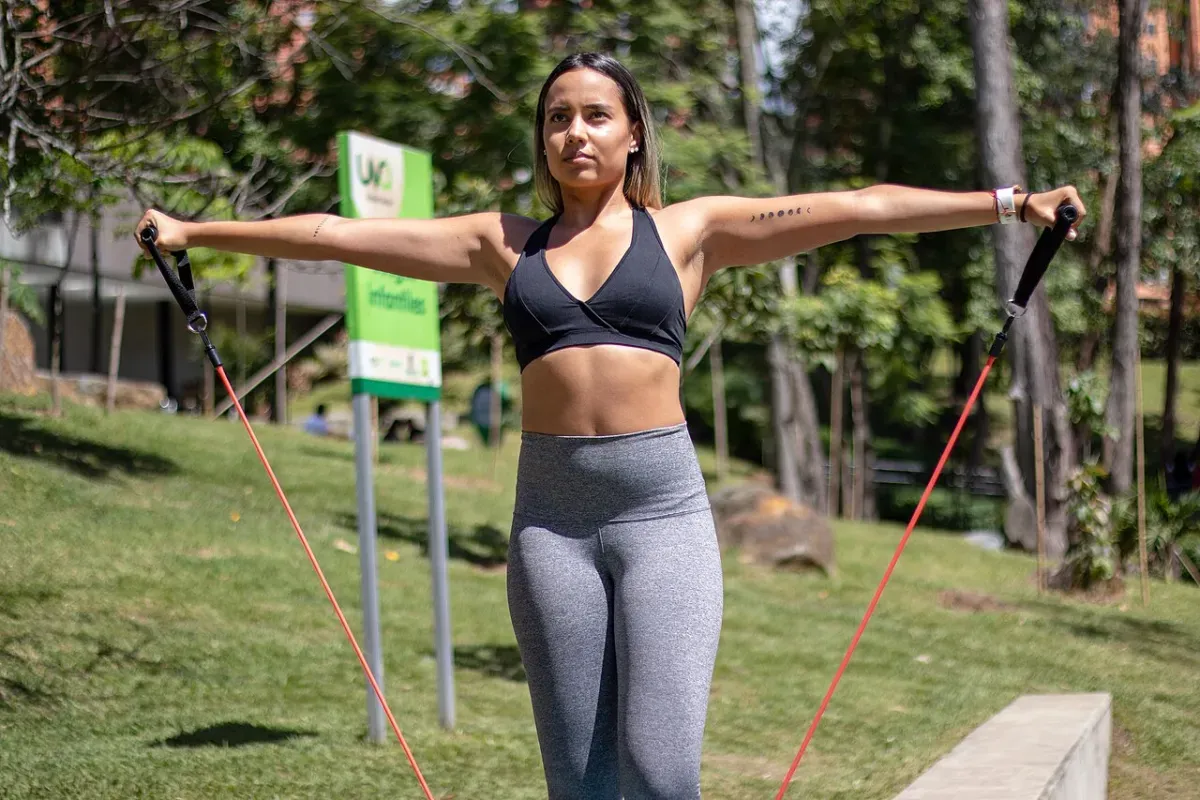
Stretching your rotator cuff is only half the job. Plenty of people pull an arm across their chest for a few weeks and hope the ache stops. It rarely does, because a sore shoulder usually isn’t just tight. It’s weak. A healthy, dependable joint requires a very specific combination of daily flexibility work paired with dedicated strengthening.
Stretching a sensitized joint might offer a brief window of relief, but flexibility alone doesn’t build the resilience your tissues need to handle daily life. Reaching overhead or simply sleeping on your side both demand baseline strength. To stop the pain from coming back, you’ll need to commit to a structured conditioning program for four to six weeks.
The good news is that this process doesn’t require a gym membership or hours of exhausting workouts. With a single resistance band and ten minutes a day, you can begin structurally changing how your shoulder operates and get back to moving comfortably.
What the Rotator Cuff Actually Is (in 60 Seconds)
Your shoulder is a highly mobile joint. That mobility comes with a distinct lack of natural stability. Understanding the basic anatomy helps clarify why certain movements feel helpful while others cause a sharp pinch.
Four small muscles, one job: keeping the ball centered
The shoulder joint operates a bit like a golf ball resting sideways on a small tee. The rotator cuff is a group of four small muscles that originate on your shoulder blade and wrap around the head of your upper arm bone. These muscles are the supraspinatus, infraspinatus, teres minor, and subscapularis.
They are not designed to lift heavy weights. They serve instead to pull that golf ball firmly into the center of the tee while your larger muscles do the heavy lifting. When you reach into the back seat of your car, your deltoid and chest muscles provide the raw power. Your rotator cuff fires quietly in the background to ensure the joint stays aligned and secure. When these four muscles fail to keep up, the ball slides out of position, often pinching sensitive tendons against the bony roof of your shoulder blade.
Tight versus weak: why most cuff pain is a capacity problem
When your shoulder aches, your first instinct is usually to stretch it. The joint feels stiff and the muscles feel tight. However, most rotator cuff issues are fundamentally problems of physical capacity. The tissues simply can’t handle the load you are placing on them.
When a muscle is weak, it tires quickly and tightens up as a protective mechanism. If you only stretch a weak muscle, you might gain a temporary feeling of relief without actually improving its ability to tolerate stress. A systematic review of eleven randomized controlled trials found that while exercise produces statistically and clinically significant improvements in pain and function for rotator cuff impingement, stretching-dominant programs alone showed no effect on range of motion or strength. The case for exercise rests on pain and function, which is what actually keeps you using the arm.
The 10-Minute Daily Routine at a Glance
Rebuilding a shoulder requires consistency rather than intensity. The American Academy of Orthopaedic Surgeons (AAOS) conditioning program outlines a highly specific protocol for recovery. You’ll stretch frequently and build strength gradually.
Warm up first: 5-10 minutes of easy movement
Never force cold tissues into a deep stretch. The official AAOS protocol asks you to warm up with 5 to 10 minutes of low-impact activity before every session. You don’t need a treadmill. Brisk walking works perfectly. You can also do gentle arm circles, march in place, or take a warm shower to increase blood flow to the area. Warming the tissues makes them more pliable and significantly reduces your risk of aggravating an existing injury.
The weekly template: stretch 5-6 days, strengthen 3 days
The schedule is predictable. You’ll stretch almost every day to maintain mobility and prevent stiffness. You will perform strengthening exercises exactly three days a week to give the muscle fibers time to recover.
| Activity Type | Frequency | Core Movements | Duration per Session |
|---|---|---|---|
| Warm-up | Every session | Brisk walking, light arm swings | 5 to 10 minutes |
| Stretching | 5 to 6 days a week* | Pendulum, crossover arm, sleeper stretch | 3 to 5 minutes |
| Strengthening | 3 days a week** | Internal/external rotation, standing rows | 5 to 7 minutes |
* Note: The sleeper stretch runs on its own schedule: 4 x 30 s, three times a day. ** Note: Trapezius strengthening is an exception and can be performed 3 to 5 days a week.
How long until it works: 4-6 weeks, honestly
Fixing a shoulder requires patience. The NHS advises staying active and gently moving the joint rather than resting it completely. They note that self-care usually needs about two weeks before any noticeable improvement shows.
The standard AAOS conditioning program runs for 4 to 6 weeks. Don’t expect miracles in the first ten days. You are structurally changing how your shoulder operates. After this initial block, you’ll transition to a maintenance phase, performing the exercises two to three days a week to keep the joint healthy. The NHS cautions that full recovery can take six months or longer.
Gentle Rotator Cuff Stretches
When you begin your stretching routine, the primary goal is restoring normal range of motion. You are trying to remind the joint how to move freely without triggering a defensive spasm. We recommend looking at a broader beginner stretching guide if you’ve never followed a mobility routine before, but the specific shoulder moves below are your daily foundations.
Pendulum swing (the ease-in move)
The pendulum swing uses gravity to gently decompress the joint. It is the safest way to introduce movement to a highly sensitive shoulder.
Lean forward and place your good hand on a sturdy table or the back of a chair for support. Let your painful arm hang completely relaxed toward the floor. Shift your body weight slightly in small circles, allowing the momentum of your body to swing your hanging arm. Don’t use your shoulder muscles to lift the arm. Let gravity do the work. The AAOS recommends doing 2 sets of 10 swings, performing this movement 5 to 6 days a week.
Crossover arm stretch
This movement targets the back of your shoulder. It helps relieve the deep, nagging ache that often settles behind the joint after a long day of typing or driving.
Stand tall and relax your shoulders. Bring your affected arm across your chest, keeping it relatively straight but soft at the elbow. Use your other hand to gently pull the arm closer to your body, grasping just above the elbow. You should feel a mild pull across the back of the shoulder blade. Do 4 repetitions per side. Hold each repetition for 30 seconds. Do this 5 to 6 days a week.
Sleeper stretch (for the back of the shoulder)
The sleeper stretch isolates tightness in the posterior capsule of the rotator cuff. It requires you to lie down.
Lie on your side on a firm mattress or an exercise mat, resting on your affected shoulder. Your body should be in a straight line. Bend your bottom arm so your elbow forms a 90-degree angle and your hand points straight up toward the ceiling. Use your other hand to gently push the forearm of the affected arm down toward the bed. Stop when you feel a stretch in the back of the shoulder. The AAOS protocol requires 4 repetitions of a 30-second hold. As noted earlier, this specific stretch runs on its own schedule and should be done 3 times daily.
Doorway pec stretch (opens the front)
Note: The doorway pec stretch is not in the official AAOS rotator cuff program. However, it is a vital posture addition we recommend dosing on the exact same 30-second-hold template.
If your chest muscles are tight, they pull your shoulder blades forward. This leaves your rotator cuff in a stretched, disadvantaged position all day. You can explore more chest stretches to fix this, but the doorway stretch is the most efficient starting point.
Stand in an open doorway. Raise your arms so your elbows are bent at 90 degrees, forming a goalpost shape. Rest your forearms flat against the doorframe. Take one small step forward with a single foot until you feel a gentle opening across your chest and the front of your shoulders. Don’t lean aggressively. Hold this position for 30 seconds, repeating it 4 times.
The Strengthening That Actually Protects Your Cuff
Once you establish a baseline of mobility, you need to build resilience. Flexibility without strength leaves the joint vulnerable. You only need a simple piece of equipment for this phase.
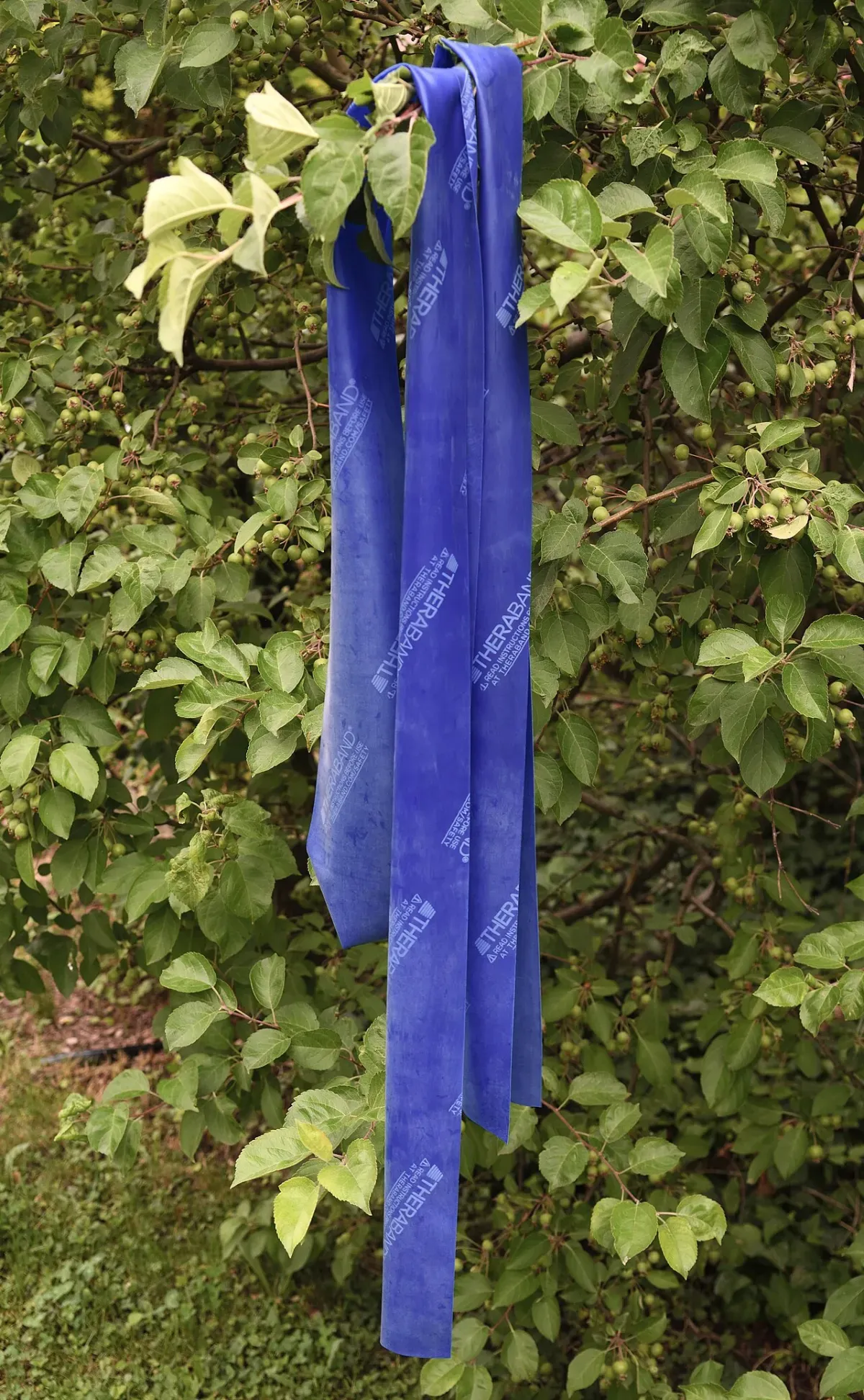 Photo by Mussklprozz on Wikimedia Commons (CC BY-SA 4.0)
External rotation with a band (the non-negotiable)
External rotation targets the infraspinatus and teres minor. These are the muscles most often responsible for weakness and pain in the back of the shoulder.
Tie a resistance band to a doorknob. Stand sideways to the door, holding the band in the hand furthest from the door. Bend your elbow to 90 degrees and pin your upper arm tightly against your ribs. Keeping your elbow locked against your side, slowly rotate your forearm outward, pulling the band away from the door. Return to the starting position slowly. The AAOS strengthening dosing is 3 sets of 8 repetitions, progressing to 3 sets of 12 repetitions. Do this 3 days a week.
Internal rotation and standing row
Balance the outside of the shoulder with the inside. Internal rotation targets the subscapularis.
Turn around so you are now holding the band with the hand closest to the door. Keep your elbow pinned to your ribs at 90 degrees. This time, pull the band inward across your stomach. Return slowly. Follow the same 3 sets of 8 to 12 repetitions.
Next, engage the larger back muscles that support the shoulder joint. Untie the band and loop it around a sturdy post, or hold both ends with the center wrapped around a heavy table leg. Stand facing the anchor point. Pull both elbows straight back, squeezing your shoulder blades together. This standing row builds the necessary support structure for the joint. Complete 3 sets of 8 to 12 repetitions, 3 days a week.
Scapular setting and retraction: training the platform
Your rotator cuff cannot function properly if your shoulder blade is unstable. You need to train the platform that the arm moves on. You can incorporate some of these concepts into a broader shoulder workout at home, but start with the basics here.
Scapular setting is a simple postural reset. Lie on your stomach with your arms by your sides. Gently squeeze your shoulder blades together and down your back, as if trying to tuck them into your back pockets. Hold for a few seconds. The protocol calls for 10 repetitions of this setting exercise.
For active scapular retraction and protraction, you can perform exercises on all fours, dropping your chest toward the floor and pushing it away without bending your elbows. The dosing for scapular retraction is 2 sets of 10 repetitions, eventually progressing to 3 sets of 15. Additionally, the AAOS recommends trapezius strengthening exercises for 3 sets of 20 repetitions, performed 3 to 5 days a week.
 Photo by Tyler Read on Wikimedia Commons (CC BY 2.0)
How to progress: 3x8 to 3x12 without flaring anything up
Progression must be slow. Start with a very light resistance band. Complete 3 sets of 8 repetitions for your strength exercises. If your shoulder feels stable and pain-free the next day, stay at this level for at least a week.
Gradually increase the volume to 3 sets of 12 repetitions. Only when you can complete 3 sets of 12 easily should you move to a thicker resistance band and drop back down to 3 sets of 8. The cardinal rule of the AAOS program is explicitly stated. You shouldn’t feel pain during an exercise. A mild muscle ache is acceptable. Sharp joint pain is a signal to stop immediately.
If You Sit at a Desk All Day
Modern life is heavily biased toward the front of the body. Typing and looking at screens both encourage a forward slump, and that slumped position is where a lot of desk workers’ shoulder pain shows up.
Two moves that fit between meetings
You don’t need to change into gym clothes to protect your shoulders at work. You can break up the workday with two highly effective movements.
First, use the doorway pec stretch described earlier. Every time you walk to the kitchen or bathroom, spend 30 seconds opening your chest in a doorframe.
Second, perform the scapular squeeze. Sit up tall in your office chair. Drop your shoulders away from your ears. Squeeze your shoulder blades together firmly for five seconds, then release. Doing ten of these every few hours reminds your upper back muscles to stay active and prevents your chest from pulling you forward. Integrating simple shoulder stretches and upper back stretches into your daily routine is one of the most effective ways to manage desk-related pain.
Balancing pushing and pulling in your training week
If you participate in general fitness or weightlifting, audit your program. Push-ups, bench presses, and shoulder presses heavily dominate many routines. These are pushing movements that internally rotate the shoulder and tighten the chest.
As a coaching rule of thumb, you want to pull more than you push. For every pressing exercise you perform in a given week, aim to perform at least one, ideally two, pulling exercises. Face pulls and the banded external rotations from the AAOS program provide the necessary counterbalance to keep the joint centered.
Common Mistakes That Keep Shoulders Sore
Recovery is rarely a perfectly straight line. Setbacks happen. Most people who fail to find relief from shoulder pain are making one of two predictable errors.
Stretching into pain (a stretch should never hurt)
This is the most common mistake. People believe that if a little stretch is good, a painful stretch must be better. They yank their arm across their chest and grit their teeth.
Aggressively stretching a sensitized, painful tendon tends to irritate it further. The AAOS protocol is clear that an exercise should not cause pain. A stretch should feel like a mild, dull tension in the belly of the muscle. If you feel a sharp pinch, a burning sensation, or pain inside the joint itself, you are pulling too hard. Back off immediately.
Doing only stretches and skipping the strengthening
We established this in the introduction, but it bears repeating. Stretching feels productive because it offers temporary relief. You stretch the arm, the stiffness fades for twenty minutes, and you feel better.
But the stiffness always returns. The muscle tightens up because it lacks the strength to stabilize the joint. If you skip the banded rotations and the standing rows, you will be trapped in an endless loop of stretching without ever solving the root cause of the instability.
Red Flags: When Stretching Is the Wrong Answer
While the vast majority of shoulder aches respond brilliantly to consistent stretching and strengthening, some conditions require professional intervention. Know when to stop exercising and consult a doctor.
Sudden weakness or a snap after a fall or heavy lift
Degenerative rotator cuff pain usually creeps up slowly over months. Acute traumatic tears happen in a split second.
If you fall on an outstretched arm, or if you jerk a heavy weight and feel a sudden, intense pain accompanied by an immediate inability to lift your arm, you may have suffered an acute tear. Classic rotator cuff tear symptoms include sudden weakness when trying to rotate or elevate the arm. Stop stretching through it and see a physical therapist or doctor to get a proper diagnosis.
Night pain that keeps waking you
Pain that prevents you from sleeping is another hallmark symptom of a more serious rotator cuff tear. Specifically, patients often report severe pain when lying on the affected shoulder.
If your shoulder pain is waking you up multiple times a night, or if you have diligently followed the rest and gentle movement guidelines for over two weeks with absolutely no improvement, it is time to schedule a clinical assessment.
What a professional visit looks like
Seeing a doctor doesn’t mean you are destined for the operating table. A professional assessment usually involves a physical exam to test your strength and range of motion. They may order an ultrasound or an MRI to visualize the tendons.
Even if a scan shows a tear, conservative treatment is highly effective. The data shows that roughly 80 to 85 percent of rotator cuff tear patients improve with nonsurgical treatment alone. Furthermore, surgical intervention for general shoulder pain is increasingly scrutinized. A rigorous randomised placebo-controlled trial published in the BMJ found that subacromial decompression surgery provided no benefit over sham surgery at 24 months. The differences in outcomes between the surgery group and the exercise therapy group did not even exceed the minimal clinically important difference.
The medical consensus strongly supports movement. Exercise is the first-line treatment for a reason.
Frequently asked
- How often should I do rotator cuff stretches?
- You should perform gentle rotator cuff stretches five to six days a week. Stretches like the crossover arm stretch and pendulum swing are most effective when done consistently, but they must always remain pain-free.
- Can stretching alone cure my rotator cuff pain?
- Rarely. In an 11-trial systematic review, exercise improved pain and function, but stretching-focused programs on their own didn't move range of motion or strength. Pair daily stretches with the AAOS strengthening work three days a week.
- How long does it take for rotator cuff exercises to work?
- You will typically need to follow a structured conditioning program for four to six weeks before noticing significant improvements. Full recovery can sometimes take up to six months of consistent effort.