Shoulder Blade Stretches and Scapular Strength

You’ve been typing for hours, and a familiar, heavy ache settles between your shoulder blades. You instinctively cross your arm over your chest and pull, stretching the stiff area. It feels wonderful for a short while, but the heavy sensation always returns. The muscles connecting your shoulder blade to your spine act as brakes against gravity. Stretching buys a real but short window of relief, and it leaves the underlying capacity problem untouched. To fix the persistent ache between your shoulder blades, you have to load the tissue with resistance to build endurance.
Before we discuss movement, we must address safety. If your back or shoulder-blade pain arrives with chest pressure, sweating, breathlessness, or nausea, or if it spreads to your jaw, neck, or arm, stop reading and call emergency services immediately. Furthermore, a sudden pain in your upper-right belly that travels to your right shoulder requires a same-day medical call. The final section of this guide covers these medical red flags in detail.
If the stiffness you feel is more of a broad band across the middle of your back, the thoracic spine might be involved. Movements like cat-cow, thread the needle, seated thoracic rotation, and child’s pose target that central spinal stiffness directly. You will find all of them in our guide to upper back stretches. The exercises below exclude common spinal stretches and upper trap work. We cover those specific areas in our trap stretches guide.
What helps the ache between your shoulder blades
Pain between the shoulder blades usually comes from muscle fatigue. The muscles attaching your shoulder blade to your spine have to work continuously to keep you upright. When they become exhausted, they ache. The fastest way to break that tension in the moment is to move the shoulder blade actively through its maximum range of motion. You draw it forward, pull it back, push it up, and pull it down.
Once the immediate stiffness breaks, you introduce light resistance. Pulling a resistance band or lifting light weights trains those muscles to handle a full day of work. You do this three times a week.
This protocol is for the dull, postural ache that settles right next to the inner border of your shoulder blade. It is for people who feel the urge to dig a tennis ball into their upper back after a long day of screen time. It is not designed for sharp shoulder joint pain. If the problem shows up mostly when you reach overhead or put a coat on, the shoulder joint itself is usually the culprit. In that case, start with our shoulder mobility exercises and try the self-tests included there.
Understanding scapular movement
A bone with no socket
The human shoulder blade is a mechanical marvel. It has no bony socket holding it to the ribcage. The scapula essentially floats over your ribs, sliding back and forth like a dinner plate moving on a beach ball.
According to the StatPearls chapter on winging of the scapula, abnormal scapula motion happens when these stabilizing muscles dysfunction. Because there is no deep ball-and-socket joint pinning the blade to the back of your ribs, your muscles must maintain constant tension to keep the bone in place.
Six directions of travel
Because it floats, the shoulder blade moves in many directions. It elevates when you shrug. Pushing yourself up out of a chair depresses the bone. Pinching your blades together causes retraction, while reaching forward to open a heavy door forces protraction.
The blade also rotates. When you reach for a high shelf, the bottom tip of your shoulder blade swings outward and upward. This upward rotation moves the bone out of the way so your arm bone can point straight up. Without that rotation, your arm would jam into the top of your shoulder joint.
The three muscles that steer it
Three primary muscles steer the blade, and each connects to a different nerve.
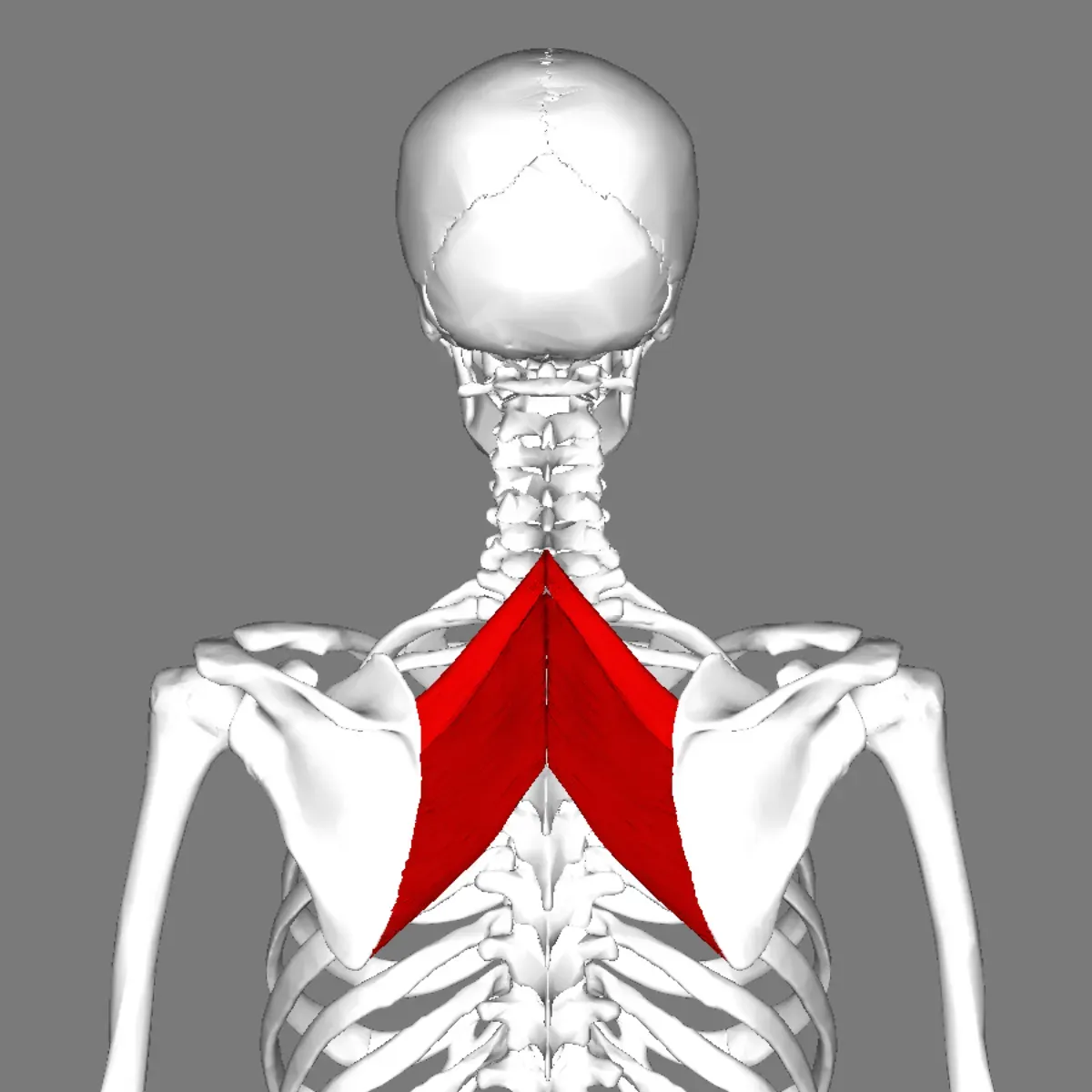 credit: Rhomboid muscles. Illustration by Anatomography via Wikimedia Commons (CC BY-SA 2.1 JP)
The rhomboids connect your spine to the inner edge of the shoulder blade. They pull the blade back and up. They are powered by the dorsal scapular nerve.
The trapezius is a large kite-shaped muscle covering the upper back. Different parts of it elevate, retract, and depress the blade. It receives signals from the spinal accessory nerve.
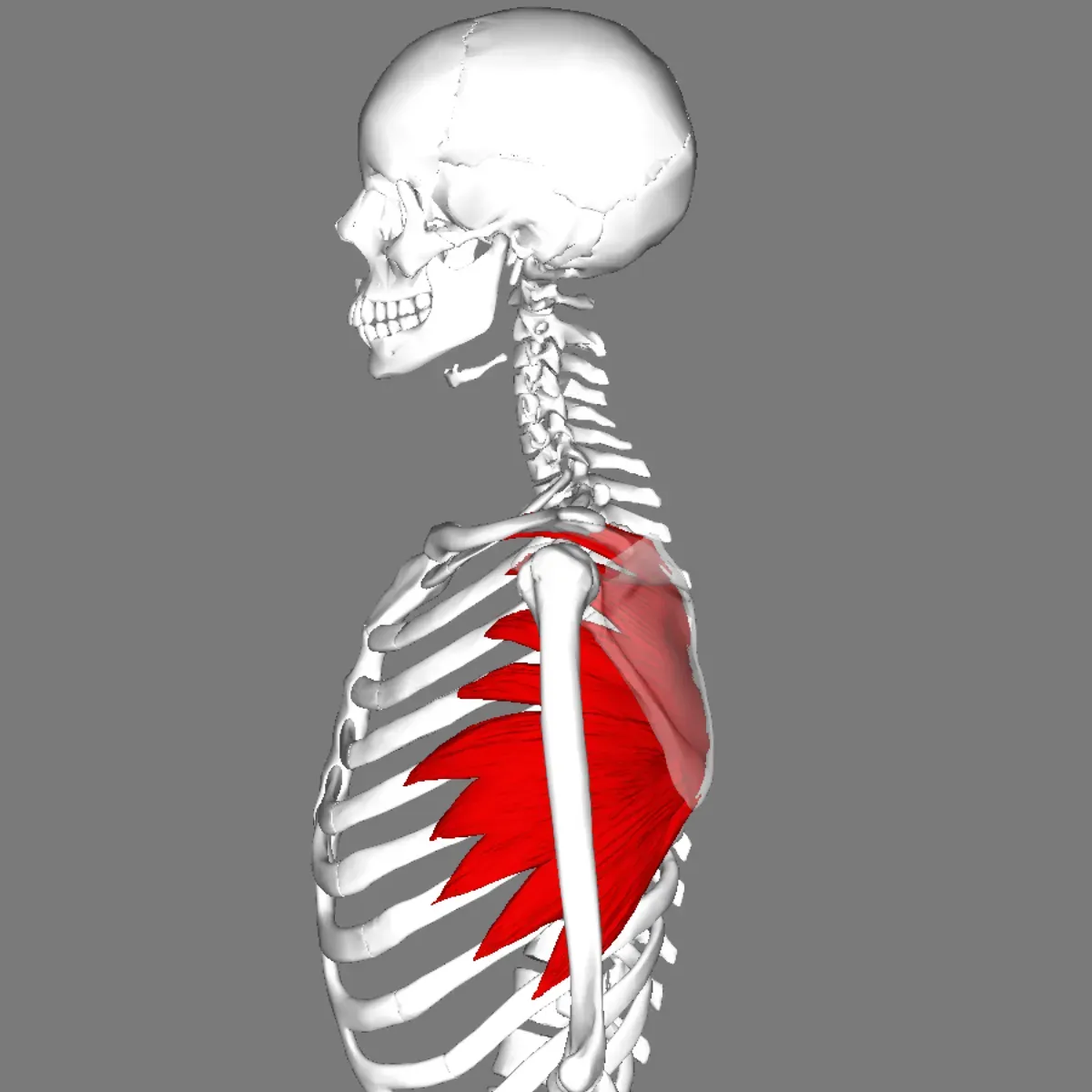 credit: Serratus anterior muscle. Illustration by Anatomography via Wikimedia Commons (CC BY-SA 2.1 JP)
The serratus anterior sits on the side of your ribs and attaches to the underside of the shoulder blade. It pulls the blade forward around your ribcage. It relies on the long thoracic nerve. Injury to this nerve, resulting in serratus anterior paralysis, is the most common cause of a severely winged scapula, which is rare, and a blade that merely sits unevenly is a different and far more common thing.
Why this postural ache is an endurance problem
The physical reality of desk work
Even your resting position requires active work. The stabilizing muscles contribute continuously to maintaining the scapula against the posterior thoracic wall.
When you sit at a desk, your arms reach forward to rest on a keyboard or grip a mouse. Gravity pulls your chest down, and your shoulders naturally round forward. The rhomboids and middle trapezius muscles have to act like brakes on a downhill slope. They contract lightly but constantly to prevent your shoulders from collapsing completely forward into your lap. Hours of this low-level tension leave the tissue feeling heavy and exhausted.
What the research found in subacromial pain syndrome
A 2024 systematic review and meta-analysis published in Frontiers in Neurology looked at patients with subacromial pain syndrome. This condition involves pain under the arch of the shoulder bone. Researchers analysed eight randomised trials involving 387 participants to see what scapular stabilisation exercises achieve in this population. The interventions ran for 4 to 12 weeks, most commonly involving three sessions a week.
The review found that the evidence moderately supports the efficacy of scapular stabilisation exercises. Patients saw improvements in pain scores and shoulder disability compared to the control groups. The exercise had no significant effect on improving the shoulder joint’s range of motion. The strength work changed the symptoms, and the range of motion did not need to change for the pain to fade.
You might also find comfort in pairing your back movements with a few dedicated chest stretches to mobilise the front of your body.
Four ways to move the shoulder blade
We focus purely on moving the scapula through the ranges it loses during a long day of sitting.
Scapular setting
Scapula setting teaches you how to control the bone without moving your arm. We cover the exact technique for drawing the blades down and back in our guide to shoulder mobility exercises.
Wall slide with forearms
The wall slide trains the shoulder blade to rotate upward smoothly. You can find the full instructions for this movement in our upper back stretches article.
Scapular push-up
This trains the serratus anterior to push the shoulder blade forward. We detail the scapular push-up in our rotator cuff stretches guide, where it is already dosed at 2 sets of 10 progressing to 3 sets of 15.
Cross-body reach
This is a traditional stretch that pulls the shoulder blade away from the spine. We outline this movement in our guide to shoulder stretches, following the AAOS recommendation of 4 repetitions per side at 30 seconds each.
Adding resistance for scapular endurance
To change the tissue, you must add load. The AAOS Rotator Cuff and Shoulder Conditioning Program provides a reliable, evidence-based dosing structure. It is a patient conditioning handout designed to build strength and flexibility.
Rows without shrugging
The standing band row builds the endurance your back needs. We feature the standing band row with the 3 sets of 8 to 12 progression in our shoulder mobility exercises guide. The key is to draw the blade into your back pocket first, and only then bend the elbow to pull straight back. If you cannot maintain that order, drop the resistance until you can.
Prone Y for the lower trapezius
This isolates the lower fibres of the trapezius. Lie face down on the floor or on a comfortable mat. You can place a rolled towel under your forehead to keep your neck in a neutral position. Extend your arms overhead and slightly outward. Your body should form a Y shape. Point your thumbs up toward the ceiling. This external rotation is crucial for engaging the correct fibres.
Keep your chin tucked. Lift your arms a few inches off the floor by squeezing your lower trapezius fibres together. The movement is small. Do not let your shoulders hike up to your ears. Hold the top position for two seconds. Lower your arms slowly to the floor. Two sets of 10 repetitions will feel surprisingly difficult. The dose here is a practical suggestion, as this specific variation is not formally detailed in the base AAOS program.
The AAOS conditioning guidelines
The handout recommends warming up before doing the strengthening exercises. Five to ten minutes of low-impact activity prepares the body for work. Walking or riding a stationary bicycle are excellent options.
The AAOS suggests performing the conditioning exercises three days per week. You start the rows at 3 sets of 8 repetitions. You eventually progress to 3 sets of 12.
What four to six weeks actually entails
You must continue the conditioning programme for 4 to 6 weeks before judging whether it worked. In the first week, your back might feel slightly sore from the new effort. When the light band work stops feeling challenging, you can graduate to a full back workout at home with heavier weights.
The results take time.
Structuring a routine for the desk
A ten-minute sequence
When you put the pieces together, you get a highly efficient sequence. You start with mobility, move to load, and finish with a stretch.
| Exercise | Purpose | Sets and Reps |
|---|---|---|
| Scapula Setting | Warm up and mind-muscle connection | 10 reps (10-second hold at half tension) |
| Wall Slide | Upward rotation | 2 sets of 10 reps |
| Scapular Push-up | Forward blade mobility | 2 sets of 10 reps (progressing to 3 sets of 15) |
| Standing Band Row | Endurance and strength | 3 sets of 8 reps (progressing to 12) |
| Prone Y | Lower trapezius strength | 2 sets of 10 reps |
| Cross-body Reach | Cool down and relieve tension | 4 reps of 30 seconds per side |
The 40-second version between meetings
You can’t do a full band workout in the middle of a busy workday. However, you can interrupt the fatigue cycle. Stand up from your chair. Place your feet flat on the floor. Perform five slow scapular settings, pulling the blades down and back. Step to a wall and do five slow wall slides to push the blades up and around. This takes forty seconds and gets the joints moving.
Where it fits in a training week
Run the full ten-minute routine on Monday, Wednesday, and Friday evenings. Use the forty-second desk version purely as a movement snack during your work hours. If you already go to a gym, simply add the scapular push-ups and band rows to your existing warm-up routine.
Mistakes that hinder progress
Squeezing harder instead of moving further
Quality beats force in a squeeze. A hard, shaky one-second pinch between the blades does not mimic the demands of your daily life. A moderate 10-second hold trains the exact type of sustained effort a desk day requires.
Focus on control.
Letting the shoulders ride up on every pull
When the mid-back muscles get tired, the upper trapezius muscles volunteer to help. You’ll notice your shoulders creeping up toward your ears during rows or wall slides. This feeds the tension straight into your neck. Always reset your posture. Pull the shoulders down away from your ears before starting the next repetition. If you need to address that specific tension, refer to our trap stretches guide.
Stretching daily without loading
Stretching buys a real but short window of relief. It feels productive because it provides immediate comfort. However, it leaves the underlying capacity problem untouched. If you stretch a weak muscle every day for a year, you still have a muscle that lacks the endurance to hold you upright. You have to challenge the tissue with resistance.
Chasing a perfect shoulder blade position
Many people worry because one shoulder blade sticks out slightly more than the other. They treat a visible, uneven shoulder blade as a diagnosis. The research tells a very different story.
A 2023 study in the International Journal of Sports Physical Therapy asked whether it is time to normalise scapular dyskinesis. They found that abnormal shoulder blade movement is common. The reported incidence was 60 percent combined in symptomatic individuals. It was 48 percent combined in asymptomatic individuals.
A shoulder blade that moves imperfectly is close to a coin flip in people who have absolutely no pain. A considerable number of individuals with shoulder symptoms do not present with dyskinesis at all. The high number of asymptomatic individuals who do present with it suggests it may simply be a normal finding among nearly half of the population. Don’t panic over an asymmetrical shoulder blade. Focus on how your back feels.
When pain between the shoulder blades needs a doctor
Zen-labo is a wellness blog, not a medical service. None of the exercises above replace a proper clinical assessment. Most pain between the shoulder blades is muscular, but this region is also a prime location for referred pain from your internal organs. You need to know when to stop reading and get help.
Symptoms that mean call emergency services now
According to the NHS chest pain guidelines, you must call 999 if you get sudden pain or discomfort in your chest that does not go away. If back or shoulder-blade pain arrives with chest pressure, breathlessness, sweating, nausea, or light-headedness, call emergency services. The same applies if the pain spreads to your jaw, neck, or arm. Do not drive yourself to the hospital.
Second, gallbladder issues frequently refer pain to the back. Per the NHS acute cholecystitis page, the main symptom is a sudden, sharp pain in the upper right-hand side of your tummy that spreads towards your right shoulder. Upper-right abdominal pain travelling to the right shoulder or shoulder-blade area is a same-day medical call. This is especially true if it arrives with a fever or yellowing skin or eyes.
The slower warnings
Other symptoms require a doctor’s assessment. If the pain wakes you up from deep sleep at night, you need to have it checked. If the pain starts immediately after a fall, a car accident, or a heavy lift, see a professional.
Nerve compression can also show up here. If your shoulder pain is accompanied by arm weakness, numbness, or pins and needles travelling down your hand, a medical professional needs to evaluate your nerves. Finally, any back pain accompanied by unexplained weight loss warrants a medical appointment.
What an assessment usually looks like
When you see a professional for shoulder blade pain, they will look for the root cause. A professional will assess your neck to look for nerve issues. They also evaluate your shoulder joint’s range of motion. Only after clearing those areas will they assess the strength and endurance of your scapular muscles. Getting this baseline assessment gives you the confidence to train safely.
Frequently asked
- Why does the pain between my shoulder blades keep coming back?
- The muscles between your shoulder blades act as brakes to hold your posture upright against gravity. Stretching buys a short window of relief, but the ache returns because the muscles lack the endurance to do their job all day. You need to build capacity.
- How often should I stretch and strengthen my shoulder blades?
- The AAOS patient conditioning handout suggests doing scapular stabilisation exercises three days a week. You can do light movements to relieve stiffness, but resistance training requires effort. Trials often run for 4 to 12 weeks before participants judge whether the programme worked.
- Should my shoulder blades stick out when I move my arms?
- A shoulder blade that sticks out slightly, often called scapular winging or dyskinesis, is common. Research shows it happens in nearly half of people with no shoulder pain at all. Unless it causes pain or weakness, it is usually a normal variation in how you move.